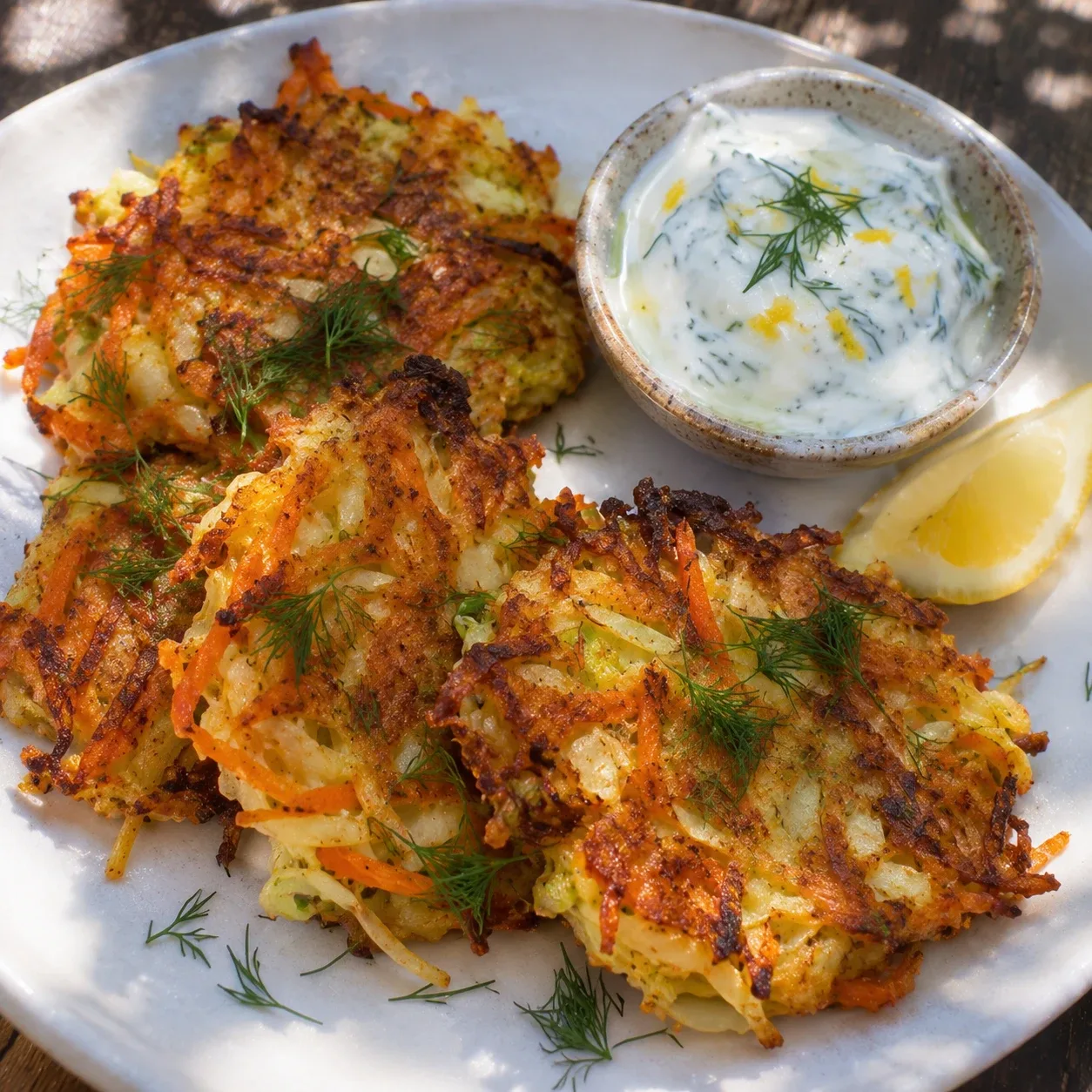
Cabbage and Carrot Fritters with Lemon-Dill Cream
Crispy, golden fritters made from shredded cabbage, sweet carrot, and scallion, fried in ghee and dipped in a cool lemon-dill cream. Simple, cheap, and loved by kids and grown-ups alike.
Yield: About 12 fritters (serves 4) · Active: 35 min · Total: 50 min · Season: Best in North America in fall and winter, when cabbage and carrots are at their peak · Best eaten: midday
Ingredients
For the lemon-dill cream
- ¾ cup raw sour cream or crème fraîche (or whole-milk Greek yogurt)
- Zest of 1 lemon
- 1 tbsp fresh lemon juice
- 2 tbsp finely chopped fresh dill
- 1 small garlic clove, finely grated
- ¼ tsp sea salt
For the fritters
- 4 cups finely shredded green or savoy cabbage (about ½ small head, 12 oz)
- 2 medium carrots, coarsely grated (about 1½ cups)
- 1 tsp sea salt, divided
- 4 scallions, thinly sliced
- 2 garlic cloves, minced
- 2 tbsp chopped fresh dill or parsley
- 3 large pasture-raised eggs
- ⅓ cup cassava flour (or ½ cup almond flour plus 2 tbsp arrowroot)
- ½ tsp ground cumin (optional)
- ¼ tsp freshly ground black pepper
- 4–6 tbsp grass-fed ghee, tallow, or avocado oil, for frying
Method
For the lemon-dill cream
- Stir together. Mix the sour cream or crème fraîche with the lemon zest, lemon juice, dill, garlic, and salt. Chill while you make the fritters so the flavors come together.
For the fritters
- Salt the vegetables. Toss the cabbage and carrots with ½ tsp of the salt in a large bowl and let sit 15 minutes. The salt pulls water out of the vegetables, which is the key to crisp fritters that hold together.
- Squeeze. Pile the vegetables into a clean kitchen towel or nut-milk bag and wring out as much liquid as you can. Return them to the dried bowl.
- Mix the batter. Add the scallions, garlic, herbs, eggs, cassava flour, cumin (if using), pepper, and the remaining ½ tsp salt. Stir until everything is evenly coated. The mixture should hold together when pressed; if it seems loose, add 1 more tbsp cassava flour.
- Heat the pan. Warm 3 tbsp of the fat in a large cast iron or stainless skillet over medium heat until it shimmers.
- Fry. Scoop ¼-cup mounds into the pan, leaving space between them, and press each into a ½-inch-thick patty with the back of a spatula. Fry 3–4 minutes, until deep golden underneath, then flip and cook 3 minutes more, until golden and set in the center. Work in batches, adding more fat as needed.
- Drain and serve. Move the fritters to a rack or a paper towel-lined plate and sprinkle with a pinch of salt. Serve hot with the lemon-dill cream.
Storage
- Fritters keep in the fridge up to 4 days. Reheat on a sheet pan at 375°F for 8–10 minutes so they crisp back up (the microwave makes them soggy).
- To freeze, lay cooled fritters on a tray until firm, then move to a bag for up to 2 months. Reheat from frozen at 375°F for 12–15 minutes.
- The lemon-dill cream keeps up to 4 days in a covered jar.
Variations
- Cheesy: Stir ¼ cup finely grated Parmigiano-Reggiano or aged raw cheddar into the batter.
- Purple: Use red cabbage for vivid magenta fritters; they’re a hit with kids.
- Ginger-scallion: Swap the dill and cumin for 1 tbsp grated fresh ginger and fry in avocado oil; serve with coconut aminos mixed with a squeeze of lime instead of the cream.
- Add protein: Fold in 1 cup shredded leftover chicken or cooked crumbled pasture-raised pork for a heartier meal.
- Herb swap: Use parsley and mint in both the fritters and the cream if you’re not a dill fan.
Season & Circadian Timing
Cabbage and carrots are the dependable stars of the cold-season harvest, keeping well for months when little else is growing. These fritters make a satisfying midday meal with a salad, when digestion is strongest, and they pack easily into lunchboxes for the week ahead.
Nourishment Notes
- Cabbage — rich in vitamin C, vitamin K, and fiber, plus the sulfur-containing glucosinolates found in all cabbage-family vegetables.
- Carrots — loaded with beta-carotene, which your body turns into vitamin A; it’s absorbed best with fat, like the ghee these fritters are fried in.
- Pasture-raised eggs — offer high-quality protein and choline, a nutrient important for the brain and liver.
- Sour cream or crème fraîche — cultured dairy brings tang and fat-soluble vitamins, and grass-fed dairy is richer in vitamin A than grain-fed.
Sourcing
- Eggs — organic and pasture-raised, from a local farm (Alexandre Family Farm)
- Crème fraîche / sour cream — organic, grass-fed, cultured
- Yogurt — goat’s milk yogurt (Sierra Nevada), sheep’s milk yogurt (Bellwether Farms), A2/A2 cow’s milk yogurt (Bellwether Farms or Straus), or raw yogurt from an Amish farm
- Ghee — grass-fed ghee, or homemade from organic grass-fed butter
- Tallow / lard / duck fat — from pasture-raised animals, from a local farm or butcher
- Avocado oil — organic, cold-pressed, and unrefined, in dark glass
- Cassava flour — organic (Otto’s Naturals)
- Almond flour — organic and blanched (keep it in the fridge)
- Tapioca / arrowroot — organic
- Salt — unrefined sea salt (Baja Gold); flaky sea salt for finishing (Maldon)
- Lemons / limes / oranges — organic (you’re using the zest)
- Fruits, vegetables, and herbs — organic, from a farmers’ market or local farm
You might also like: Zucchini Fritters with Lemon Yogurt Sauce (Two Ways), Broccoli & Shiitake Fritters with Lemon-Dill Yogurt Sauce
With Love, Light, and Health,
Anna (aka Food Marshall)
Food Marshall Approved. Grain-free, seed-oil-free and refined-sugar-free, made from organic, local and seasonal ingredients. Our standards
More Snacks, Small Bites & Seasonal Staples

Get new recipes and essays
Seasonal recipes and writing on light, circadian health, and living with nature.
Subscribe on Substack