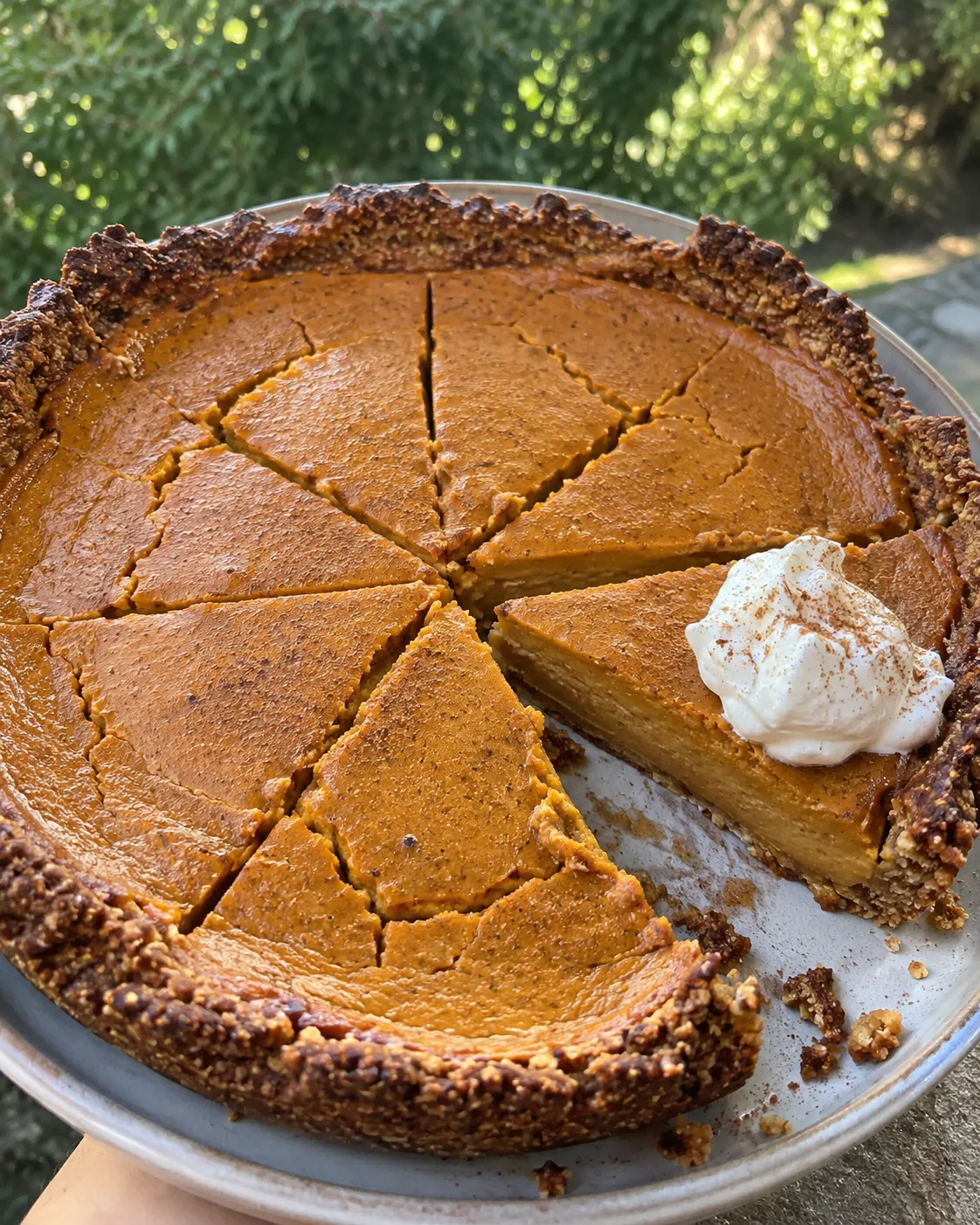
Classic Baked Pumpkin Pie (Grain-Free)
The pumpkin pie we grew up with, made grain-free: a simple almond or hazelnut crust, a silky spiced pumpkin custard baked until just set, and a swoosh of maple whipped cream. It’s even better the day after baking.
Yield: One 9-inch pie (serves 8) · Active: 25 min · Total: 1 hr 30 min, plus chilling overnight for the cleanest slices · Season: Best in North America in fall, when sugar pumpkins are at their peak · Best eaten: afternoon
Ingredients
For the crust
- 2 cups blanched almond flour or hazelnut flour (a 50/50 mix is lovely)
- ½ tsp sea salt
- 2 tbsp grass-fed butter or coconut oil, melted
- 1 large pasture-raised egg
- 2 tbsp coconut sugar (optional, for a slightly sweeter crust)
For the filling
- 1¾ cups pumpkin purée (homemade, see below, or single-ingredient canned; the label should say “pumpkin,” not “pumpkin pie filling”)
- 3 large pasture-raised eggs
- ½ cup grass-fed cream (raw if you have it) or full-fat coconut milk
- ⅓ cup maple syrup
- 1 tbsp ground Ceylon cinnamon
- 1 tsp pumpkin pie spice (or a mix of ground ginger, nutmeg, cloves, and allspice)
- 1 tsp pure vanilla extract
- Pinch of sea salt
For the maple whipped cream
- 1 cup cold grass-fed heavy cream (raw if you have it)
- 1 tbsp maple syrup
- ½ tsp pure vanilla extract
- Pinch of ground cinnamon, for dusting
For the maple-spiced pecans (optional)
- ½ cup pecan halves
- 1 tbsp maple syrup
- ¼ tsp ground Ceylon cinnamon
- Pinch of sea salt
Method
Homemade pumpkin purée (optional)
- Roast the pumpkin. Halve and seed a 3–4 lb sugar or pie pumpkin (not a jack-o’-lantern carving pumpkin). Roast cut-side down at 400°F for 45–60 minutes, until very tender.
- Purée. Scoop out the flesh and blend until smooth. If it’s watery, let it drain in a fine sieve for 30 minutes.
The pie
- Make and prebake the crust. Heat the oven to 350°F. Mix the almond flour, salt, and coconut sugar (if using), then stir in the melted butter and egg until a dough forms. Press it evenly into a 9-inch pie pan, working it up the sides. Prick the bottom with a fork and bake 10–12 minutes, until just golden. Let it cool slightly. Prebaking keeps the crust from going soggy.
- Make the filling. Blend the pumpkin and eggs until smooth. Add the cream, maple syrup, spices, vanilla, and salt and blend until completely smooth.
- Fill and shield. Pour the filling into the crust. Cover the crust edges with a ring of foil so they don’t burn.
- Bake. Bake 30 minutes, then remove the foil and bake 15–20 minutes more, until the edges are set and the center still has a slight wobble (about 175°F). It keeps setting as it cools.
- Make the pecans (optional). While the pie bakes, toss the pecans with the maple syrup, cinnamon, and salt. Spread on a parchment-lined sheet and bake alongside the pie for 8–10 minutes, until fragrant. They crisp as they cool.
- Cool and chill. Cool the pie completely on a rack, then refrigerate overnight for the cleanest slices (or serve it slightly warm if you can’t wait).
- Whip the cream. Just before serving, whip the cold cream, maple syrup, and vanilla to soft peaks.
- Serve. Top each slice with maple whipped cream, a dusting of cinnamon, and a few spiced pecans.
Storage
Refrigerate the pie up to 4 days (it’s even better on days 2 and 3), or freeze individual slices up to 1 month. For Thanksgiving, bake up to 3 days ahead and whip the cream within a few hours of serving.
Variations
- Butternut: Butternut squash purée works in place of pumpkin and is a little sweeter.
- Dairy-free: Use coconut oil in the crust, coconut milk in the filling, and whipped coconut cream on top.
- Something different: My Half-Baked Deep-Dish Pumpkin Pie with Vanilla Mascarpone Cream only bakes the crust; for no-bake, try my Raw Pumpkin Pie Cheesecake or Raw Pumpkin Pie Cheesecake Bars with Salted Caramel.
Season & Circadian Timing
Sugar pumpkins are harvested in early fall across the Northeast, Midwest, and Pacific Northwest and keep for months in a cool spot (canned pumpkin works year-round). Enjoy a slice in the afternoon or after an early dinner: the eggs, cream, and nuts bring protein and fat that soften the sugar, and there’s still daylight left to use it.
Nourishment Notes
- Pumpkin — One of the richest sources of carotenoids, including beta-carotene, lutein, and zeaxanthin. The body turns beta-carotene into vitamin A and needs fat to absorb it, which the eggs, cream, and nut crust take care of.
- Pasture-raised eggs — Bring protein, choline, and the fat-soluble vitamins A, D, E, and K2. Their lecithin is what gives the custard its silky set.
- Almond and hazelnut flours — Bring vitamin E, magnesium, monounsaturated fats, and protein, so the crust is more nourishing than a white-flour pastry.
- Warming spices — Cinnamon, ginger, cloves, allspice, and nutmeg have long been used to help digest rich, creamy dishes, and they make the whole kitchen smell like fall.
- Grass-fed cream — Brings fat-soluble vitamins and butyrate.
Sourcing
- Pumpkin — organic sugar or pie pumpkins from a farmers’ market, or organic single-ingredient canned pumpkin in a BPA-free can
- Almond flour — organic and blanched (keep it in the fridge)
- Eggs — organic and pasture-raised, from a local farm (Alexandre Family Farm)
- Heavy cream — raw from a farmer you know and trust, or organic, grass-fed, low-temperature pasteurized cream (Kalona SuperNatural)
- Grass-fed butter — organic, cultured butter from 100% grass-fed cows, or raw butter from a local dairy
- Maple syrup — organic Grade A dark
- Walnuts / pecans / hazelnuts / macadamias — organic and raw; soak and dry (or sprout) for easier digestion
- Spices — organic and non-irradiated (Ceylon cinnamon from Sri Lanka)
- Hazelnut flour — organic, finely ground and blanched
- Salt — unrefined sea salt (Baja Gold)
With Love, Light, and Health,
Anna (aka Food Marshall)
Food Marshall Approved. Grain-free, seed-oil-free and refined-sugar-free, made from organic, local and seasonal ingredients. Our standards
More Desserts
Get new recipes and essays
Seasonal recipes and writing on light, circadian health, and living with nature.
Subscribe on Substack