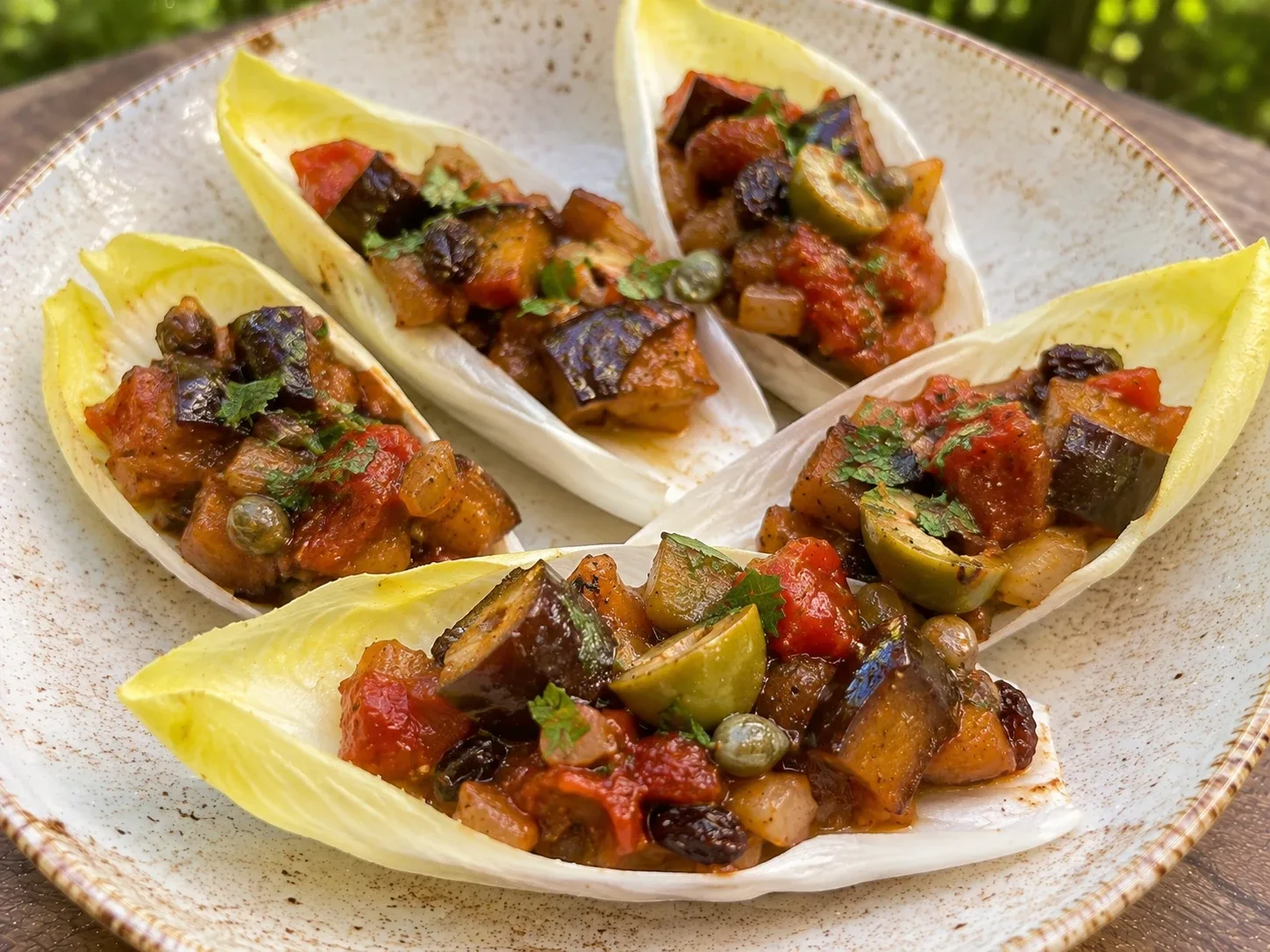
Eggplant Caponata on Endive
A sweet-and-sour Sicilian stew of golden eggplant, tomato, celery, olives, and capers, gently sweetened with honey and spooned into crisp endive leaves. It’s even better made a day ahead.
Yield: About 4 cups caponata, enough for 40 endive leaves (serves 10–12 as part of a spread) · Active: 50 min · Total: 1 hr 30 min (plus cooling) · Season: Best in North America in late summer, when eggplant, tomatoes, and celery are at their peak · Best eaten: afternoon or early evening
Ingredients
For the caponata
- 2 medium globe eggplants (about 2½ lb), cut into ¾-inch cubes
- 1½ tsp sea salt (Baja Gold), divided
- ½ cup extra virgin olive oil, divided
- 1 medium yellow onion, diced
- 3 celery ribs, diced (about 1 cup), plus the pale inner leaves for garnish
- 3 garlic cloves, thinly sliced
- 2 tbsp tomato paste
- 1½ lb ripe plum tomatoes, cored and chopped (about 3 cups), or one 28-oz jar whole peeled tomatoes, crushed by hand
- ⅓ cup red wine vinegar
- 1½ tbsp raw honey
- ½ cup green Castelvetrano olives, pitted and roughly chopped
- 3 tbsp capers, rinsed
- 2 tbsp golden raisins (optional, but traditional)
- ¼ tsp red pepper flakes
- ¼ tsp freshly cracked black pepper
- ⅓ cup pine nuts
- ¼ cup fresh basil, thinly sliced
- 2 tbsp fresh flat-leaf parsley, chopped
To serve
- 5–6 heads Belgian endive (red, white, or a mix)
- Your best extra virgin olive oil, for drizzling
- Flaky sea salt
Method
For the caponata
- Salt the eggplant. Toss the eggplant with 1 tsp salt in a colander and let it sit 30 minutes over the sink. It will release some bitter liquid. Pat very dry with a towel.
- Brown the eggplant. Heat ¼ cup olive oil in a large, heavy skillet or Dutch oven over medium-high heat. Add half the eggplant and cook, turning occasionally, 8–10 minutes, until golden on several sides and tender. Move to a plate. Repeat with 2 tbsp more oil and the rest of the eggplant.
- Soften the aromatics. Lower the heat to medium and add the remaining 2 tbsp oil. Add the onion and celery and cook, stirring, 7–8 minutes, until soft and the onion is translucent. Add the garlic and cook 1 minute more.
- Add the tomato. Stir in the tomato paste and cook 1–2 minutes, until it darkens. Add the tomatoes and simmer 10 minutes, stirring now and then, until they break down into a thick sauce.
- Sweet and sour. Stir in the vinegar, honey, olives, capers, raisins (if using), red pepper flakes, black pepper, and remaining ½ tsp salt. Return the eggplant to the pan and simmer gently 10–15 minutes, until thick and glossy and most of the liquid is gone.
- Toast the pine nuts. Meanwhile, toast the pine nuts in a dry skillet over medium-low heat, shaking often, 3–4 minutes, until golden. They go from golden to burned quickly, so stay close.
- Cool. Take the caponata off the heat and let it cool to room temperature, at least 30 minutes. Taste: it should be bright and tangy with a gentle sweetness. Add a splash more vinegar or a pinch of salt as needed. Stir in the basil and parsley just before serving.
To serve
- Prep the endive. Trim the root ends and separate the leaves, trimming a bit more as you go. Keep the larger, sturdier outer leaves for filling and save the small hearts for a salad.
- Fill. Spoon about 1 heaping tablespoon of caponata into the wide end of each leaf. Arrange on a platter, sprinkle with toasted pine nuts and celery leaves, and finish with a drizzle of olive oil and a pinch of flaky salt.
Storage
- Caponata keeps up to 5 days in a covered glass container in the fridge, and the flavor deepens each day. Bring it to room temperature before serving.
- Store the pine nuts separately so they stay crisp.
- Endive leaves can be separated up to 1 day ahead; keep them wrapped in a damp towel in the fridge. Fill them within an hour of serving.
Variations
- Nut-free: Skip the pine nuts, or swap toasted pumpkin seeds.
- Refined-sweetener swap: Use 1½ tbsp pure maple syrup in place of the honey, or leave the honey out and add 2 tbsp more golden raisins.
- Other vessels: Serve on almond-flour crostini, cucumber rounds, or radicchio leaves, or as a side next to grilled fish or lamb.
- Add zucchini or peppers: Add 1 diced zucchini or 1 diced red bell pepper with the onion and celery.
- With cheese: Top each leaf with a crumble of raw sheep’s-milk ricotta or shaved Pecorino.
Season & Circadian Timing
Eggplant, tomatoes, and celery all come together in late summer, which is exactly when Sicilian cooks make caponata. Because it’s served at room temperature, it’s ideal for an outdoor afternoon or early evening spread, where it holds beautifully next to grilled meats and fish.
Nourishment Notes
- Eggplant — Brings fiber and potassium, and its deep purple skin contains an anthocyanin called nasunin. Leave the skin on.
- Tomatoes — Rich in vitamin C and lycopene, which becomes easier to absorb when tomatoes are cooked with olive oil.
- Olives and olive oil — Monounsaturated fat, vitamin E, and polyphenols.
- Capers — Small flower buds that add a briny tang and contain the flavonoid quercetin.
- Endive — Crisp, slightly bitter, and full of fiber and folate. Bitter greens are traditionally served before or with rich food in Italian meals.
Sourcing
- Olive oil — organic, cold-pressed extra virgin, from a recent harvest
- Tomato paste and jarred tomatoes — organic, in glass jars
- Red wine vinegar — organic, raw if you can find it
- Raw honey — organic, local, and unfiltered
- Olives and capers — organic, packed in brine or sea salt
- Pine nuts — organic, from Italy or the Mediterranean (store in the fridge)
- Fruits, vegetables, and herbs — organic, from a farmers’ market or local farm
With Love, Light, and Health,
Anna (aka Food Marshall)
Food Marshall Approved. Grain-free, seed-oil-free and refined-sugar-free, made from organic, local and seasonal ingredients. Our standards
More Snacks, Small Bites & Seasonal Staples

Get new recipes and essays
Seasonal recipes and writing on light, circadian health, and living with nature.
Subscribe on Substack