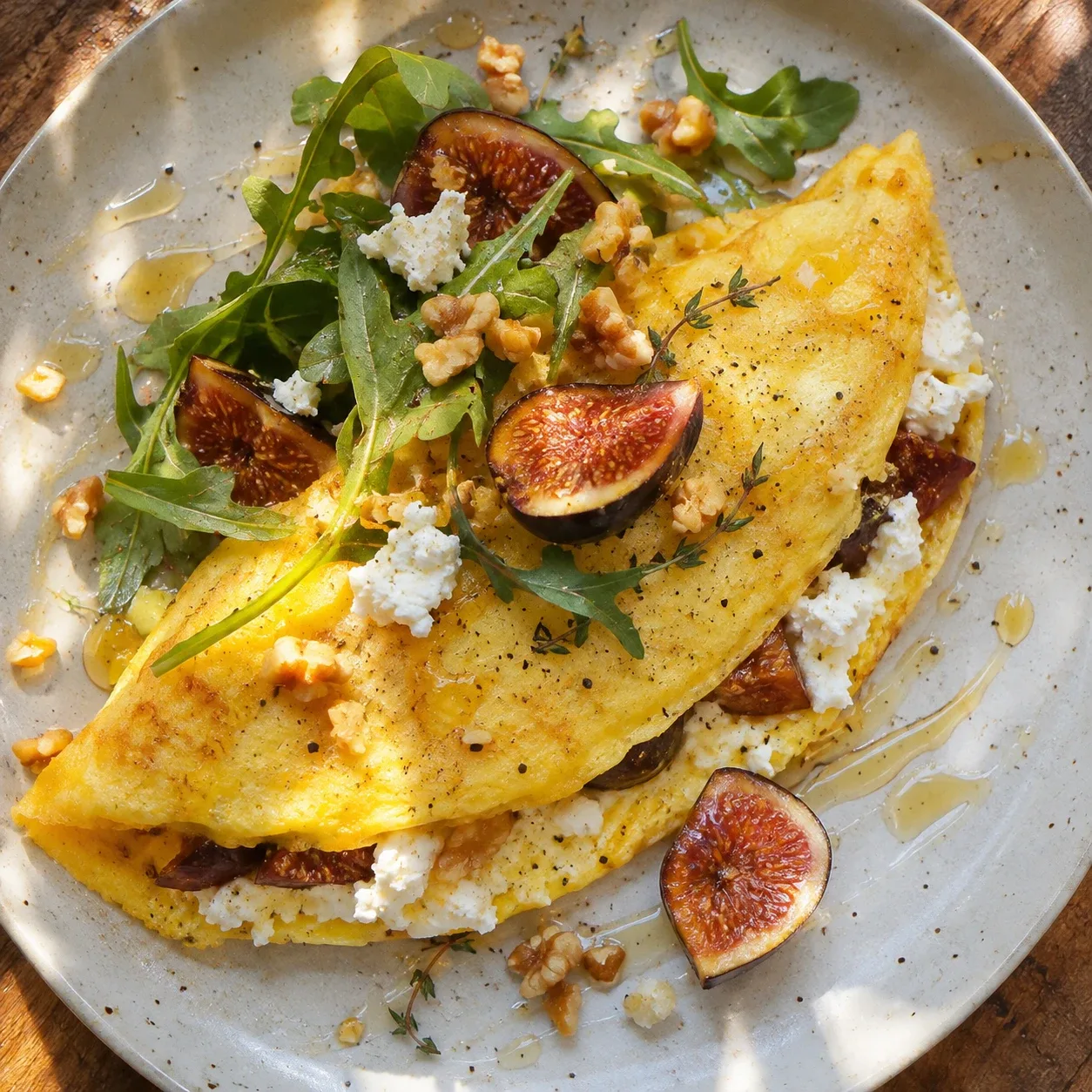
Fig and Goat Cheese Omelette
A soft, buttery French-style omelette folded around creamy goat cheese and fresh figs caramelized with thyme, finished with arugula, toasted walnuts, and a drizzle of raw honey. Sweet, savory, and ready in 15 minutes.
Yield: 1 omelette (1 generous serving; multiply for more) · Active: 15 min · Total: 15 min · Season: Late summer into fall, when fresh figs are ripe · Best eaten: morning or midday
Ingredients
For the figs
- 3 ripe fresh figs (Black Mission, Brown Turkey, or Kadota), stems trimmed, quartered
- 1 tsp grass-fed butter
- 1 tsp fresh thyme leaves
- Pinch of sea salt
For the omelette
- 3 large pasture-raised eggs
- 1 tbsp raw cream or raw milk (optional, for a softer curd)
- Pinch of sea salt and freshly ground black pepper
- 1 tbsp grass-fed butter
- 2 oz fresh goat cheese (chèvre), crumbled
To finish
- A small handful of baby arugula
- 1 tbsp walnuts or pistachios, toasted and roughly chopped
- 1 tsp raw honey, for drizzling
- A few drops of aged balsamic vinegar (optional)
- Flaky sea salt
Method
- Caramelize the figs. Melt 1 tsp butter in an 8- to 9-inch nonstick or well-seasoned carbon steel skillet over medium heat. Add the figs cut side down with the thyme and a pinch of salt, and cook 1–2 minutes, without moving them, until golden and jammy on the cut side. Slide onto a plate and wipe out the pan.
- Beat the eggs. Whisk the eggs with the cream (if using), salt, and pepper until completely smooth, with no streaks of white.
- Start the omelette. Return the pan to medium-low heat and melt 1 tbsp butter until it foams but doesn’t brown. Pour in the eggs.
- Make soft curds. Stir constantly with a silicone spatula while gently shaking the pan, for 1–2 minutes, until the eggs form small, soft curds but still look slightly wet on top. Spread them into an even layer and let them sit 20–30 seconds to set the bottom.
- Fill. Scatter the goat cheese and half the figs over one half of the omelette. Let it sit another 30 seconds so the cheese starts to soften.
- Fold and plate. Fold the empty half over the filling and slide the omelette onto a warm plate. If you’re pregnant, serving young children, or immunocompromised, cook it a minute longer, until the eggs are fully set.
- Finish. Top with the remaining figs, the arugula, and the toasted nuts. Drizzle with raw honey and a few drops of balsamic, if using, and finish with flaky salt. Serve right away.
Storage
- An omelette is best eaten as soon as it’s made.
- Caramelized figs keep, covered, in the fridge up to 2 days; warm them gently in butter before using.
Variations
- Dried figs (winter): Use 4 dried Mission figs, soaked in warm water 15 minutes, then sliced and warmed in the butter with the thyme.
- Prosciutto: Tuck a slice or two of prosciutto or jamón in with the goat cheese for a salty contrast.
- Brown butter and sage: Brown the butter for the figs and fry 4–5 fresh sage leaves in it until crisp; crumble them over the top.
- Caramelized onion: Add 2 tbsp slow-caramelized onions with the goat cheese for a deeper, savory-sweet filling.
- Other cheeses: Swap the goat cheese for sheep’s milk feta, raw ricotta, or a soft blue cheese.
- Herbs: Use rosemary instead of thyme, or finish with torn basil or mint.
- Fig and goat cheese frittata (serves 4): Whisk 8 eggs with ¼ cup raw cream, pour into a buttered 10-inch oven-safe skillet, and cook over medium-low heat until the edges set, 4–5 minutes. Dot with 4 oz goat cheese and 6 halved figs, then bake at 375°F for 10–12 minutes, until just set in the center.
Season & Circadian Timing
Fresh figs are at their best from late summer into early fall, so this is a harvest-season breakfast. In winter, use dried figs instead. Eggs, butter, and cheese make it a protein- and fat-rich morning meal that keeps you full, and the figs add gentle natural sweetness early in the day, when your body handles carbohydrates best.
Nourishment Notes
- Pasture-raised eggs — complete protein, choline, B12, and fat-soluble vitamins A, D, E, and K2.
- Fresh figs — fiber, potassium, magnesium, and calcium, plus polyphenols in their deep purple skins.
- Goat cheese — protein and calcium; many people find goat’s milk easier to digest than cow’s milk.
- Grass-fed butter — vitamins A and K2 and butyrate.
- Walnuts — plant omega-3 fat (ALA) and polyphenols.
- Raw honey — enzymes and natural sweetness, used just as a finishing drizzle.
Sourcing
- Eggs — organic and pasture-raised, from a local farm (Alexandre Family Farm)
- Fresh figs — organic, from a farmers’ market or local farm
- Goat cheese (chèvre) — fresh chèvre (Cypress Grove), or a local chèvre near you
- Butter — organic and grass-fed (Kerrygold or a local raw butter)
- Raw cream or raw milk — from a local grass-fed farm
- Nuts — organic and raw; soak and dry (or sprout) for easier digestion
- Raw honey — organic, local, and unfiltered
- Salt — unrefined sea salt (Baja Gold); flaky sea salt for finishing (Maldon)
- Fruits, vegetables, and herbs — organic, from a farmers’ market or local farm
You might also like: Fresh Figs from the Tree: With Homemade Ricotta and Bee Pollen, Plus Seven More Ways to Enjoy Them · Seasonal Frittatas: One Method, Four Seasons · Tomato, Basil, and Goat Cheese Frittata & Quiche
With Love, Light, and Health,
Anna (aka Food Marshall)
Food Marshall Approved. Grain-free, seed-oil-free and refined-sugar-free, made from organic, local and seasonal ingredients. Our standards
More Breakfast & Eggs
Get new recipes and essays
Seasonal recipes and writing on light, circadian health, and living with nature.
Subscribe on Substack