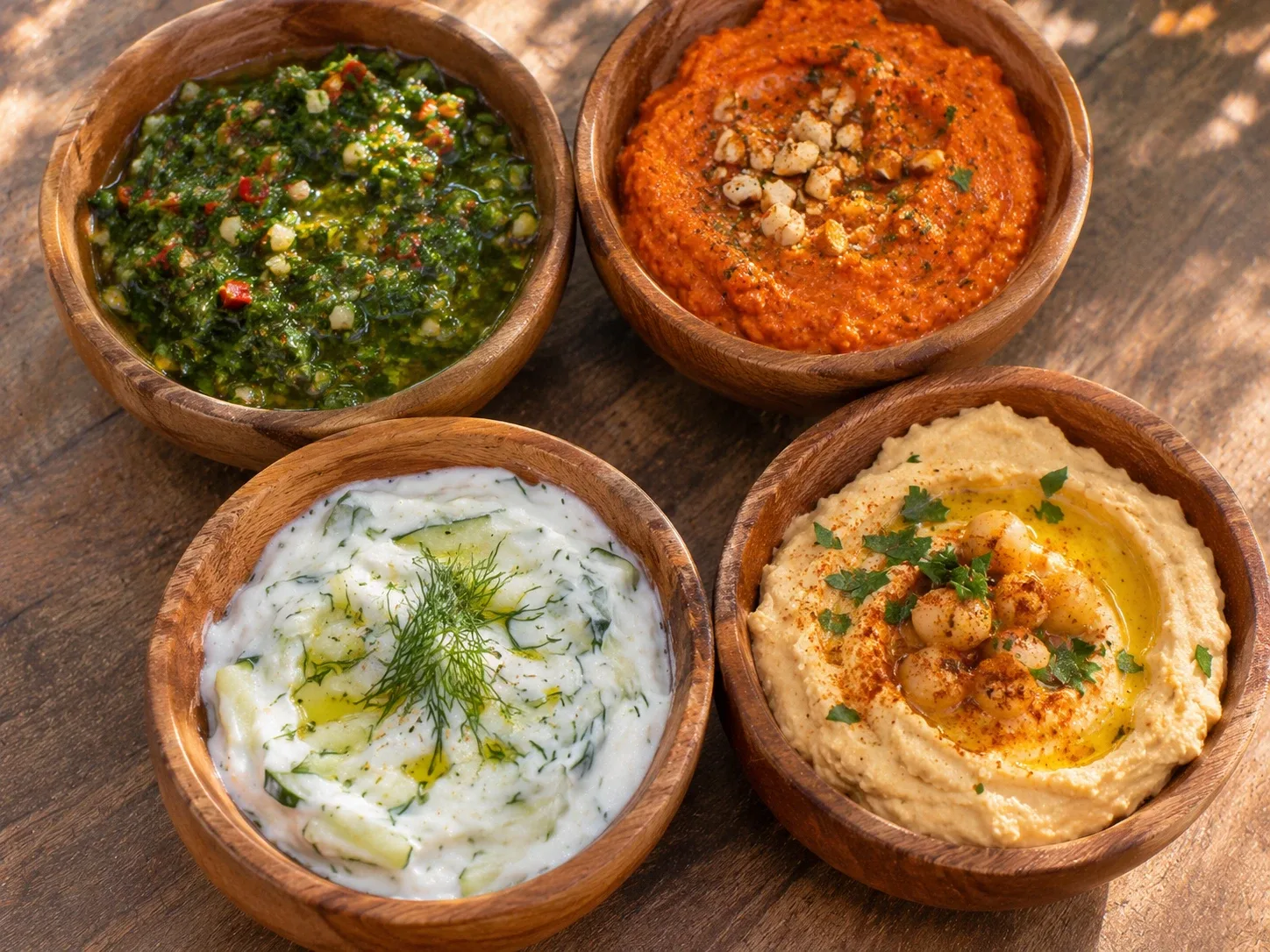
Four Homemade Sauces: Chimichurri, Romesco, Tzatziki, and Hummus
Four sauces I make for nearly every farm-to-table dinner, all built on fresh herbs, good olive oil, and lemon. Make a batch on Sunday and you’ll have something bright to spoon over meat, fish, eggs, and vegetables all week.
Yield: About 1½ cups chimichurri, 1½ cups romesco, 2½ cups tzatziki, and 3 cups hummus · Active: 1 hr 15 min · Total: 2 hr 30 min, plus overnight soaking for the chickpeas · Season: Best in North America in summer and early fall, when bell peppers, cucumbers, and fresh herbs are at their peak · Best eaten: midday
Ingredients
For the chimichurri
- 1 cup fresh cilantro (leaves and tender stems)
- 1 cup fresh flat-leaf parsley
- 1 cup fresh mint leaves
- ⅔ cup extra virgin olive oil
- 4 garlic cloves
- Juice of 2 lemons
- 3 tbsp coconut aminos
- 2 tbsp raw unfiltered honey
- 2 tbsp red wine vinegar or raw apple cider vinegar
- 1 chile (jalapeño or serrano), seeded (optional)
- 1 tsp unrefined sea salt
- A few tbsp filtered water, for a smoother sauce (optional)
For the romesco
- 2 red bell peppers
- Juice of ½ lemon
- 2 tbsp red wine vinegar or raw apple cider vinegar
- ⅓ cup extra virgin olive oil
- ½–1 tsp smoked paprika, to taste
- ¼ cup sprouted almonds
- 2 tbsp pine nuts or toasted hazelnuts (optional)
- 1 small garlic clove (optional)
- ½ tsp sea salt and a few grinds of black pepper, to taste
For the tzatziki
- 1 large English cucumber (or 3 Persian cucumbers), about 12 oz
- ½ tsp sea salt, plus more to taste
- 2 cups full-fat Greek-style yogurt (raw, cow, goat, or sheep); if your raw or homemade yogurt is thin, strain it through cheesecloth in the fridge for 1–2 hours first
- 1–2 garlic cloves, finely grated
- 2 tbsp chopped fresh dill
- 1 tbsp chopped fresh mint
- 1 tbsp fresh lemon juice, plus a little zest if you like
- 2 tbsp extra virgin olive oil, plus more for drizzling
For the hummus
- 1 cup dried chickpeas
- 1 tsp baking soda, divided
- ½ cup tahini, well stirred
- ¼ cup fresh lemon juice (1–2 lemons)
- 1–2 garlic cloves
- 1 tsp sea salt
- ½ tsp ground cumin
- 4–6 tbsp ice water
- Extra virgin olive oil, smoked paprika or sumac, and chopped parsley, for serving
Method
For the chimichurri
- Pulse. Add the cilantro, parsley, mint, olive oil, garlic, lemon juice, coconut aminos, honey, vinegar, chile (if using), and salt to a food processor. Pulse until finely chopped but still a little textured.
- Adjust. For a smoother, more pourable sauce, pulse in a few tablespoons of filtered water. Taste for salt and acid. It’s great on steak, lamb, chicken, fish, roasted veggies, or served with tacos!
For the romesco
- Roast the peppers. Heat the oven to 450°F. Set the whole peppers on a sheet pan and roast 25 minutes, turning once halfway, until the skins are blistered and charred in spots.
- Steam and peel. Move the peppers to a bowl, cover with a plate, and let them steam for 10 minutes; this loosens the skins. When cool enough to handle, peel off the skins and pull out the stems and seeds.
- Blend. Add the peppers to a food processor with the lemon juice, vinegar, olive oil, smoked paprika, almonds, pine nuts or hazelnuts and garlic (if using), salt, and pepper. Blend until smooth, scraping down the sides once or twice. Taste and add more smoked paprika, salt, or vinegar as you like.
For the tzatziki
- Salt the cucumber. Grate the cucumber on the large holes of a box grater (no need to peel), toss with the ½ tsp salt, and let sit 10 minutes.
- Squeeze. Wrap the cucumber in a clean kitchen towel or cheesecloth and wring out as much liquid as you can. This keeps the tzatziki thick instead of watery.
- Mix. Stir the cucumber into the yogurt with the garlic, dill, mint, lemon juice, and olive oil. Taste for salt and lemon. Chill at least 30 minutes so the garlic mellows, then drizzle with a little more olive oil to serve.
For the hummus
- Soak. The night before, cover the chickpeas with plenty of water (they’ll double in size) and stir in ½ tsp of the baking soda. Soak 12–24 hours at room temperature.
- Cook. Drain and rinse. Put the chickpeas in a pot with the remaining ½ tsp baking soda and cover with fresh water by 2 inches. Bring to a boil, skim off any foam, and simmer 45–90 minutes, until very soft and easily smashed between your fingers. Overcooked is better than undercooked here, since very soft chickpeas blend into the smoothest hummus. Drain, saving a little of the cooking liquid. You should have about 2½ cups.
- Mellow the garlic. In a food processor, blend the lemon juice, garlic, and salt for a few seconds and let sit 5–10 minutes. The lemon softens the garlic’s raw bite.
- Whip the tahini. Add the tahini and cumin and blend until thick. With the motor running, add the ice water 1 tbsp at a time until the mixture turns pale and creamy.
- Blend the chickpeas. Add the warm chickpeas and blend for 3–4 minutes, until very smooth, adding a splash of ice water or cooking liquid if it’s too thick. Taste for salt and lemon.
- Serve. Swirl into a shallow bowl, drizzle with olive oil, and finish with smoked paprika or sumac and parsley.
Storage
- Chimichurri keeps in the fridge up to 5 days in a jar with a thin layer of olive oil on top. Let it come to room temperature before serving.
- Romesco keeps up to 1 week in the fridge, or freeze for up to 3 months.
- Tzatziki keeps up to 4 days; stir before serving, since a little liquid may collect on top.
- Hummus keeps up to 5 days in the fridge, or freeze for up to 3 months. Cooked chickpeas also freeze well in their cooking liquid.
Variations
- Classic Argentine chimichurri: Finely chop 1 cup flat-leaf parsley by hand with 4 garlic cloves and 2 tbsp fresh oregano (or 2 tsp dried). Stir in ½ cup extra virgin olive oil, ¼ cup red wine vinegar, ½ tsp red pepper flakes, and ½ tsp salt. Let it sit at least 20 minutes before serving with grilled meat.
- Romesco nuts: Use all almonds, all hazelnuts, or a mix of almonds and pine nuts; toast them lightly for a deeper flavor.
- Spicy romesco: Add a pinch of cayenne or a rehydrated dried ñora or ancho chile.
- Goat or sheep tzatziki: Goat or sheep yogurt makes a tangier, slightly lighter tzatziki that’s often easier to digest.
- Roasted cauliflower “hummus” (legume-free): Toss 1 medium head of cauliflower (about 1½ lb), cut into florets, with 2 tbsp olive oil and ½ tsp salt, and roast at 425°F for 25–30 minutes, until tender and golden at the edges. Blend while warm with ⅓ cup tahini, 3 tbsp lemon juice, 1 garlic clove, ½ tsp cumin, and 2–4 tbsp water or olive oil until smooth. Season to taste.
- Zucchini “hummus” (legume-free): Blend 2 medium zucchini (peeled and chopped) with ⅓ cup tahini, 3 tbsp lemon juice, 1 garlic clove, ½ tsp cumin, ½ tsp salt, and 2 tbsp olive oil. It’s lighter and looser than the classic, perfect in summer.
- Hummus toppings: Top with spiced ground lamb, toasted pine nuts, or a spoonful of the chimichurri.
Season & Circadian Timing
Summer into early fall brings the sweetest bell peppers, the crispest cucumbers, and armloads of fresh herbs, which is exactly what these sauces need. They make the most of a midday meal, when digestion is at its strongest, so serve them alongside grilled meats, fish, and roasted vegetables at lunch or an afternoon gathering.
Nourishment Notes
- Fresh herbs — parsley, cilantro, and mint bring vitamin K, vitamin C, and a range of plant compounds, and a cup of each packs in far more than a sprinkle.
- Red bell peppers — among the richest vegetable sources of vitamin C, plus beta-carotene.
- Yogurt — offers protein and calcium, along with live cultures when it’s raw or unheated after culturing.
- Chickpeas — a legume (not a grain) that provides fiber, plant protein, and folate; soaking and cooking them well makes them easier to digest.
- Tahini — ground sesame seeds, which bring copper, calcium, and healthy fats.
Sourcing
- Extra virgin olive oil — organic, single-estate, harvest-dated, in dark glass
- Coconut aminos — organic and soy-free (Coconut Secret)
- Raw honey — organic, local, and unfiltered
- Raw apple cider vinegar — organic, with the mother (Bragg)
- Red wine vinegar — organic and naturally fermented
- Yogurt — goat’s milk yogurt (Sierra Nevada), sheep’s milk yogurt (Bellwether Farms), A2/A2 cow’s milk yogurt (Bellwether Farms or Straus), or raw yogurt from an Amish farm
- Almonds — organic, sprouted, blanched, and skinless
- Walnuts / pecans / hazelnuts / macadamias — organic and raw; soak and dry (or sprout) for easier digestion
- Pine nuts — organic, with the country of origin listed; keep them in the fridge
- Dried chickpeas — organic and from a recent harvest; older chickpeas can take much longer to soften
- Tahini — organic, made from 100% sesame seeds, in glass
- Smoked paprika — Pimentón de la Vera DOP (smoked Spanish paprika)
- Baking soda — aluminum-free
- Salt — unrefined sea salt (Baja Gold); flaky sea salt for finishing (Maldon)
- Lemons / limes / oranges — organic (you’re using the zest)
- Fruits, vegetables, and herbs — organic, from a farmers’ market or local farm
You might also like: Wild Sea Bass with Romesco & Green Herb Sauce, Spinach Feta Chicken Meatballs with Tzatziki, Slaw, and Crispy Cauliflower, Grass-Fed Ribeye or Lamb with Marrow Butter, Chimichurri, and Three Roasted Sides
With Love, Light, and Health,
Anna (aka Food Marshall)
Food Marshall Approved. Grain-free, seed-oil-free and refined-sugar-free, made from organic, local and seasonal ingredients. Our standards
More Sauces, Dressings & Condiments
Get new recipes and essays
Seasonal recipes and writing on light, circadian health, and living with nature.
Subscribe on Substack