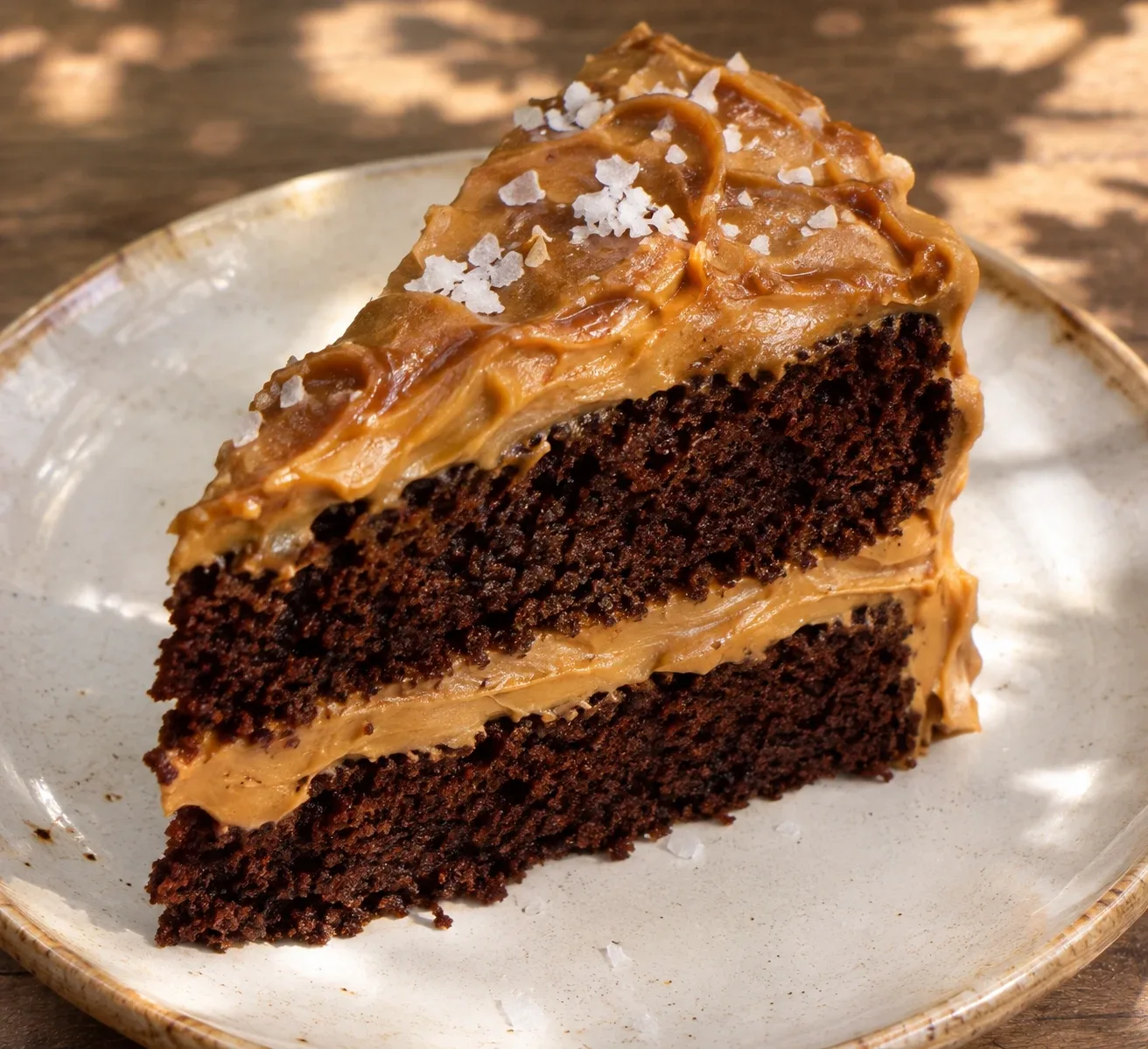
Grain-Free Chocolate Cake with Caramel Buttercream
Two moist almond-flour chocolate layers stacked with a salted coconut-sugar caramel buttercream and finished with flaky salt. Rich, celebratory, and made for birthdays and holiday dinner parties.
Yield: One 8-inch two-layer cake (12 slices) · Active: 50 min · Total: 3 hr (includes cooling) · Season: Year-round, in any region · Best eaten: afternoon
Ingredients
For the chocolate cake
- 2½ cups (280 g) blanched almond flour
- ⅓ cup (40 g) coconut flour
- ⅔ cup (55 g) raw cacao powder
- 1 tsp baking soda
- 1 tsp baking powder
- ½ tsp sea salt
- 5 large pasture-raised eggs, at room temperature
- ¾ cup maple syrup
- ½ cup coconut sugar
- ½ cup (1 stick) grass-fed butter, melted and slightly cooled, plus more for the pans
- ⅓ cup sour cream (or raw whole milk)
- ½ cup hot brewed coffee or hot water
- 2 tsp pure vanilla extract
- 1 tsp raw apple cider vinegar
For the salted caramel
- 1 cup coconut sugar (or ¾ cup maple syrup)
- ⅔ cup raw heavy cream
- 3 tbsp grass-fed butter
- ¾ tsp sea salt
- 1 tsp pure vanilla extract
For the caramel buttercream
- 1½ cups (3 sticks) grass-fed butter, softened to cool room temperature
- ¾ cup of the cooled salted caramel (above)
- Pinch sea salt, to taste
To finish
- The remaining ¼ cup salted caramel, for drizzling
- Flaky sea salt
Method
For the salted caramel (make it first so it can cool)
- Simmer. Combine the coconut sugar, cream, butter, and salt in a medium heavy saucepan over medium heat. Stir until the sugar dissolves and the mixture comes to a boil.
- Reduce. Lower the heat to medium-low and simmer, stirring often, 7–9 minutes, until thick enough to coat the back of a spoon and it leaves a trail when you drag a spatula across the bottom. Coconut sugar won’t turn amber like white sugar does; you’re looking for thickness, not color. If using maple syrup, simmer 10–12 minutes.
- Cool. Stir in the vanilla, pour into a heatproof jar, and let it cool to room temperature, about 1 hour (or 25 minutes in the fridge, stirring once). It thickens as it cools. You’ll have about 1 cup.
For the chocolate cake
- Prep the pans. Heat the oven to 350°F. Butter two 8-inch round cake pans and line the bottoms with parchment circles.
- Bloom the cacao. In a small bowl, whisk the cacao powder into the hot coffee or water until smooth. Blooming means letting cacao sit in hot liquid for a few minutes, which deepens its chocolate flavor.
- Mix the dry. In a large bowl, whisk the almond flour, coconut flour, baking soda, baking powder, and salt, breaking up any lumps.
- Mix the wet. In another bowl, whisk the eggs, maple syrup, and coconut sugar until smooth and a little foamy, about 1 minute. Whisk in the melted butter, sour cream, vanilla, vinegar, and the bloomed cacao.
- Combine. Pour the wet into the dry and stir until no dry streaks remain. Let the batter rest 5 minutes so the coconut flour can absorb the liquid; it will thicken slightly.
- Bake. Divide evenly between the pans and smooth the tops. Bake 28–32 minutes, until the centers spring back when pressed and a toothpick comes out with a few moist crumbs.
- Cool. Cool in the pans 15 minutes (almond-flour cakes are tender while warm), then run a knife around the edges, turn out onto a rack, peel off the parchment, and cool completely, about 1 hour. Chilling the cooled layers for 20 minutes makes them easier to frost.
For the caramel buttercream
- Whip the butter. Beat the softened butter with a stand mixer or hand mixer on medium-high for 4–5 minutes, until pale and fluffy.
- Add the caramel. With the mixer on medium, add ¾ cup of the cooled caramel a spoonful at a time, beating well after each. Beat 1–2 minutes more until smooth and creamy. Taste and add a pinch of salt if you like. Save the remaining caramel for the top.
- Fix if needed. Butter and caramel need to be about the same temperature. If the buttercream looks curdled, it’s too cold; warm the outside of the bowl with a warm towel for a minute and beat again. If it looks soupy, it’s too warm; chill 15 minutes and beat again.
To assemble
- Fill. Set one layer on a plate or cake stand, flat side up. Spread about 1 cup buttercream over it right to the edge.
- Stack and frost. Top with the second layer, flat side up. Spread a thin coat of buttercream over the top and sides to catch any crumbs (this is called a crumb coat), and chill 15 minutes. Finish with the rest of the buttercream, swooping the top with the back of a spoon.
- Finish. Warm the reserved caramel slightly if it’s too thick to pour, drizzle it over the top, and sprinkle with flaky salt. Let the cake sit 20 minutes at room temperature before slicing.
Storage
- Keep the cake covered at cool room temperature for up to 1 day, or in the fridge up to 4 days. Bring it to room temperature for 30–45 minutes before serving so the buttercream softens.
- Unfrosted layers freeze well up to 2 months, wrapped tightly. Extra caramel keeps in a jar in the fridge up to 2 weeks.
Variations
- Single layer or sheet cake: Bake all the batter in a buttered, parchment-lined 9x13-inch pan for 28–32 minutes and frost just the top.
- Cupcakes: Fill 18–20 lined muffin cups two-thirds full and bake 18–22 minutes.
- Chocolate drip: Swap the caramel drizzle for a ganache made from 3 oz dark chocolate melted with ¼ cup warm raw cream.
- Mocha: Use coffee rather than water in the batter and beat 1 tsp finely ground espresso into the buttercream.
- Caramel only: Skip the buttercream and pour all the caramel over a single layer for a simple salted caramel chocolate cake.
Season & Circadian Timing
This cake leans on pantry staples, so it works in any season, and it shines at winter birthdays and Christmas tables. Serve it in the afternoon or right after an early dinner, when you’re still active and your body handles sweets far better than it does late at night.
Nourishment Notes
- Pasture-raised eggs — give the cake its structure without flour, and bring protein, choline, and fat-soluble vitamins.
- Almond flour — adds vitamin E, magnesium, and fiber, and keeps the crumb moist and tender.
- Raw cacao — a source of magnesium, iron, and polyphenols, plant compounds with antioxidant activity.
- Grass-fed butter and raw cream — carry vitamin A and other fat-soluble vitamins, and grass-fed dairy is richer in them than grain-fed.
- Coconut sugar and maple syrup — less refined than white sugar and carry small amounts of minerals, but they’re still sugar, so this is a celebration cake.
Sourcing
- Eggs — organic and pasture-raised, from a local farm (Alexandre Family Farm)
- Almond flour — organic and blanched (keep it in the fridge)
- Coconut flour — organic, finely ground
- Cacao powder — organic raw cacao powder
- Grass-fed butter — organic, cultured butter from 100% grass-fed cows, or raw butter from a local dairy
- Heavy cream — raw from a farmer you know and trust, or organic, grass-fed, low-temperature pasteurized cream (Kalona SuperNatural)
- Sour cream — organic, grass-fed, cultured
- Raw milk — from a farmer you know and trust (find one at realmilk.com), or organic, grass-fed, low-temperature pasteurized milk (Kalona SuperNatural)
- Coconut sugar — organic, unrefined
- Maple syrup — organic Grade A dark
- Dark chocolate — organic, sweetened only with maple, honey, or coconut sugar, or 100% cacao
- Coffee — organic, freshly brewed
- Raw apple cider vinegar — organic, with the mother (Bragg)
- Vanilla — organic pure vanilla extract, or vanilla bean
- Baking soda — aluminum-free
- Baking powder — aluminum-free
- Salt — unrefined sea salt (Baja Gold); flaky sea salt for finishing (Maldon)
You might also like: Coconut Flour Chocolate Layer Cake with Whipped Chocolate Buttercream, Vanilla Cake with Berries (Two Frostings)
With Love, Light, and Health,
Anna (aka Food Marshall)
Food Marshall Approved. Grain-free, seed-oil-free and refined-sugar-free, made from organic, local and seasonal ingredients. Our standards
More Desserts
Get new recipes and essays
Seasonal recipes and writing on light, circadian health, and living with nature.
Subscribe on Substack