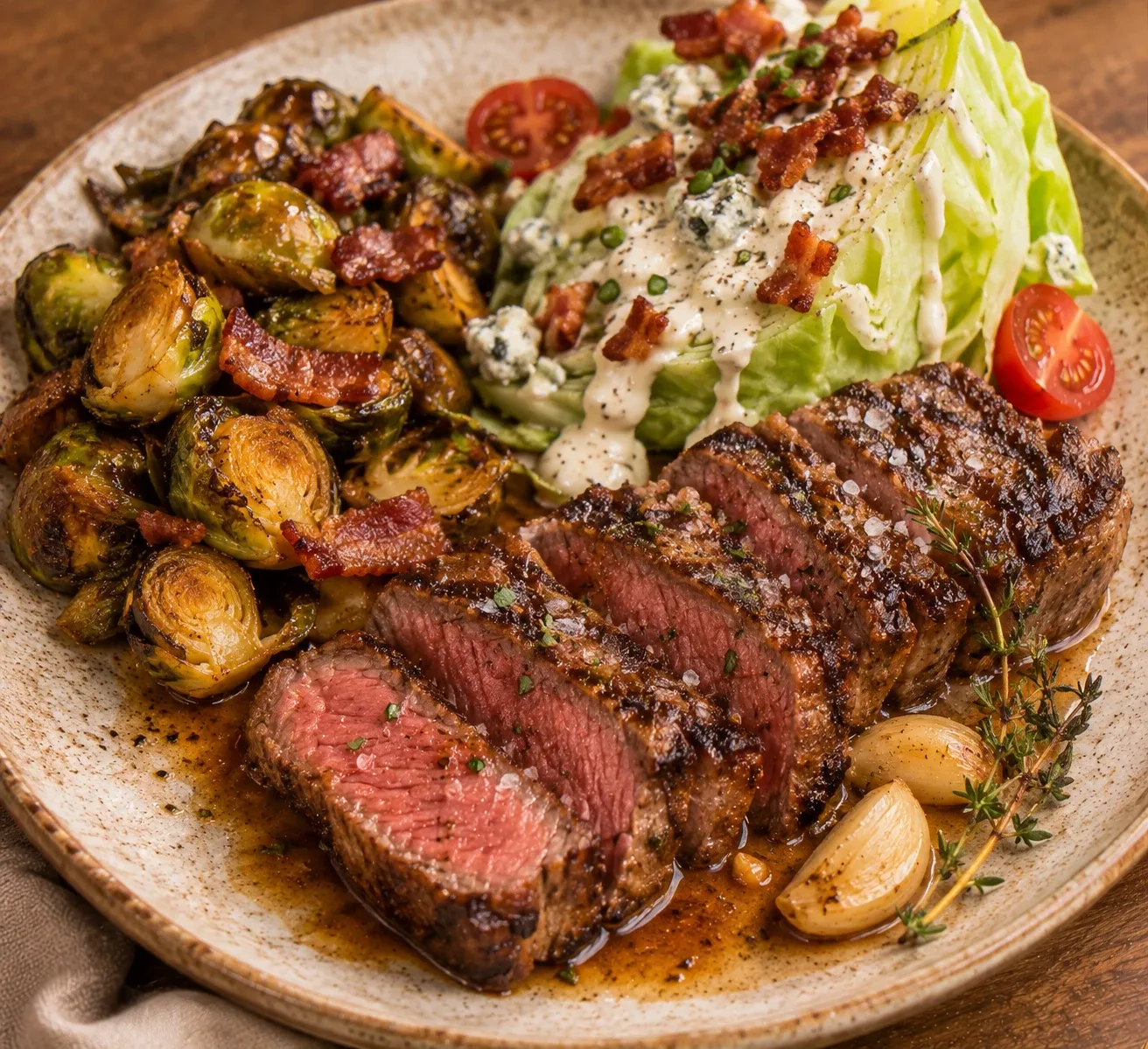
Grass-Fed Strip Steak with Maple-Miso Brussels Sprouts and a Classic Wedge Salad
A steakhouse night at home with butter-basted grass-fed strip steak, soft garlic confit, and a bone broth pan sauce, plus bacon-studded maple-miso Brussels sprouts and a cold, crunchy wedge salad with blue cheese dressing.
Yield: Serves 4 · Active: 1 hr 30 min · Total: 2 hr 15 min, plus 12–24 hr to dry-brine the steak · Season: Best in North America in fall and winter, when Brussels sprouts and pomegranates are at their peak · Best eaten: early evening
Fall swap: Fresh tomatoes generally aren’t in season in fall. Swap them for pomegranate seeds or thin slices of crisp apple on the wedges.
Ingredients
Strip steak with garlic confit and pan sauce
For the steak
- 2 grass-fed New York strip steaks (or ribeyes), 1¼–1½ inches thick, about 14–16 oz each
- 1½ tsp fine sea salt (about ¾ tsp per pound of meat)
- Freshly cracked black pepper
- 1 tbsp beef tallow or grass-fed ghee
- 3 tbsp grass-fed butter
- 4 garlic cloves, smashed
- 3 sprigs fresh thyme and 1 sprig rosemary
For the garlic confit
- 2 heads garlic, cloves separated and peeled (about 24 cloves)
- 1 cup extra virgin olive oil (enough to cover the cloves)
- 1 sprig fresh thyme
For the bone broth pan sauce
- 1 small shallot, finely minced
- ¼ cup dry red wine (optional)
- 1 cup beef bone broth
- 1 sprig fresh thyme
- 2 tbsp cold grass-fed butter, cubed
- 1 tsp Dijon mustard (optional)
- Sea salt and pepper, to taste
Maple-miso Brussels sprouts
For the sprouts
- 1½ lb Brussels sprouts, trimmed and halved
- 4 thick slices bacon, cut into ½-inch pieces
- 2 shallots, thinly sliced
- 1 tbsp avocado oil or melted tallow, if needed
- ½ tsp sea salt
- ⅓ cup pomegranate arils (the juicy red seeds)
For the maple-miso glaze
- 1½ tbsp white (shiro) or chickpea miso
- 1½ tbsp maple syrup
- 1 tbsp raw apple cider vinegar
- 1 tbsp melted grass-fed butter or warm water
For the balsamic reduction
- ½ cup aged balsamic vinegar
Classic wedge salad
For the wedges
- 2 heads baby iceberg, halved, or 4 heads little gem lettuce, halved
- 1 cup heirloom cherry tomatoes, halved
- 2 tbsp finely sliced chives
For the maple-glazed bacon
- 6 thick slices bacon
- 1½ tbsp maple syrup
- ¼ tsp freshly cracked black pepper
For the crispy shallots
- 3 large shallots, sliced into very thin rings
- ½ cup beef tallow or grass-fed ghee
- Pinch of sea salt
For the blue cheese dressing
- 3 oz raw-milk blue cheese (or Gorgonzola), crumbled (about ¾ cup), divided
- ½ cup raw sour cream or crème fraîche (or raw kefir for a thinner dressing)
- ¼ cup homemade or avocado-oil mayonnaise
- 1 tbsp fresh lemon juice
- 1 small garlic clove, finely grated
- 1–3 tbsp raw milk or kefir, to thin
- ¼ tsp sea salt and plenty of black pepper
Method
Timing plan
The steak needs a head start the day before, and a few components can be made ahead, so the last hour is mostly roasting, searing, and plating.
| When | What to do |
|---|---|
| 1 day ahead (12–24 hr) | Dry-brine the steaks. Make the blue cheese dressing. Make the garlic confit (up to 4 days ahead). |
| 2 hr before dinner | Make the crispy shallots and the balsamic reduction. Wash, halve, and chill the lettuce. |
| 1 hr before | Take the steaks out of the fridge. Heat the oven to 425°F. Crisp the bacon pieces for the sprouts. Mix the maple-miso glaze. |
| 45 min before | Roast the Brussels sprouts and the maple-glazed bacon. |
| 20 min before | Sear and baste the steaks. |
| 10 min before | Rest the steaks and make the pan sauce. Glaze the sprouts. Build the wedges. |
| Dinner | Slice the steak and plate everything. |
Strip steak with garlic confit and pan sauce
- Dry-brine the steak. Pat the steaks dry and season all over with the salt. Set them on a rack over a plate and refrigerate, uncovered, for 12–24 hours. Dry-brining means salting meat ahead of time without any liquid. The salt draws out moisture, dissolves into it, and is pulled back into the meat, seasoning it deeply while the surface dries for a better crust. (Even 45 minutes helps if you’re short on time.)
- Make the garlic confit. Confit (con-FEE) means cooking something slowly, submerged in fat, at a low temperature. Put the peeled garlic and thyme in a small saucepan and cover with the olive oil. Set over the lowest heat so just a few tiny bubbles rise, and cook 30–40 minutes, until the cloves are pale gold and soft enough to spread. Don’t let them brown, or they turn bitter. Cool in the oil.
- Bring to room temperature. Take the steaks out 45 minutes to 1 hour before cooking. Pat dry again and season with pepper.
- Sear. Heat a large cast-iron skillet over medium-high heat until it just starts to smoke. Add the tallow, then lay the steaks in, pressing the fat cap against the pan for a minute first if your steaks have one. Sear 3–4 minutes without moving them, until a deep brown crust forms. Flip and sear 2 minutes.
- Butter-baste. Lower the heat to medium and add the butter, smashed garlic, thyme, and rosemary. When the butter foams, tilt the pan toward you and use a large spoon to pour the hot butter over the steaks again and again for 1–2 minutes, flipping once. This is basting, and it browns the top while flavoring the meat with garlic and herbs. Cook until an instant-read thermometer in the thickest part reads 120–125°F for medium-rare (it will rise about 5 degrees as it rests) or 130–135°F for medium.
- Rest. Move the steaks to a cutting board and rest 8–10 minutes. Spoon the browned garlic and herbs over the top.
- Make the pan sauce. Pour off all but about 1 tbsp of fat from the skillet. Over medium heat, add the shallot and cook 1 minute. Add the wine, if using, and scrape up the browned bits from the bottom of the pan (this is deglazing). Simmer until nearly gone, about 1 minute. Add the bone broth and thyme and simmer 5–6 minutes, until reduced by about half. Pour in any juices from the resting steaks. Take the pan off the heat, remove the thyme, and swirl in the cold butter and Dijon, if using, until glossy. Season to taste. This is your homemade answer to a classic demi-glace (a rich, concentrated French brown sauce), made in minutes from bone broth.
- Slice and serve. Slice the steak against the grain (across the lines of muscle fiber, which keeps each bite tender) into ½-inch slices. Spoon over the pan sauce and scatter with a few garlic confit cloves.
Maple-miso Brussels sprouts
- Crisp the bacon. In a skillet over medium heat, cook the bacon pieces 8–10 minutes, stirring often, until browned and crisp. Lift them out with a slotted spoon and save the fat.
- Roast. Toss the halved sprouts with 2 tbsp of the bacon fat (top up with avocado oil or tallow if needed) and the salt. Spread on a sheet pan, cut side down, and roast at 425°F for 15 minutes. Add the sliced shallots, toss, and roast 8–10 minutes more, until the sprouts are deeply browned and tender.
- Make the balsamic reduction. Simmer the balsamic in a small saucepan over medium-low heat for 8–12 minutes, until it has reduced by about two-thirds and lightly coats a spoon. It thickens more as it cools, so take it off the heat while it’s still slightly runny.
- Glaze. Whisk the miso, maple syrup, vinegar, and melted butter until smooth. Miso is a fermented paste with a salty, savory flavor; white and chickpea miso are the mildest and sweetest. Toss the hot sprouts with the glaze and the crisp bacon right on the sheet pan (adding it at the end keeps the miso from burning).
- Finish. Pile onto a platter, scatter with pomegranate arils, and drizzle with the balsamic reduction.
Classic wedge salad
- Make the dressing. In a bowl, mash half the blue cheese into the sour cream with a fork. Stir in the mayonnaise, lemon juice, garlic, salt, and pepper, then fold in the rest of the cheese so you keep some chunks. Thin with raw milk or kefir until it’s thick but pourable. Chill at least 30 minutes so the flavors come together.
- Make the crispy shallots. Put the shallot rings and tallow or ghee in a small saucepan and set over medium heat (starting in cold fat helps them cook evenly). Stir often for 8–12 minutes, until light golden. Watch closely at the end, since they keep darkening after they come out. Lift onto a paper towel, sprinkle with salt, and let them crisp as they cool. Save the shallot-flavored fat for searing the steak.
- Glaze the bacon. Lay the bacon on a rack set over a foil-lined sheet pan and roast at 425°F for 12–15 minutes, until nearly crisp. Brush with the maple syrup, sprinkle with pepper, and roast 3–5 minutes more, until lacquered and bubbling. Watch closely, since maple burns fast. Cool, then chop.
- Build the wedges. Pat the lettuce dry and set a cold wedge, cut side up, on each plate. Spoon over a generous amount of dressing and top with tomatoes, maple bacon, crispy shallots, chives, and a crack of black pepper.
Storage
Steak: fridge up to 3 days. Slice cold for salads, or warm gently in the pan sauce over low heat so it doesn’t overcook.
Garlic confit: keep the cloves covered in their oil in the fridge and use within 4 days, or freeze in small portions for up to 3 months. Use the leftover garlic oil for roasting vegetables or eggs.
Brussels sprouts: fridge up to 4 days; reheat at 400°F for 8–10 minutes. Add the pomegranate fresh.
Blue cheese dressing: fridge up to 5 days. Crispy shallots: an airtight jar at room temperature up to 3 days. Balsamic reduction: room temperature up to 2 weeks.
The wedge salad is best assembled right before serving.
Variations
- Seared duck breast: Score the skin of 2 pasture-raised duck breasts in a crosshatch, season, and start skin-side down in a cold skillet over medium-low heat. Cook 10–14 minutes, until the fat renders and the skin is crisp, then flip for 2–3 minutes, to 130–135°F inside. Rest 5 minutes and slice.
- Pork tenderloin: Sear 2 pasture-raised heritage-breed pork tenderloins on all sides in tallow, then roast at 400°F for 12–18 minutes, until they read 140–145°F. Rest 5 minutes and slice.
- Ribeye: Use 2 ribeyes in place of the strip; cook the same way, rendering the fat cap well.
- Horseradish crème fraîche: Stir together ½ cup crème fraîche, 2 tbsp freshly grated horseradish (or 1–2 tbsp prepared horseradish with no additives), a squeeze of lemon, and a pinch of salt. Serve alongside the steak.
- Steak au poivre: Au poivre is French for “with pepper.” Press 1–2 tbsp coarsely crushed black peppercorns into both sides of the steaks before searing. For the sauce, deglaze with 2 tbsp cognac or brandy in place of the wine, add the bone broth, and finish with ¼ cup raw cream and the butter.
- Sprouts without bacon: Roast the sprouts in ghee or tallow and finish with toasted pecans or walnuts in place of the bacon.
- Little gem Caesar-style: Skip the blue cheese and dress the wedges with lemon, Parmigiano, and olive oil.
Season & Circadian Timing
Brussels sprouts sweeten after the first cold snaps and pomegranates ripen through late fall, so this plate belongs to the colder months, just when a good steak dinner feels right. A rich, protein-heavy meal sits best when it isn’t too late, so plan it for early evening and give yourself a few hours to digest before bed.
Nourishment Notes
- Grass-fed beef — a great source of heme iron (the most easily absorbed form of iron), zinc, and vitamin B12. Grass-finished beef also carries more omega-3s and CLA than grain-finished.
- Bone broth — the base of the pan sauce, bringing gelatin and the amino acid glycine.
- Brussels sprouts — rich in vitamin C, vitamin K, and fiber, plus the sulfur compounds that cabbage-family vegetables are known for.
- Garlic — slow-cooking turns it mild and sweet, and it adds its own sulfur compounds and plenty of flavor.
- Miso and raw blue cheese — both fermented foods; unpasteurized miso and raw-milk cheese can carry live cultures, though cooking reduces them.
Sourcing
- Beef — 100% grass-fed and grass-finished, from a local farm (White Oak Pastures or US Wellness Meats)
- Bacon — from pasture-raised heritage-breed pork (such as Berkshire, Red Wattle, or Tamworth), sugar-free, with no added nitrates or nitrites (note that “uncured” bacon made with celery powder still contains naturally occurring nitrites)
- Duck — pasture-raised, from a local farm
- Pork — pasture-raised heritage breed, from a local farm (White Oak Pastures)
- Tallow / lard / duck fat — from pasture-raised animals, from a local farm or butcher
- Ghee — grass-fed ghee, or homemade from organic grass-fed butter
- Grass-fed butter — organic, cultured butter from 100% grass-fed cows, or raw butter from a local dairy
- Extra virgin olive oil — organic, single-estate, harvest-dated, in dark glass
- Bone broth — homemade from pasture-raised bones, or organic and sold frozen (Bonafide Provisions)
- Miso — organic, unpasteurized, and kept refrigerated; white (shiro) or soy-free chickpea miso (South River or Miso Master)
- Maple syrup — organic Grade A dark
- Raw apple cider vinegar — organic, with the mother (Bragg)
- Aged balsamic vinegar — traditional balsamic (Aceto Balsamico Tradizionale di Modena DOP), or an aged balsamic with no caramel color or added sugar (Bionaturae)
- Blue cheese — raw-milk blue such as Roquefort (made from raw sheep’s milk by law) or an organic raw-milk American blue (Rogue Creamery); Gorgonzola DOP is milder and creamier, though it’s made from pasteurized milk
- Crème fraîche / sour cream — organic, grass-fed, cultured
- Raw kefir — homemade from raw milk, or organic, grass-fed whole-milk kefir
- Raw milk — from a farmer you know and trust (find one at realmilk.com), or organic, grass-fed, low-temperature pasteurized milk (Kalona SuperNatural)
- Mayonnaise — homemade with pasture-raised eggs and avocado or olive oil, or a store-bought mayo made with 100% avocado oil (Primal Kitchen)
- Dijon mustard — organic, with no preservatives or sugar (Delouis Fils or Maison Orphée)
- Salt — unrefined sea salt (Baja Gold); flaky sea salt for finishing (Maldon)
- Fruits, vegetables, and herbs — organic, from a farmers’ market or local farm
You might also like: Roasted Brussels Sprouts Two Ways · Grass-Fed Ribeye Steak with Hollandaise or Béarnaise and Roasted Root Vegetables · Grass-Fed Steak with Black Garlic Butter and More Compound Butters
With Love, Light, and Health,
Anna (aka Food Marshall)
Food Marshall Approved. Grain-free, seed-oil-free and refined-sugar-free, made from organic, local and seasonal ingredients. Our standards
More Meat
Get new recipes and essays
Seasonal recipes and writing on light, circadian health, and living with nature.
Subscribe on Substack