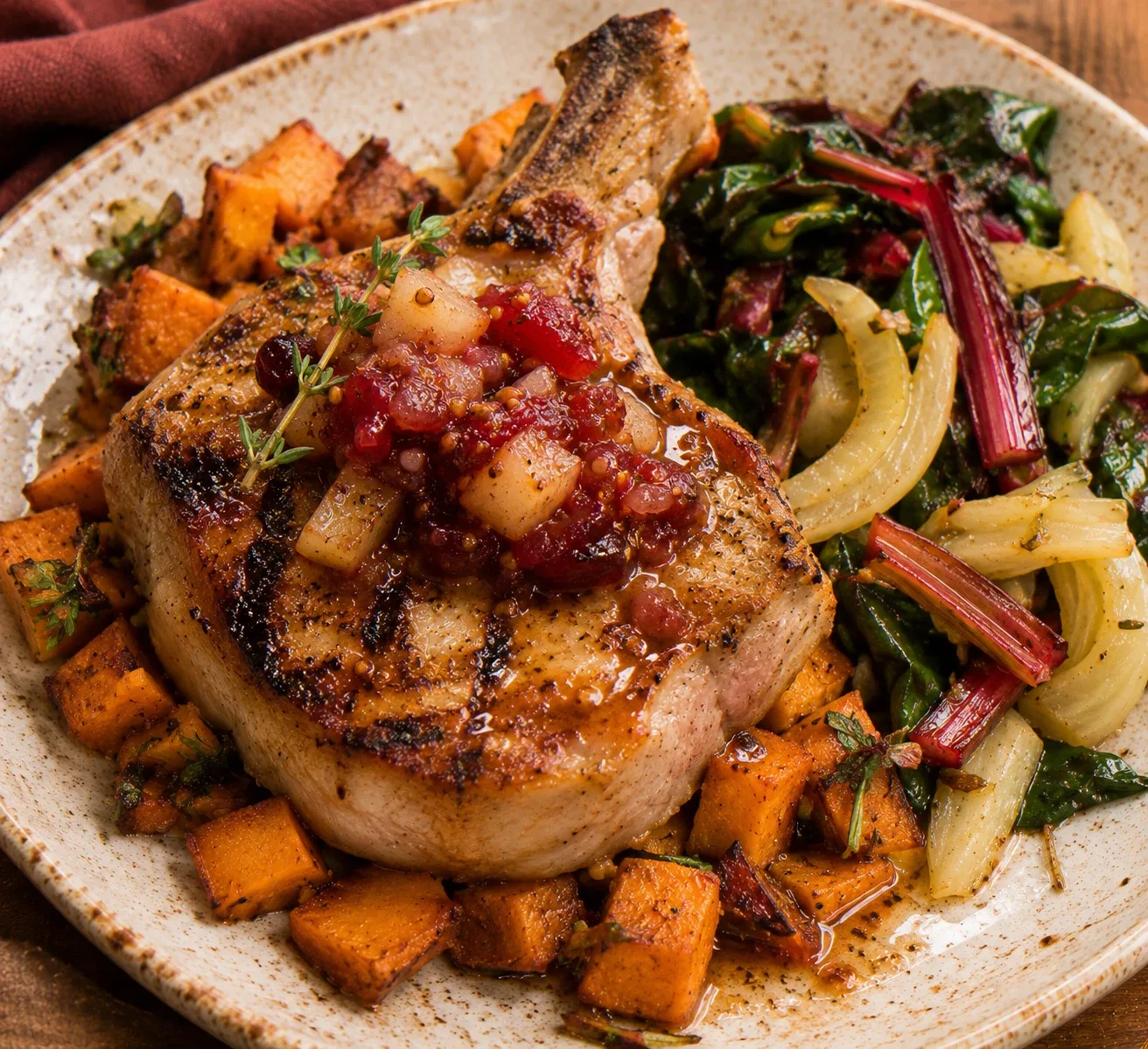
Grilled Heritage Pork Chops with Sweet Potato Hash, Rainbow Chard and Fennel, and Cranberry-Pear Mostarda
Thick, bone-in heritage pork chops, grilled or pan-seared and butter-basted, over a crispy sweet potato hash with garlicky chard and fennel. A tangy cranberry-pear mostarda and a rich bone broth pan jus make it a true fall plate.
Yield: Serves 4 · Active: 1 hr · Total: about 1 hr 30 min (plus 1–4 hr if brining) · Season: Best in North America in fall, when cranberries, pears, sweet potatoes, and rainbow chard are at their peak · Best eaten: early evening
Ingredients
For the brine (optional)
- 6 cups cold water
- ⅓ cup coarse unrefined sea salt (or ¼ cup fine sea salt)
- 2 tbsp maple syrup
- 4 garlic cloves, smashed
- 1 tsp whole black peppercorns
- 2 bay leaves
- 2 sprigs fresh rosemary or thyme
For the pork chops
- 4 bone-in pasture-raised heritage pork chops, about 1½ inches thick (about 14 oz each)
- 1 tbsp avocado oil, melted tallow, or lard
- 1½ tsp unrefined sea salt (use ½ tsp if you brined)
- 1 tsp freshly cracked black pepper
- 3 tbsp grass-fed butter, for basting
- 3 garlic cloves, smashed
- 4 sprigs fresh thyme
- 1 sprig fresh rosemary
For the cranberry-pear mostarda
- 1½ cups (6 oz) fresh or frozen cranberries
- 1 large firm-ripe pear (Bosc or Anjou), peeled and cut into ½-inch dice
- 1 small shallot, minced
- 2 tbsp yellow mustard seeds
- ⅓ cup raw apple cider vinegar
- ¼ cup water
- ¼ cup maple syrup (or raw honey)
- 1 tbsp Dijon mustard
- Zest of ½ orange (optional)
- Pinch of sea salt
For the sweet potato hash
- 3 tbsp tallow or bacon fat (or lard)
- 2 lb sweet potatoes (about 3 medium), scrubbed and cut into ½-inch cubes (peeling is optional)
- 1 medium yellow onion, diced
- 1 tsp unrefined sea salt
- ½ tsp freshly cracked black pepper
- 1 tbsp fresh thyme leaves
- 1 tsp fresh rosemary, finely chopped
- 6 fresh sage leaves, thinly sliced
- 2 tbsp chopped fresh parsley
For the rainbow chard and fennel
- 1 large bunch rainbow chard (about 12 oz)
- 1 medium fennel bulb, fronds reserved
- 2 tbsp extra virgin olive oil or grass-fed butter
- 3 garlic cloves, thinly sliced
- Pinch of chile flakes (optional)
- ½ tsp unrefined sea salt
- 1 tbsp fresh lemon juice
For the bone broth pan jus
- 1 tbsp grass-fed butter
- 1 large shallot, minced
- ½ cup dry white wine (or dry Marsala, for a deeper, sweeter jus)
- 1½ cups bone broth
- 1 sprig fresh thyme
- 2 tbsp cold grass-fed butter, cubed
- Sea salt and black pepper, to taste
Method
Timing at a glance
| When | What to do |
|---|---|
| Up to 1 week ahead | Make the mostarda (it gets better as it sits) |
| 1–4 hours ahead | Brine the chops (optional) |
| 1 hour before serving | Pull the chops from the brine or fridge, pat dry, and let them sit at room temperature |
| 50 minutes before | Start the sweet potato hash |
| 35 minutes before | Heat the grill or skillet; prep the chard and fennel |
| 25 minutes before | Cook the chops |
| 10 minutes before | Rest the chops; make the pan jus and sauté the chard and fennel |
| Serve | Plate everything and spoon on the jus and mostarda |
Brine the chops (optional)
- A brine is a saltwater soak. It seasons the meat all the way through and helps thick chops stay juicy.
- Make the brine. Stir the water, salt, and maple syrup until dissolved. Add the garlic, peppercorns, bay leaves, and herb sprigs.
- Brine. Submerge the chops and refrigerate 1–4 hours (no longer, or the texture turns ham-like). Remove, rinse briefly, and pat very dry.
Make the cranberry-pear mostarda
Mostarda is an Italian condiment of fruit cooked down with mustard. It’s sweet, sharp, and a little spicy, and it cuts right through rich pork.
- Simmer. Combine the cranberries, pear, shallot, mustard seeds, vinegar, water, maple syrup (if using honey, wait and stir it in at the end), and salt in a small saucepan. Bring to a simmer over medium heat.
- Cook down. Simmer 12–15 minutes, stirring often, until most of the cranberries have burst, the pear is tender, and the mixture is thick and jammy. The mustard seeds will soften and pop lightly when you bite them.
- Finish. Off the heat, stir in the Dijon, the orange zest (if using), and the honey (if using). Taste; add a touch more sweetener or vinegar as you like. Cool to room temperature. It thickens more as it cools.
Make the sweet potato hash
- Steam-sear the sweet potatoes. Heat the tallow or bacon fat in a large cast-iron skillet over medium-high heat. Add the sweet potatoes in an even layer, sprinkle with half the salt, and cover. Cook 8 minutes without stirring, so they steam until nearly tender and brown on the bottom.
- Crisp. Uncover, add the onion, and cook 10–12 minutes more, turning every few minutes with a thin spatula, until the potatoes are tender inside and crisp at the edges and the onion is golden.
- Season. Stir in the thyme, rosemary, sage, remaining salt, and pepper and cook 1 minute, until fragrant. Keep warm over low heat and toss in the parsley just before serving.
Grill or sear the chops
- Season. Rub the chops with the oil or fat and season all over with salt and pepper.
- To grill. Set up a two-zone fire, with one side on high (about 450–500°F) and the other side low or off. Grill over direct heat 3–4 minutes per side, until well marked. Hold each chop with tongs to sear the fat edge for 1 minute. Move to the cooler side, close the lid, and cook 6–10 minutes more, until an instant-read thermometer in the thickest part (not touching bone) reads 140°F. In the last 2 minutes, set a small skillet on the grill, melt the butter with the garlic and herbs, and brush or spoon it over the chops.
- To pan-sear instead. Heat the oven to 400°F. Heat a large cast-iron skillet over medium-high heat until very hot. Sear the chops 3–4 minutes per side until deep golden, then stand them on their fat edge for 1 minute. Lower the heat to medium, add the butter, garlic, and herbs, and baste for 1–2 minutes. To baste, tilt the pan so the foaming butter pools at one side and spoon it over the chops again and again. Move the skillet to the oven and roast 6–10 minutes, to 140°F. Keep the skillet for the jus.
- Rest. Rest the chops on a board 8–10 minutes. They’ll rise to about 145°F, juicy with a blush of pink.
Make the bone broth pan jus
A jus (say “zhoo”) is a thin, glossy pan sauce made from the browned bits left after searing meat, called the fond. It stands in for a classic demi-glace here.
- Build the base. If you pan-seared, pour off all but 1 tablespoon of fat from the skillet (if you grilled, use a small saucepan and 1 tablespoon of butter). Add the shallot and cook over medium heat 2 minutes, until soft.
- Deglaze. Pour in the wine and scrape up the browned bits with a wooden spoon. That’s deglazing, and it pulls all that flavor into the sauce. Simmer until the wine is reduced by half, about 2 minutes.
- Reduce. Add the bone broth and thyme and simmer briskly 8–10 minutes, until reduced to about ½ cup and slightly syrupy. Pour in any juices from the resting chops.
- Finish. Take the pan off the heat, remove the thyme, and swirl in the cold butter a few cubes at a time until glossy. Season with salt and pepper.
Sauté the chard and fennel
- Prep. Strip the chard leaves from the stems. Slice the stems ¼ inch thick and roughly chop the leaves. Halve and core the fennel and slice it thinly.
- Cook. Heat the olive oil or butter in a large skillet over medium heat. Add the fennel and chard stems with the salt and cook 5–6 minutes, until tender and lightly golden. Add the garlic and chile flakes and cook 1 minute. Add the leaves and toss 2–3 minutes, just until wilted. Finish with the lemon juice.
Serve
- Plate. Spoon the hash onto warm plates, add a mound of chard and fennel, and set a chop alongside (whole or sliced off the bone). Spoon the jus over the pork, add a generous spoonful of mostarda, and scatter with fennel fronds.
Storage
Mostarda: fridge up to 2 weeks in a glass jar.
Pork chops: fridge up to 3 days. Slice and warm gently in a little jus or broth so they don’t dry out.
Hash and greens: fridge up to 4 days. Re-crisp the hash in a hot skillet with a little fat.
Jus: fridge up to 5 days (it sets like jelly from the gelatin, and melts back down when warmed).
Variations
Stuffed Pork Chops with Sausage, Cremini, Spinach, and Smoked Gouda, with Roasted Red Pepper Cream Sauce
Serves 4
For the stuffed chops
- 4 bone-in pasture-raised heritage pork chops, about 1½ inches thick (about 14 oz each)
- 1 tbsp grass-fed ghee or lard, plus 1 tbsp for searing
- 8 oz pasture-raised Italian pork sausage, casings removed (or 8 oz ground pork plus 1 tsp fennel seed, ½ tsp garlic powder, ¼ tsp chile flakes, and ¾ tsp sea salt)
- 4 oz cremini mushrooms, finely chopped
- 1 small shallot, minced
- 1 garlic clove, minced
- 2 packed cups baby spinach, roughly chopped
- ½ cup (2 oz) shredded smoked Gouda
- 1 tsp sea salt and ½ tsp black pepper, for the chops
- Toothpicks or kitchen twine
For the roasted red pepper cream sauce
- 1 tbsp grass-fed butter
- 1 small shallot, minced
- 1 garlic clove, minced
- 2 roasted red peppers (from a jar, drained, or roasted at home), roughly chopped (about 1 cup)
- ½ cup bone broth
- ½ cup raw heavy cream
- ¼ tsp smoked paprika
- ½ tsp sea salt, or to taste
- 1 tsp fresh lemon juice
Method
- Cook the filling. Heat 1 tbsp ghee or lard in a skillet over medium-high heat. Brown the sausage 5–6 minutes, breaking it up, until no pink remains. Add the mushrooms and shallot and cook 4–5 minutes, until the mushrooms release their liquid and it cooks off. Add the garlic and spinach and stir until wilted, 1 minute. Cool 10 minutes, then stir in the Gouda.
- Cut a pocket. Heat the oven to 400°F. With a small sharp knife, cut a deep horizontal pocket into the fat side of each chop, going toward the bone but not through the other sides.
- Stuff. Season the chops inside and out with salt and pepper. Fill each pocket with about ⅓ cup filling and close with a toothpick or two.
- Sear and roast. Heat 1 tbsp ghee or lard in a large ovenproof skillet over medium-high heat. Sear the chops 3–4 minutes per side, until golden. Move to the oven and roast 12–18 minutes, until the meat reads 140°F and the filling is hot through. Rest 8–10 minutes (they’ll rise to about 145°F).
- Make the sauce. While the chops roast, melt the butter in a small saucepan over medium heat. Cook the shallot 2 minutes, then the garlic for 30 seconds. Add the peppers, broth, and smoked paprika and simmer 5 minutes. Add the cream and blend smooth with an immersion blender (or in a blender). Simmer 2–3 minutes more, until it coats a spoon. Season with salt and lemon juice.
- Serve. Remove the toothpicks and spoon the sauce over and around the chops. The sweet potato hash and chard from the main recipe go beautifully alongside.
Pork Chop Scarpariello
Serves 4. Scarpariello (“shoemaker’s style”) is an Italian-American skillet dish, usually made with chicken, of sweet and hot peppers in a tangy wine-and-vinegar pan sauce. It’s just as good with pork.
- 4 bone-in pasture-raised heritage pork chops, 1–1½ inches thick
- 1½ tsp sea salt and 1 tsp black pepper
- 2 tbsp extra virgin olive oil or lard
- 1 red bell pepper and 1 yellow or orange bell pepper, sliced into strips
- 1 medium yellow onion, sliced
- 4 pickled hot cherry peppers, sliced, plus 2 tbsp of their brine (or 1 fresh Fresno chile, sliced, plus 1 tbsp extra vinegar)
- 6 garlic cloves, thinly sliced
- 2 sprigs fresh rosemary
- ½ cup dry white wine
- 1 cup bone broth
- 2 tbsp red wine vinegar
- 2 tbsp grass-fed butter
- 2 tbsp chopped fresh parsley
- Sear. Heat the oven to 400°F. Season the chops with salt and pepper. Heat the oil or lard in a large ovenproof skillet over medium-high heat and sear the chops 3–4 minutes per side, until deep golden. Move them to a plate (they’ll finish in the sauce).
- Cook the peppers. Lower the heat to medium. Add the bell peppers and onion with a pinch of salt and cook 6–8 minutes, until soft and starting to char at the edges. Add the garlic, cherry peppers, and rosemary and cook 1 minute.
- Build the sauce. Pour in the wine and scrape up the browned bits. Simmer until reduced by half, about 2 minutes. Add the broth, vinegar, and cherry pepper brine and simmer 3 minutes.
- Finish in the oven. Nestle the chops and their juices into the peppers. Roast 8–12 minutes, until the pork reads 140°F. Move the chops to a board to rest 5–8 minutes.
- Finish the sauce. Set the skillet over medium heat (careful, the handle is hot) and simmer 2–3 minutes to thicken slightly. Swirl in the butter and parsley and season to taste. Spoon the peppers and sauce over the chops.
- Add sausage, if you like. For the classic version, brown 8 oz pasture-raised Italian sausage links in the pan after the chops, slice them, and add back with the chops in step 4.
More ways to change it up
- Apple mostarda: Swap the pear for a tart apple such as Pink Lady or Honeycrisp, or use half of each.
- Squash hash: Use butternut or kabocha in place of the sweet potatoes, or a mix with Yukon Gold potatoes.
- Other greens: Lacinato kale or collards work in place of chard. Give collards a few extra minutes.
- Rib or loin chops: Either cut works. Thinner (1-inch) chops need only 3 minutes per side, with no oven time.
- Pork tenderloin: Sear two tenderloins all over, roast at 400°F to 140°F (15–20 minutes), and slice into medallions.
Season & Circadian Timing
Cranberries, pears, sweet potatoes, and chard all come in together in fall, which is why this plate tastes so right when the nights turn cool. It’s a hearty, protein-rich dinner, so it’s best in the early evening, with the sweet potato’s slower carbs as the light fades and enough time to digest before bed.
Nourishment Notes
- Pasture-raised pork — complete protein and B vitamins, especially thiamine (B1), which pork is particularly rich in, plus selenium.
- Sweet potatoes — rich in beta-carotene, which your body converts to vitamin A. Cooking them in tallow or bacon fat helps you absorb it.
- Rainbow chard — an excellent source of vitamin K, with magnesium and the colorful pigments that give its stems their reds and yellows.
- Cranberries and mustard seeds — cranberries bring polyphenols and bright tartness. Mustard seeds carry glucosinolates, the same family of compounds found in broccoli and cabbage.
- Bone broth — the jus is a concentrated broth, so it carries gelatin and minerals (see Broths 101 — A Foundation to make your own).
Sourcing
- Pork — pasture-raised heritage breed, from a local farm (White Oak Pastures). Berkshire, Red Wattle, and Tamworth are a few heritage breeds to look for. Ask for thick-cut, bone-in chops about 1½ inches thick.
- Italian sausage (stuffed chop variation) — pasture-raised pork, with no added sugar, nitrites, or fillers, from a local farm or butcher
- Salt — unrefined sea salt (Baja Gold); flaky sea salt for finishing (Maldon)
- Maple syrup — organic Grade A dark
- Raw honey — organic, local, and unfiltered
- Raw apple cider vinegar — organic, with the mother (Bragg)
- Red wine vinegar — organic, naturally fermented
- Dijon mustard — organic, with no preservatives or sugar (Delouis Fils or Maison Orphée)
- Mustard seeds and spices — organic and non-irradiated
- Grass-fed butter — organic, cultured butter from 100% grass-fed cows, or raw butter from a local dairy
- Ghee — grass-fed ghee, or homemade from organic grass-fed butter
- Tallow / lard / duck fat — from pasture-raised animals, from a local farm or butcher
- Bacon fat — saved from pasture-raised bacon with no added sugar, from a local farm or butcher
- Avocado oil — organic, cold-pressed, in dark glass
- Extra virgin olive oil — organic, single-estate, harvest-dated, in dark glass
- Bone broth — homemade from pasture-raised bones, or organic and sold frozen (Bonafide Provisions)
- Wine / Marsala — an organic dry white wine you’d happily drink, or a dry Marsala from Sicily (not “cooking wine,” which has added salt)
- Heavy cream — raw from a farmer you know and trust, or organic, grass-fed, low-temperature pasteurized cream (Kalona SuperNatural)
- Smoked Gouda — raw-milk or grass-fed Gouda that’s naturally smoked over wood, not “smoke-flavored”
- Roasted red peppers (jarred) — organic, packed in water or vinegar, with no seed oils
- Pickled cherry peppers — packed in vinegar and salt, with no added sugar or preservatives
- Lemons / limes / oranges — organic (you’re using the zest)
- Fruits, vegetables, and herbs — organic, from a farmers’ market or local farm
You might also like: Pork Chops — Four Seasonal Preparations · Pork Chops with Garlicky Rainbow Chard, Crispy Shiitakes, Carrot Purée, Roasted Vegetables, and Gremolata · and Pastured Pork Chops with Fennel Pan Sauce · Gremolata · and Roasted Cabbage.
With Love, Light, and Health,
Anna (aka Food Marshall)
Food Marshall Approved. Grain-free, seed-oil-free and refined-sugar-free, made from organic, local and seasonal ingredients. Our standards
More Meat
Get new recipes and essays
Seasonal recipes and writing on light, circadian health, and living with nature.
Subscribe on Substack