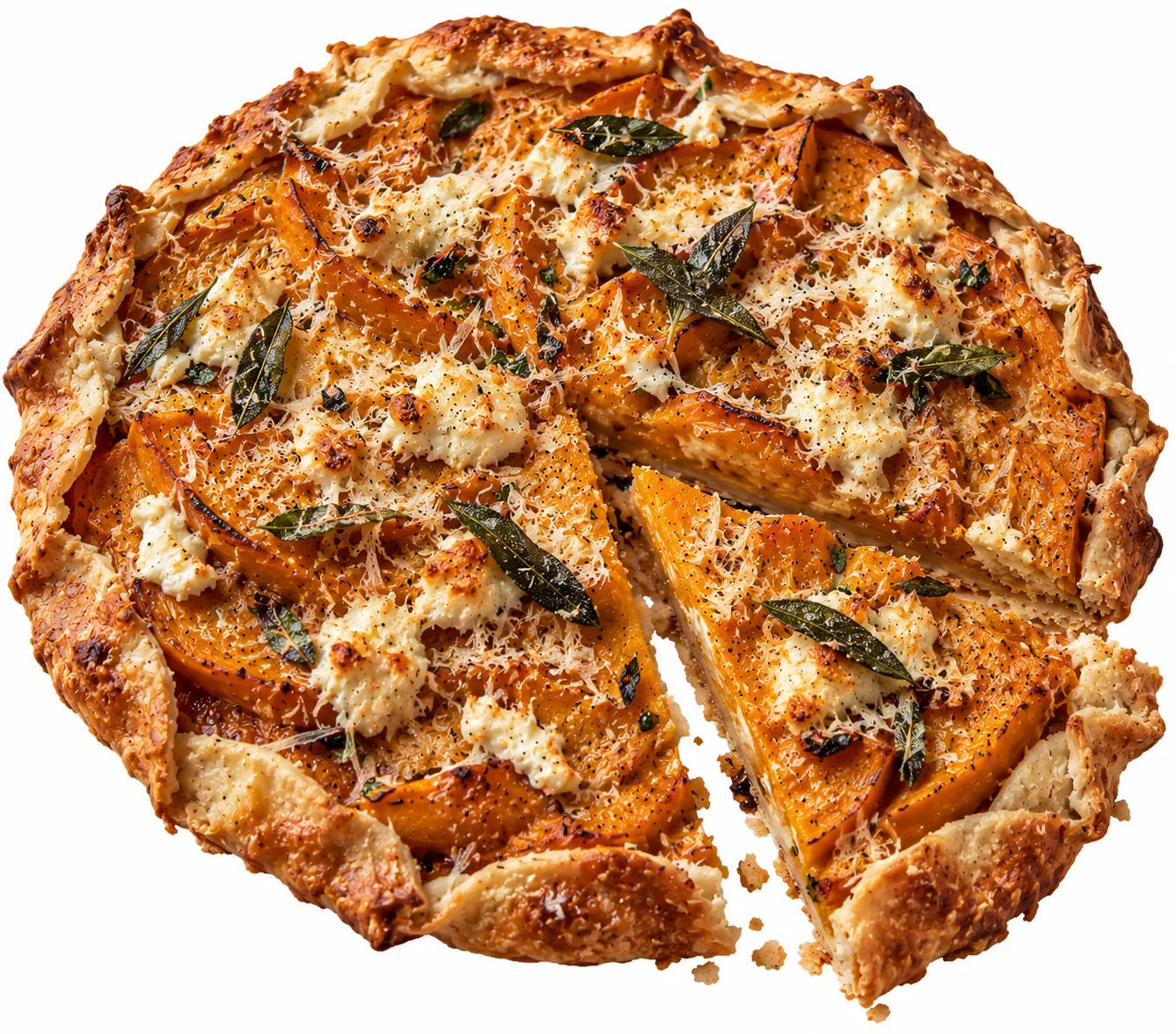
Pumpkin Galette
A rustic galette filled with sage-scented roasted pumpkin and a silky Parmigiano-chèvre cream, wrapped in a buttery, flaky crust. It’s cozy, savory, and made for crisp fall evenings.
Yield: Serves 8 · Active: 1 hr · Total: 2 hr 15 min · Season: Best in North America in fall, when pumpkins and sage are at their peak · Best eaten: early evening
Ingredients
For the crust
- 1½ cups sprouted spelt or sprouted white wheat flour (or a grain-free blend of 1 cup almond flour + ½ cup cassava flour)
- ½ cup sprouted whole wheat flour (or an extra ½ cup cassava flour for grain-free)
- 1 tsp unrefined sea salt, finely ground
- ¾ cup grass-fed butter, cold and cubed
- 4–8 tbsp ice water
- For grain-free only: 1 pasture-raised egg, beaten (it binds the dough, since there’s no gluten to hold it together)
For the filling
- 2½ lb pumpkin (sugar pumpkin or kabocha)
- 2 tbsp extra virgin olive oil
- 1 large yellow onion, sliced thin
- 4 garlic cloves, sliced thin
- 3 tbsp fresh sage, minced
- 1 tsp fresh thyme leaves
- 2 tsp unrefined sea salt, finely ground
- 1 cup grated Parmigiano-Reggiano DOP
- 2 oz chèvre, crumbled
- 1 medium pasture-raised egg yolk
For the egg wash
- 1 pasture-raised egg
- 2 tbsp filtered water
For the optional garnish
- 2 tbsp grass-fed butter and 12 fresh sage leaves, for crispy sage
- The pumpkin seeds, rinsed, for roasting
Method
Make the crust
- Pulse. Pulse the flours, salt, and butter in a food processor until the mixture looks like coarse cornmeal.
- Add the water. With the processor running, drizzle in the ice water a tablespoon at a time, until the dough just begins to clump. Sprouted flour drinks more water than regular flour, so you may need the full 8 tbsp. For grain-free, add the beaten egg with the first few tablespoons of water.
- Chill. Turn it out onto a floured surface and press into a 1-inch-thick disk. Wrap it well and refrigerate at least 1 hour while you make the filling.
Make the filling
- Roast the pumpkin. Preheat the oven to 400°F. Halve the pumpkin and scrape out the seeds (save them for roasting if you like). Place the halves cut-side down on a parchment-lined baking sheet and roast 40–50 minutes, until completely soft.
- Scoop. Cool, then scoop the flesh into a blender. If it looks wet, squeeze it gently in a clean towel first so the filling doesn’t run.
- Cook the onions. Heat the olive oil in a wide skillet over medium heat. Add the onions, garlic, sage, and thyme, sprinkle with salt, and cook 15 minutes, stirring occasionally, until soft and melted.
- Blend. Add the onion mixture, Parmigiano, chèvre, and egg yolk to the blender with the pumpkin and purée until smooth.
- Lower the oven. Reduce the oven to 375°F.
Assemble and bake
- Roll. Roll the chilled dough into a circle about ⅛ inch thick on a floured sheet of parchment (for grain-free dough, roll it between two sheets of parchment). Slide the parchment and dough onto a sheet pan.
- Fill. Starting in the center, spread the filling evenly, leaving 1½ inches clear at the edges. Bake any extra filling in a small buttered ramekin alongside.
- Fold. Fold the edges inward over the filling, pleating naturally to form a rustic crust.
- Brush. Beat the egg with the water and brush it over the crust.
- Bake. Bake 35–45 minutes, until the filling is set and the crust is deep golden brown.
- Rest. Cool 15–20 minutes so the filling can set, then serve warm or at room temperature.
Crispy sage and roasted pumpkin seeds (optional)
- Roast the seeds. Toss the rinsed, dried pumpkin seeds with a little olive oil and salt and roast on a sheet pan at 375°F alongside the galette for 12–15 minutes, until golden.
- Fry the sage. Fry the sage leaves in the butter over medium heat for 30–60 seconds until crisp. Scatter both over the finished galette.
Storage
- Refrigerate, well wrapped, up to 3 days.
- Reheat at 300°F for 10 minutes.
Season & Circadian Timing
Sugar pumpkins and kabocha are sweetest and densest in fall, right when fresh sage is at its most fragrant. Warm, savory, and satisfying without being heavy, it’s a lovely early-evening meal as the days get shorter.
Nourishment Notes
- Pumpkin — Beta-carotene (fat-soluble, so the butter and cheese help you absorb it), potassium, vitamin C, and fiber.
- Sage and thyme — Rosmarinic acid (sage) and thymol (thyme), with a long tradition of supporting digestion.
- Parmigiano-Reggiano and chèvre — Calcium, K2, and complete protein. Goat’s milk chèvre carries mostly A2-type casein.
- Pasture-raised eggs — Choline, B12, and fat-soluble vitamins.
- Sprouted flour — Sprouting breaks down phytic acid (improving mineral absorption), so many people find it easier to digest. It still contains gluten, so use the grain-free blend if you need to avoid it.
Sourcing
- Sprouted flour — organic, sprouted and stone-milled (To Your Health Sprouted Flour Co. or One Degree Organic Foods)
- Almond flour — organic and blanched (keep it in the fridge)
- Cassava flour — organic (Otto’s Naturals)
- Grass-fed butter — organic, cultured butter from 100% grass-fed cows, or raw butter from a local dairy
- Parmigiano-Reggiano — DOP, aged 24+ months, made from raw milk by law
- Goat cheese (chèvre) — fresh chèvre (Cypress Grove), or a local chèvre near you
- Eggs — organic and pasture-raised, from a local farm (Alexandre Family Farm)
- Fruits, vegetables, and herbs — organic, from a farmers’ market or local farm
Recipe adapted from Nourished Kitchen.
With Love, Light, and Health,
Anna (aka Food Marshall)
Food Marshall Approved. Grain-free, seed-oil-free and refined-sugar-free, made from organic, local and seasonal ingredients. Our standards
More Breads & Savory Bakes

Get new recipes and essays
Seasonal recipes and writing on light, circadian health, and living with nature.
Subscribe on Substack