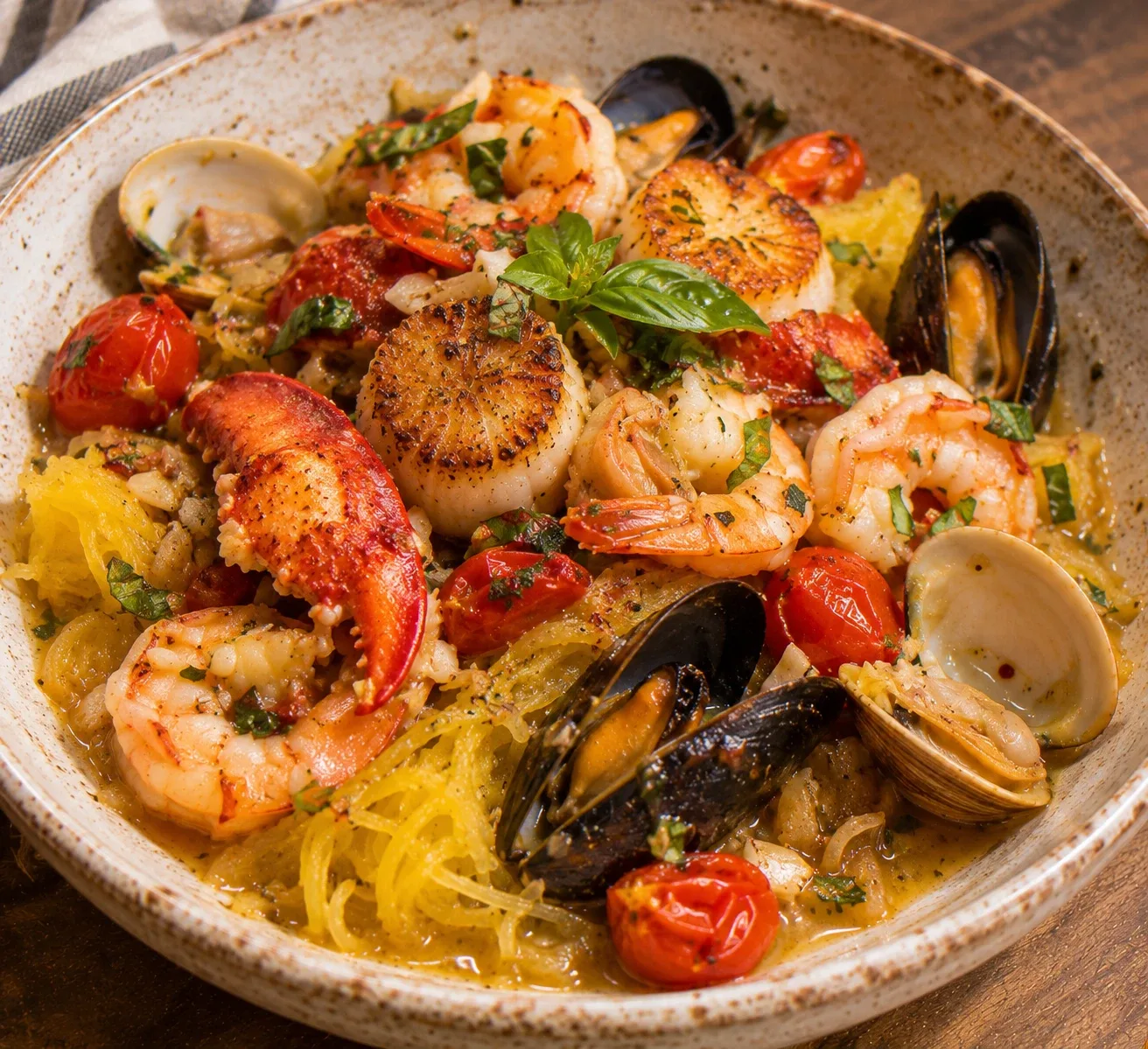
Seafood Pescatore over Spaghetti Squash
Lobster, seared scallops, wild shrimp, clams, and mussels in a garlicky sherry and white wine clam broth with sweet cherry tomato confit and basil, all spooned over long strands of roasted spaghetti squash.
Yield: Serves 4 · Active: 50 min · Total: about 1 hr 15 min · Season: Best in coastal regions year-round, and sweetest in North America in late summer, when cherry tomatoes and basil are at their peak · Best eaten: early evening
Ingredients
For the cherry tomato confit
- 2 pints (about 4 cups) cherry tomatoes
- ¾ cup extra virgin olive oil
- 4 garlic cloves, lightly smashed
- 2 sprigs fresh thyme
- ½ tsp unrefined sea salt
For the spaghetti squash
- 1 large spaghetti squash (3–4 lb) or 2 small ones
- 2 tbsp extra virgin olive oil or avocado oil
- ½ tsp unrefined sea salt
- ¼ tsp freshly cracked black pepper
For the seafood
- 2 lobster tails (5–6 oz each), thawed if frozen
- 12 dry-packed sea scallops (about ¾ lb), side muscle removed
- 12 oz wild Gulf shrimp (16–20 per pound), peeled and deveined, tails on or off
- 1 lb littleneck or Manila clams, scrubbed
- 1 lb mussels, scrubbed and debearded
- ½ tsp unrefined sea salt
- 1 tbsp grass-fed ghee or avocado oil, for searing
For the sherry and white wine clam broth
- 3 tbsp extra virgin olive oil
- 1 large shallot, minced
- 6 garlic cloves, thinly sliced
- ½ tsp chile flakes (or to taste)
- ¼ cup dry sherry (fino or amontillado)
- ½ cup dry white wine
- 1 cup clam juice (bottled, or homemade)
- ½ cup bone broth or fish stock
- 3 tbsp grass-fed butter
- 1 tbsp fresh lemon juice
- 1 cup fresh basil leaves, torn
- 2 tbsp chopped fresh flat-leaf parsley
- Lemon wedges, for serving
Method
Seafood cooking times
| Seafood | Prep | How long it cooks | It’s done when |
|---|---|---|---|
| Clams | Scrub; discard any that stay open when tapped | 6–8 minutes, covered | Shells open wide |
| Lobster tails | Split in half lengthwise | 4–5 minutes, covered | Meat is opaque white (about 140°F) |
| Mussels | Scrub; pull off the stringy “beard” | 3–4 minutes, covered | Shells open wide |
| Shrimp | Peel and devein | 2–3 minutes | Pink and curled into a loose “C” |
| Scallops | Pat very dry | 1½–2 minutes per side, seared separately | Deep golden crust, still slightly translucent in the center |
Make the cherry tomato confit
Confit (say “kon-FEE”) means slowly cooking something in fat at a low temperature until it’s meltingly tender. Here the tomatoes turn sweet and jammy, and the olive oil becomes a flavorful tomato-garlic oil.
- Slow-roast. Heat the oven to 300°F. Put the tomatoes, olive oil, garlic, thyme, and salt in a small baking dish where the tomatoes fit snugly in one layer. Roast 45–60 minutes, until the tomatoes are soft and blistered and some have burst. Set aside. (On the stovetop, cook them over low heat 30–40 minutes, never letting the oil bubble hard.)
Roast the spaghetti squash into long strands
The strands of a spaghetti squash run in circles around the squash, not from end to end. Cutting it crosswise into rings gives you the longest, most noodle-like strands.
- Cut into rings. Turn the oven up to 400°F (or roast alongside the confit and give the squash a few extra minutes). Trim off both ends of the squash, stand it up, and slice it crosswise into 1½-inch-thick rings. Scoop the seeds from the center of each ring with a spoon.
- Roast. Brush the rings on both sides with oil and season with salt and pepper. Lay them flat on a parchment-lined sheet pan and roast 25–35 minutes, flipping once, until a fork pulls the strands apart easily but they still have some bite. Over-roasted squash turns watery and soft.
- Pull the strands. Let the rings cool for 5 minutes, then peel off the skin and gently pull the strands apart with a fork into long noodles. Keep them warm on the sheet pan in the turned-off oven.
Prep the seafood
- Split the lobster. With kitchen shears, cut down the center of the top shell of each tail, then use a heavy knife to cut all the way through, lengthwise, making two halves. Remove the dark vein if there is one.
- Check the shellfish. Tap any open clams or mussels on the counter. If they don’t close within a minute, throw them out.
- Sear the scallops. Dry-packed scallops haven’t been soaked in a salty preservative solution, so they brown beautifully instead of steaming in their own liquid. Pat them very dry and season with salt. Heat the ghee or avocado oil in a skillet over high heat until it shimmers. Sear the scallops 1½–2 minutes per side, without moving them, until deep golden. Move them to a plate.
Build the broth and cook the seafood
- Start the broth. In a large, wide pot or deep skillet with a lid, heat the olive oil over medium heat. Cook the shallot 2 minutes, until soft, then add the garlic and chile flakes and cook 1 minute, until fragrant but not browned.
- Add the sherry and wine. Pour in the sherry and wine and simmer 2–3 minutes, until reduced by about half. Add the clam juice and broth and bring to a simmer.
- Cook the clams. Add the clams, cover, and cook 3 minutes.
- Add the lobster and mussels. Nestle in the lobster halves, meat-side down, and scatter in the mussels. Cover and cook 4 minutes more.
- Add the shrimp and tomatoes. Tuck in the shrimp and spoon in the confit tomatoes with about 3 tablespoons of their oil. Cover and cook 2–3 minutes, until the shrimp are pink, the lobster is opaque, and the shells have opened. Throw out any clams or mussels that stayed closed.
- Finish. Turn off the heat. Swirl in the butter and lemon juice, return the scallops and any juices to the pot to warm through, and scatter in the basil and parsley. Taste the broth and add salt only if needed (clam juice and shellfish are naturally salty).
Serve
- Plate. Twirl a nest of spaghetti squash into each wide, shallow bowl. Divide the seafood among the bowls, with half a lobster tail for each person, and ladle plenty of broth and tomatoes over the top. Finish with a drizzle of the remaining confit oil, more basil, and lemon wedges. Set out an empty bowl for the shells.
Storage
Seafood and broth: best the day it’s made. Leftovers keep 1 day in the fridge; take the clams and mussels out of their shells and warm everything gently, just until hot, so the seafood doesn’t toughen.
Spaghetti squash: fridge up to 4 days. Warm in a dry skillet to drive off extra moisture.
Cherry tomato confit: fridge up to 1 week, covered in its oil. Spoon it over eggs, fish, or roasted vegetables.
Variations
Bouillabaisse-Style Seafood Stew
Serves 4. Bouillabaisse (say “BOO-yuh-base”) is the classic fish stew of Marseille, in the south of France, with a saffron and orange-scented tomato broth and whatever the day’s catch brings in. It’s served with rouille (say “roo-EE”), a garlicky, saffron-tinted sauce similar to mayonnaise that you stir into the broth.
For the broth
- 3 tbsp extra virgin olive oil
- 1 medium yellow onion, diced
- 1 leek, white and light green parts, cleaned and sliced
- 1 medium fennel bulb, diced, fronds reserved
- 4 garlic cloves, sliced
- 2 tbsp tomato paste
- 1 can (14 oz) crushed tomatoes, or 3 ripe tomatoes, chopped
- ½ cup dry white wine
- 4 cups fish stock, or 2 cups clam juice plus 2 cups bone broth
- 1 generous pinch saffron threads (about ½ tsp), crumbled into 2 tbsp warm stock
- 2 wide strips orange peel (from a vegetable peeler, white pith avoided)
- 2 sprigs fresh thyme and 1 bay leaf
- ½ tsp fennel seed (optional)
- 1 tbsp pastis or other anise liqueur (optional)
- 1 tsp unrefined sea salt, or to taste
For the seafood
- 1½ lb firm, wild white fish (catch of the day, such as halibut, cod, rockfish, snapper, or monkfish), cut into 2-inch pieces
- 1 lb mussels or clams, scrubbed (mussels debearded)
- ½ lb wild Gulf shrimp, peeled and deveined
For the rouille (optional)
- 1 pasture-raised egg yolk, at room temperature
- 1 small garlic clove, grated
- Pinch of saffron threads, soaked in 1 tsp hot water
- 1 tsp fresh lemon juice
- Pinch of cayenne
- ½ cup olive oil (use a mild, light-tasting olive oil, or half extra virgin olive oil and half avocado oil, so it doesn’t turn bitter)
- Pinch of sea salt
Method
- Make the rouille. Whisk the egg yolk, garlic, saffron water, lemon juice, cayenne, and salt in a bowl. Whisking constantly, add the oil a few drops at a time, then in a thin stream, until thick and glossy. Chill until serving.
- Build the base. Heat the olive oil in a large Dutch oven over medium heat. Cook the onion, leek, and fennel with a pinch of salt 8–10 minutes, until soft but not browned. Add the garlic and cook 1 minute. Stir in the tomato paste and cook 1 minute more.
- Simmer the broth. Add the wine and simmer 2 minutes. Add the tomatoes, stock, saffron and its liquid, orange peel, thyme, bay leaf, fennel seed, and pastis (if using). Simmer, partly covered, 20 minutes. Taste and adjust the salt. Remove the orange peel, thyme stems, and bay leaf.
- Poach the fish. Lower the heat so the broth barely bubbles. Slip in the fish and simmer gently 4 minutes, without stirring (stirring breaks up the fish).
- Add the shellfish. Add the mussels or clams and the shrimp, cover, and cook 3–5 minutes, until the shells open and the shrimp are pink. Throw out any that stay closed.
- Serve. Ladle into wide bowls (over spaghetti squash, if you like) and scatter with fennel fronds. Pass the rouille at the table for each person to swirl a spoonful into their broth.
More ways to change it up
- Over zucchini noodles: In summer, spoon the seafood and broth over lightly sautéed zucchini noodles instead of squash.
- Simpler shellfish mix: Skip the lobster and use 1 lb shrimp and 1 lb scallops, or any mix of what your fishmonger has fresh.
- Add wild fish: Simmer 1 lb wild halibut or cod chunks in the broth for 4 minutes before adding the clams.
- Spicy fra diavolo style: Double the chile flakes and add a sliced fresh Calabrian or Fresno chile with the garlic.
- Quick tomatoes: No time for the confit? Halve the cherry tomatoes and cook them in the olive oil with the shallot for 4–5 minutes, until they start to burst.
Season & Circadian Timing
Shellfish is good year-round wherever you live near the coast, and the dish shines brightest in late summer, when cherry tomatoes and basil are at their sweetest. It’s a light, protein-rich dinner that suits the early evening, and the spaghetti squash keeps it gentle enough to digest well before bed.
Nourishment Notes
- Clams and mussels — some of the richest food sources of vitamin B12, plus iron and selenium.
- Lobster, shrimp, and scallops — lean, easy-to-digest protein, with lobster also bringing copper and selenium.
- Cherry tomatoes cooked in olive oil — cooking tomatoes with fat makes their lycopene, the red pigment, easier for your body to absorb.
- Spaghetti squash — much lighter than pasta, with fiber and a mild, sweet flavor that lets the broth shine.
- Garlic and basil — big flavor and aroma, with garlic’s sulfur compounds and basil’s fresh, peppery oils.
Sourcing
- Shrimp — wild-caught U.S. Gulf or South Atlantic shrimp. Ask where it’s from, since most shrimp sold in the U.S. is imported and farmed.
- Scallops — wild-caught, dry-packed sea scallops (not soaked in phosphates), from a fishmonger you trust
- Lobster — wild-caught cold-water tails from Maine or Atlantic Canada, from a fishmonger you trust
- Clams and mussels — buy them alive, with tightly closed shells and a fresh ocean smell; farmed mussels and clams are generally rated well by Seafood Watch
- Fish (general, for the bouillabaisse) — wild-caught, from a fishmonger you trust; check Seafood Watch for the best choices in your area
- Clam juice — bottled clam juice made from just clams, water, and salt, or the strained liquid from steaming your own clams
- Dry sherry — a real fino or amontillado from Jerez, Spain (not “cooking sherry,” which has added salt)
- Wine — an organic dry white wine you’d happily drink
- Saffron — whole threads, not powder (powder is easy to cut with fillers); look for deep red threads from Spain or Iran
- Eggs — organic and pasture-raised, from a local farm (Alexandre Family Farm)
- Extra virgin olive oil — organic, single-estate, harvest-dated, in dark glass
- Avocado oil — organic, cold-pressed, in dark glass
- Grass-fed butter — organic, cultured butter from 100% grass-fed cows, or raw butter from a local dairy
- Ghee — grass-fed ghee, or homemade from organic grass-fed butter
- Bone broth — homemade from pasture-raised bones, or organic and sold frozen (Bonafide Provisions)
- Spices — organic and non-irradiated
- Salt — unrefined sea salt (Baja Gold); flaky sea salt for finishing (Maldon)
- Lemons / limes / oranges — organic (you’re using the zest and peel)
- Fruits, vegetables, and herbs — organic, from a farmers’ market or local farm
You might also like: Salmon · Scallop · Shrimp & Mussel Cioppino over Zucchini Noodles and Spaghetti Squash · Eight Ways: Weeknight to Dinner Party.
With Love, Light, and Health,
Anna (aka Food Marshall)
Food Marshall Approved. Grain-free, seed-oil-free and refined-sugar-free, made from organic, local and seasonal ingredients. Our standards
More Seafood
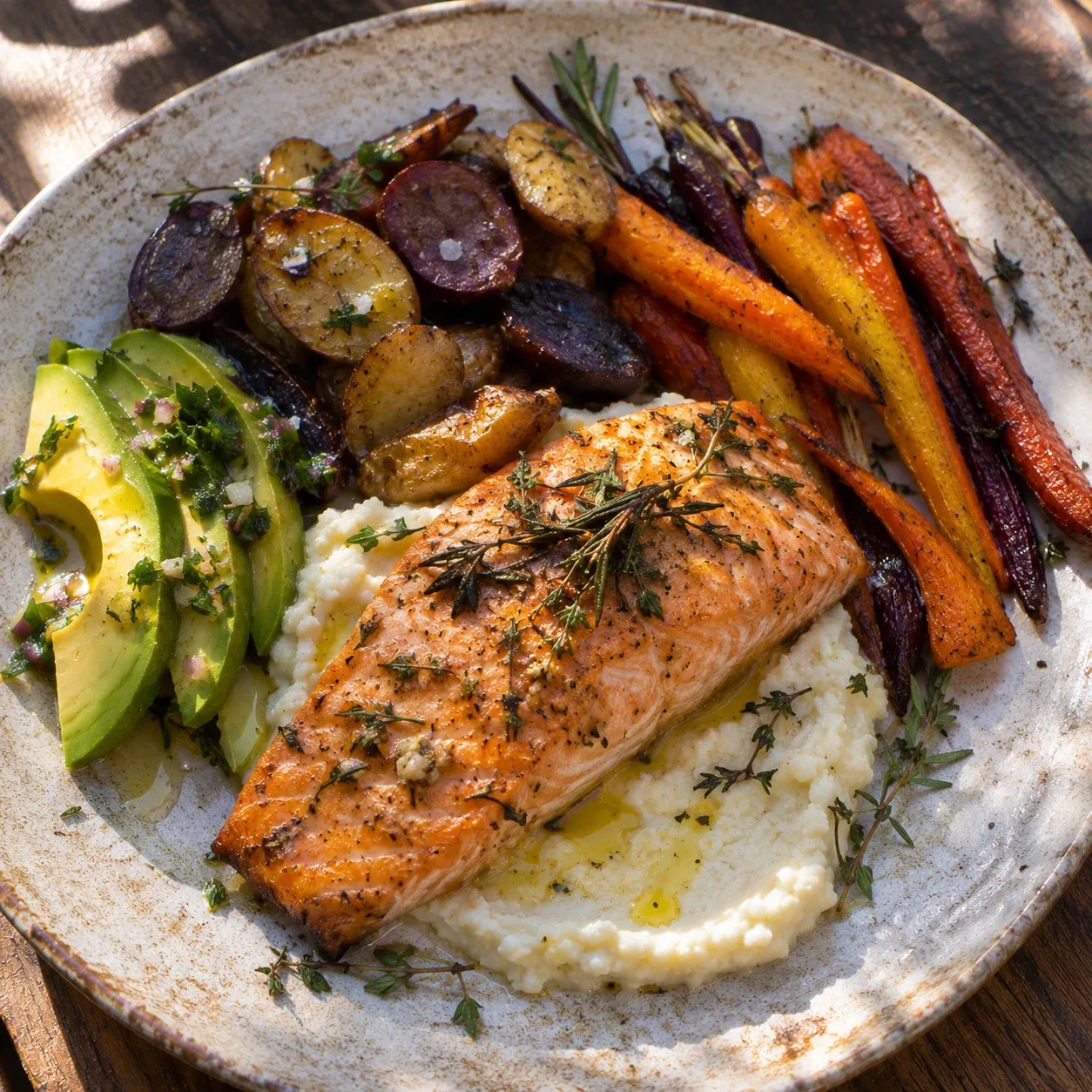
Baked Wild Salmon with Rosemary and Thyme, Whipped Cauliflower Purée, Roasted Rainbow Carrots, Purple and Fingerling Potatoes, and Avocado with Herb Vinaigrette
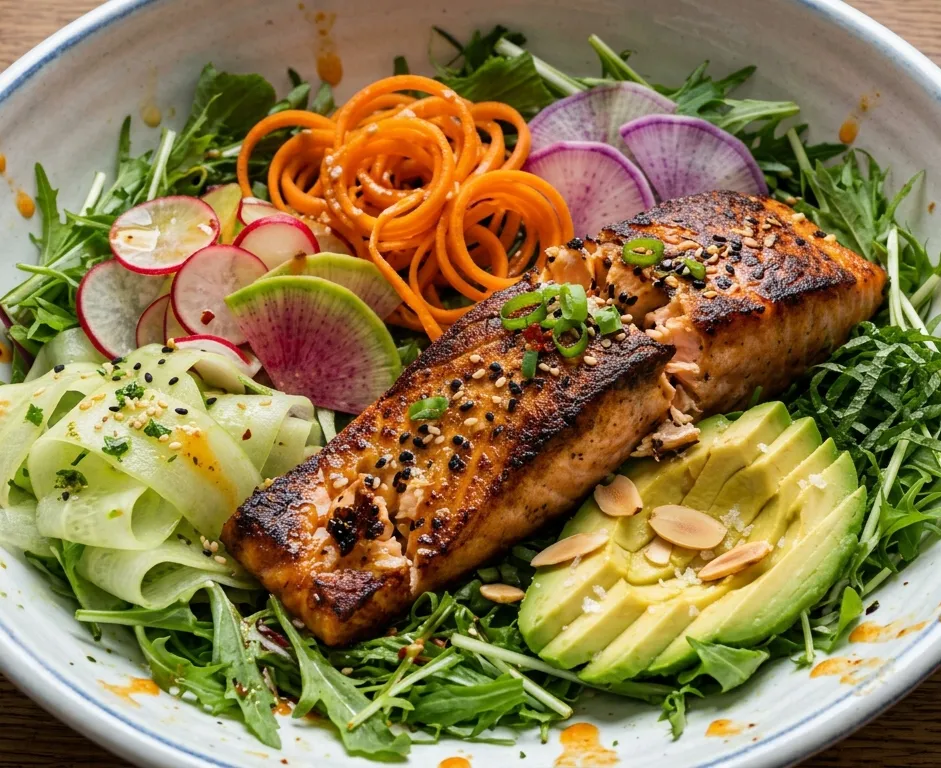
Pan-Seared Wild Salmon with Ponzu-Dressed Salad and Sesame Ginger Cucumber
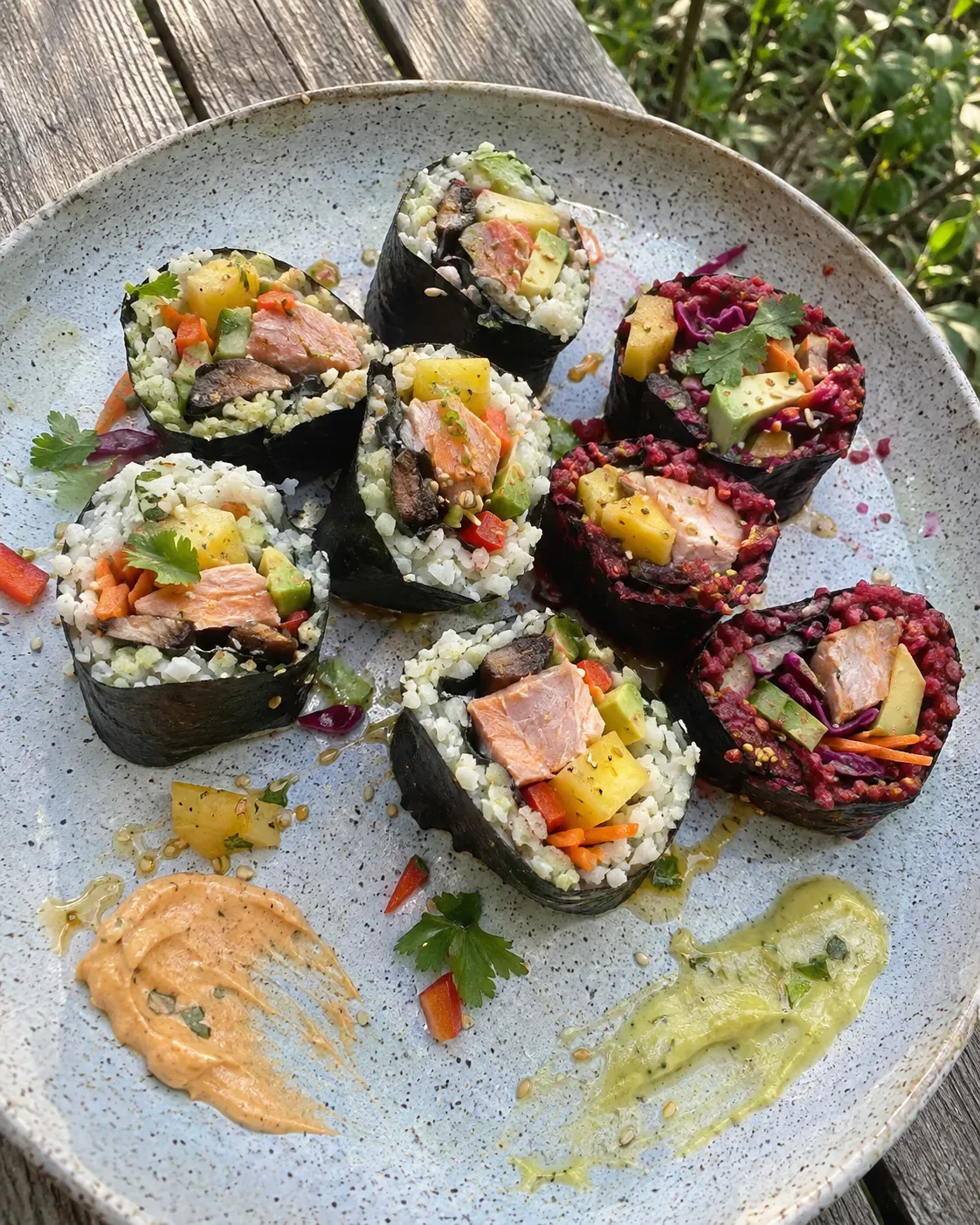
Coastal Sushi Rolls with Wild Fish, Colorful Vegetables, and Tropical Fruit
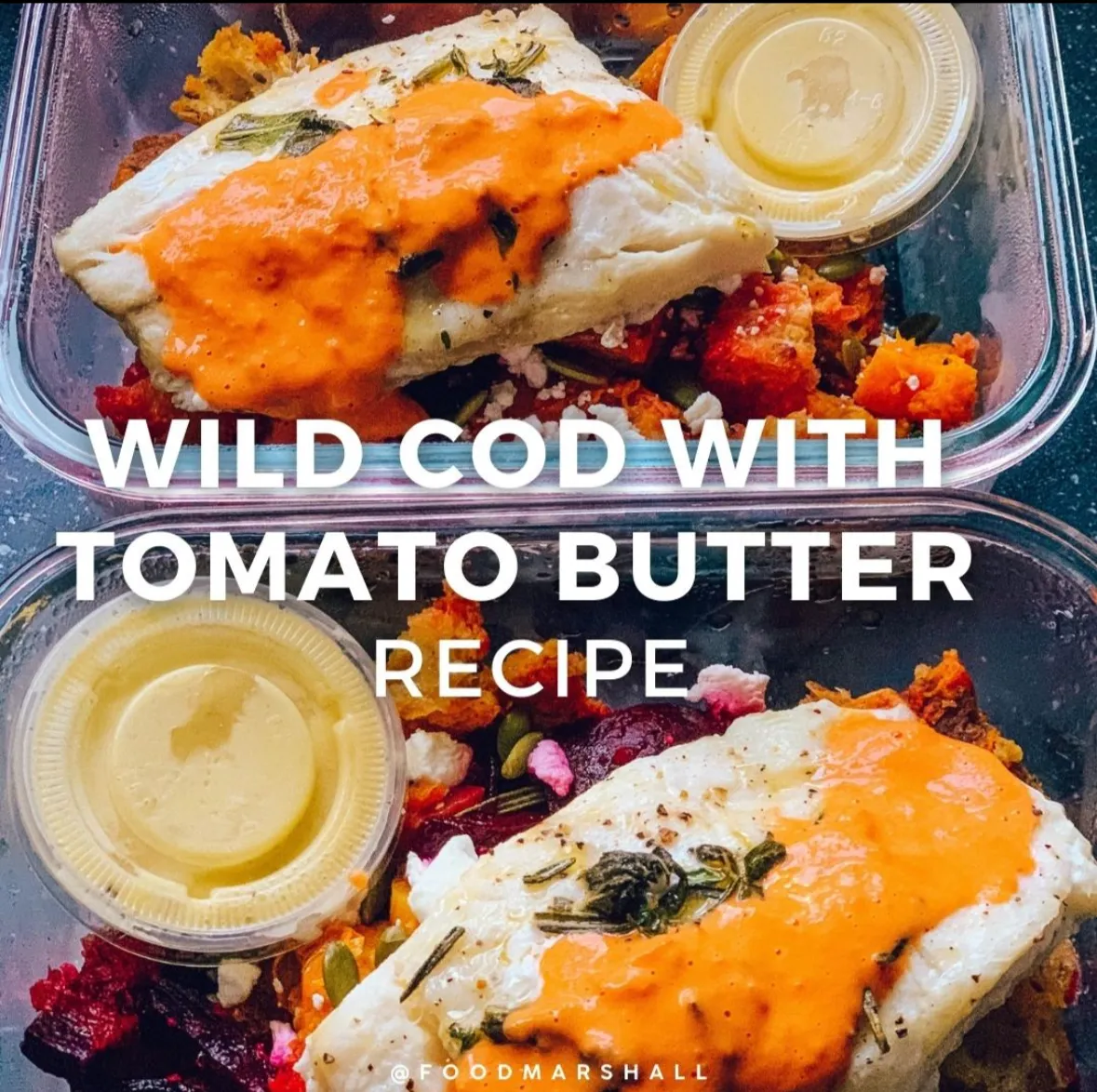
Braised Cod with Tomato Butter, Fennel Salsa Verde, and Roasted Baby Potatoes
Get new recipes and essays
Seasonal recipes and writing on light, circadian health, and living with nature.
Subscribe on Substack