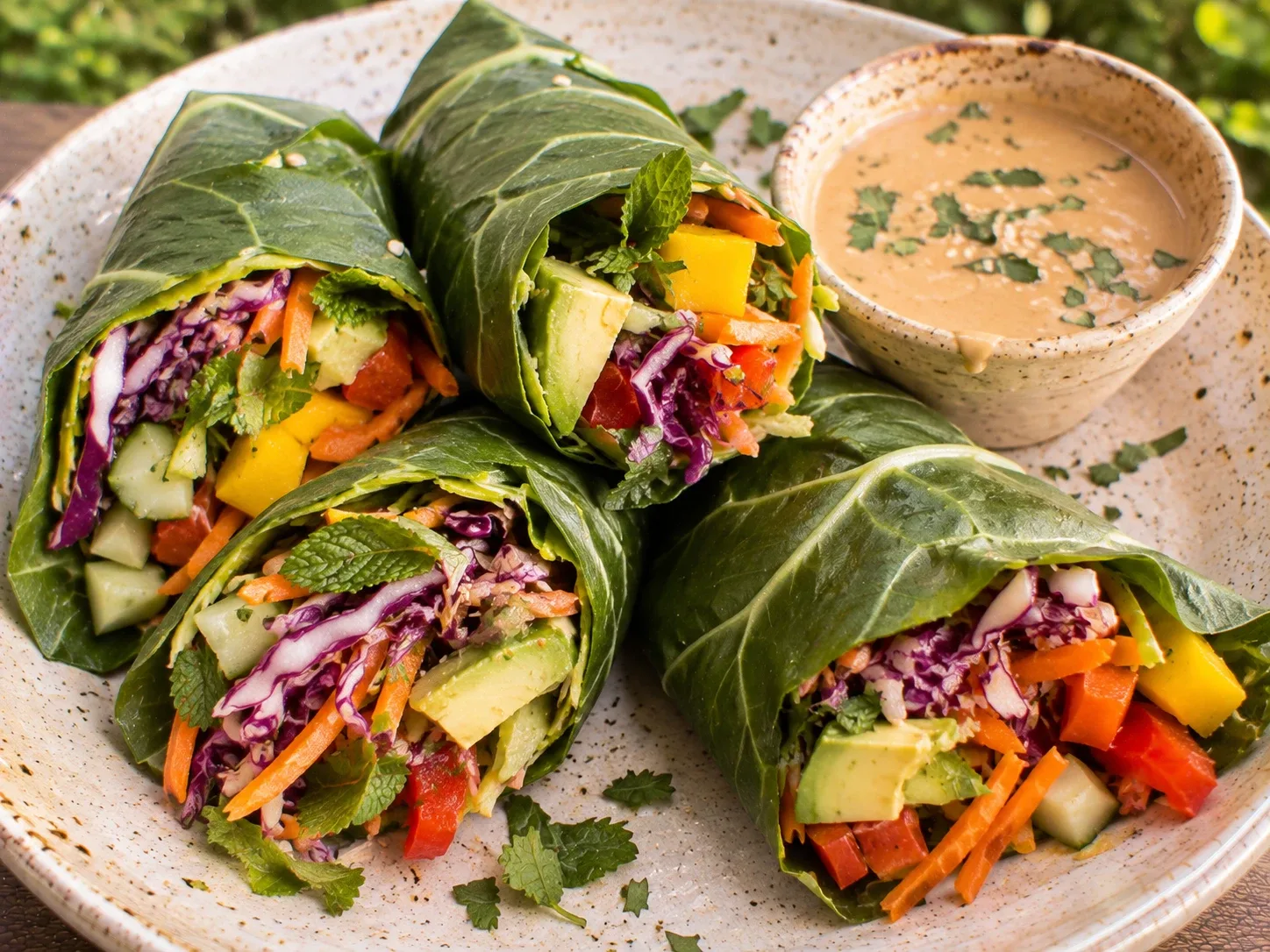
Spring Veggie Collard Green Wraps with Almond-Ginger Sauce
Crisp collard leaves rolled around sauce-tossed cabbage, avocado, cucumber, bell pepper, carrot, mango, and fresh mint and cilantro, with a creamy almond-ginger-lime sauce for dipping.
Yield: About 12 wraps, serves 4 · Active: 35 min · Total: 35 min · Season: Best in North America in late spring and summer, when cucumbers, peppers, and fresh herbs are at their peak · Best eaten: midday
Ingredients
For the almond-ginger sauce
- ½ cup raw almond butter or raw tahini
- ½ cup coconut aminos
- 2 tbsp toasted sesame oil
- 2 tsp grated fresh ginger
- Juice of 1 lime
- 1 tbsp raw honey
- ¼ cup extra virgin olive oil, plus more as needed
For the wraps
- 6 large collard green leaves
- 2 cups finely shredded cabbage
- 1 avocado, thinly sliced
- 1 bell pepper, thinly sliced
- 1 cucumber, cut into thin sticks
- 2–3 carrots, cut into thin sticks
- 1 mango, thinly sliced (if in season)
- 1 handful cilantro leaves, finely chopped
- 1 handful mint leaves, finely chopped
Method
For the sauce
- Blend. Whisk the almond butter, coconut aminos, sesame oil, ginger, lime juice, and honey in a bowl, or blend in a food processor. Add the olive oil a little at a time until the sauce is smooth and creamy. Add a splash of water if it’s still thick.
For the wraps
- Marinate the cabbage. Put the shredded cabbage in a bowl, pour half of the sauce over it, and toss well. Let it sit while you prep the leaves; it softens a little as it stands.
- Prep the collards. Cut out the thick center rib of each leaf with a small knife, which divides each leaf into two halves. If the leaves are stiff, dip them in hot water for 10 seconds and pat dry to make them easier to roll.
- Fill. Lay a half-leaf on a cutting board, underside facing up. Spread 2–3 tbsp of the cabbage across the bottom third, leaving about an inch clear at the bottom edge. Lay a few sticks of each vegetable and a slice of avocado and mango on top, then sprinkle with cilantro and mint.
- Roll. Fold the bottom of the leaf up and over the filling, keep it snug, tuck it under, and roll forward. Set it seam side down on a platter. Repeat with the remaining leaves.
To serve
- Dip. Serve the wraps with the rest of the sauce in a small bowl for dipping.
Storage
- Wraps are best the day they’re made. Keep any extras covered with a damp towel in the fridge for up to 1 day.
- The sauce keeps up to 1 week in a jar in the fridge. Stir or warm briefly if it thickens.
Variations
- Protein: Add sliced grilled pasture-raised chicken, shrimp, or wild salmon.
- Nut-free: Use tahini in place of the almond butter.
- Spicy: Add a pinch of red pepper flakes or a little fresh chile to the sauce.
- Butter lettuce: Use large butter lettuce leaves instead of collards for a softer wrap.
Season & Circadian Timing
These crunchy, cooling wraps suit warm days when you want something fresh and raw. They make a great lunch, when digestion is strongest and raw vegetables sit easiest.
Nourishment Notes
- Collard greens — offer vitamin K, vitamin A, and calcium, and hold up beautifully as a wrapper.
- Cabbage — a cruciferous vegetable with fiber and vitamin C.
- Avocado — brings monounsaturated fat, potassium, and fiber.
- Almond butter — provides magnesium, vitamin E, and plant protein.
- Fresh ginger — adds warmth and brightness and has long been used to support digestion.
Sourcing
- Almond butter — organic, raw, with no added oils
- Coconut aminos — organic
- Raw honey — organic, local, and unfiltered
- Extra virgin olive oil — organic, single-estate, harvest-dated, in dark glass
- Limes — organic
- Fruits, vegetables, and herbs — organic, from a farmers’ market or local farm
You might also like: Thai Vegetable Wraps with Tamarind Dipping Sauce · Wild Fish and Vegetable Wraps (Four Ways) · Beef Lettuce Rolls with Fresh Herbs and Almond Butter Dipping Sauce
With Love, Light, and Health,
Anna (aka Food Marshall)
Food Marshall Approved. Grain-free, seed-oil-free and refined-sugar-free, made from organic, local and seasonal ingredients. Our standards
More Vegetable Sides & Mains
Get new recipes and essays
Seasonal recipes and writing on light, circadian health, and living with nature.
Subscribe on Substack