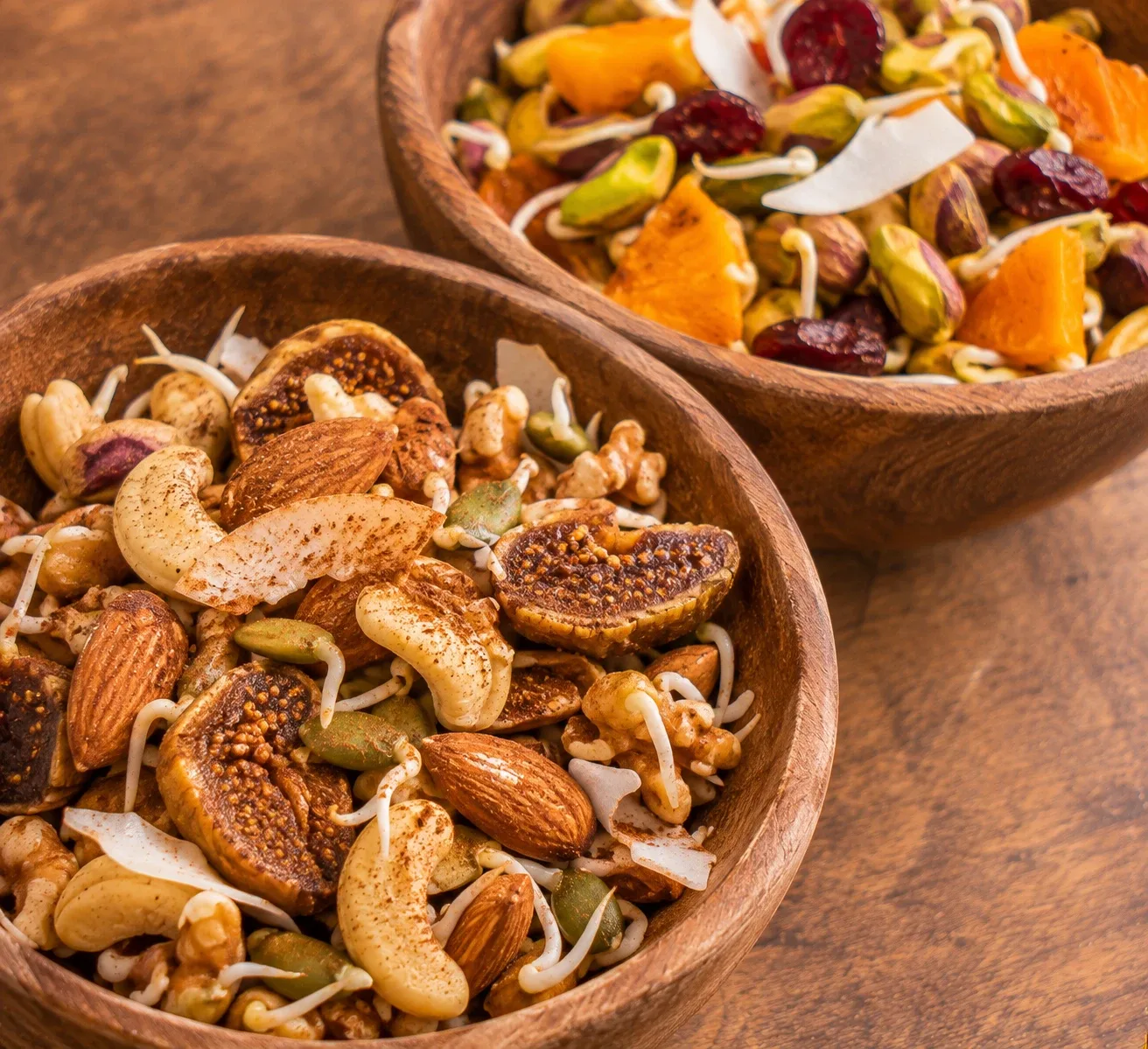
Sprouted Trail Mix Two Ways
Soaked, slow-dried nuts and seeds tossed with orchard fruit. One blend is warm with cinnamon and figs; the other is bright with pistachios, persimmons, and honey-dried cranberries.
Yield: About 6 cups per blend (24 servings of ¼ cup) · Active: 40 min · Total: 24–36 hours, mostly hands-off soaking and drying · Season: Best in North America in fall and early winter, when apples, pears, figs, and persimmons come in, and keeps in the pantry year-round · Best eaten: morning or midday, and on the trail
Those bulk-bin blends of soaked, dehydrated nuts run $22–25 a pound. Made at home, they cost a fraction of that, and you choose every nut, every fruit, and how it’s dried. Soaking and slow drying is the traditional “crispy nuts” method from Sally Fallon’s Nourishing Traditions. It leaves nuts lighter, crunchier, and easier on digestion than raw nuts straight from the bag.
Ingredients
For soaking (both blends)
- Filtered water, enough to cover the nuts by 2 inches
- 1 tbsp sea salt (Baja Gold) per 4 cups nuts or seeds
For the Hearth & Harvest Mix (warm, cinnamon-spiced)
- 1 cup walnuts
- 1 cup almonds
- ¾ cup hazelnuts
- ½ cup hulled sunflower seeds
- ½ cup hulled pumpkin seeds (pepitas)
- ½ cup raisins
- ½ cup dried apple, chopped
- ½ cup dried pear, chopped
- ½ cup dried figs, stems removed, quartered
- 1–1½ tsp ground Ceylon cinnamon
For the Sunset Coast Trail Mix (bright, jewel-toned)
- ¾ cup hazelnuts, roasted after drying
- ¾ cup almonds, roasted after drying
- ¾ cup walnuts
- ¾ cup hulled pumpkin seeds (pepitas), sprouted
- ½ cup raw shelled pistachios
- ½ cup dried persimmon (Fuyu), chopped
- ½ cup flame raisins (from red flame grapes)
- ½ cup dried pear, chopped
- ½ cup dried apple, chopped
- ½ cup honey-dried cranberries (homemade, below, or store-bought sweetened with honey or juice)
For honey-dried cranberries (optional, makes about ¾ cup)
- 2 cups fresh cranberries
- 2–3 tbsp raw honey, warmed just enough to drizzle
Soaking and Drying Guide
| Nut or seed | Soak (salted water) | Dry at 115–150°F |
|---|---|---|
| Almonds | 8–12 hours | 12–24 hours |
| Hazelnuts | 8–12 hours | 12–24 hours |
| Walnuts | 6–8 hours | 18–24 hours (dry until completely crisp) |
| Pumpkin seeds | 7–8 hours | 12–18 hours |
| Sunflower seeds | 6–7 hours | 12–18 hours |
| Pistachios | Skip, or 4–6 hours | 12–18 hours if soaked |
Method
- Soak. Put each kind of nut or seed in its own glass bowl or jar, since soaking times differ. Cover by 2 inches with filtered water, stir in the salt, and leave on the counter for the times above. For the Sunset Coast Trail Mix, the pumpkin seeds are the “sprouted” element. Soak them the full 8 hours, drain, and leave them in a strainer covered with a damp towel for 8–12 hours more, rinsing once, until a few show a tiny white tip. Pistachios stay raw to keep their green color.
- Drain and rinse. Drain, rinse well, and shake off as much water as you can.
- Dry slowly. Spread the nuts and seeds in a single layer on dehydrator trays or parchment-lined sheet pans. Dry in a dehydrator at 115°F, which keeps them closer to raw, or in the oven at its lowest setting, ideally 150°F or below, with the door cracked. Dry until completely crisp all the way through: 12–24 hours for most, longer for walnuts. Break one open to check. Any softness in the center means mold later, so when in doubt, keep drying.
- Roast (Sunset Coast Trail Mix only). Once the hazelnuts and almonds are fully dry, roast them at 300°F for 12–15 minutes, until fragrant and lightly golden. Rub the warm hazelnuts in a kitchen towel to loosen their papery skins; a few left on is fine. Cool completely.
- Make honey-dried cranberries (optional). Pour boiling water over the cranberries and let them sit 3–5 minutes, until most of the skins split. Drain, pat dry, and toss with the honey. Spread on parchment-lined dehydrator trays and dry at 135°F for 12–16 hours, until chewy with no wet spots.
- Chop the fruit. Cut the dried apple, pear, figs, and persimmon into pieces about the size of an almond, so every handful gets a little of everything.
- Toss. In a large bowl, combine the cooled nuts and seeds with the fruit. For the Hearth & Harvest Mix, sprinkle in the cinnamon and toss until everything wears a light dusting.
- Cool and jar. Let the mix sit uncovered for an hour to make sure it’s fully cool and dry, then pack it into glass jars.
Drying your own fruit (optional)
- Apples and pears: core, slice ⅛ inch thick, dip in lemon water, and dry at 135°F for 6–10 hours, until leathery to crisp.
- Fuyu persimmons: slice ¼ inch thick (no need to peel) and dry at 135°F for 8–12 hours, until chewy and deep orange.
- Figs: halve fresh figs and dry at 135°F for 12–24 hours, until leathery with no moisture inside.
Storage
- Trail mix: airtight glass jars in a cool, dark cupboard up to 1 month, in the fridge up to 3 months, or in the freezer up to 6 months. Walnuts and pumpkin seeds are rich in delicate fats and go stale fastest, so the fridge keeps them freshest.
- Soaked, dried nuts on their own: same as above. Make a big batch and use them all season.
How to Serve It
- Over raw milk kefir or whole-milk yogurt, with a drizzle of raw honey, for a breakfast bowl
- On a cheese board with aged cheddar or Manchego, sliced pears, and a few dates
- Over homemade vanilla ice cream, with the Hearth & Harvest Mix’s cinnamon especially good here
- Scattered over a fall salad of arugula, roasted delicata squash, goat cheese, and a lemon-Dijon vinaigrette
- Spooned over warm baked apples or poached pears with a little raw cream
- With apple slices and a spoonful of sprouted almond butter for an afternoon snack
- Packed for the trail alongside grass-fed beef sticks or jerky, for protein, fat, and steady carbohydrate in one pocket
- Stirred into warm buckwheat porridge on a cold morning
Season & Circadian Timing
Apples, pears, figs, and persimmons all come into season from late summer through early winter, so this is the time to make a big batch and dry your own fruit. Fresh persimmons last only a few weeks, so drying them is how you keep their flavor into winter. As a circadian food, trail mix belongs to the daylight hours. The fruit sugars arrive alongside the fat and protein of the nuts, so they give you a steady lift rather than a spike, and your body handles them best in the morning and midday.
Nourishment Notes
- Soaking and slow drying — Nuts and seeds carry phytic acid and enzyme inhibitors that protect them until they sprout. Traditional cultures soaked, sprouted, or fermented them, and soaking may reduce phytic acid and make minerals like zinc, iron, and magnesium easier to absorb. Many people also find soaked nuts gentler on digestion.
- Walnuts — ALA omega-3 fats, polyphenols, and melatonin; walnuts carry more omega-3s than any other common nut.
- Almonds — Vitamin E, magnesium, and riboflavin.
- Hazelnuts — Vitamin E, manganese, copper, and folate.
- Pumpkin seeds — Zinc, magnesium, and iron; one of the richest plant sources of zinc.
- Sunflower seeds — Vitamin E, selenium, and B vitamins.
- Pistachios — Lutein and zeaxanthin, the carotenoids that protect your eyes, plus vitamin B6 and potassium.
- Figs — Calcium, potassium, and fiber; dried figs are one of the best fruit sources of calcium.
- Persimmons — Beta-carotene, which your body turns into vitamin A, plus fiber and manganese.
- Cranberries — Proanthocyanidins, plant compounds studied for supporting urinary tract health. Drying them with honey instead of sugar keeps the sweetener simple.
- Raisins, apples, and pears — Potassium, plus pectin, a soluble fiber that feeds your gut bacteria.
- Ceylon cinnamon — Warm flavor with far less coumarin than the cassia cinnamon most stores sell, so it’s the one to use every day.
For your cycle: In traditional seed cycling, pumpkin seeds are eaten in the follicular phase for their zinc, and sunflower seeds in the luteal phase for their vitamin E and selenium. The research on seed cycling is limited, but both seeds are nourishing at any point in your cycle, and the Hearth & Harvest Mix carries both. The magnesium in almonds and pumpkin seeds can help steady luteal-phase cravings and cramps.
A note on honey: honey heated above about 115°F is no longer raw, and in the cranberries it’s dried at 135°F. Never give honey to babies under 12 months.
A note for little ones: whole nuts are a choking hazard for children under 4. For toddlers, pulse the mix in a food processor until finely chopped and stir it into yogurt or kefir.
Sourcing
- Walnuts, almonds, hazelnuts, and pistachios — organic and raw; Oregon hazelnuts and California almonds, walnuts, and pistachios are excellent, from a farmers’ market, co-op bulk bin, or Terrasoul
- Pumpkin and sunflower seeds — organic, raw, and hulled
- Dried fruit (if not making your own) — organic and unsulfured, with no added sugar or oil; check that raisins aren’t coated in vegetable oil
- Fresh apples, pears, figs, and persimmons (for drying) — organic, from a farmers’ market or local orchard
- Cranberries — fresh organic cranberries in season, or dried cranberries sweetened with honey or apple juice rather than cane sugar
- Raw honey — organic, local, and unfiltered, from a nearby beekeeper
- Cinnamon — organic, non-irradiated Ceylon cinnamon
- Salt — unrefined sea salt (Baja Gold)
You might also like: Raw Milk Kefir: A Living Daily Ferment · Homemade Ice Cream: A Foundation · Food Marshall Homemade Granola: Seven Flavors, Grain-Free or Sprouted
With Love, Light, and Health,
Anna (aka Food Marshall)
More Snacks, Small Bites & Seasonal Staples
Get new recipes and essays
Seasonal recipes and writing on light, circadian health, and living with nature.
Subscribe on Substack