Ultimate Weekly Meal Prep: Roasted Vegetables, Proteins, and Broth
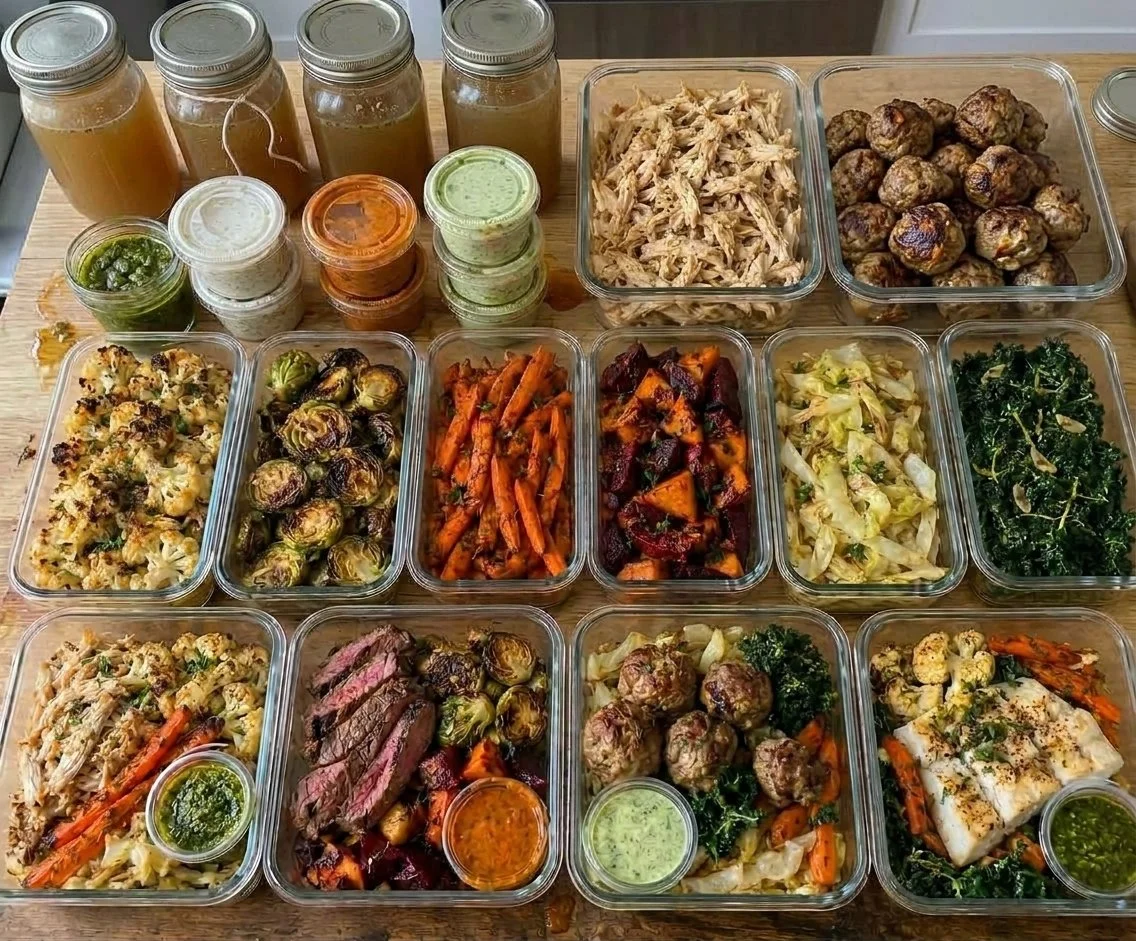
A whole week of nourishing meals. Six simple vegetable dishes (roasted cauliflower with chimichurri, crispy smashed Brussels sprouts, cumin-roasted carrot matchsticks, beets and sweet potato, sautéed cabbage, and lemony garlic kale), your choice of protein, a few easy dressings, and a pot of homemade broth to sip all week. Mix and match into bowls, plates, and wraps, and dinner is basically done before Monday starts.
Putting this one together brought me right back to my Food Marshall days, when I was a private chef running a farm-to-table organic meal delivery service.
Yield: 6-8 servings · Active: 1 hr 30 min · Total: about 3 hrs (the broth and braise simmer while everything else roasts, then the broth keeps going on its own for a few more hours, or overnight) · Year-round with seasonal swaps · Best eaten: Sunday supper, then all week long.
Why Seasonal, Local, and Home-Cooked Matters
The most nourishing food is the food grown closest to you, in its season. A carrot pulled from rich, living soil at a local farm last week isn’t the same food as one that spent two weeks traveling across the world. It’s fresher, more flavorful, and fuller of the vitamins, minerals, and plant compounds that start fading the moment a vegetable is picked. Fresh vegetables can lose up to half their vitamin C within a week of harvest, even in the fridge (Rickman et al., 2007). When you shop at farmers’ markets and eat what’s in season, you’re getting food at its absolute peak.
Food is also stored sunlight. Plants grow by capturing sunlight, and fresh, living foods carry that light within them as biophotons. German biophysicist Fritz-Albert Popp spent decades measuring this faint glow given off by living cells, and found it tracks the freshness and vitality of food. The more alive and freshly harvested the food, the more of that light it holds. The same goes for animals: chickens, cows, and pigs raised outdoors, moving in the sunshine and eating what nature intended, build richer, more nourishing meat, eggs, milk, and fat than animals raised indoors. Eggs from hens with outdoor access carry three to four times more vitamin D than eggs from hens kept indoors (Kühn et al., 2014), and milk from 100% grass-fed cows has a far healthier balance of omega-3 to omega-6 fats (Benbrook et al., 2018). Plants grown in healthy, mineral-rich soil become more mineral-rich food. The reverse holds too: when Davis and colleagues (2004) compared U.S. Department of Agriculture (USDA) data on 43 garden crops from 1950 and 1999, they found measurable drops in protein, calcium, iron, and vitamin C as farming chased bigger yields. How your food lived becomes part of you.
Eating with the seasons matters for your mitochondria, the tiny power plants inside nearly every one of your cells. Seasonal foods carry the signals of the environment you actually live in, like the long, bright days of summer and the short, cool days of winter. Plants build protective compounds like polyphenols in answer to the sun, cold, and stress of their season, and when you eat them, those same compounds signal your own cells to grow stronger. Howitz and Sinclair (2008) named this xenohormesis. Your gut keeps the calendar too: the Hadza of Tanzania, who still hunt and gather, carry gut bacteria that rise and fall with the wet and dry seasons, with some species vanishing and returning each year (Smits et al., 2017). When you eat in step with those seasons, you’re helping your cells, and the mitochondria that power them, stay in sync with the world around you.
Cooking at home is the simplest way to know exactly what’s in your food. You choose the farm, the fat, the salt, and the ingredients, and nothing sneaks in that you didn’t put there yourself. That’s what this meal prep is all about: a few hours in your own kitchen that set you up for a whole week of real, nourishing food.
Finally, when you eat matters as much as what you eat. Your body runs on a circadian rhythm set by the sun. Day is for activity and feasting, and night is for darkness and rest. Eating your meals during daylight hours, and letting your body rest from food once the sun goes down, helps your digestion, blood sugar, and sleep all work the way they’re designed to. As melatonin rises after dark, it signals your pancreas to ease off on insulin, so the very same meal raises your blood sugar more at night than it does in the morning (Garaulet et al., 2020). In mice, eating the same calories within an 8-hour window during their active hours protected against weight gain and fatty liver, while round-the-clock grazing did not (Hatori et al., 2012).
Light trumps food. Even the most beautiful farm-to-table meal can’t make up for a day spent indoors under artificial light. Get morning sunlight in your eyes, step outside as often as you can, and keep your evenings dim and cozy. Pair that with seasonal, home-cooked food, and you’re giving your body everything it needs to thrive.
There’s so much more to say about all of this, and I go much deeper in my other writing. Explore light’s impact on health in my Substack series:
Your Sunday Prep Game Plan
First: Start the longest-cooking protein, either the poached chicken and broth or the braised beef. It simmers away on its own.
Next: Heat the oven to 425°F. Parboil the Brussels sprouts, and make the chimichurri so it can rest.
Oven round 1 (two pans): cauliflower and beets with sweet potato. Making chicken thighs? Slide them onto a third rack now.
Oven round 2 (two pans): smashed Brussels sprouts and carrot matchsticks. Making meatballs? Bake them on a third rack now.
While the oven works: Cook your quicker proteins (lamb or shrimp), sauté the cabbage and kale, and shake up a dressing or two. Salmon and cod roast in about 12 minutes once the vegetables come out.
Last: Shred the chicken, strain the broth, and pack everything into separate glass containers.
Part 1 — Choose Your Protein
Option A — Pasture-Raised Chicken
Pros: Affordable, quick, and kid-friendly, with a forgiving cooking window. Bone-in, skin-on cuts bring extra flavor and collagen.
Cons: Less iron and zinc than red meat, and the skin can burn if you don’t keep an eye on it.
Herb-Dijon Roasted Chicken Thighs (or Breasts)
3 lb pasture-raised bone-in, skin-on chicken thighs (or breasts)
2 tbsp Dijon mustard
2 tbsp extra virgin olive oil
3 garlic cloves, minced
1 tbsp fresh thyme leaves
1 tbsp fresh rosemary, finely chopped
Zest of 1 lemon
1½ tsp Baja Gold sea salt
½ tsp freshly cracked black pepper
Heat the oven to 425°F. Pat the chicken dry. Stir together everything else and rub it under the skin and all over the underside, so the skin crisps instead of burning. Roast skin-side up on a sheet pan 35-40 minutes, until the skin is golden and the thickest part reads at least 165°F (thighs are even more tender at 175°F). Rest 5 minutes, then slice or shred.
Poached Whole Chicken and Sipping Broth (the easiest meal prep)
One pot gives you a week of tender shredded chicken and a big batch of golden broth to sip.
1 whole pasture-raised chicken (4-5 lb)
1 onion, quartered
2 carrots and 2 celery stalks, roughly chopped
1 head garlic, halved crosswise
2 bay leaves and a few sprigs of thyme
1 tsp whole black peppercorns
1 tbsp raw apple cider vinegar
2 tsp Baja Gold sea salt
Filtered water to cover (about 4 quarts)
Poach. Put everything in a large stockpot, cover with cold water by an inch, and bring to a bare simmer. Skim off any foam. Simmer gently, never boiling, 1-1½ hours, until the thickest part of the thigh reads 165°F.
Shred. Lift out the chicken and let it cool enough to handle. Pull the meat off the bones and shred it.
Make the broth richer. Return the bones and skin to the pot and simmer gently another 3-4 hours (or overnight on low). The longer it goes, the more gelatin it pulls from the bones.
Strain through a fine-mesh sieve, cool, and refrigerate.
To sip: Warm a mug of broth with a pinch of salt, a squeeze of lemon, and a few slices of fresh ginger. It’s a cozy, gelatin-rich drink any time of day. Broth’s gelatin and glycine have long been used to soothe and support the gut lining.
Quick chicken salad: Toss 2 cups shredded chicken with ⅓ cup homemade mayo or thick yogurt, a diced celery stalk, chopped fresh herbs, a squeeze of lemon, and salt and pepper.
Prefer it roasted? Roast a whole chicken at 425°F for about 1 hour 15 minutes, until the thigh reads 165°F, then simmer the carcass for broth the same way.
Option B — Grass-Fed Beef
Pros: Deeply satisfying, with heme iron, B12, and zinc that are especially restorative during menstruation. It’s even better the next day, and it freezes beautifully.
Cons: The braise needs 2½-3 hours, though the meatballs are quick.
Braised Grass-Fed Beef and Sipping Broth
2½ lb grass-fed beef stew meat or chuck roast, cut into 1½-inch cubes
2 tsp Baja Gold sea salt
1 tsp freshly cracked black pepper
2 tbsp grass-fed tallow or ghee
1 large onion, chopped
6 garlic cloves, smashed
2 tbsp tomato paste
6 cups beef bone broth (or 3 cups broth plus 3 cups water)
3 sprigs thyme and 2 bay leaves
1 tbsp raw apple cider vinegar
Sear. Pat the beef dry and season it with the salt and pepper. Heat the tallow in a Dutch oven over medium-high heat and brown the beef in batches, 2-3 minutes per side. Set it aside.
Build the braise. Lower the heat to medium, add the onion, and cook 5 minutes. Add the garlic and tomato paste and stir 1 minute. Pour in the broth and vinegar, scraping up the browned bits, then add the beef, thyme, and bay leaves.
Braise. Cover and simmer very gently on the stovetop (or in a 300°F oven) 2½-3 hours, until the beef is fork-tender.
Save the broth. Lift out the beef and strain the cooking liquid. Use some as a sauce for your bowls, and sip the rest from a mug all week.
For a classic slow-cooked showstopper, see my Beef Brisket Master Recipe with Variations.
Simple Grass-Fed Beef Meatballs or Patties (the quickest meal prep)
2 lb grass-fed ground beef
1 pasture-raised egg
3 garlic cloves, finely grated
¼ cup fresh parsley, finely chopped
1 tsp ground cumin (optional)
1½ tsp Baja Gold sea salt
½ tsp freshly cracked black pepper
Heat the oven to 400°F. Mix everything gently with your hands, just until combined. Roll into 1½-inch meatballs or shape into patties, and bake on a parchment-lined sheet pan 15-18 minutes, until they reach 160°F inside. If they’re sharing the oven with the vegetables at 425°F, bake them 12-15 minutes instead. They freeze beautifully.
Option C — Grass-Fed Lamb
Pros: Distinctive and festive, with plenty of heme iron and B12. It pairs beautifully with the vegetable-forward feast.
Cons: Pricier than beef or chicken.
Sautéed Ground Lamb
1½ lb grass-fed ground lamb
1 small onion, finely diced
4 garlic cloves, minced (optional)
1 tsp ground cumin
1 tsp ground coriander
Pinch of Ceylon cinnamon
1 tsp Baja Gold sea salt
½ tsp freshly cracked black pepper
2 tbsp fresh mint or parsley, chopped
Squeeze of lemon
Brown the lamb in a large skillet over medium-high heat, breaking it up, 6-8 minutes. Push it aside, add the onion, and cook 3-4 minutes until soft. Stir in the garlic and spices for 1 minute, then season with the salt and pepper. Finish with the fresh herbs and lemon.
For a special occasion, try my Herb-Dijon Rack of Lamb with Zucchini Pasta & Charred Tomatoes or my Crispy-Edged Slow-Cooked Lamb Shoulder with Apricot Preserve, Idiazabal & Roasted Basque Vegetables.
Option D — Wild Fish and Seafood
Pros: The quickest protein of all. Salmon and sardines are among the richest sources of omega-3s.
Cons: Best eaten within 2 days, and fish doesn’t reheat as well as meat.
Wild salmon: Cut a large fillet into portions, season with salt, pepper, and lemon zest, and roast at 400°F for 12-15 minutes, until it just flakes (about 125-130°F for a silky center).
Wild cod: Season and roast at 400°F for 12-15 minutes, until opaque and flaky (about 140°F). Spoon over a little of my Tomato Butter Sauce for an easy upgrade.
Shrimp: Sauté in a little butter or olive oil with garlic, 2-3 minutes per side, or steam 3-4 minutes until pink and curled into a loose “C.”
Wild sardines (in a pinch): Open a tin! Canned wild sardines are one of the easiest, most affordable omega-3 sources there is. Flake them over your bowl with a squeeze of lemon.
An honest note: the USDA recommends cooking all fish to 145°F, so if you’re pregnant or cooking for anyone with a weakened immune system, take the salmon and cod all the way there.
Part 2 — The Vegetables
Recipe 1 — Roasted Cauliflower with Chimichurri
Yield: 6-8 servings · Active: 12 min · Total: 40 min
Roasted cauliflower
1 large head cauliflower, cut into large florets (about 2 lb)
3 tbsp extra virgin olive oil
4 garlic cloves, thinly sliced
1 tsp Baja Gold sea salt
½ tsp freshly cracked black pepper
Pinch of red pepper flakes (optional)
Zest of ½ lemon
Chimichurri
1 cup fresh flat-leaf parsley, packed and finely chopped
¼ cup fresh oregano leaves, finely chopped
6 garlic cloves, finely minced
1 small shallot, finely minced
½ cup extra virgin olive oil
3 tbsp raw apple cider vinegar
1 tsp red pepper flakes
1 tsp Baja Gold sea salt
½ tsp freshly cracked black pepper
Optional: 1 tsp raw honey
Optional: 2 tbsp each fresh mint and cilantro, chopped, for a more refreshing, cooling version
Method
Preheat the oven to 425°F and line a sheet pan with parchment.
Roast. Toss the cauliflower with the olive oil, salt, pepper, and optional red pepper flakes, and spread it in a single layer. Roast 15 minutes, then toss and scatter the garlic and lemon zest over it. Roast another 10-15 minutes, until deeply golden at the edges and tender.
Make the chimichurri. In a bowl, combine the parsley, oregano, garlic, shallot, and optional mint and cilantro. Whisk in the olive oil, vinegar, red pepper flakes, salt, pepper, and optional honey. Let it sit 20-30 minutes so the flavors can come together.
Plate. Pile the hot cauliflower on a platter and drizzle the chimichurri generously over the top.
Love a good sauce? The cauliflower is also delicious with the smoky romesco from my Wild Sea Bass with Romesco & Green Herb Sauce.
Recipe 2 — Smashed Roasted Brussels Sprouts
Yield: 6-8 servings · Active: 15 min · Total: 45 min
Smashing gives every sprout far more crispy, caramelized edges than regular roasting. It’s honestly one of the best ways to cook them.
2 lb Brussels sprouts, trimmed
4 tbsp extra virgin olive oil, divided
6 garlic cloves, smashed
2 tbsp fresh thyme leaves
1½ tsp Baja Gold sea salt
½ tsp freshly cracked black pepper
Pinch of red pepper flakes (optional)
2 tbsp raw honey
2 tbsp fresh lemon juice
Optional: 1 tbsp Dijon mustard, whisked into the honey and lemon
Optional: ½ tsp mustard powder, whisked into the honey and lemon (see Nourishment Notes)
Optional: ¼ cup grated Parmigiano-Reggiano and/or 2 tbsp nutritional yeast
Flaky sea salt
Method
Parboil. Boil the sprouts in salted water 5-6 minutes, until fork-tender but not falling apart. Drain well and let them cool 5 minutes.
Prep the pan. Heat the oven to 425°F and drizzle a sheet pan generously with 2 tbsp olive oil.
Smash. Set the sprouts on the oiled pan and press each one with the bottom of a heavy glass until it’s about ½ inch thick.
Season. Drizzle with the remaining 2 tbsp olive oil and sprinkle with the salt, pepper, and optional red pepper flakes.
Roast 15 minutes, then scatter the garlic and thyme over the top and roast another 10-15 minutes, until deeply crispy and golden on the bottom.
Finish. While they’re hot, drizzle with the honey and lemon juice (whisked with the Dijon and mustard powder, if using). Shower with the Parmigiano and/or nutritional yeast and a pinch of flaky salt.
Recipe 3 — Roasted Carrot Matchsticks
Yield: 6-8 servings · Active: 10 min · Total: 30 min
1½ lb carrots (rainbow carrots are especially pretty), cut into matchsticks about ¼ inch thick and 3 inches long
3 tbsp extra virgin olive oil
2 tbsp fresh thyme leaves
1 tbsp raw honey (optional)
1 tsp ground cumin
1 tsp Baja Gold sea salt
½ tsp freshly cracked black pepper
1 tbsp fresh flat-leaf parsley, chopped
Flaky sea salt
Method
Preheat the oven to 425°F and line a sheet pan with parchment.
Toss the carrots with the olive oil, thyme, optional honey, cumin, salt, and pepper.
Roast in a single layer 18-22 minutes, tossing once, until tender with deeply caramelized edges. Give them plenty of room on the pan; crowded matchsticks steam instead of browning, and the thin tips can catch quickly at the end.
Finish with the parsley and flaky salt.
Recipe 4 — Roasted Beets and Sweet Potato
Yield: 6-8 servings · Active: 12 min · Total: 45 min
Two jewel-toned roots roasted on one pan, for easy meal prep and a gorgeous splash of color.
2 medium beets (golden, red, or a mix), peeled and cut into ¾-inch cubes
2 medium sweet potatoes (Garnet, Jewel, Japanese, or purple), cut into ¾-inch cubes
3 tbsp extra virgin olive oil
3 garlic cloves, thinly sliced
2 tbsp fresh thyme leaves
1 tbsp fresh rosemary, finely chopped
½ tsp Ceylon cinnamon (optional, warming)
1 tsp Baja Gold sea salt
½ tsp freshly cracked black pepper
2 tbsp fresh flat-leaf parsley, chopped
Flaky sea salt
Method
Preheat the oven to 425°F and line a sheet pan with parchment.
Toss. If you’re using red beets, toss them in a separate bowl and keep them on their own side of the pan so they don’t stain the sweet potatoes pink. Toss the beets and sweet potatoes with the olive oil, garlic, thyme, rosemary, optional cinnamon, salt, and pepper.
Roast in a single layer 30-35 minutes, tossing once, until deeply caramelized and tender when pierced.
Finish with the parsley and flaky salt.
Recipe 5 — Sautéed Cabbage with Fresh Herbs
Yield: 6-8 servings · Active: 15 min · Total: 15 min
1 medium head green, savoy, or purple cabbage (about 2 lb), cored and thinly sliced
2 tbsp grass-fed butter or ghee
1 tbsp extra virgin olive oil
3 garlic cloves, thinly sliced
1 tsp Baja Gold sea salt
½ tsp freshly cracked black pepper
Pinch of red pepper flakes (optional)
2 tbsp fresh lemon juice
Zest of ½ lemon
3 tbsp fresh flat-leaf parsley, chopped
Flaky sea salt
Method
Heat the fat. Melt the butter with the olive oil in a large skillet or wok over medium-high heat.
Add the garlic and cook 20-30 seconds until fragrant but not browned.
Add the cabbage in batches, tossing to coat it in the fat, and season with the salt, pepper, and optional red pepper flakes.
Sauté 6-8 minutes, tossing often, until tender-crisp and lightly caramelized. Don’t overcook it; you want a little bite.
Finish. Off the heat, toss in the lemon juice and zest, then scatter with parsley and flaky salt.
Recipe 6 — Sautéed Lemony Kale with Garlic
Yield: 6-8 servings · Active: 10 min · Total: 10 min
2 large bunches lacinato (dinosaur) or curly kale, tough stems removed, torn into 2-inch pieces (about 12 cups). Or make it a medley with Swiss chard, rainbow chard, and collard greens
3 tbsp extra virgin olive oil (or garlic-infused olive oil)
4 garlic cloves, thinly sliced (garlic lovers, add as many as you like)
1 tsp Baja Gold sea salt
½ tsp freshly cracked black pepper
Pinch of red pepper flakes (optional)
3 tbsp fresh lemon juice
Zest of 1 lemon
Flaky sea salt
Method
Heat the olive oil in a large skillet over medium heat.
Add the garlic and cook 30-45 seconds until fragrant but not browned.
Add the greens in batches, tossing as each addition wilts, about 5 minutes total. (If you’re using collards, add them first; they need a few extra minutes.) Season with the salt, pepper, and optional red pepper flakes.
Cook 2-3 minutes more, until tender-crisp and bright green.
Finish with the lemon juice and zest, and a pinch of flaky salt.
Part 3 — Simple Dressings
Make one or two on Sunday and you’ll have a different flavor for every bowl of the week. For even more sauces to rotate in, try the romesco and green herb sauce from my Wild Sea Bass with Romesco & Green Herb Sauce, or the Tomato Butter Sauce from my cod recipe, which is lovely over fish, chicken, and roasted vegetables.
Simple Balsamic Vinaigrette
½ cup extra virgin olive oil
3 tbsp aged balsamic vinegar
1 tbsp fresh lemon juice
Optional: 1 tsp Dijon mustard (it helps the dressing stay emulsified)
Optional: ½ tsp dried Italian herbs (oregano, basil, thyme)
½ tsp Baja Gold sea salt
¼ tsp freshly cracked black pepper
Shake everything in a jar until combined. Olive oil firms up in the fridge, so let it come to room temperature and shake again before using.
Golden Tahini-Turmeric Dressing
⅓ cup tahini
3 tbsp fresh lemon juice
2 tbsp extra virgin olive oil
1 small garlic clove, finely grated
½ tsp ground turmeric (or 1 tsp grated fresh turmeric)
½ tsp Baja Gold sea salt
¼ tsp freshly cracked black pepper (it helps your body absorb the turmeric)
3-5 tbsp water, to thin
Whisk the tahini, lemon juice, olive oil, garlic, turmeric, salt, and pepper. It will seize up and thicken at first; that’s normal. Keep whisking in water a tablespoon at a time until it’s smooth and pourable. It thickens as it chills, so loosen it with a splash of water before using.
Avocado-Basil Lemon Dressing
1 ripe avocado
1 cup fresh basil leaves, packed
¼ cup extra virgin olive oil
Juice of 2 lemons (about ¼ cup)
1 small garlic clove (optional)
½ tsp Baja Gold sea salt
¼ tsp freshly cracked black pepper
¼-½ cup water, to thin
Blend everything until silky, adding water until it’s thick but pourable. Press plastic or a beeswax wrap right onto the surface to slow browning; the lemon helps too.
Herby Kefir Ranch
Whisk ½ cup raw kefir or thick yogurt with 2 tbsp homemade mayo (optional, for richness), 1 tbsp each chopped fresh dill, chives, and parsley, 1 small grated garlic clove, a squeeze of lemon, salt, and pepper. It’s creamy and cooling, especially good on the roasted vegetables and chicken. Because it’s never heated, the kefir’s live cultures stay intact. For more on kefir, see my Raw Milk Kefir post.
Green Goddess
Blend ½ cup thick yogurt, ¼ cup extra virgin olive oil, 1 cup mixed soft herbs (basil, parsley, chives, and a few tarragon leaves), 1-2 anchovy fillets (optional, for savory depth), the juice of 1 lemon, 1 small garlic clove, salt, and pepper until smooth and bright green. It’s wonderful on fish and the cauliflower.
More Sides to Mix In
Want even more variety? Any of these fit right into the week:
Quick-pickled red onions. Thin-sliced red onion in raw apple cider vinegar with a pinch of salt and honey. They keep 2 weeks and brighten every bowl.
Roasted delicata squash rings. No peeling needed, they roast in 20 minutes, and they’re perfect for autumn and winter.
Massaged kale salad. Raw kale rubbed with lemon, olive oil, and salt actually gets better after a day in the fridge.
Roasted mushrooms. Meaty, savory, and great alongside every protein.
Roasted fennel and red onion. Sweet and caramelized, especially good with fish and chicken.
Garlicky roasted broccolini or broccoli. A quick, bright green option.
Jammy soft-boiled eggs. Boil a dozen on Sunday for an easy extra protein all week.
A simple fresh salad, assembled daily. Cucumber, cherry tomatoes, herbs, and arugula with one of the dressings above, for a crunchy, fresh contrast to all the roasted things.
Toasted seed sprinkle. Pepitas, sunflower seeds, and sesame toasted with a pinch of salt. It adds crunch to every bowl and keeps for weeks.
Sliced avocado, added fresh each day.
Assembling the Complete Feast
For a family-style platter
Vegetables: Arrange all six vegetables in loose sections across a large warm platter or wooden board.
Protein: Set your sliced or shredded protein in the center or in its own section.
Finishing touches: Dollop or crumble 4-6 oz fresh goat chèvre across the platter. Scatter 3 tbsp each minced parsley and cilantro over everything, drizzle with extra chimichurri, and add flaky salt. Serve more chimichurri, lemon wedges, and a bowl of raw sauerkraut at the table.
For individual bowls
Base: A handful of the sautéed kale.
Vegetables: 2-3 scoops of the other vegetables, arranged in sections.
Protein: A portion of chicken, beef, lamb, or seafood.
Finishing: Crumbled goat chèvre, minced parsley and cilantro, a drizzle of chimichurri or your favorite dressing from Part 3 (or a spoonful of romesco or tomato butter), a spoonful of raw sauerkraut, and flaky salt.
For meal prep
Store each vegetable in its own glass container, and keep the protein, chimichurri, dressings, cheese, and fresh herbs separate too. Assemble your bowls fresh each day; the components hold up beautifully for 4-5 days. Keep a jar of broth in the fridge for sipping. Add a dollop of raw sauerkraut to each bowl after reheating, never before, since heat kills its living microbes.
Plating Variations
Weeknight version (3-4 vegetables): Pick 3 or 4 of the six. My honest weeknight picks are the roasted cauliflower with chimichurri, smashed Brussels sprouts, roasted beets and sweet potato, and sautéed kale. Everything tastes even better with crumbled goat chèvre or sheep’s milk feta on top, plus a handful of mixed salad greens, arugula, or microgreens and sprouts, a scattering of fresh cilantro and parsley, and a dollop of raw sauerkraut for a tangy, probiotic finish.
Peak summer: Add char-grilled zucchini and cherry tomatoes, and use fresh basil in the finishing herbs.
Peak autumn and winter: Highlight the roasted beets and sweet potato, add roasted butternut squash or delicata, and dust the roots with warming Ceylon cinnamon.
Peak spring: Add roasted asparagus, radishes, and baby carrots, and finish with pea shoots and fresh dill.
Sourcing
For the proteins
Pasture-raised chicken (thighs, breasts, or whole) — organic, from a local farm raising birds on pasture. Look for a third-party pasture-raised label such as Certified Humane Pasture-Raised or Animal Welfare Approved, since "free-range" alone can mean little more than a door to the outside
Grass-fed beef (stew meat, chuck roast, brisket, or ground) — organic, 100% grass-fed and grass-finished, from a local regenerative ranch. Look for third-party grass-fed certification such as American Grassfed Association or PCO Certified 100% Grassfed, since "grass-fed" alone can still mean grain-finished
Grass-fed lamb (ground, rack, or shoulder) — organic and 100% grass-fed, from a local farm. Lamb usually grazes on pasture, but ask whether it was grain-finished
Wild salmon — wild Alaskan, from a trusted fishmonger, frozen at sea if it isn't truly fresh. Skip anything labeled "Atlantic salmon," which is almost always farmed
Wild cod — wild Pacific cod from Alaska, from a trusted fishmonger
Shrimp — wild-caught U.S. or Argentine red shrimp, with no added sodium tripolyphosphate
Canned sardines — wild-caught, packed in olive oil, in BPA (bisphenol A)-free tins. Fishwife's sardines are wild-caught off Cornwall in Europe's only Marine Stewardship Council (MSC)-certified sustainable sardine fishery and hand-packed in Galicia, Spain, in extra virgin olive oil. Wild Planet labels its tins BPA-free too.
Pasture-raised eggs (for the meatballs) — organic, from a local farm where the hens truly range on pasture
Beef bones and bone broth — homemade from organic grass-fed bones, or store-bought organic bone broth, sold frozen, made with just bones, water, vegetables, vinegar, and salt
Grass-fed tallow — render your own from organic grass-fed suet, or buy tallow rendered from 100% grass-fed suet with nothing added, in glass
For the vegetables
Cauliflower, Brussels sprouts, cabbage, kale, chard, and collards — organic, with tight, fresh heads and dark green leaves
Carrots — organic rainbow or orange carrots from a farmers’ market
Beets — organic (red, golden, or Chioggia)
Sweet potatoes — organic (Garnet, Jewel, Japanese, or purple)
Fresh herbs (parsley, cilantro, mint, basil, dill, chives, thyme, rosemary, oregano) — organic, from a farmers’ market or windowsill pot
Garlic, shallots, onions, and celery — organic, hardneck garlic
Lemons — organic (you’re using the zest)
Avocados — organic Hass or other variety
For the finishing and dressings
Goat chèvre — organic, a farmstead chèvre from a local goat dairy, or a French raw-milk AOP chèvre such as Sainte-Maure de Touraine
Sheep’s milk feta — organic Greek Feta PDO (at least 70% sheep’s milk, the rest goat’s), or a 100% sheep’s milk feta. Buy it as a whole block packed in brine, not pre-crumbled, and look for sheep’s and goat’s milk as the only milks on the label
Parmigiano-Reggiano DOP — organic, aged 24+ months, made from raw milk by law. Buy a wedge with the dotted rind stamp and grate it yourself
Sauerkraut — raw and unpasteurized, from the refrigerated section, in a glass jar, made with just organic cabbage and sea salt. Shelf-stable sauerkraut has been heat-treated, so its live cultures are gone. Homemade is easy too: just shredded organic cabbage and sea salt, packed tightly in a jar to ferment
Kefir and yogurt — raw from a local dairy (find one near you at realmilk.com), or from Amish farms such as Miller’s Biodiversity Farm, with its 100% A2 herd, and Dutch Meadows Farm, whose state-certified raw milk comes from Dutch Belted cows. From the store, Alexandre Family Farm whole milk kefir is certified regenerative organic, 100% grass-fed, and 100% A2/A2.
Nutritional yeast — organic and unfortified
Mustard powder — organic, ground from whole mustard seed
Dijon mustard — organic and stone-ground, made with just mustard seed, vinegar or verjuice, water, and salt, in a glass jar. Skip any with sugar or sulfites (watch for potassium metabisulfite on the label)
Balsamic vinegar — organic Aceto Balsamico di Modena IGP with grape must listed first and no caramel color. For a special bottle, Aceto Balsamico Tradizionale DOP is made from nothing but cooked grape must, aged at least 12 years
Tahini — organic, 100% sesame with nothing added, stone-ground, in a glass jar. Unhulled tahini keeps the calcium-rich hull, while hulled is smoother and milder. It should taste fresh and nutty, never bitter or rancid
Turmeric — organic and non-irradiated, ideally single-origin with the curcumin percentage listed (look for a deep orange color). Or use fresh organic turmeric root
Anchovies (optional) — Ortiz Cantabrian anchovies, packed in olive oil, or Fishwife Cantabrian anchovies, from Europe’s only MSC-certified anchovy fishery.
Garlic-infused olive oil — make your own by warming sliced organic garlic in organic extra virgin olive oil, then refrigerate it and use it within 4 days
Raw apple cider vinegar — organic, unfiltered, with the mother, in glass
Raw honey — local and unfiltered, from a beekeeper you trust; organic when you can find it
Grass-fed butter or ghee — organic cultured butter from 100% grass-fed cows, raw butter from a local dairy, or organic ghee made from 100% grass-fed butter, in glass
Spices (cumin, coriander, Ceylon cinnamon, red pepper flakes, black peppercorns) — organic and non-irradiated; buy whole and grind fresh when you can
Single-estate extra virgin olive oil — organic, harvest-dated within the past year, in dark glass. Save your best bottle for the finishing drizzle
Sea salt — unrefined and unbleached, with no anti-caking agents, for cooking (the recipes use Baja Gold), and a hand-harvested flaky salt such as fleur de sel de Guérande for finishing
Storage
Roasted vegetables (cauliflower, Brussels sprouts, carrots, beets and sweet potato): Refrigerated up to 5 days in separate glass containers. Reheat at 400°F for 5-6 minutes to recrisp
Sautéed cabbage and kale: Refrigerated up to 3 days
Chimichurri: Refrigerated up to 1 week in a sealed jar. It’s even better after 24 hours
Balsamic vinaigrette: Refrigerated up to 2 weeks
Tahini-turmeric dressing: Refrigerated up to 1 week
Kefir ranch: Refrigerated up to 5 days
Green goddess: Refrigerated up to 4 days
Avocado-basil dressing: Refrigerated up to 3 days
Raw sauerkraut: Refrigerated up to several months once opened; always use a clean spoon
Goat chèvre: Refrigerated up to 2 weeks unopened, 1 week opened
Fresh minced herbs: Refrigerated, wrapped in a slightly damp paper towel, up to 3-4 days
Cooked chicken, beef, lamb, and meatballs: Refrigerated up to 4 days; frozen up to 3 months
Cooked fish and shrimp: Refrigerated up to 2 days
Chicken or beef broth: Refrigerated up to 5 days, or frozen up to 6 months (freeze some in mug-sized portions for easy sipping)
Leftover transformations: This is one of the most useful meal prep frameworks in an ancestral kitchen. Fold leftover vegetables into pastured eggs with fresh herbs for a hearty frittata; wrap vegetables, protein, and chimichurri in lettuce cups or grain-free tortillas for lunch; blend leftover roasted vegetables with broth for a silky soup; toss leftover cabbage and kale with lemon and olive oil for a warm slaw; spoon leftover chimichurri or dressing over any protein all week.
Nourishment Notes
Pasture-raised chicken, grass-fed beef, and grass-fed lamb — B12, choline, complete protein, zinc, and heme iron (richest in beef and lamb). Grass-fed meat carries more omega-3s and CLA (conjugated linoleic acid) than meat from feedlot animals. Heme iron absorbs far more easily than the iron in plants, and the skin and bones of bone-in chicken add collagen and glycine.
Wild salmon, sardines, cod, and shrimp — complete protein, selenium, iodine, and B12. Salmon and sardines are among the richest food sources of omega-3s (eicosapentaenoic acid and docosahexaenoic acid, EPA and DHA), the fats your brain, eyes, and cell membranes are built from, and vitamin D, and sardines, eaten bones and all, add calcium.
Homemade broth — gelatin, glycine, and proline pulled from the bones, plus electrolytes from the vegetables and salt. Broth has long been used to soothe and support the gut lining, and glycine also supports restful sleep.
Roasted cauliflower — glucosinolates, choline, vitamin C, vitamin K, and fiber.
Chimichurri — parsley’s apigenin and vitamin K, oregano’s carvacrol, and garlic’s allicin.
Smashed Brussels sprouts — glucosinolates (the precursors to sulforaphane and DIM, or diindolylmethane), vitamin K, vitamin C, and folate. Parboiling and roasting switch off myrosinase, the enzyme that turns glucosinolates into sulforaphane, so a pinch of mustard powder in the honey-lemon drizzle switches the conversion back on (Okunade et al., 2018).
Roasted carrots — beta-carotene (fat-soluble, so roasting in olive oil helps you absorb it), potassium, and fiber. Rainbow carrots bring a wider range of carotenoids.
Roasted beets — betalains (betaxanthins in golden beets, betacyanins in red), nitrates that support healthy blood flow, which your body turns into nitric oxide to relax and open your blood vessels, folate, and potassium. Beets have long been valued as a blood-building food (their folate helps you build new red blood cells), which makes them especially welcome during heavier menstrual days.
Roasted sweet potato — beta-carotene, potassium, vitamin C, fiber, and steady, satisfying carbohydrate, which is especially welcome in the luteal phase.
Sautéed cabbage — glucosinolates (including the precursors to DIM), vitamin K, and vitamin C. Purple cabbage adds anthocyanins.
Sautéed lemony kale — glucosinolates, vitamin K (one of the highest food sources), folate, magnesium, and calcium. Kale is low in oxalates, so its calcium absorbs as well as the calcium in milk, or even better (Heaney & Weaver, 1990), unlike spinach and chard. The lemon’s vitamin C helps your body absorb the greens’ plant iron.
Goat chèvre and sheep’s milk feta — calcium, K2, and complete protein. Goat’s and sheep’s milk carry mostly A2-type casein, which many people find easier to digest.
Raw sauerkraut — living probiotic microbes (mainly lactic acid bacteria) that support a healthy gut, plus vitamin C, vitamin K2, and the protective compounds fermentation releases from cabbage’s glucosinolates. Its bright, tangy crunch also helps cut through the richness of the roasted vegetables and meat. Only raw, refrigerated sauerkraut carries live cultures, so add it cold, right before eating.
Kefir and yogurt — live cultures, calcium, and K2.
Tahini — sesame lignans (sesamin and sesamolin), calcium (richest in unhulled tahini, since most of sesame’s calcium sits in the hull), and magnesium.
Turmeric — curcumin. Black pepper’s piperine and the fat in the dressing both help your body absorb it.
Avocado — monounsaturated fats, potassium, folate, and fiber, plus extra help absorbing the fat-soluble nutrients in all those roasted vegetables.
Fresh parsley, cilantro, and basil — vitamin K, chlorophyll, folate, apigenin (parsley), and eugenol (basil). Cilantro is traditionally valued for heavy-metal binding.
Fresh garlic — allicin and organosulfur compounds.
Fresh oregano, thyme, and rosemary — carvacrol, thymol, rosmarinic acid, and carnosic acid.
Ceylon cinnamon and cumin — cinnamaldehyde for blood-sugar support, and cuminaldehyde for digestion.
Raw apple cider vinegar and balsamic vinegar — acetic acid for blood-sugar balance.
Raw honey — trace minerals and gentle sweetness.
Grass-fed butter and ghee — CLA, K2, butyrate, and beta-carotene.
Extra virgin olive oil — oleic acid, hydroxytyrosol, oleuropein, and oleocanthal. Its fat helps you absorb all the fat-soluble nutrients in the meal.
Fresh lemon — d-limonene, hesperidin, and vitamin C.
Baja Gold sea salt — Baja Gold reports over 90 trace minerals.
Stay tuned for more in this series, where I’ll be sharing more nutrient-dense recipes and how to source the highest-quality ingredients. Please feel free to reach out with any questions. I’d love to hear how your meal prep goes!
Learn more about working with me as your Wellness Chef, and find more nourishing recipes on my Recipe Blog.
— Anna aka Food Marshall