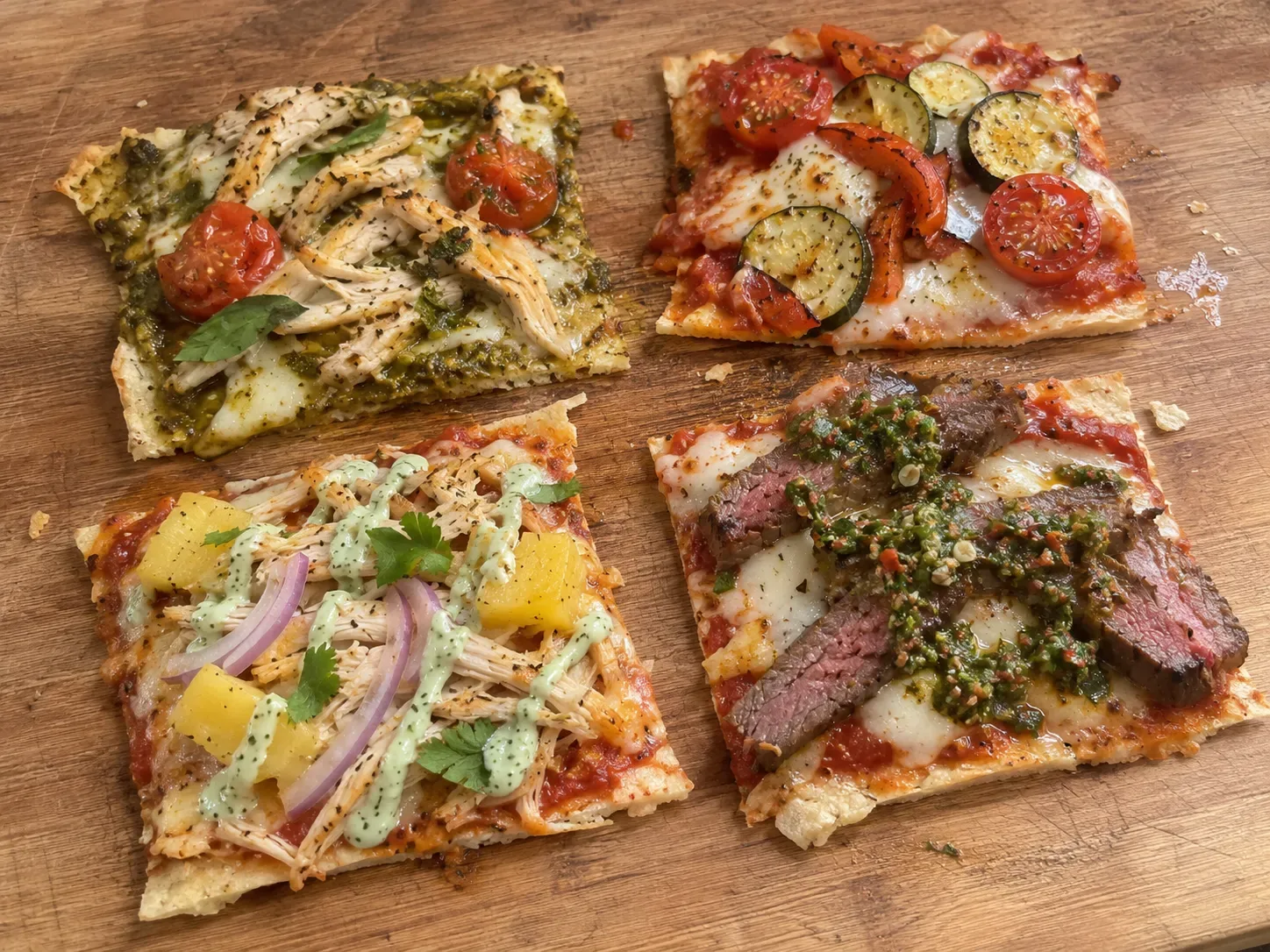
Yuca Crust Pizza Four Ways: Pesto Chicken, Roasted Vegetable Margherita, Pineapple Chicken with Cilantro-Lime Crema, and Chimichurri Steak
A golden, chewy, grain-free pizza crust made from just fresh yuca, water and salt, blended smooth in a high-speed blender and baked until crisp at the edges. One batch makes four pizzas: basil pesto with grilled chicken and Parmesan, roasted cauliflower and zucchini with tomato sauce and mozzarella, charred pineapple chicken with cilantro-lime crema, and seared steak with chimichurri and sweet peppers. Crispy chicharrones on top are optional.
Yield: 4 pizzas (10–12 inch), serves 8 · Active: about 1 hr 15 min · Total: about 2 hr · Season: Best year-round in tropical areas like Costa Rica, where yuca, pineapple, peppers, and fresh herbs grow all year · Best eaten: midday or early evening
Ingredients
For the yuca crusts (makes 4)
- 4 lb fresh yuca (cassava root), about 3 large roots
- 1–1⅓ cups filtered water
- 2 tsp unrefined sea salt
- Olive oil or ghee, for the parchment
For Pizza 1: Basil Pesto, Grilled Chicken, and Parmesan
- 1 lb pasture-raised boneless chicken thighs or breasts
- 1 tbsp extra virgin olive oil
- Juice of ½ lemon
- 1 garlic clove, minced
- ½ tsp dried oregano
- ½ tsp sea salt and a few grinds of black pepper
- ½ cup basil pesto (below)
- ½ cup shredded Parmigiano-Reggiano
- A handful of baby arugula or fresh basil leaves, to finish (optional)
For the basil pesto (makes about 1 cup)
- 2 packed cups fresh basil leaves
- ⅓ cup pine nuts, macadamias, or walnuts, lightly toasted
- ½ cup finely grated Parmigiano-Reggiano
- 1 garlic clove
- 1 tbsp lemon or lime juice
- ½ cup extra virgin olive oil
- ¼ tsp sea salt
For Pizza 2: Roasted Cauliflower, Zucchini, Tomato Sauce, and Mozzarella
- 2 cups small cauliflower florets
- 1 medium zucchini, sliced into ¼-inch half-moons
- 1 tbsp extra virgin olive oil
- ½ tsp sea salt
- ½ cup tomato sauce (below)
- 6 oz mozzarella, fresh (torn and patted dry) or low-moisture raw-milk (shredded)
- Fresh basil, a pinch of chili flakes, and a drizzle of olive oil, to finish
For the quick tomato sauce (makes about 1½ cups)
- 1 (14-oz) jar crushed tomatoes
- 2 tbsp extra virgin olive oil
- 2 garlic cloves, minced
- ½ tsp dried oregano
- ½ tsp sea salt
- A few fresh basil leaves
For Pizza 3: Pineapple Chicken with Cilantro-Lime Crema
- 1 lb pasture-raised boneless chicken thighs
- Juice of 1 lime
- 1 tbsp extra virgin olive oil or avocado oil
- 2 garlic cloves, minced
- ½ tsp ground cumin
- ½ tsp smoked paprika
- ½ tsp sea salt
- 1 cup fresh pineapple, cut into ½-inch pieces
- ½ cup tomato sauce (above), or a thin layer of olive oil and garlic for a white pizza
- 4 oz mozzarella or queso Turrialba (a mild, fresh Costa Rican cheese that softens when baked), shredded or torn
- ¼ red onion, very thinly sliced
- 1 jalapeño, thinly sliced (seeds removed for less heat)
- ½ cup chicharrones, broken into small pieces (optional)
- Fresh cilantro, lime wedges, and flaky salt, to finish
For the cilantro-lime crema (makes about ¾ cup)
- ½ cup raw sour cream, crème fraîche, or whole-milk Greek yogurt
- ½ packed cup fresh cilantro (or ¼ cup culantro, a long-leaf herb common in Costa Rica with a stronger cilantro flavor)
- Zest of 1 lime, plus 1–2 tbsp juice
- 1 small garlic clove
- ¼ tsp sea salt
- 1–2 tbsp water or raw milk, to thin
For Pizza 4: Chimichurri Steak with Sweet Peppers and Caramelized Onion
- 1 lb grass-fed skirt or flank steak
- 1 tsp sea salt and ½ tsp black pepper
- 1 tbsp ghee or tallow, for searing
- 1 large onion, thinly sliced
- 1 tbsp grass-fed butter
- 1 red and 1 yellow sweet pepper, sliced into thin strips
- 4 oz mozzarella or queso Turrialba
- ½ cup chicharrones, broken into small pieces (optional)
- A handful of baby arugula (optional) and flaky salt, to finish
For the chimichurri (makes about ¾ cup)
- 1 packed cup fresh parsley
- ½ packed cup fresh cilantro (or ¼ cup culantro)
- 2 garlic cloves
- 1 tsp dried oregano
- ¼ tsp chili flakes
- 2 tbsp red wine vinegar
- ½ cup extra virgin olive oil
- ½ tsp sea salt
Method
Make the yuca crusts
- Preheat. Heat the oven to 425°F. Line 4 baking sheets with parchment, or bake in batches. Brush the parchment lightly with olive oil or ghee.
- Peel the yuca. Cut the yuca into 3-inch sections. Stand each piece on end and slice off the thick waxy brown skin and the pink layer underneath, down to the white flesh. Halve each piece lengthwise and cut out the tough, woody string down the center. Cut into 1-inch chunks.
- Blend. Blend in two batches. For each, put half the yuca, ½ cup water and 1 tsp salt in a high-speed blender. Blend on high with the tamper until completely smooth and thick, like a dense batter, 1–2 minutes. Add more water a tablespoon at a time only if the blender stalls.
- Spread. Divide the batter among the 4 sheets, about 1⅓ cups each. With an oiled offset spatula, spread each into a 10–11-inch round about ¼ inch thick, a little thicker at the edges.
- First bake. Bake 25–30 minutes, until the top looks dry and matte and the edges are golden.
- Flip and crisp. Lay a second sheet of parchment on top and flip each crust over. Peel off the original parchment and bake 5–8 minutes more, until the second side is firm and lightly golden. The crust should be fully set before it gets toppings. Yuca always needs to be fully cooked, and these two bakes take care of it.
Make the sauces (while the crusts bake)
- Pesto. Pulse the basil, nuts, Parmigiano, garlic, citrus juice and salt in a food processor until finely chopped. With the motor running, stream in the olive oil until smooth but still a little textured.
- Tomato sauce. Warm the olive oil and garlic in a small saucepan over medium-low heat until fragrant, about 1 minute. Add the tomatoes, oregano and salt, and simmer 10–15 minutes until slightly thickened. Tear in the basil.
- Cilantro-lime crema. Blend the sour cream, cilantro, lime zest and juice, garlic and salt until smooth and pale green. Thin with water until it drizzles. Refrigerate until serving.
- Chimichurri. Finely chop the parsley, cilantro and garlic by hand, or pulse briefly in a food processor so they stay a little chunky. Stir in the oregano, chili flakes, vinegar, olive oil and salt. Let it sit at least 15 minutes for the flavors to meld.
Prep the toppings
- Pesto chicken (Pizza 1). Toss the chicken with the olive oil, lemon, garlic, oregano, salt and pepper. Grill, or sear in a hot cast-iron skillet, 5–6 minutes per side for thighs (4–5 for breasts), until cooked through (165°F). Rest 5 minutes, then slice thin.
- Roasted vegetables (Pizza 2). Toss the cauliflower and zucchini with the olive oil and salt, and spread on a sheet pan. Roast at 425°F for 20–25 minutes, until browned at the edges. You can roast them alongside the crusts.
- Pineapple chicken (Pizza 3).
- Toss the chicken with the lime juice, oil, garlic, cumin, smoked paprika and salt. Marinate 20 minutes, or up to overnight in the fridge.
- Heat a dry cast-iron skillet over high heat and sear the pineapple 2–3 minutes, until charred in spots. Set aside.
- In the same skillet or on the grill, cook the chicken over medium-high heat 5–6 minutes per side, until cooked through (165°F). Rest 5 minutes, then chop into bite-size pieces.
- Onion and peppers (Pizza 4). Cook the onion in the butter with a pinch of salt over medium-low heat, stirring now and then, about 20 minutes, until golden and soft. Add the peppers for the last 8–10 minutes so they turn tender and sweet.
- Steak (Pizza 4).
- Pat the steak dry and season with the salt and pepper.
- Heat the ghee in a cast-iron skillet over high heat until smoking. Sear 2–3 minutes per side for medium-rare (130°F), since skirt steak is thin and cooks fast.
- Rest 10 minutes, then slice very thinly against the grain, meaning across the long muscle fibers, so every bite is tender.
Top and bake
- Pizza 1. Spread the pesto over a crust, leaving a thin border. Scatter on the sliced chicken and the Parmigiano.
- Pizza 2. Spread the tomato sauce over a crust. Top with the roasted cauliflower and zucchini, then the mozzarella.
- Pizza 3. Spread the tomato sauce (or olive oil and garlic) over a crust. Add half the cheese, then the chicken, pineapple, red onion and jalapeño. Top with the rest of the cheese.
- Pizza 4. Brush a crust with 2 tbsp of the chimichurri. Spread on the onions and peppers, then the cheese. Hold back the steak.
- Bake.
- Bake all four at 425°F for 8–10 minutes, until the cheese is melted and bubbling. For extra browning, broil 1–2 minutes, watching closely.
- For Pizza 4, lay the sliced steak over the hot pizza and return it to the oven for 1–2 minutes, just to warm through, so the steak stays pink and juicy.
- Finish.
- Pizza 1: add arugula or basil.
- Pizza 2: add basil, chili flakes and a drizzle of olive oil.
- Pizza 3: drizzle with the cilantro-lime crema, then add fresh cilantro, a squeeze of lime and flaky salt.
- Pizza 4: spoon more chimichurri over the top, then add arugula and flaky salt.
- Add the crunch (optional). Scatter the chicharrón pieces over Pizzas 3 and 4 just before slicing. Adding them after the oven keeps them crisp, and the crema and chimichurri help them stick.
- Slice. Let the pizzas rest 3 minutes, then cut each into 6 slices with a pizza wheel.
Storage
Baked crusts (untopped): fridge up to 4 days, or freeze up to 2 months with parchment between them. Top straight from frozen and add 3–5 minutes to the final bake.
Leftover pizza: fridge up to 3 days. Reheat in a 400°F oven or a dry skillet so the crust crisps again, and add any chicharrones after reheating.
Pesto: fridge up to 5 days with a thin layer of olive oil on top, or freeze in ice cube trays.
Tomato sauce: fridge up to 5 days, or freeze up to 3 months.
Cilantro-lime crema: fridge up to 3 days.
Chimichurri: fridge up to 1 week. Bring it to room temperature before using, since the olive oil firms up when cold.
Variations
Crust variations
- Cheesy crust: Blend ½ cup grated Parmigiano into each batch of yuca batter for a richer, more golden crust.
- Herb crust: Blend in 1 tsp dried oregano, ½ tsp garlic powder and a little fresh rosemary.
- Sturdier crust: Blend in 1 pasture-raised egg and 2 tbsp olive oil per batch. It holds heavier toppings and browns more.
- Cassava flour shortcut: No fresh yuca? For one crust, mix 1½ cups cassava flour, ¾ cup warm water, 2 tbsp olive oil and ¾ tsp salt into a dough. Press it out, bake 12–15 minutes, then top and bake again.
- Mini pizzas: Spread the batter into 4-inch rounds for party bites. Bake 18–20 minutes before flipping.
Topping variations
- Chicharrón crunch: Top any of the pizzas with small pieces of chicharrón after baking. In Costa Rica, chicharrones are chunks of pork belly fried in their own fat until crisp outside and tender inside; chop them small. Crispy pork rinds (the puffed skin) work too, crumbled over the top.
- Homemade chicharrones:
- Cut 1 lb pasture-raised pork belly into ½-inch cubes and season with salt.
- Simmer in a heavy pot with ½ cup water over medium heat until the water evaporates and the fat renders out, about 30 minutes.
- Keep cooking in the rendered fat, stirring often, until deep golden and crisp, 15–20 minutes more.
- Drain and salt. Save the rendered lard for frying plantains.
- Margherita: tomato sauce, fresh mozzarella, basil and olive oil.
- Garlic shrimp and sweet plantain: tomato sauce, garlic-butter shrimp, fried ripe plantain, hearts of palm, red onion and queso Turrialba, finished with culantro, lime and fresh chili.
- Black bean and plantain: a smear of refried black beans, fried sweet plantain, queso Turrialba and pickled red onions, with sliced avocado added after baking.
- Pineapple and chorizo: swap the chicken on Pizza 3 for quality chorizo, made from pasture-raised pork with no nitrates or fillers.
- Sausage and peppers: tomato sauce, pasture-raised Italian sausage, roasted peppers and onions, and mozzarella.
Season & Circadian Timing
In tropical places like Costa Rica, yuca, pineapple, sweet peppers, cilantro, culantro, and limes are at the feria (the weekly farmers’ market) all year, so these pizzas work in any season. Outside the tropics, they’re best from late summer into fall, when basil, zucchini and peppers are at their peak. Pizza night sits best at midday or in the early evening, giving dinner time to settle before bed.
Nourishment Notes
- Yuca (cassava): a naturally grain-free, gluten-free root that gives steady, slow energy. It also has resistant starch, a type of starch that feeds friendly gut bacteria, and more of it forms once cooked yuca cools.
- Pasture-raised chicken: a clean source of protein, with B vitamins and selenium.
- Grass-fed steak: iron, zinc, B12, and more omega-3 fats than grain-fed beef.
- Pineapple: vitamin C and bromelain, a natural enzyme that helps break down protein.
- Basil, parsley, and cilantro: vitamins K and C, and a fresh, bright lift to rich dishes.
- Tomatoes: cooking them with olive oil makes their lycopene, the red pigment, easier for the body to absorb.
- Cauliflower and zucchini: fiber, vitamin C and potassium.
- Sweet peppers: among the richest sources of vitamin C.
- Parmigiano-Reggiano: naturally aged, rich in protein and calcium, with a deep savory flavor.
- Chicharrones: pork skin is mostly collagen, the same protein found in bone broth, which supports skin, joints and the gut lining. Rendered pork fat is rich in monounsaturated fat.
Sourcing
- Yuca — fresh, firm roots with no soft spots or dark streaks inside; from the feria, a Latin or Asian market, or organic from a grocery store
- Chicken — pasture-raised, from a local farm
- Steak — grass-fed and grass-finished skirt or flank, from a local butcher or rancher
- Chicharrones — from pasture-raised pork, fried only in their own lard, with no seed oils or added flavorings (Epic pork rinds are fried in pork fat); or fresh from a local carnicería (butcher shop)
- Parmigiano-Reggiano — authentic, aged 24+ months
- Mozzarella — fresh whole-milk, or raw-milk low-moisture from a local dairy
- Queso Turrialba — fresh, from a local quesería (cheese shop)
- Sour cream or crème fraîche — raw, from a farmer you know and trust, or organic and cultured
- Crushed tomatoes — organic, in glass jars (Bionaturae)
- Pine nuts, macadamias, or walnuts — organic
- Pineapple — fresh and ripe, from the feria or a local farm; it should smell sweet at the base
- Extra virgin olive oil — organic, single-estate, harvest-dated, in dark glass
- Avocado oil — organic, cold-pressed, in dark glass
- Ghee — grass-fed ghee, or homemade from organic grass-fed butter
- Tallow — from grass-fed beef
- Grass-fed butter — organic, from 100% grass-fed cows, or raw butter from a local dairy
- Red wine vinegar — organic, raw if available
- Spices — organic and non-irradiated
- Salt — unrefined sea salt (Baja Gold); flaky sea salt for finishing (Maldon)
- Lemons and limes — organic (you’re using the zest)
- Fruits, vegetables, and herbs — organic, from the feria, a farmers’ market, or a local farm
You might also like: Grain-Free Pizza Pockets · Taco Night Staples: Quick-Pickled Radish and Red Onion, Classic Guacamole, and Cassava Tortillas · Argentine Skirt Steak with Herb Chimichurri
With Love, Light, and Health,
Anna (aka Food Marshall)
Food Marshall Approved. Grain-free, seed-oil-free and refined-sugar-free, made from organic, local and seasonal ingredients. Our standards
More Breads & Savory Bakes
Get new recipes and essays
Seasonal recipes and writing on light, circadian health, and living with nature.
Subscribe on Substack