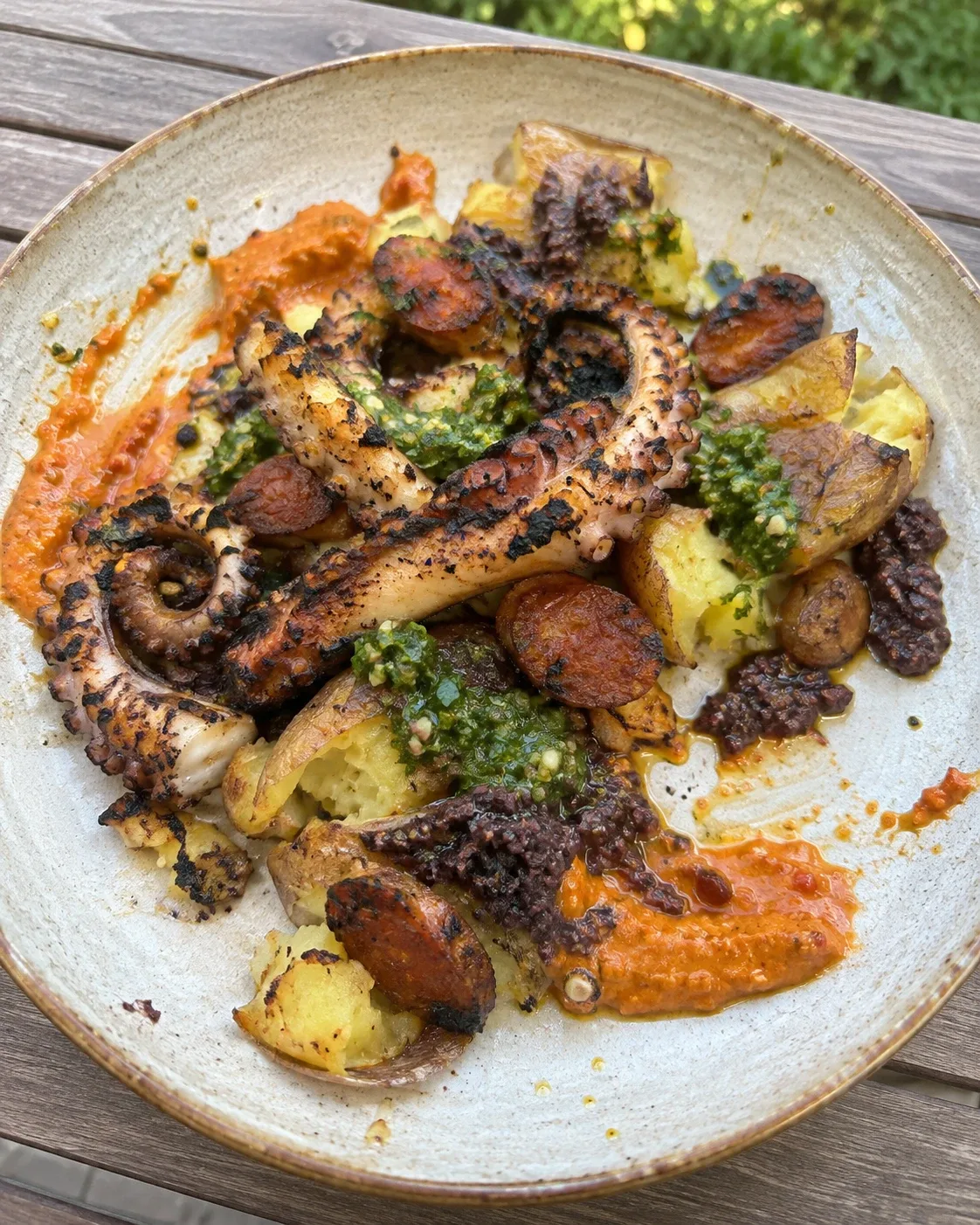
Charred Octopus with Chorizo, Crushed Fingerling Potatoes, Olive Tapenade, Romesco, and Chimichurri
Tender octopus charred over high heat, crispy smashed fingerlings, and nuggets of real pasture-raised chorizo, brought together with three bold sauces. Every sauce can be made ahead, so the last-minute work is just a hot pan and a platter.
Yield: Serves 4 as a main (6–8 as a shared starter) · Active: about 1¼ hr · Total: about 2 hr (plus overnight if you make your own chorizo) · Season: Best in North America in late summer and fall, when red peppers, fingerling potatoes, and parsley are at their peak · Best eaten: midday
Ingredients
For the octopus
- 1 whole octopus, about 3 lb, cleaned (or 2 smaller ones, about 1½ lb each), thawed if frozen
- 1 yellow onion, halved
- ½ lemon
- 2 bay leaves
- 1 tsp black peppercorns
- 1 cup dry white wine (optional)
- 2 tbsp extra virgin olive oil, plus more for drizzling
- ½ tsp smoked paprika
- 1 tbsp avocado oil or tallow, for the pan (if not grilling)
- Sea salt and lemon wedges, for serving
For the chorizo
- 8 oz quality chorizo, either fresh Mexican-style (removed from its casing) or cured Spanish-style, sliced into ¼-inch coins (see Sourcing), or 8 oz homemade chorizo (below)
For homemade Mexican-style chorizo (optional; makes 1 lb)
- 1 lb ground pasture-raised pork (about 20–25% fat)
- 2 dried ancho chiles and 2 dried guajillo chiles, stemmed and seeded (or 2 tbsp ancho chile powder plus 1 tbsp guajillo chile powder)
- 3 tbsp raw apple cider vinegar
- 3 garlic cloves
- 1 tbsp sweet or smoked paprika
- 1 tsp ground cumin
- 1 tsp dried Mexican oregano
- ¼ tsp ground Ceylon cinnamon
- Pinch of ground cloves
- 1½ tsp sea salt
- ½ tsp black pepper
For the crushed fingerlings
- 1½ lb fingerling potatoes, scrubbed
- 1 tbsp sea salt, for the cooking water
- 3 tbsp tallow or extra virgin olive oil
- Flaky sea salt and black pepper
For the olive tapenade (makes about 1 cup)
- 1 cup pitted Kalamata olives (or half Kalamata, half green Castelvetrano)
- 2 tbsp capers, rinsed
- 2 anchovy fillets (optional, for depth)
- 1 small garlic clove
- 1 tbsp fresh lemon juice
- 1 tsp fresh thyme leaves
- ¼ cup extra virgin olive oil
- Black pepper
For the romesco (makes about 1½ cups)
- 2 red bell peppers (or 1 cup jarred fire-roasted red peppers, drained)
- ½ cup blanched almonds
- 2 garlic cloves
- 1½ tbsp sherry vinegar
- 1 tsp smoked paprika
- Pinch of cayenne (optional)
- ⅓ cup extra virgin olive oil
- ½ tsp sea salt
For the chimichurri (makes about 1 cup)
- 1 cup packed fresh flat-leaf parsley, finely chopped
- 2 tbsp fresh oregano leaves, finely chopped (or 1 tsp dried)
- 3 garlic cloves, minced
- 1 small shallot, minced
- ¼ cup red wine vinegar
- ½ tsp red pepper flakes
- ½ tsp sea salt
- ½ cup extra virgin olive oil
Method
This plate has several parts, but most of them wait happily in the fridge, so you can spread the work over a day or two.
| Component | Active | Total | Make ahead? |
|---|---|---|---|
| Homemade chorizo (optional) | 20 min | 1 hr to overnight | Up to 2 days ahead, raw, in the fridge |
| Simmered octopus | 10 min | about 1¼ hr | Up to 2 days ahead, chilled |
| Romesco | 20 min | 35 min | Up to 5 days |
| Olive tapenade | 10 min | 10 min | Up to 1 week |
| Chimichurri | 10 min | 25 min | Best the same day; keeps 2 days |
| Fingerlings | 15 min | 40 min | Boil up to 2 days ahead; crisp right before serving |
| Char octopus and cook chorizo | 15 min | 15 min | Right before serving |
For homemade chorizo (optional, make first)
- Toast and soak the chiles. Toast the dried chiles in a dry skillet over medium heat for 20–30 seconds per side, just until fragrant. Cover with hot water and soak 15–20 minutes until soft. Drain, saving 2 tablespoons of the soaking water. (Using chile powders? Skip this step.)
- Blend the paste. Blend the chiles, reserved soaking water, vinegar, garlic, paprika, cumin, oregano, cinnamon, cloves, salt, and pepper into a smooth paste.
- Season the pork. Work the paste into the ground pork with your hands until it’s evenly red all the way through. Cover and refrigerate at least 1 hour, ideally overnight, so the flavors sink in. Use 8 oz for this dish and freeze the rest, or use the full pound for a heartier plate.
For the octopus
- Simmer. Put the octopus in a large pot with the onion, lemon, bay leaves, peppercorns, and wine (if using), and add water to cover by an inch. Skip the salt here, since octopus is naturally salty. Bring to a boil, then lower to a gentle simmer, cover, and cook 45–60 minutes. Start checking at 40 minutes. It’s ready when a paring knife slides easily into the thickest part of a tentacle, like piercing a cooked potato.
- Cool in the liquid. Turn off the heat and let the octopus cool in its cooking liquid for 20 minutes. This keeps it moist and helps the skin stay on.
- Cut. Lift it out and cut off the tentacles. If there’s a hard beak (the small, sharp mouth piece in the center where the tentacles meet), discard it. Trim the head into pieces too, if you like. Pat everything very dry. You can stop here and chill the octopus for up to 2 days.
For the sauces
- Roast the peppers. Roast the bell peppers directly over a gas flame, on a hot grill, or under the broiler, turning, until blackened all over, 10–15 minutes. Put them in a bowl, cover, and let steam 10 minutes. Peel off the skins, then remove the stems and seeds. (Skip this if using jarred peppers.)
- Make the romesco. Romesco is a Catalan sauce of roasted red peppers and nuts. Toast the almonds in a dry skillet over medium-low heat, stirring, 4–5 minutes until golden. Blend the peppers, almonds, garlic, sherry vinegar, smoked paprika, cayenne (if using), and salt. With the blender running, stream in the olive oil. Leave a little texture. Taste and adjust the salt and vinegar.
- Make the tapenade. Tapenade is a chunky olive spread from Provence. Pulse the olives, capers, anchovies (if using), garlic, lemon juice, and thyme in a food processor until finely chopped. Pulse in the olive oil and a few grinds of pepper. Keep it rustic, not smooth. No salt needed, since the olives and capers bring plenty.
- Make the chimichurri. Chimichurri is an Argentine sauce of chopped fresh herbs, garlic, vinegar, and olive oil. Stir together the parsley, oregano, garlic, shallot, vinegar, red pepper flakes, and salt. Stir in the olive oil. Let it sit at least 15 minutes so the garlic mellows.
For the potatoes
- Boil. Put the fingerlings in a pot of cold water with 1 tablespoon salt. Bring to a boil and cook 12–18 minutes, until a knife slides in easily. Drain and let them steam-dry for 5 minutes.
- Crush. Press each potato gently with the bottom of a glass or the flat of a knife until it cracks open and flattens a little but still holds together. The rough, broken edges are what get crispy.
- Crisp. Heat the tallow or olive oil in a large cast-iron skillet over medium-high heat. Add the potatoes in a single layer (work in batches if needed) and cook undisturbed 4–5 minutes, until deep golden underneath. Flip and cook 3–4 minutes more. Season with flaky salt and pepper. Keep warm in a 200°F oven while you finish.
To finish and plate
- Cook the chorizo. For fresh (Mexican-style or homemade) chorizo, crumble it into a skillet over medium heat and cook 6–8 minutes, breaking it up, until browned and cooked through (160°F). For cured Spanish chorizo, crisp the coins in a dry skillet 2–3 minutes per side. Save the brick-red fat left in the pan.
- Char the octopus. Toss the octopus with the olive oil, smoked paprika, and a pinch of salt. Grill over high heat, or sear in a very hot cast-iron skillet with the avocado oil or tallow, 2–3 minutes per side, until crisp and charred at the edges. “Charring” just means letting the surface get deeply browned and a little blackened in spots, which adds a smoky flavor.
- Plate. Swoosh the romesco across a platter. Pile on the potatoes, then the octopus and chorizo. Drizzle a spoonful of the chorizo fat over the top. Add small spoonfuls of tapenade, spoon chimichurri over everything, and serve with lemon wedges and the remaining sauces on the side.
Storage
Cooked octopus keeps in the fridge up to 3 days. Re-char it in a hot pan rather than microwaving, which makes it rubbery.
Romesco keeps up to 5 days, tapenade up to 1 week, and chimichurri up to 2 days (it loses its bright green after that), all in glass jars in the fridge.
Leftover potatoes re-crisp in a hot skillet or a 425°F oven in about 10 minutes.
Raw homemade chorizo keeps 2 days in the fridge or up to 3 months in the freezer.
Variations
- Spanish or Mexican chorizo: Cured Spanish chorizo gives smoky, firm coins with a paprika-garlic flavor. Fresh Mexican chorizo crumbles into soft, chile-rich bits. Both work beautifully here.
- Without chorizo: Skip it and add 4 oz diced pancetta or bacon (no added nitrites), or leave the plate pork-free and add an extra drizzle of smoked paprika oil.
- Pressure cooker octopus: Cook the octopus with the same aromatics and about 1 cup of water at high pressure for 15–20 minutes, then let the pressure release naturally. Test with a knife the same way.
- Squid or shrimp instead: Swap in 2 lb cleaned squid or wild shrimp. Skip the simmering and just char them hot and fast, 1–2 minutes per side.
- Oven-roasted potatoes: Instead of pan-crisping, toss the crushed potatoes with the fat and roast on a sheet pan at 450°F for 20–25 minutes, flipping once.
- One-sauce shortcut: On a busy night, pick just one sauce. Romesco or chimichurri alone is plenty.
- Smaller starter: Serve the octopus and chorizo over the romesco with chimichurri only, and skip the potatoes, for a shared small plate.
Season & Circadian Timing
Red peppers are sweetest in late summer and early fall, right as new-crop fingerlings and big bunches of parsley show up at the market. This is a protein- and fat-rich plate, so it sits best at midday or a long late lunch, when digestion is strong and you have the afternoon light ahead of you.
Nourishment Notes
- Octopus — lean protein that’s especially rich in vitamin B12, with iron, selenium, and copper.
- Pasture-raised pork — protein and B vitamins, including thiamine (vitamin B1), which pork is one of the best food sources of.
- Red peppers — one of the richest vegetable sources of vitamin C, plus carotenoids that give them their color.
- Parsley — vitamin K and vitamin C, and a fresh, bright counterpoint to the richer elements.
- Almonds and olives — vitamin E from the almonds, and monounsaturated fat and polyphenols from the olives and olive oil.
- Fingerling potatoes — potassium and vitamin C, especially with the skins left on.
Sourcing
- Octopus — wild-caught, from a fishmonger you trust; frozen is fine and freezing helps tenderize it. Spanish, Portuguese, and Mexican (Yucatán) octopus are common; check Seafood Watch for the best choices in your area.
- Chorizo — made from pasture-raised pork, with no added nitrites or nitrates (including celery powder or celery juice, which are natural nitrite sources), no fillers, no sugar or dextrose, and no seed oils. Look for fresh Mexican-style chorizo from a local butcher or farm, or cured Spanish chorizo made with just pork, paprika, garlic, and salt.
- Pork — pasture-raised heritage breed (such as Berkshire, Red Wattle, or Tamworth), from a local farm (White Oak Pastures)
- Tallow / lard / duck fat — from pasture-raised animals, from a local farm or butcher
- Extra virgin olive oil — organic, single-estate, harvest-dated, in dark glass
- Avocado oil — organic, cold-pressed, in dark glass
- Olives — organic, cured in brine or olive oil, with no added preservatives or color
- Capers — salt-packed, from Sicily or Pantelleria; rinse before using
- Anchovies — wild-caught, packed in olive oil or salt, in glass
- Almonds — organic, sprouted, blanched, and skinless
- Sherry vinegar — Vinagre de Jerez DOP, aged in oak barrels in Spain
- Red wine vinegar — organic and naturally fermented
- Raw apple cider vinegar — organic, with the mother (Bragg)
- Dried chiles — organic whole ancho and guajillo chiles
- Smoked paprika — Pimentón de la Vera DOP, smoked over oak in Spain
- Spices — organic and non-irradiated (Ceylon cinnamon from Sri Lanka)
- Potatoes — organic fingerlings, since you’re eating the skins
- Lemons / limes / oranges — organic
- Salt — unrefined sea salt (Baja Gold); flaky sea salt for finishing (Maldon)
- Fruits, vegetables, and herbs — organic, from a farmers’ market or local farm
You might also like: Chopped Herb Octopus Salad over Crispy Roasted Potatoes and Radishes · Mediterranean Octopus Salad with Shaved Fennel and Skillet Green Beans · Asturian Chorizo in Cider (Chorizo a la Sidra)
With Love, Light, and Health,
Anna (aka Food Marshall)
Food Marshall Approved. Grain-free, seed-oil-free and refined-sugar-free, made from organic, local and seasonal ingredients. Our standards
More Seafood
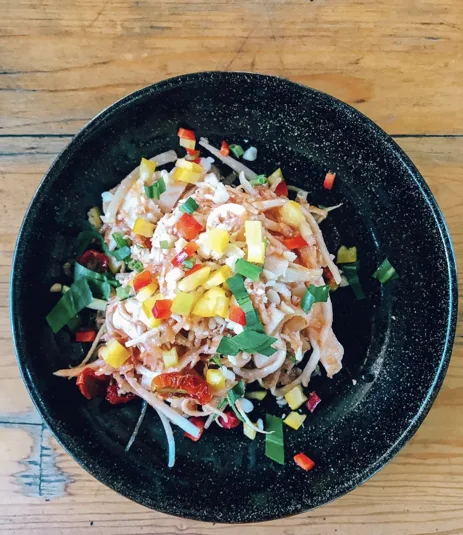
Asian Ceviche Noodle Salad with Lime-Ginger Dressing
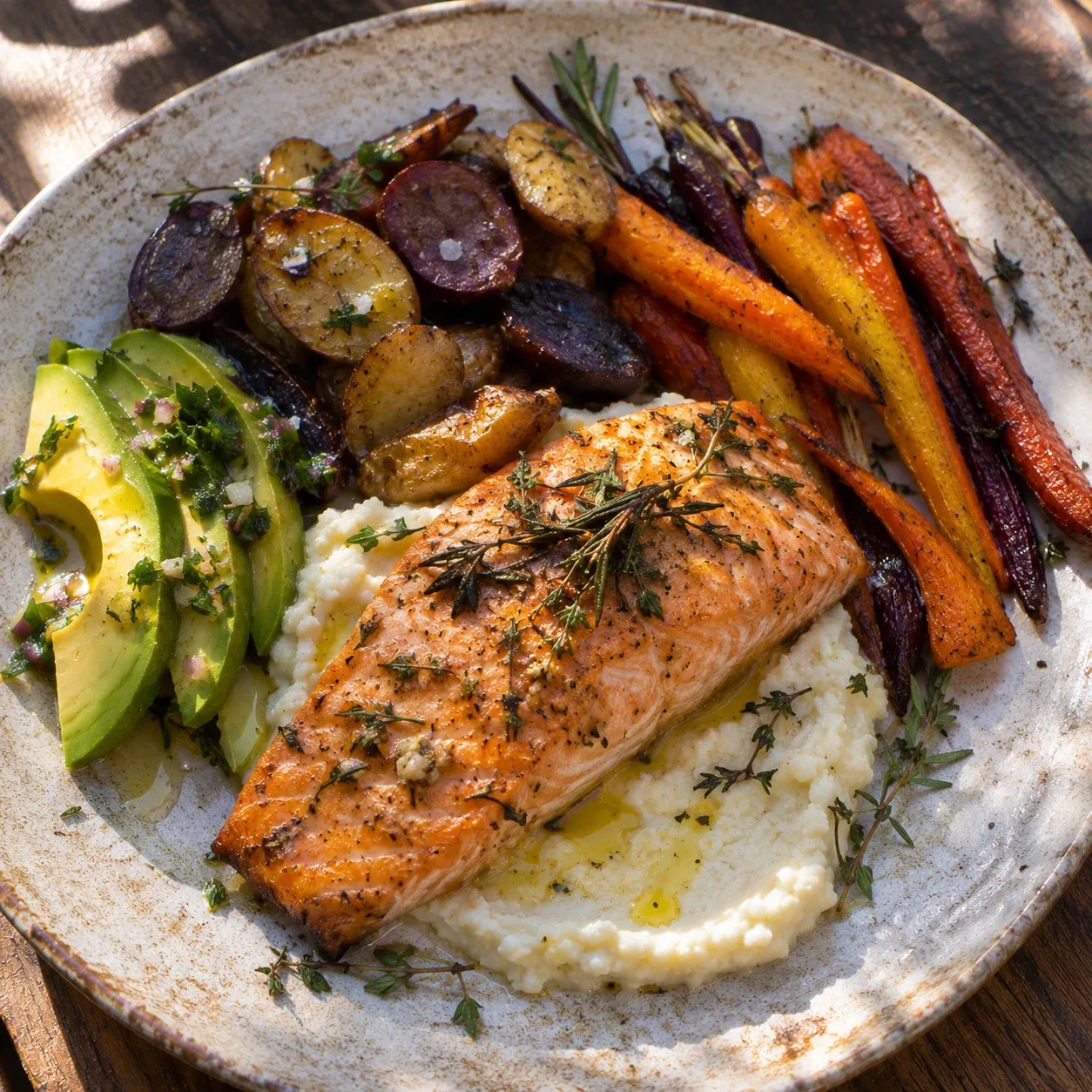
Baked Wild Salmon with Rosemary and Thyme, Whipped Cauliflower Purée, Roasted Rainbow Carrots, Purple and Fingerling Potatoes, and Avocado with Herb Vinaigrette
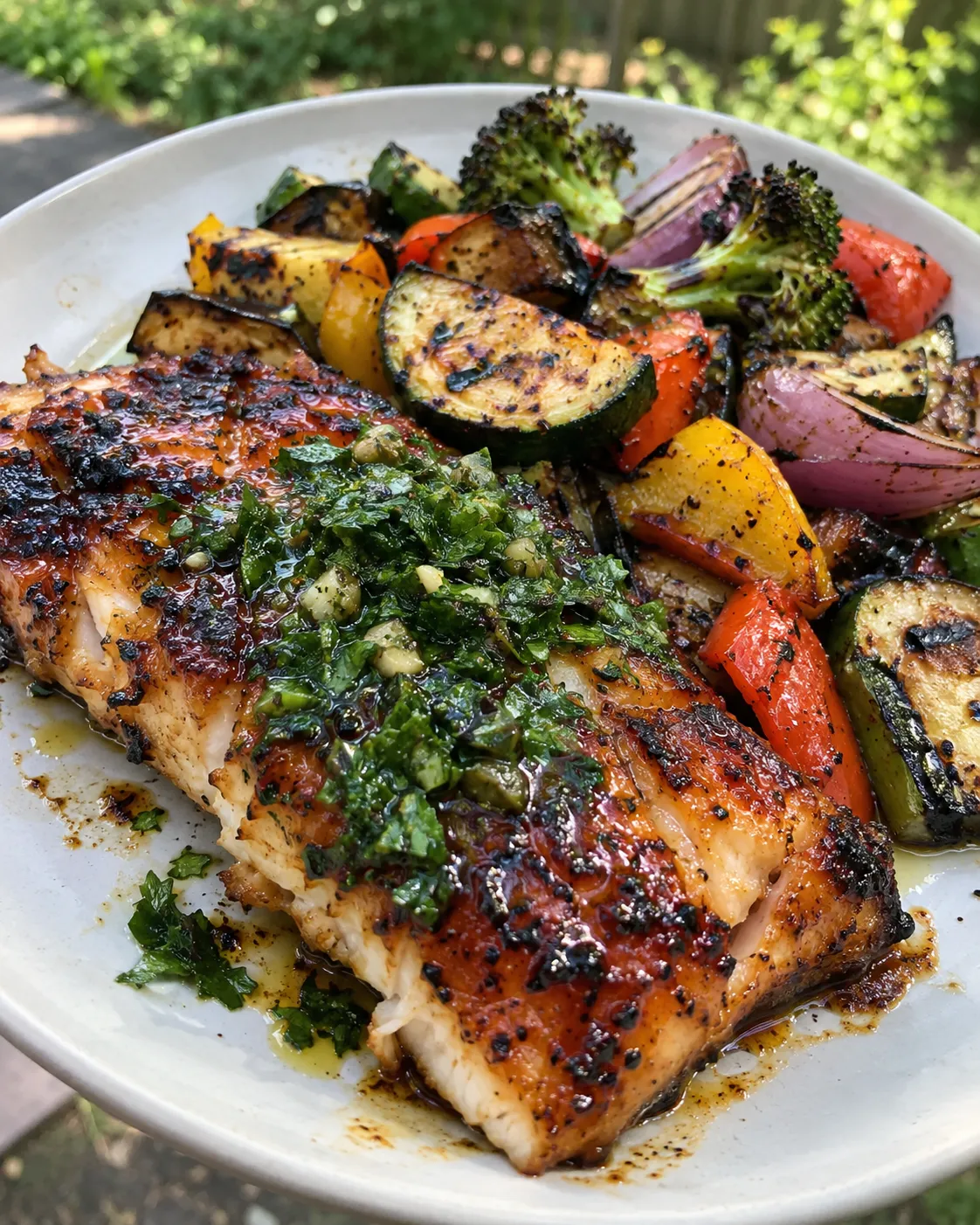
BBQ Wild Sablefish (or Cod) with Parsley Verde and Charred Summer Vegetables
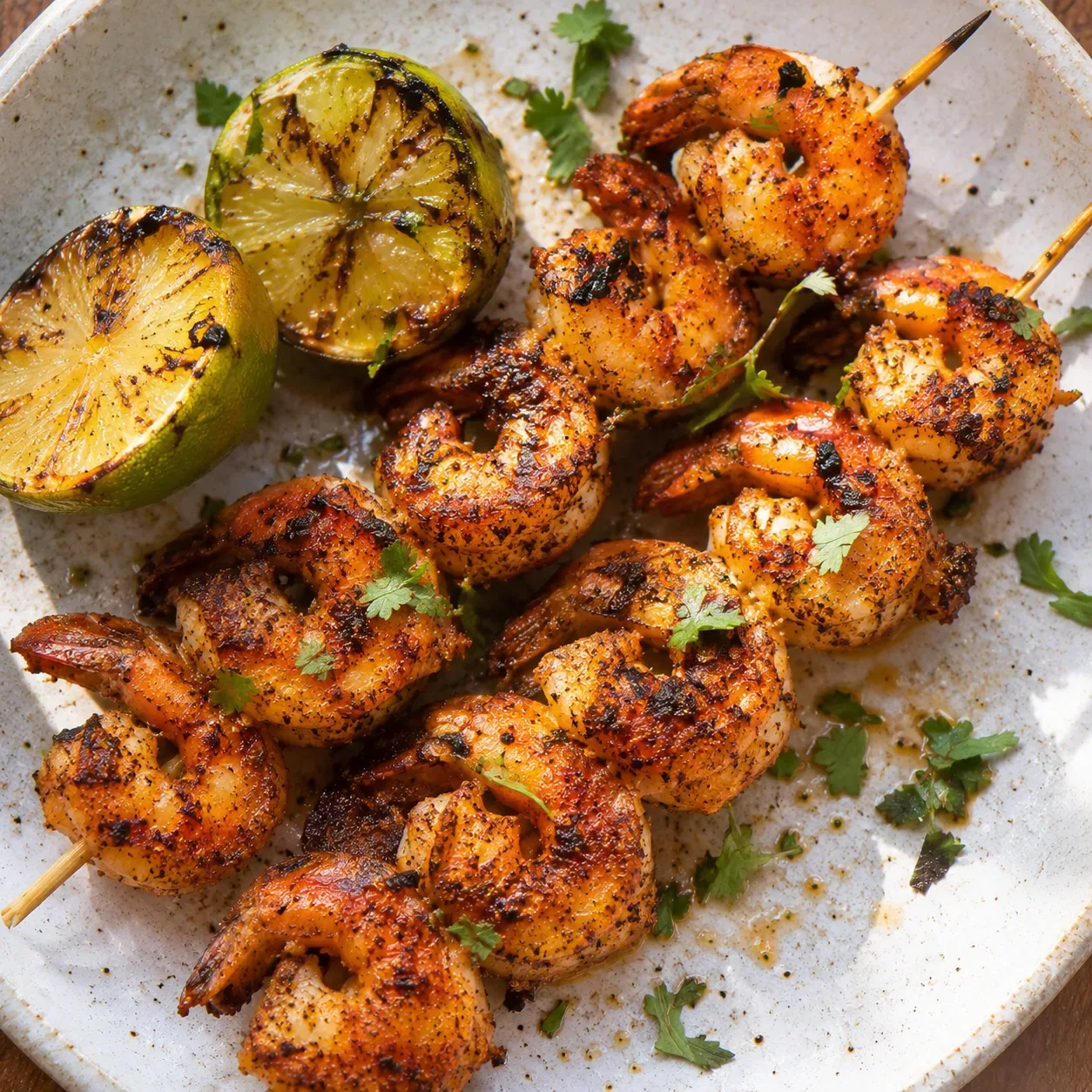
Blackened Wild Shrimp Skewers with Charred Lime
Get new recipes and essays
Seasonal recipes and writing on light, circadian health, and living with nature.
Subscribe on Substack