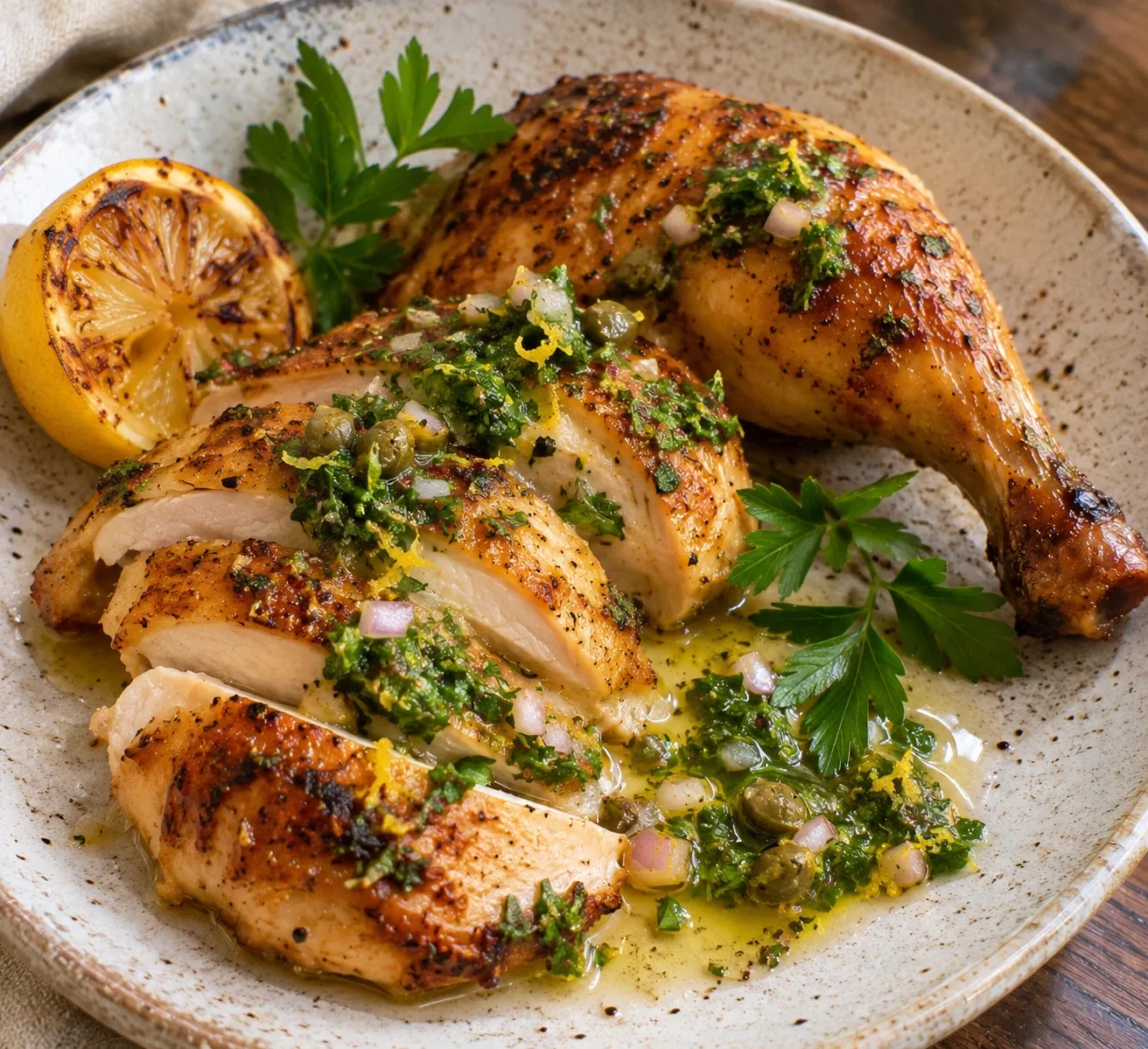
Herb-Roasted Bird with Bright Parsley Sauce (Chicken, Duck, Squab, or Quail)
A crisp-skinned, herb-butter-roasted bird with a sharp, bright parsley sauce of shallot, capers, and lemon. Use a whole chicken for a Sunday supper, or duck breast, squab, or quail for an elegant little dinner-party plate. The method is the same for each bird, and only the cooking time changes.
Yield: Serves 4 · Active: 35 min · Total: 30 min to 1 hr 30 min, depending on the bird (plus optional overnight dry brine) · Season: Best in North America in fall through spring, when parsley, lemons, and shallots are at their peak · Best eaten: early evening
Choose Your Bird
| Bird | How much for 4 | How to prep | Cook | Pull it at |
|---|---|---|---|---|
| Chicken | 1 whole bird, 3½–4 lb | Spatchcock (see method) | Roast at 425°F for 40–50 min | 160°F in the breast, 175°F in the thigh |
| Guinea hen | 1 bird, 2½–3 lb | Spatchcock | Roast at 425°F for 35–45 min | 160°F in the breast, 175°F in the thigh |
| Cornish hen | 2–4 hens, 1¼–1½ lb each | Halve | Roast at 425°F for 25–30 min | 160°F in the breast, 175°F in the thigh |
| Squab | 4 whole squab, 12 oz–1 lb each | Halve | Sear 4–5 min, then roast at 425°F for 4–6 min | 130–135°F in the breast |
| Quail | 8 quail (2 per person) | Butterfly | Sear 2–3 min, then roast at 425°F for 3–4 min | 140–145°F in the breast |
| Duck breast | 4 breasts, 6–8 oz each | Score the skin | Render skin-side down 8–10 min, then roast at 425°F for 3–5 min | 130–135°F for medium-rare |
Pull it at means take the bird out of the oven at that temperature: it keeps climbing a few degrees as it rests. Pulling the breast at 160°F keeps it juicy, while taking the thigh to 175°F makes the dark meat tender instead of rubbery. A spatchcocked bird cooks evenly enough that both reach their numbers at about the same time.
Squab, quail, and duck breast are traditionally served pink, like a steak. If you’d rather cook them through, take them to 165°F (the USDA guideline for all poultry). Expect the meat to be firmer and less juicy.
The duck breast sizes are for Pekin duck. Moulard breasts are much bigger (about 14–16 oz each), so use 2 breasts for 4 people and add a few minutes in the oven.
Ingredients
For the bird
- Your bird of choice (see the table above)
- 2 tsp sea salt (1 tsp per pound for a whole chicken or guinea hen)
- ½ tsp freshly cracked black pepper
- 2 tbsp grass-fed ghee (or rendered duck fat)
For the herb butter
- 6 tbsp grass-fed butter, softened
- 1 tbsp fresh thyme leaves, plus 4 whole sprigs for basting
- 1 tsp finely chopped fresh rosemary
- 4 fresh sage leaves, finely chopped
- 2 garlic cloves, minced, plus 2 more lightly smashed for basting
- Zest of ½ lemon
- ¼ tsp sea salt
For the parsley sauce
- 1 small shallot, finely minced
- Zest of 1 lemon, plus 2 tbsp fresh lemon juice
- 1 packed cup fresh flat-leaf parsley leaves, finely chopped
- 1 tbsp capers, rinsed and chopped
- 2 anchovy fillets, finely minced (optional)
- ½ cup extra virgin olive oil
- Pinch of sea salt and black pepper
Method
Prep the bird
- Cut it down.
- Spatchcock (chicken, guinea hen): spatchcocking means removing the backbone so the bird lies flat, roasts evenly, and cooks in about half the time. Set the bird breast-side down. With kitchen shears, cut along both sides of the backbone and remove it, saving it for broth. Flip the bird over and press firmly on the breastbone until it cracks and lies flat.
- Halve (squab, Cornish hen): remove the backbone the same way, then cut through the breastbone to split the bird in two. Tuck the wing tips behind the breast.
- Butterfly (quail): remove the backbone and press each one flat.
- Duck breasts: with a sharp knife, score the skin in a tight crosshatch, cutting through the skin and fat but not into the meat. Scoring helps the fat melt out and the skin crisp.
- Dry brine. Pat the bird very dry and season all over with the salt and pepper. Dry brining simply means salting ahead. The salt seasons the meat deeply and dries the skin so it roasts up crisp. For the best results, refrigerate uncovered on a rack overnight, or for at least 1 hour. Take it out 30 minutes before cooking.
- Make the herb butter. Mash the softened butter with the thyme leaves, rosemary, sage, minced garlic, lemon zest, and salt.
- Butter the bird. For chicken, guinea hen, and Cornish hen, slide your fingers under the skin of the breast and thighs to loosen it, and push most of the herb butter underneath. Rub the rest over the skin. For squab and quail, rub a thin layer over the skin and save the rest for basting. For duck breast, skip this step: duck carries plenty of its own fat, so save all the herb butter for basting.
- Preheat. Heat the oven to 425°F.
Cook the bird
Larger birds (chicken, guinea hen, Cornish hen):
- Set the bird skin-side up in a cast-iron skillet or on a rimmed sheet pan, and drizzle with the melted ghee.
- Roast for the time in the table, until the skin is deep golden and the thermometer reads the “pull it at” temperature.
- Halfway through, spoon the pan juices over the top.
Small birds (squab, quail):
- Heat the ghee in a large cast-iron or oven-safe skillet over medium-high heat until it shimmers.
- Lay the birds in skin-side down, pressing gently so the skin makes full contact. Use two pans or work in batches so they don’t crowd.
- Sear without moving them until deep golden: 4–5 minutes for squab, 2–3 minutes for quail.
- Flip skin-side up and move the skillet to the oven for the time in the table.
Duck breasts:
- Lay the breasts skin-side down in a cold, dry skillet, then set it over medium-low heat. Starting cold lets the fat melt out slowly so the skin turns thin and crackly.
- Cook 8–10 minutes, pouring off the rendered fat into a jar as it builds up (save it for roasting potatoes).
- When the skin is deep golden, flip the breasts and move the skillet to the oven for 3–5 minutes.
Then, for every bird
- Baste. Set the skillet on the stovetop over medium heat. Add the reserved herb butter, the thyme sprigs, and the smashed garlic. Once the butter foams, tilt the pan and spoon it over the bird for about 1 minute. For a large bird on a sheet pan, melt the butter, herbs, and garlic in a small pan and spoon it over.
- Rest. Move the bird to a board and rest before carving: 5–8 minutes for small birds and duck breast, 10–15 minutes for chicken and guinea hen. The meat keeps cooking a few degrees as it rests, and the juices settle back into it.
For the parsley sauce
- Soften the shallot. In a small bowl, combine the shallot, lemon zest, lemon juice, and a pinch of salt. Let it sit 5–10 minutes to mellow.
- Stir together. Add the parsley, capers, anchovy (if using), and olive oil. Season with pepper and taste. It should be bright, salty, and loose enough to spoon. Make it no more than an hour ahead so the parsley stays vivid green.
To serve
- Plate.
- Carve the chicken or guinea hen into pieces, slice the duck breasts on an angle, or set the small birds whole on warm plates.
- Spoon a little of the buttery pan juices over each plate, then add a generous spoonful of parsley sauce.
- Pass the rest of the sauce at the table.
Storage
Leftovers keep in the fridge up to 3 days for chicken and guinea hen, or 2 days for duck, squab, and quail. Serve cold, or warm gently in a low oven (300°F) so the meat doesn’t overcook.
Parsley sauce keeps in the fridge up to 2 days in a glass jar with a thin layer of olive oil on top. It will darken a little but still taste great.
Save the backbones and carcass in the freezer for your next pot of broth.
Variations
- Whole roasted squab or quail: Leave the birds whole, sear on all sides, and roast at 425°F, 12–15 minutes for squab or 8–10 minutes for quail, until the breast reaches the temperature in the table.
- Whole duck: For a whole bird, slow-roast it instead. See Slow-Roasted Whole Pastured Duck with Orange, Herbs, and Shallots.
- Pheasant: Pheasant is very lean, so lay strips of pasture-raised bacon over the breast before roasting. Spatchcock 2 pheasants (about 2½ lb each) and roast at 425°F for 30–40 minutes, until the breast reads 155–160°F.
- Salsa verde: Add 2 tbsp each chopped mint and basil to the parsley sauce, plus 1 tsp Dijon mustard.
- Without anchovy: Leave it out and add an extra ½ tbsp capers for the salty depth.
- Lemon-roasted chicken: Tuck lemon halves and a head of garlic, halved crosswise, around the spatchcocked chicken in the pan. Squeeze the roasted lemon over the meat at the table.
- On the plate: Serve over roasted roots, a parsnip or celery root purée, or a bitter-leaf salad with shaved fennel.
Season & Circadian Timing
Parsley is at its most tender in spring and fall, and lemons and storage shallots carry through winter, so this sauce is brightest from fall through spring. Enjoy it in the early evening so your body has a few hours to digest before bed.
Nourishment Notes
- Pasture-raised chicken: a great source of protein, plus niacin, vitamin B6, and selenium. Birds raised outdoors on pasture also carry more vitamins in their fat.
- Duck, squab, and quail: rich, dark meat with plenty of iron, zinc, and B vitamins, and a deeper, more mineral flavor than chicken.
- Parsley: an excellent source of vitamin K, plus vitamin C and plenty of bright, grassy flavor.
- Anchovies: small, oily fish that bring omega-3 fats and deep savory flavor in tiny amounts.
- Extra virgin olive oil: monounsaturated fat and polyphenols, the plant compounds behind its peppery bite. It’s also the base that carries the whole sauce.
- Ghee, duck fat, and butter: ghee and duck fat handle a high sear without burning, and butter adds richness for basting.
Sourcing
- Chicken — pasture-raised, from a local farm (White Oak Pastures)
- Duck — pasture-raised, from a local farm (Dutch Meadows Farm)
- Squab — farm-raised, from a specialty squab farm or a butcher who can order it for you; ask for fresh rather than frozen when you can
- Quail, Cornish hen, guinea hen, and pheasant — pasture-raised, from a local farm or a butcher who can special-order them
- Ghee — grass-fed ghee, or homemade from organic grass-fed butter
- Duck fat — pasture-raised, from a local farm, or saved from your own roasted duck
- Grass-fed butter — organic, cultured butter from 100% grass-fed cows, or raw butter from a local dairy
- Anchovies — wild-caught, salt-packed or packed in olive oil, in glass jars
- Capers — organic, packed in sea salt or brine
- Extra virgin olive oil — organic, single-estate, harvest-dated, in dark glass
- Salt — unrefined sea salt (Baja Gold); flaky sea salt for finishing (Maldon)
- Lemons — organic (you’re using the zest)
- Fruits, vegetables, and herbs — organic, from a farmers’ market or local farm
You might also like: Crispy Duck with Fig, Brassicas, Carrot-Leek-Mushroom Sauté & Arugula-Fennel Salad · Crispy Duck with Butternut Squash Purée, Grilled Broccolini, and Blueberry Glaze · Broths 101 — A Foundation
With Love, Light, and Health,
Anna (aka Food Marshall)
Food Marshall Approved. Grain-free, seed-oil-free and refined-sugar-free, made from organic, local and seasonal ingredients. Our standards
More Poultry
Get new recipes and essays
Seasonal recipes and writing on light, circadian health, and living with nature.
Subscribe on Substack