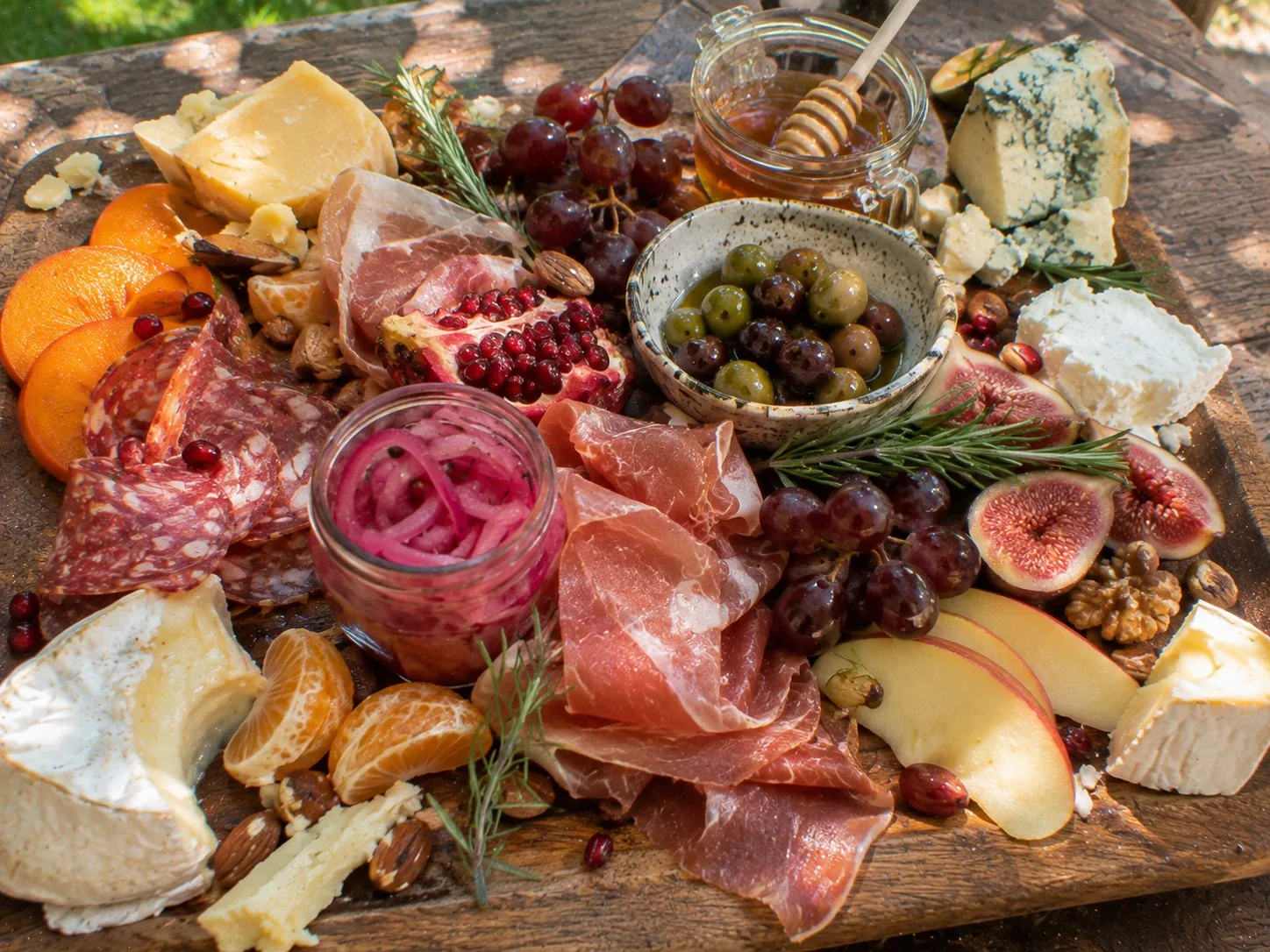
Holiday Charcuterie Board
A generous holiday grazing board built the way I set them up for retreats, with raw-milk cheeses anchoring each corner, cured meats folded into ribbons, and every gap filled with winter fruit, olives, nuts, honey, and rosemary.
Yield: One large board for 8 guests as a hearty appetizer (amounts scale per guest below) · Active: 30–40 min · Total: 1 hr (including 30 min for the cheese to come to room temperature) · Season: Best in North America in winter, when pomegranates, pears, and citrus are at their peak · Best eaten: afternoon or early evening
Ingredients
How much to buy
| Per guest | Appetizer board | Board as the meal |
|---|---|---|
| Cheese | 2 oz | 4–5 oz |
| Cured meats | 1½–2 oz | 3–4 oz |
| Crackers and vegetable “chips” | 5–6 pieces | 8–10 pieces |
| Fresh fruit | ½ cup | ¾–1 cup |
| Olives, pickles, artichokes (combined) | ¼ cup | ⅓ cup |
| Nuts | 2 tbsp | ¼ cup |
| Dried fruit | 1–2 tbsp | 2–3 tbsp |
For reference, my retreat board for 12 guests as a full grazing meal used 3½–4 lb of cheese and 2½–3 lb of cured meats.
For the cheeses (one per quadrant, about 1 lb total for 8)
- 1 aged hard cheese, such as Parmigiano-Reggiano, aged raw-milk Manchego, or aged raw cheddar, broken into rough chunks
- 1 nutty Alpine cheese, such as Gruyère or Comté, sliced into thin triangles
- 1 soft or creamy cheese, such as a soft-ripened goat or cow’s milk round, left whole
- 1 blue or fresh cheese, such as Roquefort or a log of fresh chèvre rolled in chopped herbs
For the cured meats (12–16 oz total for 8)
- Prosciutto di Parma or San Daniele, thinly sliced
- 1 or 2 salamis or soppressata, thinly sliced
- Bresaola (air-dried beef), thinly sliced
For the briny things
- 1 cup mixed olives, such as Castelvetrano, Kalamata, and Niçoise
- 1 cup marinated artichoke hearts, drained
- ½ cup cornichons or lacto-fermented pickles
- ½ cup roasted red peppers or piquillo peppers, sliced (optional)
For the crackers and crisp things
- Grain-free seed crackers (homemade, below), or grain-free almond-flour or cassava crackers
- 1 English cucumber, sliced into thick rounds
- 2 heads Belgian endive, separated into leaves
- 1 small jicama, peeled and cut into thin rounds or planks
For the holiday fruit
- 1 pomegranate, half cut into wedges and half seeded for scattering
- 2 ripe pears, sliced just before serving
- 1 crisp red apple, sliced just before serving
- 1 small bunch red or black grapes, cut into small clusters
- 3–4 clementines or satsumas, some peeled into segments
- 4–6 Fuyu persimmons or fresh figs, sliced, if you can find them
For the sweet and finishing touches
- ½ cup dried fruit, such as dried figs, dried apricots, or Medjool dates
- 1 cup rosemary-maple roasted nuts (below), or raw pecans, walnuts, and almonds
- A small piece of honeycomb, or ¼ cup raw honey in a small bowl
- ¼ cup fig jam or fruit preserves sweetened only with fruit or honey
- 2 tbsp Dijon or whole-grain mustard, in a small bowl
- 6–8 fresh rosemary sprigs, plus thyme or sage
- Edible flowers (optional)
For the rosemary-maple roasted nuts (makes 2 cups)
- 2 cups raw pecans, walnuts, and/or almonds
- 1 tbsp grass-fed butter, melted
- 1 tbsp maple syrup
- 1 tbsp finely chopped fresh rosemary
- ½ tsp flaky sea salt
- Pinch of cayenne (optional)
For the grain-free seed crackers (makes about 40 crackers)
- ½ cup ground flaxseed
- ¾ cup water
- ½ cup raw pumpkin seeds
- ½ cup raw sunflower seeds
- ¼ cup sesame seeds
- 2 tbsp extra virgin olive oil
- ½ tsp sea salt
- 1 tsp chopped fresh rosemary or ½ tsp dried thyme
- Flaky sea salt, for the tops
Method
For the rosemary-maple roasted nuts
- Toss. Heat the oven to 325°F. Toss the nuts with the melted butter, maple syrup, rosemary, salt, and cayenne (if using) on a parchment-lined sheet pan.
- Roast. Spread them out in a single layer and roast 12–15 minutes, stirring once, until fragrant and lightly browned. Cool completely on the pan; they crisp as they cool.
For the grain-free seed crackers
- Soak the flax. Heat the oven to 325°F. Stir the ground flax into the water and let it sit 10 minutes, until it thickens into a gel.
- Mix. Stir in the pumpkin seeds, sunflower seeds, sesame seeds, olive oil, salt, and herbs.
- Spread. Spread the mixture very thin (about ⅛ inch) on a parchment-lined sheet pan, using a second sheet of parchment on top and pressing with your hands or a rolling pin. Peel off the top sheet and sprinkle with flaky salt. Score into squares or rectangles with a knife.
- Bake. Bake 30 minutes, then carefully flip the whole sheet (or break it along the score lines and flip the pieces). Bake 15–25 minutes more, until completely dry and crisp. Turn off the oven and let them cool inside with the door cracked. Break along the score lines.
To build the board
- Temper the cheese. Take the cheeses out of the fridge 30 minutes before guests arrive so their flavor and texture open up.
- Choose your board. Use one very large board, or 2–3 boards spaced along the table for easy reaching. For kosher guests, set up two separate boards (see below).
- Place the bowls. Set small bowls for the olives, honey, jam, and mustard on the board first, spaced apart, so everything else can build around them.
- Anchor with the cheeses. Place one cheese in each quadrant of the board. Cut a few slices or wedges from each one to show people how to dig in, and leave the rest whole with a small knife alongside.
- Fold in the meats. Fold the prosciutto and bresaola into loose ribbons and fan the salami into overlapping rows or folded quarters. Weave them in rivers between the cheeses.
- Fill the gaps. Tuck the artichokes, pickles, peppers, and crackers into the larger spaces, keeping the crackers near the cheeses.
- Add the fruit. Cluster the grapes, pear and apple slices, clementine segments, persimmons or figs, and pomegranate wedges in groups of color across the board. Add the dried fruit and nuts in small piles in the remaining gaps.
- Finish. Scatter pomegranate seeds over the top, drizzle a little honey over the soft cheese, and tuck rosemary sprigs around the edges like a garland. Add thyme, sage, or edible flowers for color. Set out small knives, spoons, and toothpicks.
For a kosher setup
- Keep two boards. Build one cheese-only board and one charcuterie-only board, so meat and dairy never share a surface, serving tools, or space on a plate.
- Choose kosher items. Use kosher-certified cheeses and kosher-certified beef or poultry cured meats (beef bresaola and beef salami work well, and pork is left out).
- Divide the extras. Fruit, nuts, olives, pickles, crackers, and honey can go on both boards. Use separate knives and spoons for each, and keep the butter-roasted nuts on the cheese board only (or roast a batch for the meat board with olive oil instead of butter).
Storage
Wrap leftover cheeses individually in parchment or beeswax wrap and refrigerate up to 1–2 weeks for hard cheeses and up to 5 days for soft ones. Wrap meats tightly and use within 3–5 days.
The roasted nuts and seed crackers keep in airtight jars at room temperature up to 2 weeks.
A board can sit out for about 2 hours; refill from the fridge rather than leaving everything out all evening.
Variations
- Fall board: Swap in fresh figs, Concord grapes, sliced apples, and roasted delicata squash rings, with sage instead of rosemary.
- Summer board: Use stone fruit, cherries, berries, melon, cherry tomatoes, and fresh basil.
- Mediterranean board: Add whipped feta, roasted peppers, grilled eggplant, and extra marinated artichokes, with oregano and lemon.
- Wreath board: Arrange everything in a ring on a round board, with rosemary sprigs tucked all the way around and a bowl of honey or pomegranate seeds in the center.
- Vegetarian board: Leave out the meats and add more cheese, a second dip, and extra roasted nuts and vegetables.
- Bacon-wrapped dates: Add a warm element with Goat Cheese Stuffed Bacon-Wrapped Dates with Rosemary Honey.
Season & Circadian Timing
Pomegranates, pears, persimmons, and citrus all come into their own in late fall and winter, which makes this board feel festive without any effort. The protein and fat from the cheese and meat sit best earlier in the day, so set this out in the afternoon or as an early-evening spread, before the main meal or as the meal itself.
Nourishment Notes
- Raw-milk cheeses — protein, calcium, and fat-soluble vitamins, and aged cheeses are naturally very low in lactose.
- Cured meats — protein and B vitamins in small, rich portions; traditional prosciutto is made with just pork and salt.
- Pomegranate — vitamin C and fiber, plus bright color and tartness that cut through the rich cheese.
- Lacto-fermented pickles and olives — briny and tangy, and pickles fermented in salt brine (rather than vinegar) carry live cultures.
- Nuts and seeds — healthy fats, magnesium, and crunch, without the grains in most crackers.
Sourcing
- Raw-milk cheeses — from a local cheesemaker you trust, or traditional raw-milk cheeses such as Parmigiano-Reggiano DOP, Gruyère AOP, Comté AOP, and Roquefort AOP, which are made from raw milk by law
- Parmigiano-Reggiano — DOP, aged 24+ months, made from raw milk by law
- Manchego — DOP, aged, made from sheep’s milk; look for “leche cruda” (raw milk) on the label
- Goat cheese (chèvre) — fresh chèvre (Cypress Grove), or a local chèvre near you
- Cured meats — from pasture-raised animals, with short ingredient lists and no synthetic nitrates or nitrites; Prosciutto di Parma DOP is made with only pork and sea salt
- Pork — pasture-raised heritage breed, from a local farm (White Oak Pastures)
- Beef — 100% grass-fed and grass-finished, from a local farm (White Oak Pastures or US Wellness Meats)
- Olives — organic, cured in brine or olive oil, with no added coloring
- Artichoke hearts — organic, jarred in olive oil or water (not sunflower or canola oil)
- Pickles — lacto-fermented in salt brine, from the refrigerated section
- Grain-free crackers — homemade, or store-bought crackers made with olive oil, avocado oil, or butter (check labels for seed oils)
- Dried fruit — organic and unsulfured, with no added sugar
- Medjool dates — organic, soft, and plump
- Fig jam — organic, sweetened only with fruit or honey
- Raw honey — organic, local, and unfiltered
- Dijon mustard — organic, with no preservatives or sugar (Delouis Fils or Maison Orphée)
- Maple syrup — organic Grade A dark
- Grass-fed butter — organic, cultured butter from 100% grass-fed cows, or raw butter from a local dairy
- Extra virgin olive oil — organic, single-estate, harvest-dated, in dark glass
- Walnuts / pecans / hazelnuts / macadamias — organic and raw; soak and dry (or sprout) for easier digestion
- Almonds — organic, sprouted, blanched, and skinless
- Seeds (flax, pumpkin, sunflower, sesame) — organic and raw; keep them in the fridge or freezer
- Salt — unrefined sea salt (Baja Gold); flaky sea salt for finishing (Maldon)
- Fruits, vegetables, and herbs — organic, from a farmers’ market or local farm
You might also like: Goat Cheese Stuffed Bacon-Wrapped Dates with Rosemary Honey · Fig and Goat Cheese Pastries — Two Ways (Pinwheels or Hand Pies) · Spiced Orange Chocolate Bark with Pistachios, Pecans, Walnuts, and Mulberries
With Love, Light, and Health,
Anna (aka Food Marshall)
Food Marshall Approved. Grain-free, seed-oil-free and refined-sugar-free, made from organic, local and seasonal ingredients. Our standards
More Snacks, Small Bites & Seasonal Staples
Get new recipes and essays
Seasonal recipes and writing on light, circadian health, and living with nature.
Subscribe on Substack