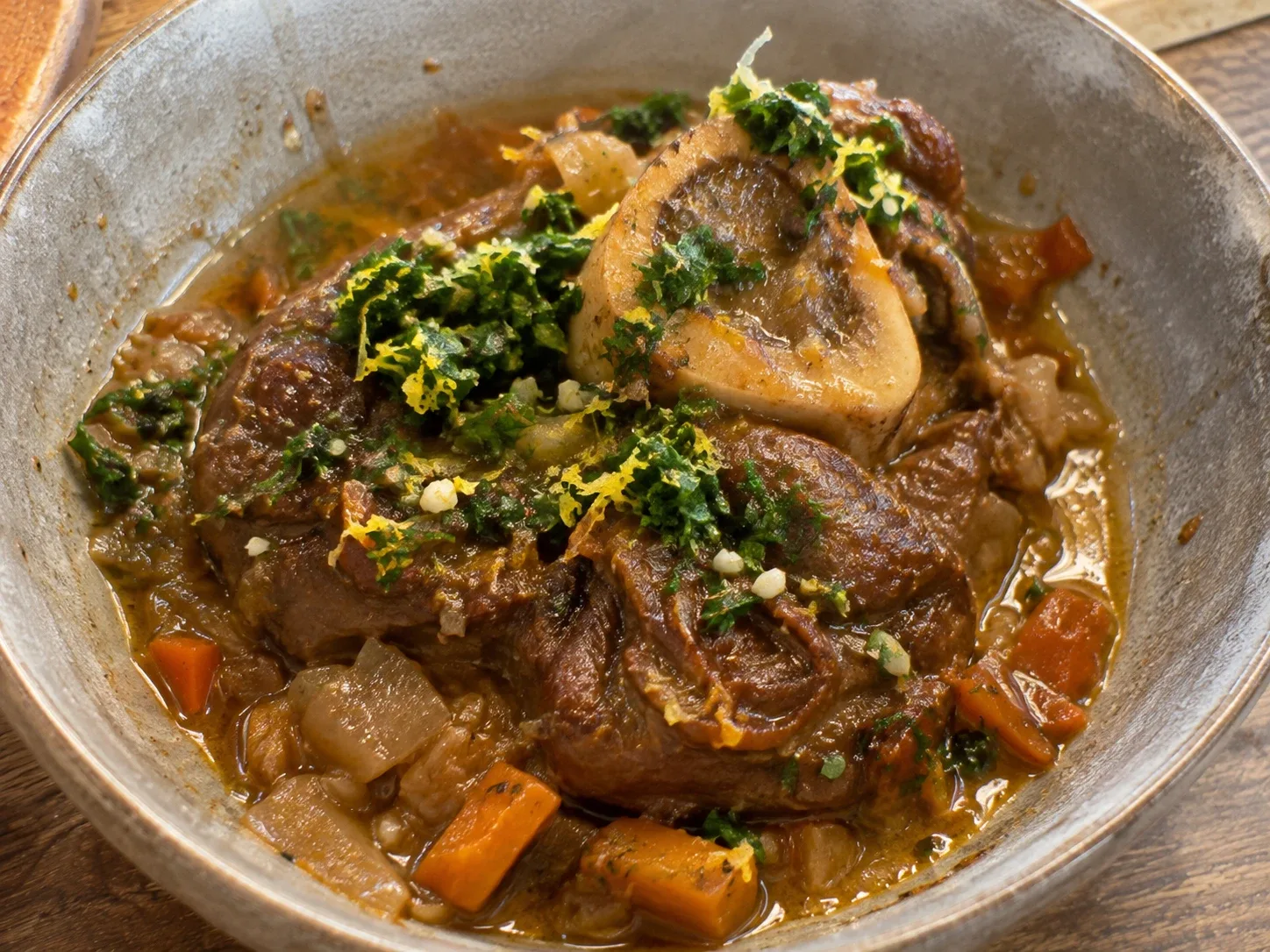
Osso Buco: Braised Veal Shanks with Gremolata
The Milanese winter braise. Thick veal shanks cooked low and slow in white wine until they fall from the bone, then lifted at the end with a bright gremolata of raw parsley, lemon, and garlic.
Yield: Serves 4 · Active: 50 min · Total: 3 hr 30 min · Season: Best in North America in fall and winter, when carrots, celery, and cauliflower are at their peak · Best eaten: early evening
Ingredients
For the veal shanks
- 4 thick veal shanks (osso buco cut, about 2 inches thick and 12 oz each)
- Kitchen twine
- 2 tsp sea salt, plus more to taste
- 1 tsp freshly cracked black pepper
- 2–3 tbsp blanched almond flour, for a light dusting (optional; it helps the browning)
- 3 tbsp grass-fed butter
- 2 tbsp grass-fed ghee
For the braising base
- 1 large yellow onion, finely diced
- 2 large carrots, finely diced
- 2 celery stalks, finely diced
- 4 garlic cloves, minced
- 2 tbsp tomato paste
- 1½ cups dry white wine (a good Pinot Grigio or Soave)
- 3 cups beef bone broth
- 2 bay leaves
- 4 sprigs fresh thyme
- 2 sprigs fresh rosemary
- 1 strip lemon peel, about 3 inches long (use a vegetable peeler)
For the saffron cauliflower “risotto”
- 1 large head cauliflower (about 2½ lb), cut into florets
- 2 tbsp grass-fed butter, divided
- 1 small shallot, minced
- Generous pinch of saffron threads (about 20 threads)
- ½ cup warm bone broth
- ⅓ cup heavy cream
- ½ cup finely grated Parmigiano-Reggiano
- ½ tsp sea salt, or to taste
For the gremolata (made fresh at serving)
- 1 cup fresh flat-leaf parsley, very finely chopped
- Zest of 2 lemons
- 3 garlic cloves, grated to a paste
- Pinch of sea salt
Method
For the veal shanks
- Prep the shanks. Tie a piece of twine snugly around the middle of each shank, like a belt, so it holds its shape as it softens. Pat the shanks very dry and season all over with the salt and pepper. If using, dust them very lightly with almond flour and tap off the excess.
- Brown. Heat the oven to 325°F. Melt the butter and ghee in a heavy Dutch oven over medium-high heat. Brown the shanks 4 minutes per side, in two batches if needed so they aren’t crowded. Move them to a plate.
- Soften the vegetables. Lower the heat to medium. Add the onion, carrot, and celery with a pinch of salt and cook, stirring now and then, 10 minutes, until soft. Add the garlic and stir 30 seconds. Stir in the tomato paste and cook 2 minutes, until it darkens a shade.
- Deglaze. Pour in the wine and scrape up all the browned bits from the bottom of the pot. (Deglazing just means loosening those flavorful bits with liquid.) Simmer until reduced by half, about 5 minutes.
- Braise. Return the shanks to the pot in a single layer. Add the broth, bay, thyme, rosemary, and lemon peel. The liquid should come about two-thirds of the way up the shanks. Bring to a gentle simmer, cover, and move to the oven. Braise 2–2½ hours, until the meat pulls cleanly from the bone but the shanks still hold their shape.
- Make the sauce. Carefully lift the shanks onto a warm platter and cover loosely. Fish out the herb stems, bay, and lemon peel. Simmer the braising liquid on the stove, uncovered, about 10 minutes, until glossy and lightly thickened. Taste and adjust the salt.
For the saffron cauliflower “risotto”
- Rice the cauliflower. While the shanks braise, pulse the florets in a food processor in batches until they look like grains of rice. Don’t overdo it, or it turns to mush.
- Bloom the saffron. Crumble the saffron into the warm broth and let it steep 10 minutes, until the broth turns deep gold.
- Cook. Melt 1 tbsp butter in a wide skillet over medium heat. Cook the shallot 2 minutes, until soft. Add the riced cauliflower and salt and cook, stirring, 5 minutes. Pour in the saffron broth and cook 4–5 minutes more, until the cauliflower is tender and most of the liquid is gone.
- Finish. Stir in the cream, Parmigiano, and remaining 1 tbsp butter and cook 1–2 minutes, until creamy. Taste for salt. Keep warm over the lowest heat.
To serve
- Make the gremolata. Just before serving, stir together the parsley, lemon zest, garlic, and salt.
- Plate. Snip the twine off the shanks. Spoon the cauliflower “risotto” into warm shallow bowls and set one shank on each. Spoon the sauce generously over the top and finish with a big spoonful of gremolata. Give everyone a small spoon for the marrow.
Storage
- Braised shanks keep up to 4 days in the fridge, covered in their sauce in a glass container. They’re even better on day two. Rewarm gently, covered, in a 300°F oven for 25–30 minutes.
- The shanks and sauce freeze well for up to 3 months. Thaw overnight in the fridge.
- Make the gremolata fresh each time you serve. It loses its brightness within a few hours.
- The cauliflower “risotto” keeps 3 days in the fridge. Rewarm in a skillet with a splash of broth.
Variations
- Cauliflower purée: Skip the “risotto” and serve the shanks over a silky cauliflower purée. Simmer the florets until very soft, then blend with butter, a splash of cream, and salt.
- Beef or lamb shanks: Use cross-cut grass-fed beef shanks or lamb shanks and add 30–60 minutes to the braise.
- Orange gremolata: Swap the zest of 1 lemon for orange zest for a sweeter, more festive finish.
- Classic Milanese: Add 1 cup chopped canned tomatoes to the braise along with the broth for a redder, richer sauce.
Season & Circadian Timing
Osso buco is a cold-weather dish, made for the months when you want the oven on all afternoon. It’s a celebration meal in Italy, often served at Christmas, New Year’s, and birthdays. Serve it in the early evening so this rich, slow meal has time to settle before bed.
Nourishment Notes
- Veal shanks — the slow braise turns the collagen in the shank into gelatin, which gives the sauce its silky body and supplies the amino acid glycine.
- Bone marrow — rich, buttery fat at the center of each bone, traditionally scooped out with a small spoon at the end of the meal.
- Gremolata — raw parsley and lemon bring vitamin C, which helps your body absorb the iron in the meat, and their sharp brightness cuts the richness of the marrow.
- Cauliflower — a grain-free base that soaks up the sauce, with vitamin C, vitamin K, and fiber.
- Saffron — a few threads give deep golden color and a gentle floral flavor, like the classic risotto alla milanese.
Sourcing
- Veal — humanely raised on a pasture-based farm (Marcho Farms, Strauss Brands, or a local farmer you trust)
- Grass-fed butter — organic, cultured butter from 100% grass-fed cows, or raw butter from a local dairy
- Ghee — grass-fed ghee, or homemade from organic grass-fed butter
- Bone broth — homemade from pasture-raised bones, or organic and sold frozen (Bonafide Provisions)
- Heavy cream — raw from a farmer you know and trust, or organic, grass-fed, low-temperature pasteurized cream (Kalona SuperNatural)
- Almond flour — organic and blanched (keep it in the fridge)
- Lemons — organic (you’re using the zest)
- Salt — unrefined sea salt (Baja Gold); flaky sea salt for finishing (Maldon)
- Fruits, vegetables, and herbs — organic, from a farmers’ market or local farm
You might also like: Lamb Osso Buco with Braised Green Cabbage, Broccolini, Juniper, and Creamy Goat Chèvre · Fennel & Orange Braised Beef Shanks · Silky Purées Three Ways: Buttery Mashed Potatoes, Whipped Cauliflower Purée, and Roasted Carrot Purée
With Love, Light, and Health,
Anna (aka Food Marshall)
Food Marshall Approved. Grain-free, seed-oil-free and refined-sugar-free, made from organic, local and seasonal ingredients. Our standards
More Meat
Get new recipes and essays
Seasonal recipes and writing on light, circadian health, and living with nature.
Subscribe on Substack