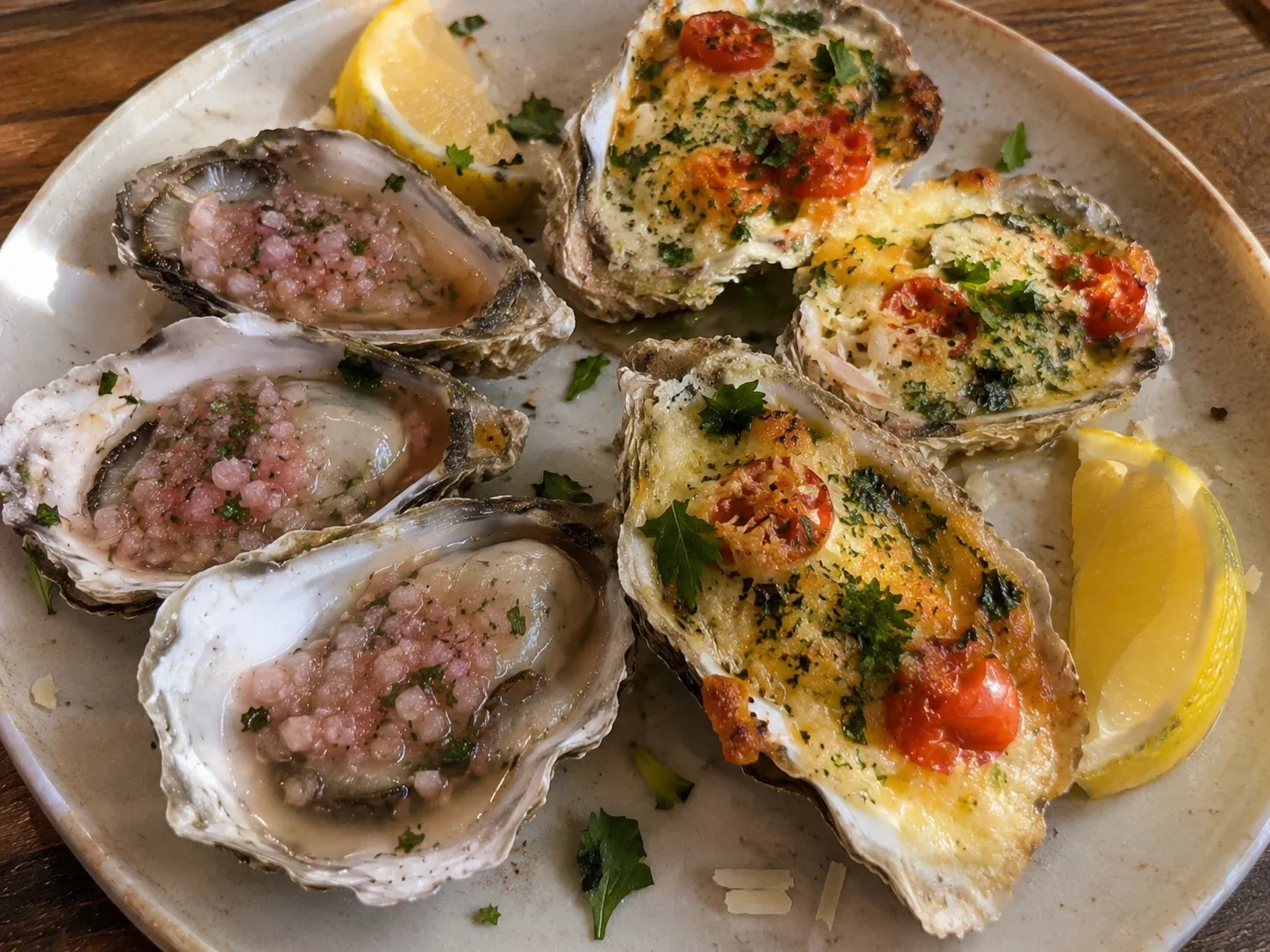
Oysters Two Ways: On the Half Shell with Champagne Mignonette, and Baked with Garlic-Lemon-Parsley Butter, Asiago, and Cherry Tomatoes
Two dozen oysters, half served raw on ice with a classic Champagne mignonette and half baked under garlic-lemon-parsley butter, cherry tomato, and aged Asiago until bubbling. A celebration platter for the cold months.
Yield: Serves 4 (2 dozen oysters) · Active: 40 min · Total: 1 hr, plus at least 2 hr for the mignonette to mellow · Season: Best in North America in fall and winter, when oysters from cold water are at their firmest, sweetest, and briniest · Best eaten: early evening
Fall swap: Fresh tomatoes generally aren’t in season in fall. Leave them off, or use a few pomegranate seeds or finely diced shallot instead.
Ingredients
For the oysters
- 24 fresh, live oysters (Kumamoto, Blue Point, Malpeque, or a mix), scrubbed
- Crushed ice, for the raw platter
- About 4 cups coarse rock salt, for the baking tray and the serving platter
- 2 lemons, cut into wedges
For the Champagne mignonette
- ¼ cup Champagne vinegar (or good white wine vinegar)
- 1 small shallot, very finely minced
- 1 tsp coarsely cracked black pepper
- 1 tsp coarsely cracked pink peppercorns (optional)
- Pinch of flaky sea salt
For the garlic-lemon-parsley butter
- 6 tbsp raw or grass-fed butter, softened
- 3 garlic cloves, finely grated or minced
- Zest of 1 lemon
- 1 tbsp fresh lemon juice
- 3 tbsp finely chopped flat-leaf parsley
- ¼ tsp sea salt
- A few grinds of black pepper
For the baked topping
- 6 cherry tomatoes, finely chopped
- ½ cup finely grated aged Asiago (about 1½ oz)
Optional at the table
- Freshly grated horseradish
- A few drops of hot sauce (no added sugar)
- Very cold Champagne
Method
For the Champagne mignonette
- Combine. Stir the vinegar, shallot, black pepper, pink peppercorns, and salt together in a small bowl.
- Rest. Cover and refrigerate at least 2 hours, or overnight. The shallot softens and the vinegar picks up its sweetness.
For the garlic-lemon-parsley butter
- Mash. Mash the softened butter with the garlic, lemon zest and juice, parsley, salt, and pepper until evenly mixed. Keep it at cool room temperature so it spreads easily. You can make it up to 3 days ahead and refrigerate it; let it soften 30 minutes before using.
To shuck the oysters
- Check. Each oyster should be tightly closed, feel heavy for its size, and smell like clean sea water. Discard any that are open and won’t close when tapped, or that smell off.
- Set up. Fold a kitchen towel into a thick pad. Hold the oyster cupped side down in the towel, with the hinge (the pointed end) facing you. The towel protects your hand.
- Pop the hinge. Work the tip of an oyster knife into the small gap at the hinge. Push gently and twist the knife like a key until you feel the hinge give with a small pop.
- Cut the top muscle. Slide the blade along the inside of the flat top shell to cut the muscle holding it. Lift off the top shell and discard it. Wipe away any grit or shell bits with the knife tip.
- Free the oyster. Slide the knife under the oyster to cut the bottom muscle, so it sits loose in its shell. Keep the cup level so you don’t lose the liquor (the salty juice inside, which is part of the pleasure).
- Divide. Shuck all 24 and set 12 aside for the raw platter and 12 for baking. Shuck as close to serving as you can, or ask your fishmonger to shuck them no more than 20 minutes before you pick them up.
For the raw oysters
- Build the platter. Spread a deep bed of crushed ice on a large platter or tray. Press the 12 raw oysters firmly into the ice so they sit level.
- Serve. Tuck in the bowl of mignonette, a few lemon wedges, and the horseradish if using. Serve right away, while the oysters are very cold.
For the baked oysters
- Heat the oven. Heat the oven to 450°F, or set the broiler to high with a rack about 6 inches from the heat.
- Make a salt bed. Spread a ½-inch layer of rock salt on a rimmed sheet pan. Nestle the 12 oysters into the salt so they sit level and the butter can’t spill out.
- Top. Spoon about 1½ tsp garlic-lemon-parsley butter onto each oyster. Scatter a little chopped cherry tomato over each, then a generous pinch of Asiago.
- Bake. Bake 8–10 minutes, or broil 3–5 minutes, until the butter is bubbling, the edges of the oysters just curl, and the cheese is melted and starting to brown. Watch closely under the broiler.
- Serve. Spread a fresh layer of rock salt on a serving platter, move the hot oysters onto it with tongs, and serve with lemon wedges. Warn everyone that the shells are very hot.
Storage
- Keep live, unshucked oysters cupped side down in a bowl in the fridge, covered with a damp towel, for up to 2 days. Never store them in water or a sealed bag; they need to breathe.
- Shucked oysters are best eaten within the hour. Leftover baked oysters keep 1 day in the fridge and can be rewarmed in a 400°F oven for 4–5 minutes.
- The mignonette keeps up to 1 week in the fridge. The herb butter keeps 1 week in the fridge or 2 months in the freezer.
Variations
- All baked: Double the butter, tomato, and Asiago and bake all 24 oysters. This is a gentle way in for anyone who is shy about raw oysters.
- Grilled: Set the topped oysters directly on a hot grill grate, close the lid, and cook 5–7 minutes, until bubbling.
- Spinach and bacon: Add a spoonful of wilted chopped spinach and crumbled pasture-raised bacon under the butter before baking.
- Other cheeses: Swap the Asiago for aged Parmigiano-Reggiano, Pecorino Romano, or Gruyère.
- Citrus mignonette: Replace half the vinegar with fresh blood orange or grapefruit juice.
Each of the three toppings below is enough for 12 shucked oysters. Shuck them as described above.
Raw Oysters with Mango Pico de Gallo
- 12 freshly shucked oysters, on ice
- 1 ripe mango, peeled, pitted, and cut into small dice
- ½ small red onion or 2 shallots, finely chopped
- 1 small handful fresh cilantro, finely chopped
- Juice of 1 lime, plus lime wedges for serving
- 2–3 tbsp extra virgin olive oil
- Pinch of sea salt and black pepper
- Optional: ½ red bell pepper, finely diced, and 1 tomato, seeded and finely diced
- Marinate. Stir the mango, onion, cilantro, lime juice, olive oil, salt, pepper, and the bell pepper and tomato if using in a bowl. Let it sit at room temperature for 30 minutes so the flavors come together.
- Top. Set the oysters on a bed of crushed ice. Spoon a small dollop of pico onto each one and finish with a squeeze of lime. Serve right away.
Oysters with Bacon, Garlic, and Herbs
- 12 freshly shucked oysters
- ½ lb pasture-raised bacon, chopped into very small bits
- 3–4 garlic cloves, minced
- 1 small handful fresh sage leaves, finely chopped
- 1 small handful fresh rosemary or thyme, finely chopped
- Pinch of sea salt and black pepper
- Juice of 1 lemon
- Optional: 2 tbsp finely grated Parmigiano-Reggiano
- Crisp the bacon. Cook the bacon in a large skillet over medium-low heat, stirring now and then, for 10–12 minutes, until browned and crisp.
- Add the aromatics. Stir in the garlic and herbs and cook 1 minute more, until fragrant. Lift everything out with a slotted spoon into a small bowl and season with salt and pepper. Save the fat in the pan.
- Top. Arrange the oysters on a platter of ice or rock salt and spoon the bacon mixture over each. Drizzle with a little of the warm bacon fat if you like, then add a squeeze of lemon and a pinch of Parmigiano.
- Or broil. For warm oysters, set them on a rock-salt-lined sheet pan, add the topping and cheese, and broil on high about 6 inches from the heat for 2–4 minutes, until the edges just curl.
Oysters Rockefeller with an Almond-Parmigiano Crumb
- 12 freshly shucked oysters
- 3 tbsp raw or grass-fed butter, divided
- 1 shallot, finely chopped
- 2 garlic cloves, minced
- 2 cups packed spinach (or watercress), finely chopped
- 3 tbsp finely chopped flat-leaf parsley
- 1 tbsp finely chopped fresh tarragon (or 2 tbsp chopped celery leaves)
- 2 tbsp heavy cream (optional)
- Sea salt and black pepper
- ¼ cup blanched almond flour
- ¼ cup finely grated Parmigiano-Reggiano
- Lemon wedges, for serving
- Cook the greens. Melt 2 tbsp of the butter in a skillet over medium heat. Add the shallot and garlic and cook 4–5 minutes, until soft. Add the spinach, parsley, and tarragon and stir 1–2 minutes, until wilted. Stir in the cream, if using, simmer 1 minute, and season with salt and pepper.
- Make the crumb. Melt the remaining 1 tbsp butter and toss it with the almond flour, Parmigiano, and a pinch of salt until it looks like damp sand. This stands in for the usual breadcrumbs.
- Top. Heat the broiler to high with a rack about 6 inches from the heat. Nestle the oysters into a rock-salt-lined sheet pan. Spoon about 1 tbsp of the greens onto each oyster and sprinkle with the crumb.
- Broil. Broil 3–5 minutes, until the topping bubbles and the crumb is golden. Serve hot with lemon wedges.
Season & Circadian Timing
Oysters are at their best in the cold months, when the water is chilly and they are plump and firm. That is why they show up on holiday tables from Thanksgiving through New Year’s Eve. Serve them as an early evening first course, while the evening is still young and the meal can unfold slowly.
Nourishment Notes
- Oysters — the most zinc-rich food there is; a half dozen covers more than a day’s needs. They also bring copper, vitamin B12, selenium, iodine, and DHA, an omega-3 fat.
- Raw versus baked — eating some raw keeps their heat-sensitive nutrients intact, while baking adds warmth and comfort without losing the minerals.
- Champagne mignonette — the sharp vinegar and shallot cut the oyster’s mineral richness without covering its clean ocean flavor.
- Aged Asiago — a hard aged cheese that adds protein, calcium, and deep savory flavor.
- Garlic and parsley — garlic brings its sharp, sulfur-rich compounds, and parsley adds vitamin K and vitamin C.
Sourcing
- Oysters — live, from a reputable fishmonger, bought the morning you serve them. Ask where they came from and when they were harvested. Pacific oysters like Kumamoto tend to be small, sweet, and creamy; Atlantic oysters like Malpeque and Blue Point are larger, brinier, and more mineral. A mix makes a beautiful platter.
- Asiago — aged Asiago d’Allevo DOP, or another raw-milk aged hard cheese, from a good cheesemonger
- Grass-fed butter — organic, cultured butter from 100% grass-fed cows, or raw butter from a local dairy
- Champagne vinegar — naturally fermented, in glass
- Spices — organic and non-irradiated (Ceylon cinnamon from Sri Lanka)
- Lemons / limes / oranges — organic (you’re using the zest)
- Salt — unrefined sea salt (Baja Gold); flaky sea salt for finishing (Maldon)
- Fruits, vegetables, and herbs — organic, from a farmers’ market or local farm
You might also like: Dover Sole Meunière with Lemon, Capers, and Brown Butter · Pan-Seared Scallops with Garlic-Chive Sauce, Celery Root Purée, and Roasted Root Vegetables
With Love, Light, and Health,
Anna (aka Food Marshall)
Food Marshall Approved. Grain-free, seed-oil-free and refined-sugar-free, made from organic, local and seasonal ingredients. Our standards
More Seafood
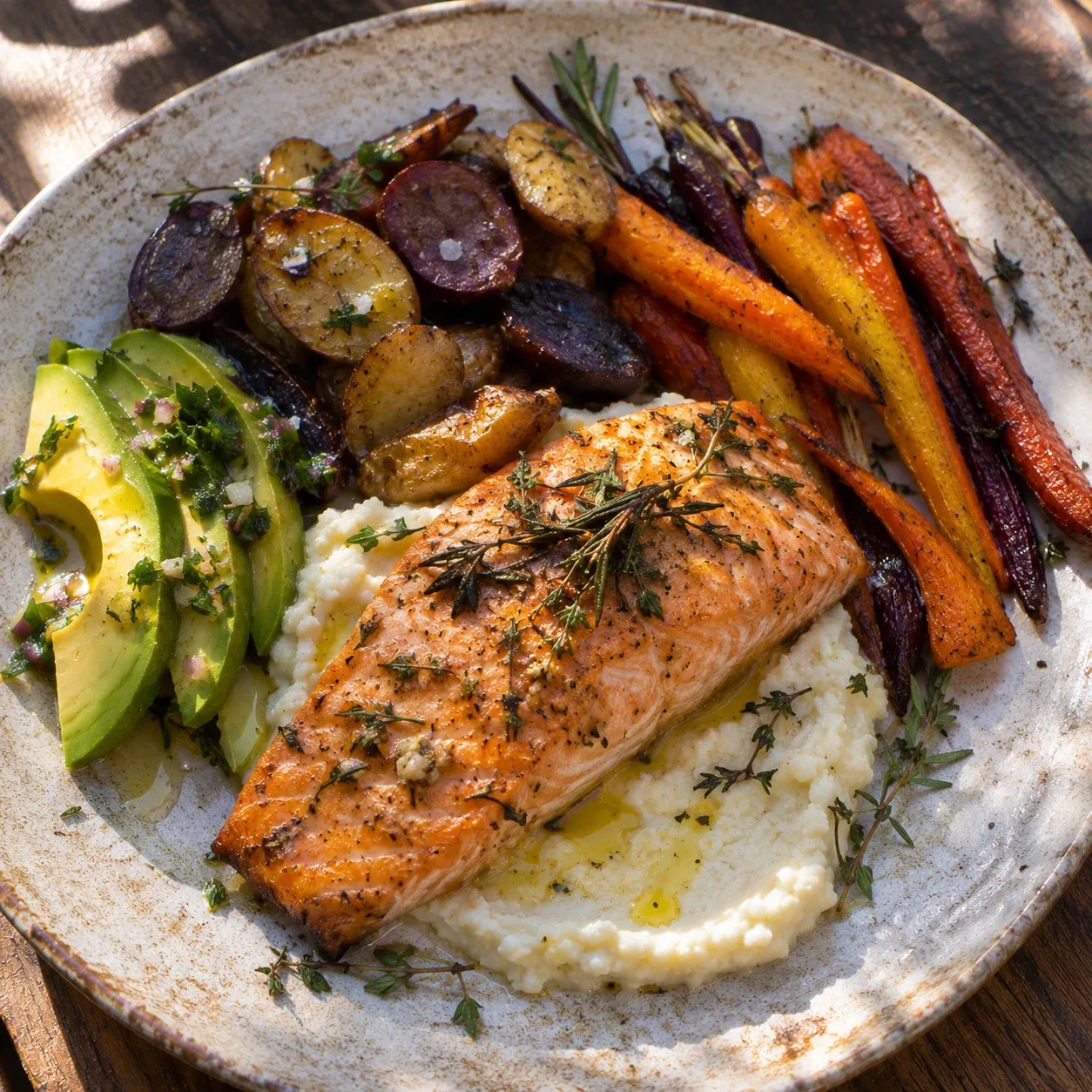
Baked Wild Salmon with Rosemary and Thyme, Whipped Cauliflower Purée, Roasted Rainbow Carrots, Purple and Fingerling Potatoes, and Avocado with Herb Vinaigrette
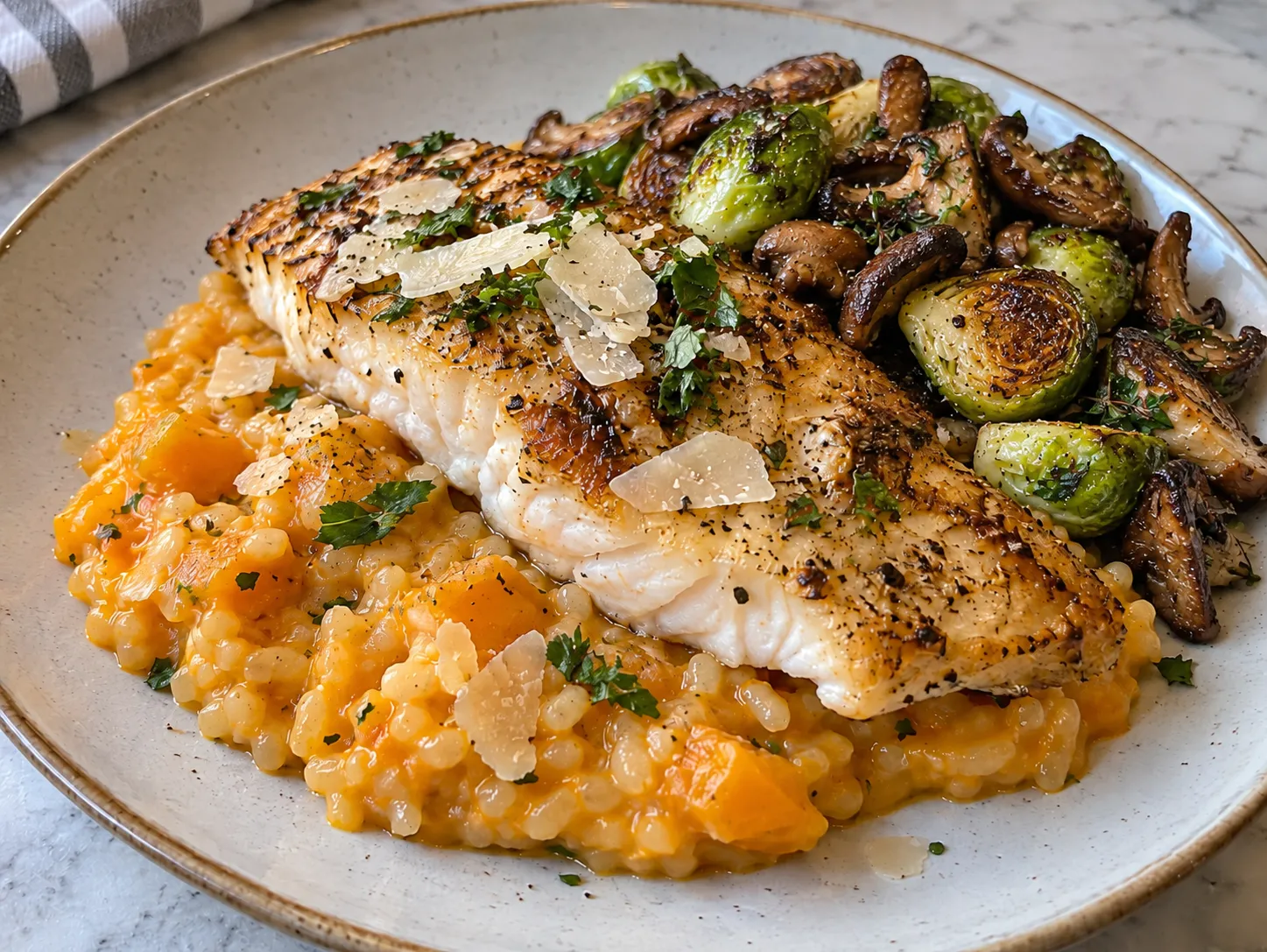
Caesar-Roasted Whole Snapper with Butternut Squash "Risotto", Wild Mushrooms, and Roasted Brussels Sprouts
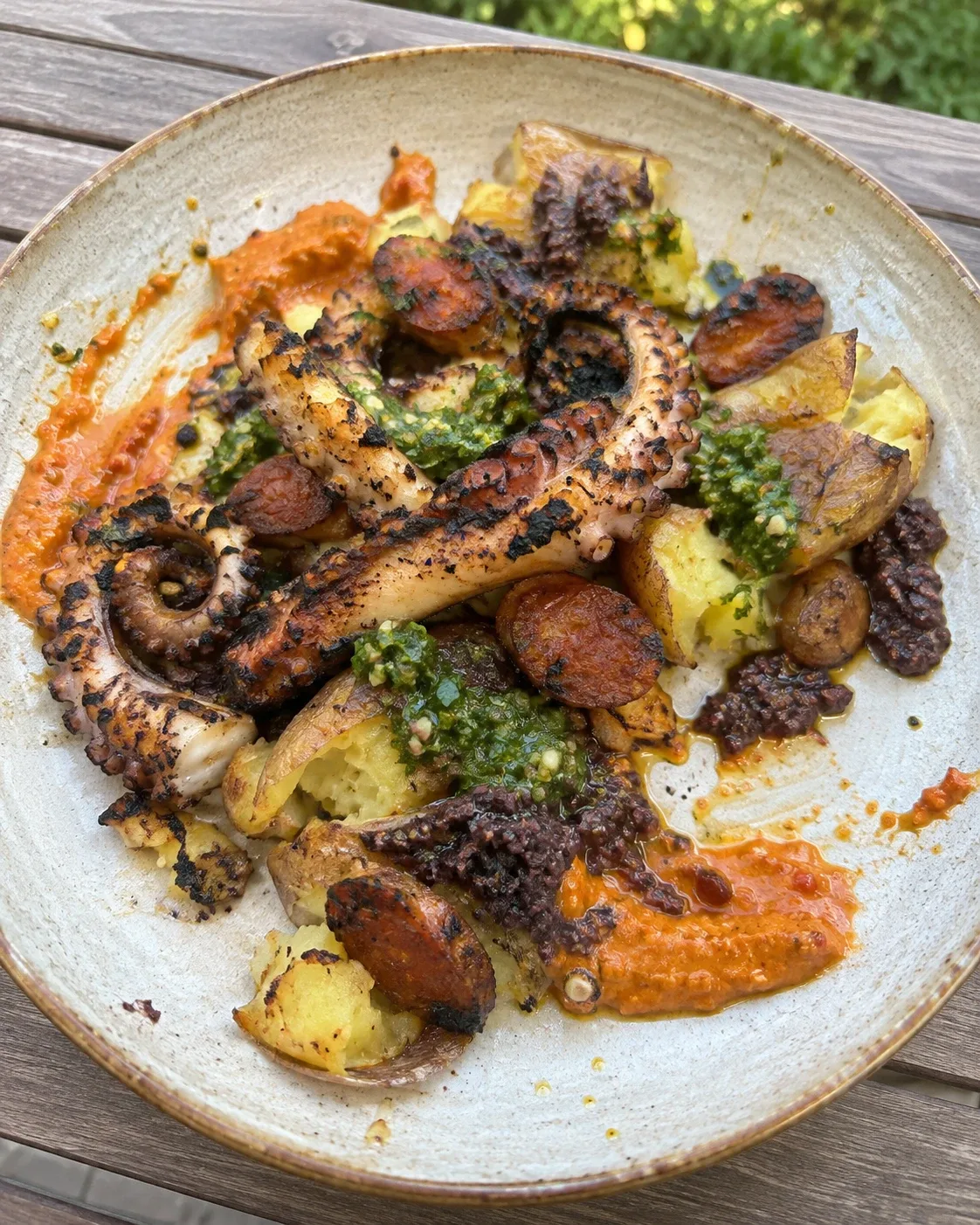
Charred Octopus with Chorizo, Crushed Fingerling Potatoes, Olive Tapenade, Romesco, and Chimichurri
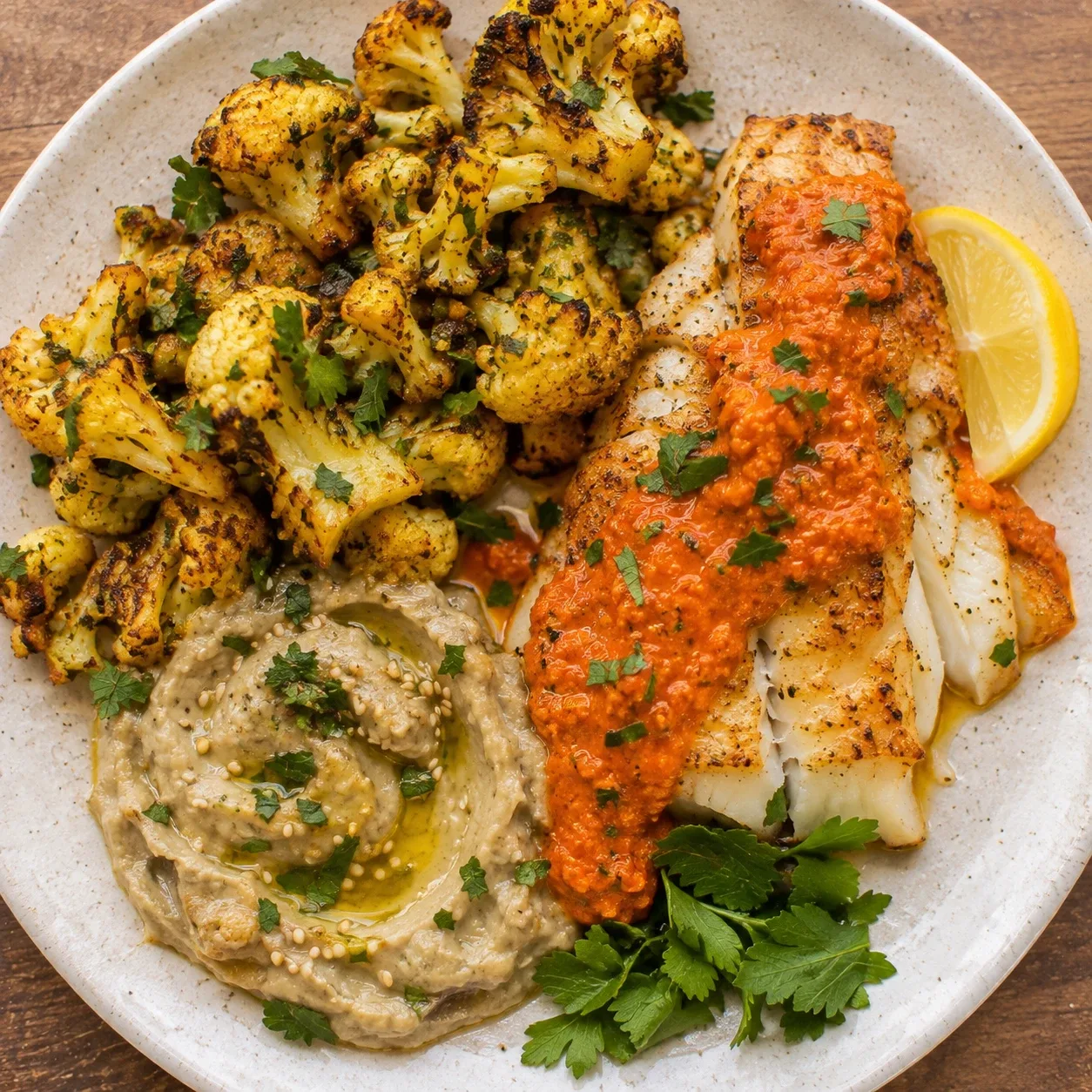
Roasted Chermoula Cauliflower with Baba Ghanoush, Red Pepper Romesco, and Wild Fish
Get new recipes and essays
Seasonal recipes and writing on light, circadian health, and living with nature.
Subscribe on Substack