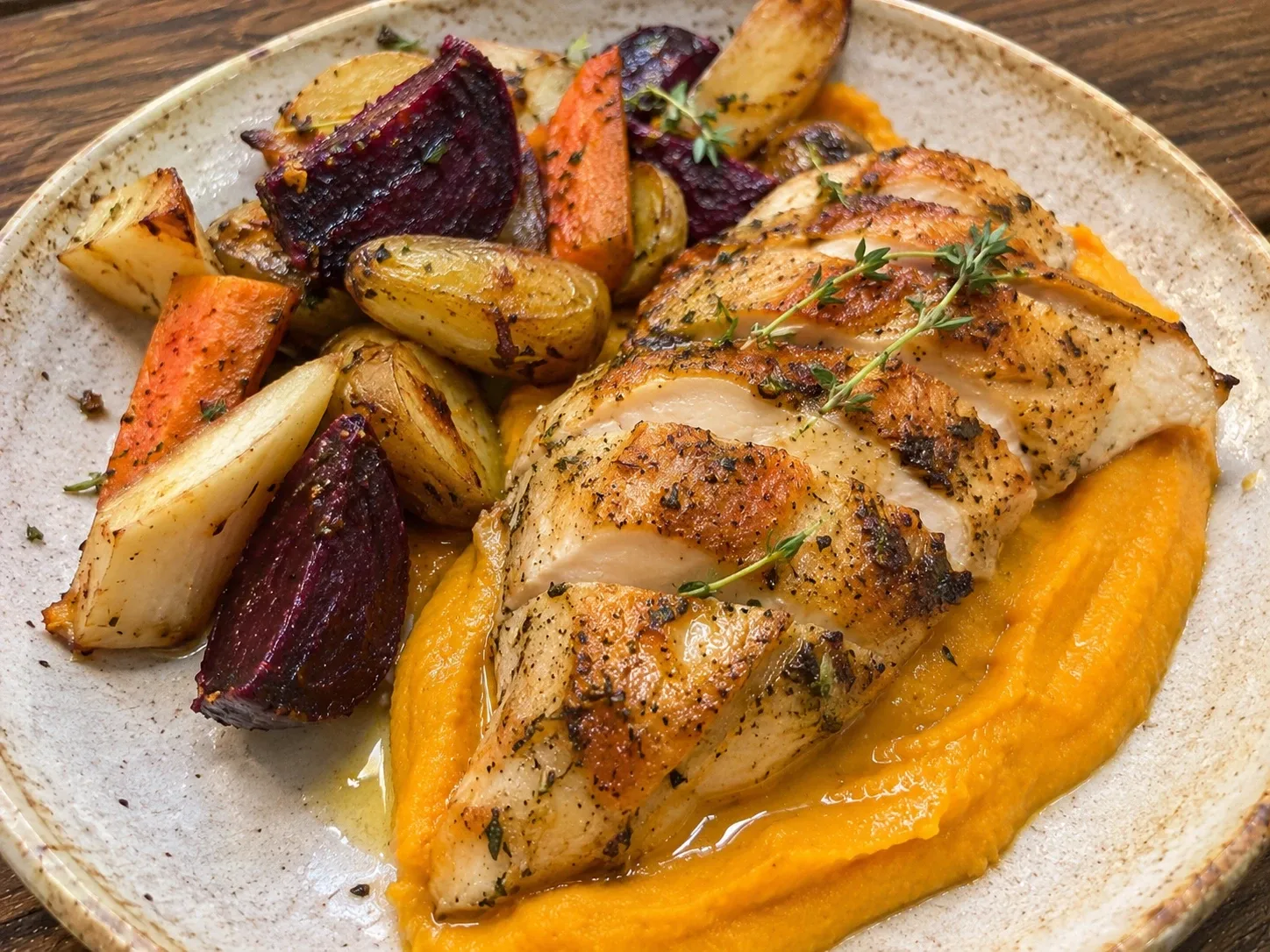
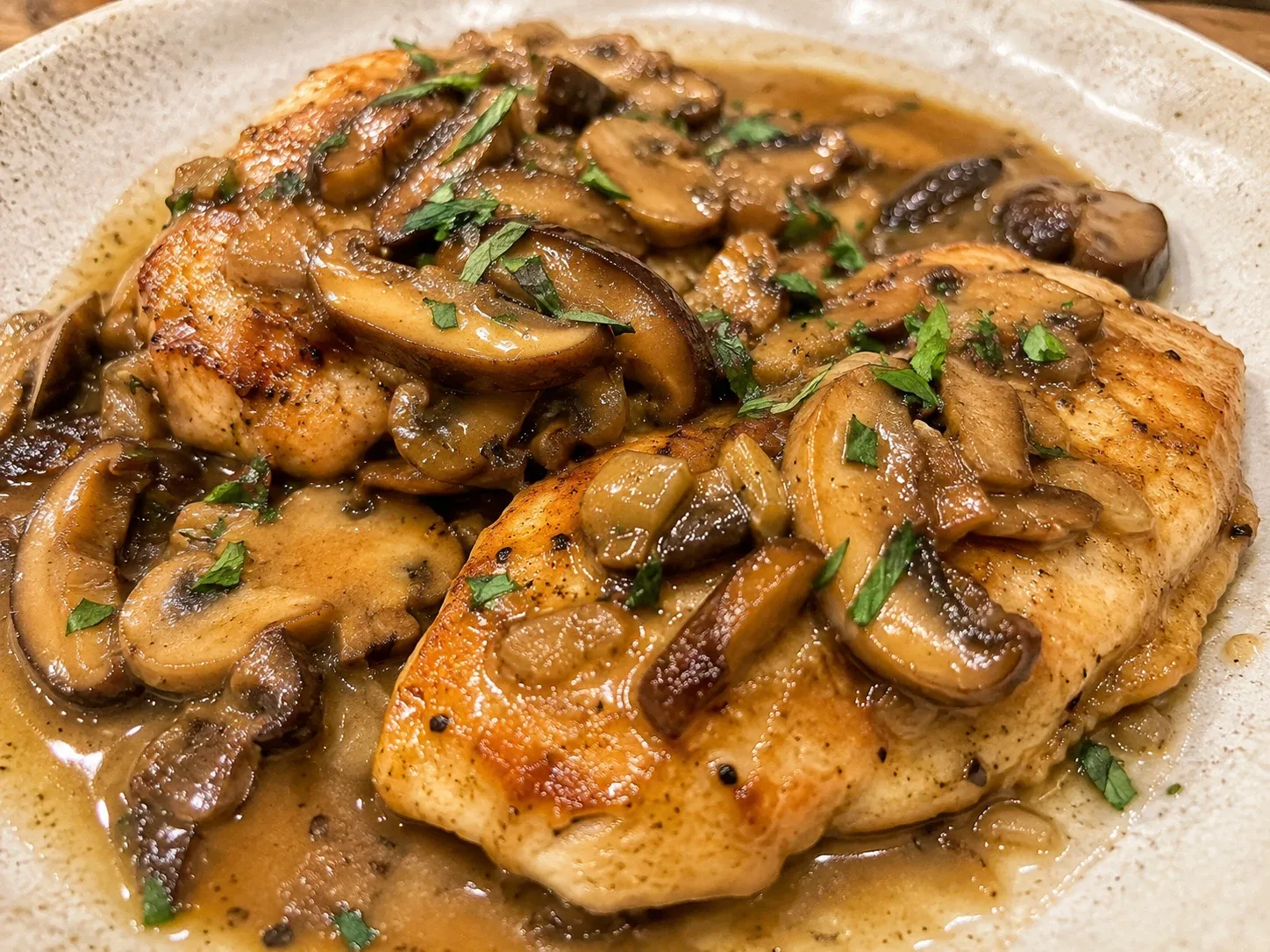
Pan-Seared Chicken Breast with Carrot Purée and Roasted Root Vegetables
Dijon and thyme chicken seared golden in butter, over a velvety roasted carrot purée, with a tray of crispy fingerlings, beets, parsnips, and turnips. A cozy, colorful plate for the cold months.
Yield: Serves 4 · Active: 45 min · Total: 1 hr 45 min · Season: Best in North America in fall and winter, when carrots, beets, parsnips, and turnips are at their peak · Best eaten: early evening
Ingredients
For the carrot purée
- 2 lb carrots, peeled and julienned (cut into thin matchsticks)
- 1 tsp sea salt
- ¼ tsp freshly ground black pepper
- 2 tbsp extra virgin olive oil
- 1 garlic clove
- 4–5 sprigs fresh thyme, leaves stripped (about 1 tsp leaves)
- ¼ cup (4 tbsp) grass-fed butter
- ¼–½ cup bone broth, warmed, as needed
For the roasted root vegetables and baby potatoes
- 1 lb baby fingerling potatoes, halved lengthwise
- 2 medium beets, peeled and cut into ¾-inch dice
- 2 medium carrots, cut into ¾-inch pieces
- 2 medium parsnips, peeled and cut into ¾-inch pieces
- 2 small turnips, peeled and cut into ¾-inch dice
- 1 bunch radishes, trimmed and halved
- 1¼ tsp sea salt
- ½ tsp freshly ground black pepper
- 1 tbsp fresh thyme leaves
- 1 tbsp finely chopped fresh rosemary
- 3–4 tbsp melted grass-fed ghee, tallow, duck fat, or extra virgin olive oil
For the caramelized onion (optional)
- 1 large red or yellow onion, thinly sliced
- 1 tbsp grass-fed butter
- Pinch of sea salt
For the pan-seared chicken
- 4 boneless, skinless pastured organic chicken breasts (6–8 oz each)
- 1 tsp sea salt
- ½ tsp freshly ground black pepper
- 1 tbsp extra virgin olive oil
- 1 tbsp Dijon mustard
- 1 tbsp fresh thyme leaves
- 2 tbsp grass-fed butter
Method
For the carrot purée
- Roast the carrots. Heat the oven to 400°F. Spread the julienned carrots on a parchment-lined rimmed baking sheet, sprinkle with the salt and pepper, and drizzle with the olive oil. Toss and spread into an even layer. Bake 35–40 minutes, tossing halfway, until softened and crispy at the edges.
- Blend. Put the roasted carrots in a food processor with the garlic, thyme leaves, and butter. Blend, adding warm bone broth a splash at a time and scraping down the sides, until smooth and velvety. Taste for salt. Keep warm in a covered pot over very low heat.
For the roasted root vegetables and baby potatoes
- Turn up the heat. When the carrots for the purée come out, raise the oven to 450°F.
- Season. Divide the potatoes, carrots, parsnips, turnips, and radishes between two rimmed baking sheets, keeping the beets in their own corner so their color doesn’t stain everything. Season with the salt, pepper, thyme, and rosemary, and drizzle with your fat of choice. Toss to coat and spread out in a single layer.
- Roast. Roast 30–40 minutes, tossing once halfway and swapping the pans between racks, until the vegetables are crispy and browned outside and tender all the way through.
For the caramelized onion (optional)
- Caramelize. While the vegetables roast, melt the butter in a skillet over medium-low heat. Add the onion and salt and cook, stirring every few minutes, 25–30 minutes, until soft, sweet, and deep golden. Add a splash of water if it starts to stick. Fold into the roasted vegetables just before serving.
For the pan-seared chicken
- Even it out. If the breasts are very thick at one end, place them between two sheets of parchment and pound the thick end with a meat mallet or heavy pan to an even ¾ inch, so they cook through evenly.
- Season. Rub the chicken with the salt, pepper, olive oil, Dijon, and thyme on both sides.
- Sear. Melt the butter in a large cast iron or stainless steel skillet over medium heat until it foams. Add the chicken and cook, without moving it, 5–6 minutes, until a golden crust forms. Flip and cook 5–6 minutes more, until the thickest part reads 165°F on an instant-read thermometer. Keep the heat at medium so the butter and mustard brown without burning.
- Rest. Move the chicken to a board and rest 5 minutes, then slice.
To serve
- Plate. Swoosh a big spoonful of carrot purée across each plate, lay the sliced chicken over it, and pile the roasted root vegetables (with the caramelized onion, if using) alongside. Spoon any butter left in the pan over the chicken.
Storage
- The carrot purée keeps up to 5 days in the fridge, or 3 months in the freezer. Rewarm over low heat with a splash of bone broth.
- Chicken and roasted vegetables keep up to 4 days. Rewarm the vegetables on a sheet pan at 425°F for 8–10 minutes to bring back the crisp.
Variations
- Chicken thighs: Use 6–8 boneless thighs and sear 5–7 minutes per side, to 175°F.
- Pick your roots: Use any mix of root vegetables you have, such as celery root, rutabaga, sweet potato, or golden beets, keeping the total around 3 lb.
- Spiced purée: Add ½ tsp ground cumin or a pinch of cinnamon to the carrots before blending.
- Dairy-free purée: Blend with 3 tbsp extra virgin olive oil in place of the butter.
Season & Circadian Timing
Carrots, beets, parsnips, and turnips get sweeter after the first frosts, so this is a plate made for fall and winter, when the root cellar is full and the days are short. Enjoy it in the early evening; the roasted roots and potatoes are warming and settling at the end of a cold day, and an earlier dinner gives your body time to digest before sleep.
Nourishment Notes
- Pasture-raised chicken — a great source of protein, niacin, vitamin B6, and selenium.
- Carrots — rich in beta-carotene, which your body turns into vitamin A; blending them with butter helps you absorb it.
- Beets — bring folate, potassium, and the deep red pigments called betalains.
- Root vegetables and potatoes — offer fiber, potassium, and vitamin C, plus slow, steady carbohydrates for cold-weather days.
- Bone broth — adds gelatin and the amino acid glycine to the purée, along with savory depth (see Broths 101 — A Foundation to make your own).
Sourcing
- Chicken — pasture-raised, from a local farm (White Oak Pastures)
- Grass-fed butter — organic, cultured butter from 100% grass-fed cows, or raw butter from a local dairy
- Ghee — grass-fed ghee, or homemade from organic grass-fed butter
- Tallow / lard / duck fat — from pasture-raised animals, from a local farm or butcher
- Extra virgin olive oil — organic, single-estate, harvest-dated, in dark glass
- Dijon mustard — organic, with no preservatives or sugar (Delouis Fils or Maison Orphée)
- Bone broth — homemade from pasture-raised bones, or organic and sold frozen (Bonafide Provisions)
- Potatoes — organic; conventional potatoes are often treated with sprout inhibitors after harvest
- Salt — unrefined sea salt (Baja Gold); flaky sea salt for finishing (Maldon)
- Fruits, vegetables, and herbs — organic, from a farmers’ market or local farm
You might also like: Pork Chops with Garlicky Rainbow Chard, Crispy Shiitakes, Carrot Purée, Roasted Vegetables, and Gremolata, Chicken Breast with Lemon-Caper Butter, Potato Purée, and Roasted Pepper-Zucchini Medley, Farm-to-Table Roasted Root Vegetables with Labneh, Dukkah, and Mint Gremolata
With Love, Light, and Health,
Anna (aka Food Marshall)
Food Marshall Approved. Grain-free, seed-oil-free and refined-sugar-free, made from organic, local and seasonal ingredients. Our standards
More Poultry
Get new recipes and essays
Seasonal recipes and writing on light, circadian health, and living with nature.
Subscribe on Substack