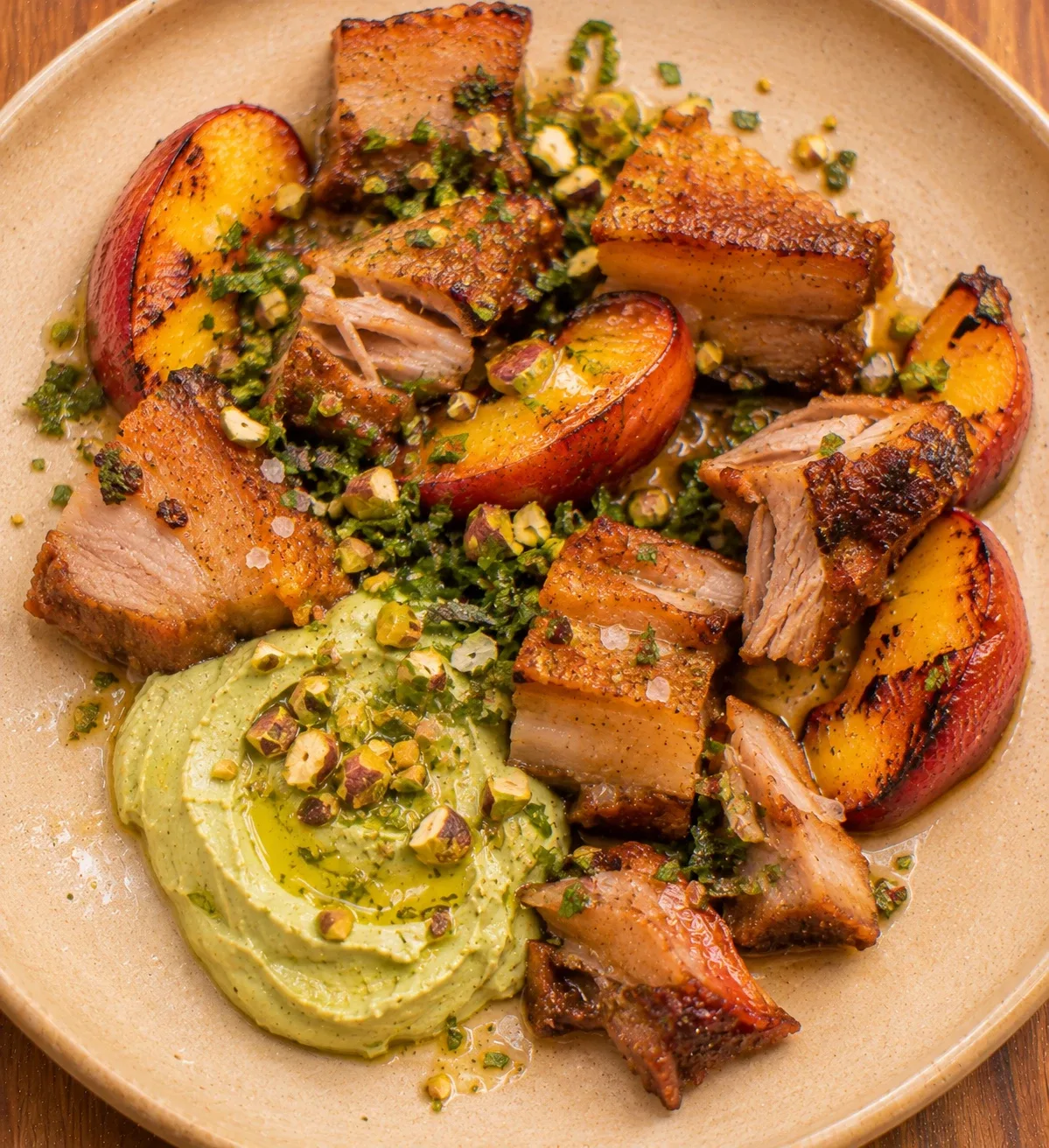
Pork Belly with Charred Peaches and Nectarines and Pistachio Mousse
Crackling slow-roasted pork belly, caramelized peaches and nectarines, and a silky savory pistachio mousse, finished with a pile of summer herbs. It’s a showpiece, but almost all of it can be made a day ahead.
Yield: Serves 6 · Active: about 1 hr · Total: about 4 hr, plus an overnight dry brine (and an optional overnight press) · Season: Best in North America in mid to late summer, when peaches, nectarines, mint, and basil are at their peak · Best eaten: midday
Ingredients
For the pork belly
- 2½–3 lb pasture-raised pork belly, skin on, in one slab
- 1 tbsp unrefined sea salt (plus more for the skin)
- 1 tsp freshly cracked black pepper
- 1 tsp fennel seeds, lightly crushed
- 1 tsp coconut sugar (optional, for browning)
For the peaches and nectarines
- 2 ripe but firm peaches
- 2 ripe but firm nectarines
- 1 tbsp grass-fed ghee or avocado oil (for searing)
- Juice of 1 lime
- Pinch of flaky sea salt
For the pistachio mousse
- 1 cup raw shelled pistachios
- ⅓ cup raw cream, plus ½ cup more for whipping
- 3 tbsp extra virgin olive oil
- Zest of 1 lemon, plus 2 tbsp juice
- 1 small garlic clove
- ½ tsp unrefined sea salt, or to taste
To finish
- 1 cup mixed soft herbs (mint, basil, Thai basil, cilantro)
- 2 tbsp chopped toasted pistachios
- Extra virgin olive oil
- Flaky sea salt
- Lime wedges
- Thinly sliced fresh red chile (optional)
Method
Dry-brine the pork (the day before)
- Score the skin. Pat the belly dry. With a very sharp knife, score the skin in a tight crosshatch, about ½ inch apart, cutting through the skin and into the fat but not into the meat.
- Season. Mix the salt, pepper, fennel, and coconut sugar (if using). Rub it into the meat side and edges only. Rub a light extra pinch of salt into the skin.
- Dry it out. Set the belly skin-side up on a rack over a tray and refrigerate, uncovered, overnight (up to 24 hours). The dry skin is what gives you crackling.
Slow-roast the pork
- Roast low. Heat the oven to 300°F. Pat any moisture off the skin. Roast the belly skin-side up on the rack for 2½–3 hours, until a skewer slides through the meat with almost no resistance.
- Choose your route. To serve right away, go to step 6. To make ahead (this gives the cleanest slices for plating), skip to step 7.
- Crisp and serve. Raise the oven to 450°F and roast another 20–30 minutes, watching closely, until the skin puffs and crackles all over. Rest 15 minutes, then cut into 2-inch blocks with a serrated knife.
- Press (make-ahead). Let the roasted belly cool 30 minutes. Lay it skin-side up on a parchment-lined tray, cover with parchment and a second tray, and weigh it down with a few cans. Refrigerate overnight (up to 2 days). Trim the edges and cut into neat 2-inch blocks.
- Crisp the blocks. Place the blocks skin-side down in a cold cast-iron skillet. Turn the heat to medium and cook 8–12 minutes, until the skin is deep golden and crackling, pouring off fat as it renders. Turn and sear the other sides about 1 minute each, until hot through.
Char the peaches and nectarines
- Cut. Halve the peaches and nectarines along the seam, twist the halves apart, and remove the pits. Cut each half into 2 thick wedges.
- Sear. Pat the cut sides dry. Heat the ghee or avocado oil in a cast-iron skillet over medium-high heat until shimmering. Lay the wedges in cut-side down and sear 2–3 minutes without moving them, until deeply caramelized. Turn and sear the other cut side 1–2 minutes. They should be golden and just softened but still hold their shape.
- Season. Transfer to a plate, squeeze over the lime juice, and sprinkle with flaky salt. Serve warm or at room temperature.
Make the pistachio mousse
- Soften the pistachios. Soak the pistachios in water for 2–4 hours, or cover with boiling water for 10 minutes. Drain well.
- Blend. Blend the pistachios, ⅓ cup cream, olive oil, lemon zest and juice, garlic, and salt on high, scraping down often, until very smooth, 2–3 minutes. Add a splash of water if it’s too thick to move. Taste for salt and lemon.
- Fold. Whip the remaining ½ cup cream to soft peaks. Fold it into the pistachio purée in two additions until light and airy. Refrigerate at least 30 minutes to set.
Plate
- Build. Swoosh a spoonful of pistachio mousse across each plate. Set a block of crispy pork belly beside 2–3 wedges of charred peach and nectarine.
- Finish. Tuck in the herbs, scatter the toasted pistachios and chile (if using), drizzle with olive oil, and sprinkle with flaky salt. Serve with lime wedges.
Storage
- Pressed, uncrisped pork belly: fridge up to 2 days. Crisp the blocks just before serving.
- Charred peaches and nectarines: best the day they’re cooked. Leftovers keep in the fridge up to 2 days; bring them to room temperature before serving.
- Pistachio mousse: fridge up to 2 days in a covered container. Stir gently before plating.
Variations
- Grilled peaches: Brush the cut sides lightly with ghee and grill over medium-high heat 2–3 minutes per side, until marked and caramelized.
- Peaches only, or nectarines only: Use 4 of either. Nectarines have smooth skin, so there’s no need to peel, and they hold their shape a little better in the pan.
- Figs (late summer into fall): Halve 8–10 fresh figs and sear cut-side down 1–2 minutes, just until jammy.
- Apples or pears (fall and winter): Cut 2 firm apples or pears into ½-inch slabs and sear 2–3 minutes per side. Swap the mint and Thai basil for sage and thyme.
- Honey-lime glaze: Simmer 3 tbsp raw honey with 2 tbsp lime juice and a pinch of chile flakes for 1 minute. Brush it over the meat sides of the hot pork blocks, keeping it off the skin so it stays crisp. It’s also lovely brushed over the peaches in their last minute in the pan.
- Skinless belly: If your butcher only has skinless belly, score the fat cap, skip the 450°F blast, and crisp the pressed blocks fat-side down in the skillet.
- Chèvre mousse: Blend 2 oz fresh chèvre in with the pistachios for a tangier mousse.
- Burrata: Tear a ball of burrata over the plate in place of the mousse for a quicker version.
- Weeknight version: Skip the mousse and serve the pork and peaches over arugula with a spoonful of pistachio pesto.
- Pistachio dip: Serve any extra mousse with cucumbers, radishes, and endive.
Season & Circadian Timing
Peaches and nectarines are at their juiciest from July through early September, and their sweet-tart caramelized edges cut right through the richness of the pork. A plate this rich in fat and protein sits best at midday, with long summer daylight and the rest of the day ahead to use it.
Nourishment Notes
- Pasture-raised pork belly: the fat is mostly monounsaturated, the same oleic acid family found in olive oil. Pork from pastured pigs carries the flavor of a varied, outdoor diet.
- Peaches and nectarines: vitamin C, potassium, and beta-carotene, the orange plant pigment your body turns into vitamin A. Searing them in fat helps you absorb it.
- Pistachios: a source of vitamin B6, potassium, and fiber, plus lutein and zeaxanthin, which give them their green color.
- Raw cream: carries the fat-soluble vitamins A, D, and K2, especially from grass-fed cows.
- Fresh herbs: mint and basil bring aromatic compounds and brightness that make a rich plate feel light.
Sourcing
- Pork — pasture-raised heritage breed, from a local farm (White Oak Pastures). Ask your butcher for a skin-on slab.
- Peaches and nectarines — organic and in season, from a farmers’ market or local orchard. Peaches are among the most heavily sprayed fruits, so organic matters here.
- Salt — unrefined sea salt (Baja Gold); flaky sea salt for finishing (Maldon)
- Heavy cream — raw from a farmer you know and trust, or organic, grass-fed, low-temperature pasteurized cream (Kalona SuperNatural)
- Pistachios — organic, California or Sicilian Bronte
- Extra virgin olive oil — organic, single-estate, harvest-dated, in dark glass
- Ghee — grass-fed ghee, or homemade from organic grass-fed butter
- Avocado oil — organic, cold-pressed, in dark glass
- Coconut sugar — organic, unrefined
- Raw honey — organic, local, and unfiltered
- Spices — organic and non-irradiated
- Lemons and limes — organic (you’re using the zest)
- Fruits, vegetables, and herbs — organic, from a farmers’ market or local farm
You might also like: Pork Chops with Charred Peach-Basil Salsa, Burrata, and Heirloom Tomato Salad · Thai Apple & Fennel Salad with Crispy Pork Belly · Seared Scallops with Creamed Brussels Sprouts and Crispy Pork Belly
With Love, Light, and Health,
Anna (aka Food Marshall)
Food Marshall Approved. Grain-free, seed-oil-free and refined-sugar-free, made from organic, local and seasonal ingredients. Our standards
More Meat
Get new recipes and essays
Seasonal recipes and writing on light, circadian health, and living with nature.
Subscribe on Substack