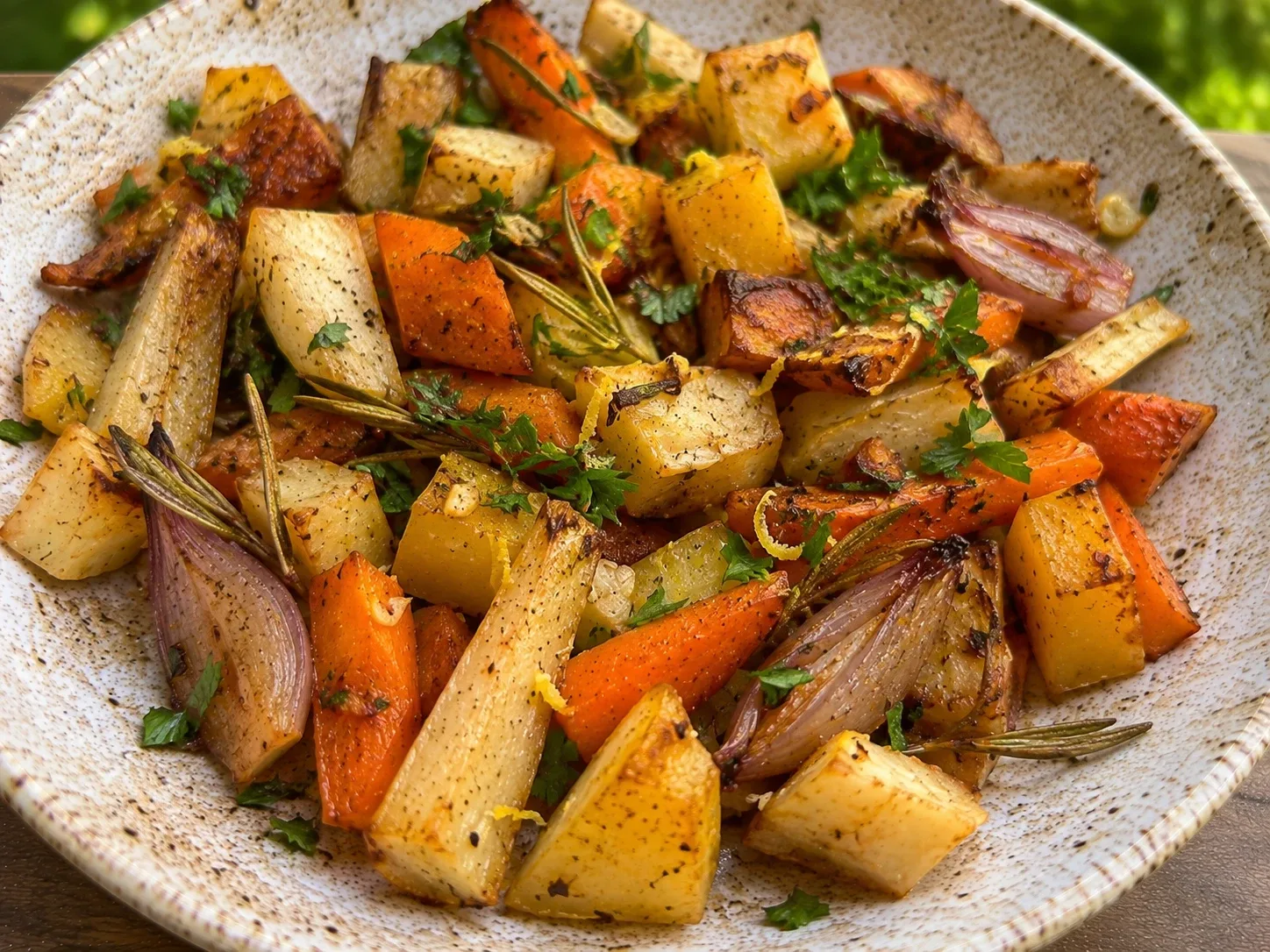
Root Medley with Lamb Fat
Carrots, parsnips, rutabaga, celery root, and shallots roasted in rendered lamb fat with rosemary and garlic until crisp-edged and caramelized, then finished with lemon and parsley. A humble winter side with real depth.
Yield: Serves 6 · Active: 25 min · Total: 1 hr 10 min · Season: Best in North America in winter, when storage roots are sweetest after the first frosts · Best eaten: evening
Ingredients
For the lamb fat
- 6 oz lamb fat trimmings (from a leg or shoulder; ask your butcher), or ⅓ cup saved lamb drippings
For the vegetables
- 4 medium carrots (about 1 lb), peeled and cut on the diagonal into 2-inch pieces
- 3 medium parsnips (about 12 oz), peeled, cored if woody, and cut into 2-inch pieces
- 1 small rutabaga (about 1 lb), peeled and cut into 1-inch cubes
- 1 small celery root (about 1 lb), peeled and cut into 1-inch cubes
- 6 shallots, peeled and halved lengthwise
- 1 head garlic, cloves separated and left in their skins
- 3 sprigs fresh rosemary, plus 1 tbsp chopped leaves
- 4 sprigs fresh thyme
- 1½ tsp sea salt
- ½ tsp freshly cracked black pepper
To finish
- Zest of 1 lemon and 1 tbsp juice
- ¼ cup chopped fresh flat-leaf parsley
- Flaky sea salt
Method
- Render the lamb fat. Chop the lamb fat into small pieces (it’s easiest when very cold). Put it in a small heavy pot with 2 tbsp water and cook over low heat 30–40 minutes, stirring now and then, until the fat has melted and the bits are golden and crisp. Strain the clear fat into a heatproof jar. You need about ⅓ cup. Salt the crisp bits and save them for the top.
- Heat the oven and pans. Heat the oven to 425°F with two large sheet pans inside. Hot pans give the vegetables a crisp, browned bottom right away.
- Season. In a large bowl, toss the carrots, parsnips, rutabaga, celery root, shallots, and garlic with the warm lamb fat, the chopped rosemary, salt, and pepper until everything is glossy.
- Roast. Carefully spread the vegetables in a single layer across the hot pans, cut sides down, and tuck in the rosemary and thyme sprigs. Don’t crowd them, or they steam instead of browning. Roast 20 minutes.
- Turn and finish. Turn the vegetables, swap the pans between racks, and roast 15–20 minutes more, until tender all the way through and deeply caramelized at the edges. The rutabaga and celery root take the longest; test them with a knife.
- Brighten. Pile onto a platter. Squeeze the soft garlic out of its skins over the top, then scatter with lemon zest, a squeeze of lemon juice, parsley, flaky salt, and the crisp lamb bits.
Storage
Refrigerate leftovers in a covered container up to 4 days. Reheat on a sheet pan at 400°F for 10–12 minutes to bring back the crisp edges. Strained lamb fat keeps refrigerated up to 3 months or frozen up to a year.
Variations
- Other fats: Beef tallow, duck fat, or lard all work the same way. Save the tallow from my 24-Hour Beef Stock.
- More roots: Add beets (roast them on their own pan so they don’t stain everything), turnips, or sunchokes.
- Sweet and sticky: Drizzle 1 tbsp raw honey over the carrots and parsnips for the last 5 minutes (the dish is then no longer free of added sugar).
- Make it a meal: Serve with lamb chops or a slow-roasted shoulder, or under a fried egg. For a creamy, spiced version, see my Farm-to-Table Roasted Root Vegetables with Labneh, Dukkah, and Mint Gremolata.
Season & Circadian Timing
Carrots, parsnips, rutabaga, and celery root are pulled in late fall and keep for months in cold storage. A frost or two turns some of their starch to sugar, so they’re at their sweetest in the middle of winter. This is an evening dish: warm, grounding carbohydrates and good fat beside a protein, on a long, dark night.
Nourishment Notes
- Carrots — Rich in beta-carotene, which your body turns into vitamin A, best absorbed with fat like the lamb fat here.
- Parsnips, rutabaga, and celery root — Fiber, potassium, and vitamin C; rutabaga is a cruciferous root in the cabbage family.
- Lamb fat — Pasture-raised lamb fat carries fat-soluble vitamins and is rich in monounsaturated and saturated fats that stay stable at roasting heat.
- Garlic, shallots, and rosemary — Sulfur compounds from the alliums, and rosemary’s aromatic compounds, like carnosic acid.
Sourcing
- Lamb fat — from pasture-raised, grass-fed lamb, from a local farm or butcher
- Lemons / limes / oranges — organic (you’re using the zest)
- Spices — organic and non-irradiated
- Salt — unrefined sea salt (Baja Gold); flaky sea salt for finishing (Maldon)
- Fruits, vegetables, and herbs — organic, from a farmers’ market or local farm
With Love, Light, and Health,
Anna (aka Food Marshall)
Food Marshall Approved. Grain-free, seed-oil-free and refined-sugar-free, made from organic, local and seasonal ingredients. Our standards
More Vegetable Sides & Mains
Get new recipes and essays
Seasonal recipes and writing on light, circadian health, and living with nature.
Subscribe on Substack