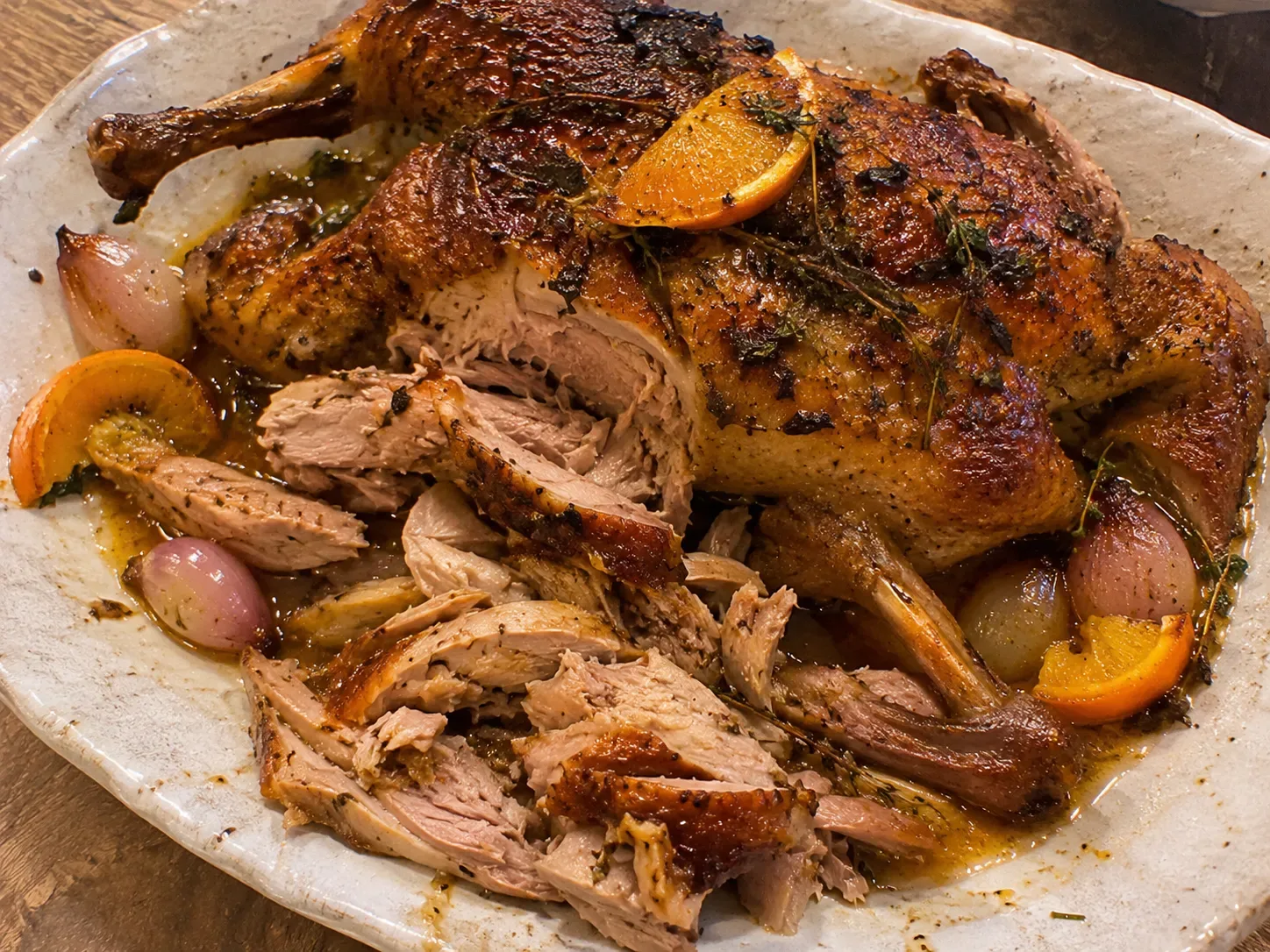
Slow-Roasted Whole Pastured Duck with Orange, Herbs, and Shallots
A whole pastured duck slow-roasted in its own fat with orange, garlic, shallots, and fresh herbs until the meat falls off the bone, then broiled for crackling skin. It’s an easy, mostly hands-off showpiece for Christmas and holiday tables.
Yield: Serves 4 · Active: 25 min · Total: 6½–8½ hr · Season: Best in North America in winter, when oranges are at their peak · Best eaten: early evening
Ingredients
For the duck
- 1 whole pasture-raised duck (5–6 lb), giblets and neck removed (save them for broth)
- 1 tbsp sea salt, plus more as needed
- 2 tsp freshly ground black pepper
For the citrus-herb fat
- ½ cup pasture-raised duck fat, plus 2–3 tbsp more for drizzling
- 3 sprigs fresh rosemary
- 6 sprigs fresh thyme
- 6 fresh sage leaves
- Zest of 2 oranges
- ⅔ cup freshly squeezed orange juice (from about 2 oranges)
- 4 garlic cloves, smashed
- 3 shallots, diced
For the vegetables (optional)
- 1 lb baby potatoes, halved
- 4 carrots, cut into 2-inch pieces
- 1 yellow onion, cut into wedges
Method
For the duck
- Prep the duck. Heat the oven to 250°F. Pat the duck completely dry inside and out with paper towels, and trim off any loose flaps of fat at the neck and cavity opening. Dry skin is what lets it crisp at the end.
- Season. Season generously all over and inside the cavity with the salt and pepper. Set the duck breast side up in a large Dutch oven (an oval 7-quart or larger is ideal) or a deep roasting pan with a lid.
For the citrus-herb fat
- Melt and infuse. In a small pot over low heat, melt the ½ cup duck fat. Add the rosemary, thyme, sage, orange zest and juice, garlic, and shallots, and warm for 3–4 minutes, until the shallots soften and everything smells fragrant. Don’t let it boil hard.
- Fill the cavity. Spoon or pour the citrus-herb mixture, herbs and all, into the cavity of the duck. Whatever runs out into the pot will baste the bird as it cooks.
- Drizzle. Drizzle the extra 2–3 tbsp duck fat along the top of the duck.
Slow-roast and crisp
- Slow-roast. Cover with the lid (or tightly with foil) and slow-cook in the oven for 6–8 hours. The duck is ready when a leg wiggles loosely in its joint and the meat pulls easily away from the bone. The thigh will read well above 180°F at this point, which is what makes the meat so tender.
- Add vegetables (optional). For the last hour of cooking, lift the lid and tuck the potatoes, carrots, and onion into the fat and juices around the duck. Cover again and keep roasting.
- Broil for crispy skin. Take off the lid and switch the oven to broil (high), with a rack set so the top of the duck sits about 6 inches from the heat. Broil 7–10 minutes, watching closely and turning the pot if needed, until the skin is deep golden and crackling.
- Rest and serve. Let the duck rest 10 minutes, then carve or simply pull the meat from the bone. Serve with the vegetables and a spoonful of the orange-herb juices from the pot.
Save the fat, juices, and bones
- Strain. Pour everything left in the pot through a fine-mesh strainer into a heat-safe glass jar or bowl. Discard the herb stems.
- Separate. Chill overnight. The fat rises and sets into a creamy white layer on top, and the juices underneath set into a rich jelly. Lift off the fat and store it in its own jar; keep the jelly for sauces, soups, or braising greens.
- Make broth. Save the carcass, neck, and giblets for broth. See Broths 101 — A Foundation for how.
Storage
- Leftover duck keeps up to 4 days in the fridge in a covered glass container. Reheat skin side up in a 375°F oven for 10–15 minutes to re-crisp.
- Strained duck fat keeps about 3 months in a sealed jar in the fridge, or up to a year in the freezer. Use it for roasting potatoes, frying eggs, or searing meat.
- The jellied juices keep up to 5 days in the fridge, or freeze them in an ice cube tray for easy pan sauces.
- The carcass can be frozen for up to 3 months until you’re ready to make broth.
Variations
- Holiday spice: Add 1 cinnamon stick, 2 star anise, and a few strips of orange peel to the melting fat for a festive, warmly spiced version.
- Blood orange: Use blood oranges for the juice and zest in mid-winter for a deeper color and flavor.
- Root vegetable swap: Use parsnips, turnips, celery root, or wedges of fennel in place of the potatoes and carrots.
- Crispier skin: Season the duck with the salt a day ahead and leave it uncovered on a rack in the fridge overnight to dry the skin even more.
Season & Circadian Timing
Citrus peaks in the darkest months of the year, which makes orange and duck a natural pairing for Christmas, New Year’s, and cold winter Sundays. This is a rich, fat-forward dish, so it’s best in the early evening as the main meal of the day, giving your body a few hours to digest before sleep.
Nourishment Notes
- Pasture-raised duck — a rich source of protein, iron, selenium, and B vitamins, including B12 and niacin.
- Duck fat — mostly monounsaturated fat (the same type found in olive oil) and stable at high heat, which makes it a great cooking fat to keep on hand.
- Oranges — bring vitamin C along with bright flavor that balances the richness of the duck.
- Garlic and shallots — members of the allium family, rich in sulfur compounds that give them their savory bite.
- Bones for broth — simmering the carcass draws out gelatin, a source of the amino acid glycine.
Sourcing
- Duck — pasture-raised, from a local farm (Dutch Meadows Farm)
- Tallow / lard / duck fat — from pasture-raised animals, from a local farm or butcher
- Potatoes — organic; conventional potatoes are often treated with sprout inhibitors after harvest
- Salt — unrefined sea salt (Baja Gold); flaky sea salt for finishing (Maldon)
- Spices — organic and non-irradiated
- Lemons / limes / oranges — organic (you’re using the zest)
- Fruits, vegetables, and herbs — organic, from a farmers’ market or local farm
You might also like: Crispy Duck with Fig, Brassicas, Carrot-Leek-Mushroom Sauté & Arugula-Fennel Salad, Crispy Shredded Duck over Cauliflower Rice with Savoy Cabbage, Fried Egg, and Sesame-Lime Finish, Broths 101 — A Foundation
With Love, Light, and Health,
Anna (aka Food Marshall)
Food Marshall Approved. Grain-free, seed-oil-free and refined-sugar-free, made from organic, local and seasonal ingredients. Our standards
More Poultry
Get new recipes and essays
Seasonal recipes and writing on light, circadian health, and living with nature.
Subscribe on Substack