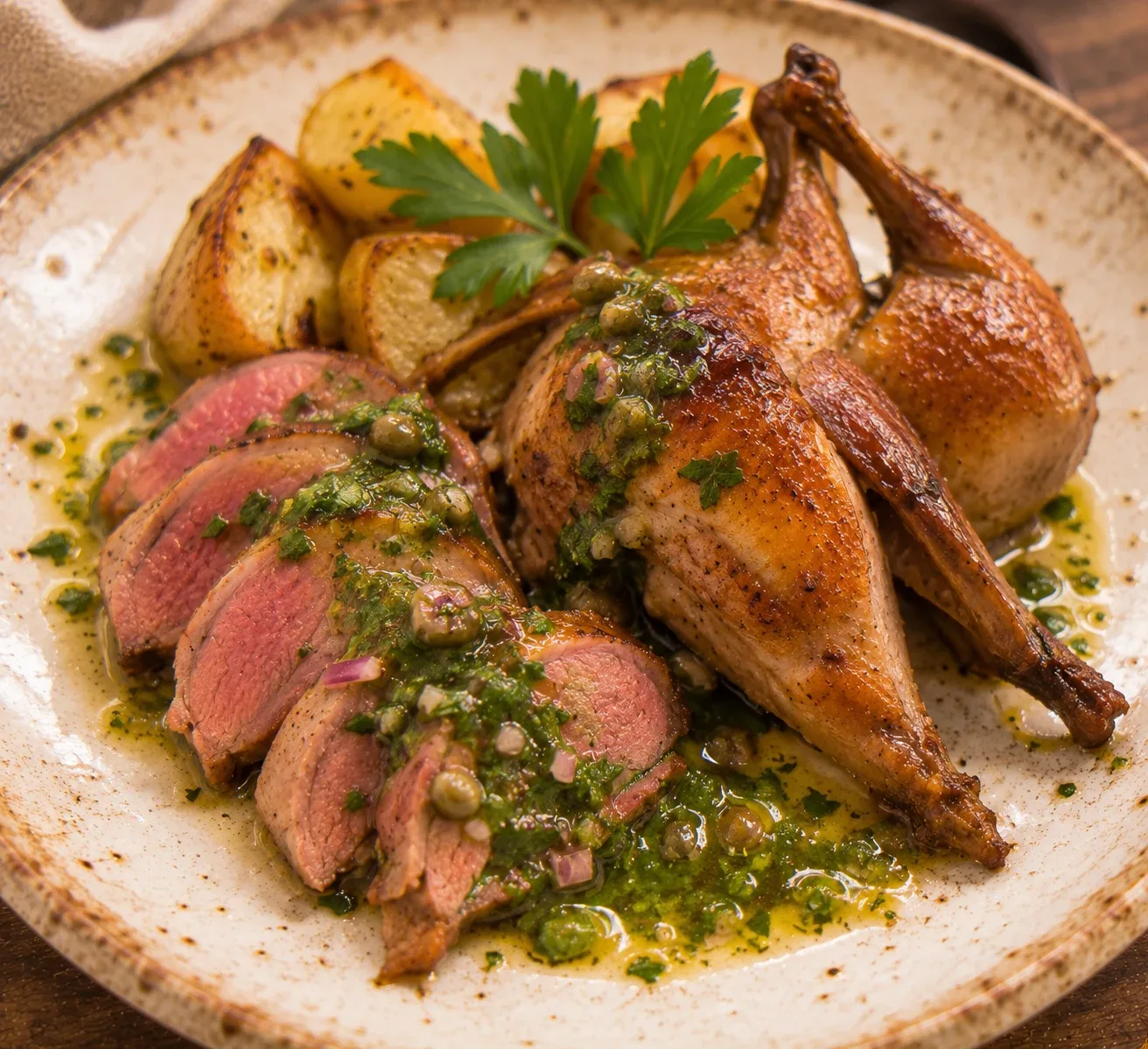
Squab with Parsley Sauce
Pan-roasted squab, crisp-skinned and rosy pink at the breast, with a sharp, bright parsley sauce of shallot, capers, and lemon. It’s an elegant little dinner-party plate that cooks in about 15 minutes.
Yield: Serves 4 (1 squab per person) · Active: 35 min · Total: about 50 min (plus optional overnight dry brine) · Season: Best in North America in fall through spring, when parsley, lemons, and shallots are at their peak · Best eaten: early evening
Ingredients
For the squab
- 4 whole squab (about 1 lb each)
- 2 tsp sea salt
- ½ tsp freshly cracked black pepper
- 2 tbsp grass-fed ghee
- 3 tbsp grass-fed butter
- 4 sprigs fresh thyme
- 2 garlic cloves, lightly smashed
For the parsley sauce
- 1 small shallot, finely minced
- Zest of 1 lemon, plus 2 tbsp fresh lemon juice
- 1 packed cup fresh flat-leaf parsley leaves, finely chopped
- 1 tbsp capers, rinsed and chopped
- 2 anchovy fillets, finely minced (optional)
- ½ cup extra virgin olive oil
- Pinch of sea salt and black pepper
Method
For the squab
- Halve the birds. With kitchen shears, cut along both sides of each backbone and remove it (save the backbones for broth). Cut through the breastbone to split each squab into two halves. Tuck the wing tips behind the breast.
- Dry brine. Pat the halves very dry and season all over with the salt and pepper. For the crispiest skin, refrigerate uncovered on a rack overnight. Take them out 30 minutes before cooking.
- Preheat. Heat the oven to 425°F.
- Sear the skin. Heat the ghee in a large cast-iron or oven-safe skillet over medium-high heat until it shimmers. Lay the squab halves in skin-side down (work in two pans or batches if needed so they don’t crowd) and press gently so the skin makes full contact. Sear 4–5 minutes, without moving, until deep golden.
- Roast. Flip the halves skin-side up and transfer the skillet to the oven for 4–6 minutes, until the thickest part of the breast reads 130–135°F for medium-rare.
- Baste. Return the skillet to the stovetop over medium heat. Add the butter, thyme, and garlic, and once the butter foams, tilt the pan and spoon it over the squab for 1 minute.
- Rest. Move the squab to a board and rest 5–8 minutes. The breasts will stay rosy pink while the legs finish cooking through in the carryover heat.
For the parsley sauce
- Soften the shallot. In a small bowl, combine the shallot, lemon zest, lemon juice, and a pinch of salt. Let sit 5–10 minutes to mellow.
- Stir together. Add the parsley, capers, anchovy (if using), and olive oil. Season with pepper and taste. It should be bright, salty, and loose enough to spoon. Make it no more than an hour ahead so the parsley stays vivid green.
To serve
- Plate. Set two squab halves on each warm plate, spoon a little of the buttery pan juices over them, and finish with a generous spoonful of parsley sauce. Pass the rest at the table.
Storage
Squab is best right after cooking. Leftovers keep in the fridge up to 2 days; serve cold or gently warm in a low oven so the breast doesn’t overcook.
Parsley sauce: fridge up to 2 days in a glass jar with a thin layer of olive oil on top. It will darken a little but still taste great.
Variations
- Whole roasted squab: Leave the birds whole, sear on all sides, and roast at 425°F for 12–15 minutes until the breast reads 130–135°F.
- Salsa verde: Add 2 tbsp each chopped mint and basil to the parsley sauce, plus 1 tsp Dijon mustard.
- Without anchovy: Leave it out and add an extra ½ tbsp capers for the salty depth.
- Other birds: Use quail (roast just 3–4 minutes after searing) or duck breast (score the skin and render it slowly, skin-side down, for 8–10 minutes).
- On the plate: Serve over roasted roots, a parsnip or celery root purée, or a bitter-leaf salad with shaved fennel.
Season & Circadian Timing
Parsley is at its most tender in spring and fall, and lemons and storage shallots carry through winter, so this sauce is brightest from fall through spring. Squab is rich but light enough for an early-evening dinner. Serve it on the earlier side so your body has time to digest before bed.
Nourishment Notes
- Squab — All dark meat, rich in protein, iron, and B vitamins, with a deeper, more mineral flavor than chicken.
- Parsley — An excellent source of vitamin K, plus vitamin C and plenty of bright, grassy flavor.
- Anchovies — Small, oily fish that bring omega-3 fats and deep savory flavor in tiny amounts.
- Extra virgin olive oil — Monounsaturated fat and polyphenols, and the base that carries the whole sauce.
- Ghee and butter — Ghee handles the high sear without burning, and butter adds richness for basting.
Sourcing
- Squab — farm-raised, from a specialty squab farm or a butcher who can order it for you; ask for fresh rather than frozen when you can
- Ghee — grass-fed ghee, or homemade from organic grass-fed butter
- Grass-fed butter — organic, cultured butter from 100% grass-fed cows, or raw butter from a local dairy
- Anchovies — wild-caught, salt-packed or packed in olive oil, in glass jars
- Capers — organic, packed in sea salt or brine
- Extra virgin olive oil — organic, single-estate, harvest-dated, in dark glass
- Salt — unrefined sea salt (Baja Gold); flaky sea salt for finishing (Maldon)
- Lemons / limes / oranges — organic (you’re using the zest)
- Fruits, vegetables, and herbs — organic, from a farmers’ market or local farm
You might also like: Crispy Duck with Fig, Brassicas, Carrot-Leek-Mushroom Sauté & Arugula-Fennel Salad · Crispy Duck with Butternut Squash Purée, Grilled Broccolini, and Blueberry Glaze
With Love, Light, and Health,
Anna (aka Food Marshall)
Food Marshall Approved. Grain-free, seed-oil-free and refined-sugar-free, made from organic, local and seasonal ingredients. Our standards
More Poultry
Get new recipes and essays
Seasonal recipes and writing on light, circadian health, and living with nature.
Subscribe on Substack