Beef Eggplant Rollatini with Raw Ricotta and Slow-Simmered Tomato Sauce
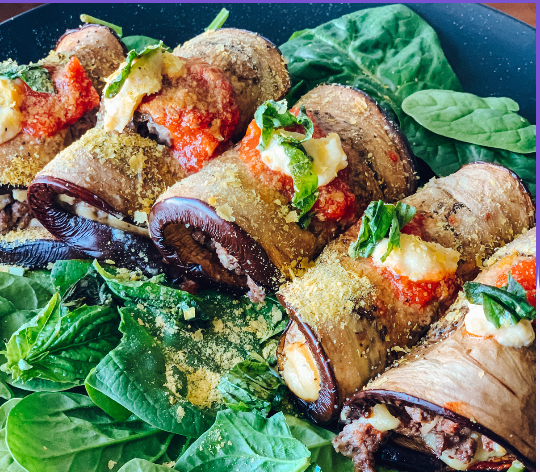
Italian-American comfort food, made grain-free: tender roasted eggplant slices rolled around creamy herbed ricotta and fennel-scented grass-fed beef, then baked in a quick-simmered garlic and basil tomato sauce, with Parmigiano on top.
Yield: Serves 4 · Active: 40 min · Total: 1 hr 15 min · Best in North America from late summer into early fall, when eggplant, tomatoes, and basil peak together · Best eaten: early evening
A Note from the Kitchen
Rollatini is a cousin of the Italian involtini tradition, in which thin slices of meat or vegetables are rolled around a filling, sauced, and baked. Many American versions use pasta tubes, like manicotti, but this one uses thin slices of eggplant, which turn silky in the oven and soak up the sauce. It's naturally grain-free, and it's every bit as comforting.
Ingredients
Eggplant
2 large Italian globe eggplants (or 3 medium Japanese eggplants)
3 tbsp extra virgin olive oil
1 tsp Baja Gold sea salt
½ tsp freshly ground black pepper
Simmered tomato sauce
2 tbsp extra virgin olive oil
3 garlic cloves, thinly sliced
24 oz tomato passata or sauce, with no added sugar
½ tsp Baja Gold sea salt
A handful of fresh basil leaves, plus more for finishing
Optional: a pinch of red pepper flakes
Beef filling
1 lb grass-fed ground beef (80/20 or 85/15)
1 tbsp extra virgin olive oil
2 garlic cloves, minced
½ tsp fennel seeds, lightly crushed
½ tsp dried oregano
½ tsp dried basil
½ tsp Baja Gold sea salt
Freshly ground black pepper
2 tbsp fresh basil, chopped
Ricotta filling
1 cup whole-milk grass-fed ricotta (cow's, sheep's, or goat's milk), or homemade
¼ cup grated Parmigiano-Reggiano, plus more for the top
¼ cup fresh basil, chopped
1 garlic clove, finely grated
Pinch of salt and black pepper
Dairy-free cashew ricotta: Blend 1 cup cashews (soaked at least 4 hours and drained), 2 tbsp olive oil, 2 tbsp unfortified nutritional yeast, 1 garlic clove, the juice of 1 lemon, ½ tsp salt, and ¼ cup water in a food processor for 2–3 minutes, until smooth and ricotta-like, adding water as needed. Stir in ¼ cup chopped basil by hand. Skip the Parmigiano.
To serve: a bed of fresh spinach, arugula, or wilted bitter greens, fresh basil, red pepper flakes, and extra Parmigiano
Method
Simmer the sauce. Warm the olive oil in a saucepan over medium-low heat, add the garlic, and cook 1–2 minutes, until fragrant but not browned. Add the passata, salt, basil, and chili flakes (if using), and simmer gently, partly covered, for 20–25 minutes, while you prepare everything else.
Slice and roast the eggplant. Heat the oven to 400°F. Slice the eggplants lengthwise into ¼-inch slices (a mandoline makes them even, so they roll cleanly). Lay them on parchment-lined sheet pans, brush both sides with olive oil, and season with salt and pepper. Roast 15 minutes, until pliable and just beginning to brown at the edges.
Cook the beef. While the eggplant roasts, heat the olive oil in a large skillet over medium heat. Add the beef and cook 5–6 minutes, breaking it up, until browned. Add the garlic, fennel, oregano, dried basil, salt, and pepper, and cook 2–3 minutes more, until fragrant and any liquid has cooked off. Stir in the fresh basil, and let it cool slightly.
Make the ricotta filling. Stir together the ricotta, Parmigiano, basil, garlic, salt, and pepper.
Roll. Spread a thin layer of sauce over the bottom of a 9x13 baking dish. Lay an eggplant slice flat, spoon 1–2 tbsp of ricotta at one short end, and top it with 2–3 tbsp of beef. Roll it up from the filled end, and place it seam-side down in the dish. Repeat with the rest, packing them snugly.
Bake. Spoon the remaining sauce over the rollatini, scatter with Parmigiano, and bake 15–20 minutes, until the sauce is bubbling.
Serve. Set a handful of greens on each plate, and top with 2–3 rollatini and a spoonful of sauce. Finish with fresh basil, a pinch of red pepper flakes, and extra Parmigiano.
For larger or older eggplants: Lightly salt the slices on both sides and let them drain on a towel-lined tray for 20–30 minutes, then pat them dry before roasting. This draws out bitterness and excess moisture. Fresh, peak-season eggplant can skip this step.
Variations
Pork: Use pasture-raised ground pork, or half pork and half beef, for a more traditional Italian flavor.
Italian sausage: Use 1 lb mild or hot pasture-raised Italian sausage, casings removed, and reduce the fennel seeds to a pinch.
Lamb: Use pasture-raised ground lamb, and add 1 tsp Ceylon cinnamon and ½ tsp allspice, for a Greek-inspired version.
More vegetables: Stir ½ cup finely diced sautéed zucchini or chopped spinach into the beef.
Mushroom (vegetarian): Replace the beef with 2 cups finely chopped sautéed mushrooms (cremini, shiitake, and oyster), cooked with the same garlic, fennel, and herbs until all their liquid has evaporated.
Sheep's milk ricotta, for a richer, slightly sweeter filling.
Make ahead: Roast the eggplant and make the fillings and sauce up to 1 day ahead. The rollatini can be assembled and refrigerated up to 24 hours before baking (add 5–10 minutes to the bake time).
Storage
Refrigerated up to 3 days; the flavor improves overnight. Reheat covered at 325°F until warmed through. Freezing isn't recommended, since the eggplant turns watery when thawed.
Nourishment Notes
Eggplant — fiber, potassium, and nasunin, the deep purple anthocyanin in its skin, studied for its antioxidant effects. Like other nightshades, eggplant contains very small amounts of solanine, which some sensitive people notice.
Grass-fed beef — complete protein, heme iron, zinc, B12, and CLA, plus more omega-3s than conventional beef.
Fennel seeds — anethole, the same compound behind the anise flavor of sambuca, traditionally used in Italian and Middle Eastern cooking to support digestion.
Ricotta — protein, calcium, and vitamins A and K2, especially from grass-fed milk. Ricotta is made by heating milk or whey and adding acid, so it's never raw, but grass-fed milk makes all the difference in flavor and nutrition.
Parmigiano-Reggiano — calcium, protein, and vitamin K2.
Tomato sauce — lycopene, the carotenoid behind tomatoes' red color. Cooking tomatoes with olive oil makes their lycopene much easier to absorb than eating them raw.
Cashews (dairy-free version) — magnesium, copper, and zinc.
Leafy greens — folate, vitamin K, and iron, plus a fresh, slightly bitter contrast to the rich rollatini.
For your cycle: The beef's heme iron, zinc, and B12 make this especially restorative during the menstrual phase, and the tomatoes and greens bring vitamin C and folate. Its warm, comforting richness is also satisfying in the luteal phase.
Sourcing
Eggplant — organic, from a farmers' market in late summer (heirloom varieties like Rosa Bianca, Listada de Gandia, and Japanese long eggplant are especially sweet and tender)
Ground beef — 100% grass-fed and grass-finished, from a local rancher, White Oak Pastures, Force of Nature, or US Wellness Meats
Ricotta — whole-milk ricotta from grass-fed milk, with no gums or stabilizers, like Bellwether Farms sheep's milk ricotta, or homemade from raw milk (see my Garden Ribbon Salad for the method)
Parmigiano-Reggiano — DOP, aged 24+ months, made from raw milk by law; look for the stamped rind
Tomato passata or sauce — organic, in glass, with no added sugar or seed oils (Bionaturae or Jovial), or homemade from summer tomatoes
Cashews (dairy-free version) — organic (every cashew sold has been heat-treated, even "raw" ones), like Terrasoul
Nutritional yeast (dairy-free version) — unfortified, like Sari Foods
Garlic, basil, and greens — organic, from a farmers' market or your windowsill
Fennel seeds, dried herbs, and red pepper flakes — organic and non-irradiated (Calabrian chili flakes are lovely here)
Extra virgin olive oil — organic, single-estate, harvest-dated, in dark glass
Salt — Baja Gold sea salt
— Anna aka Food Marshall