Blistered Broccolini with Slow-Confited Garlic, Rainbow Beet and Bell Pepper Salad, and Your Choice of Wild Fish or Shrimp
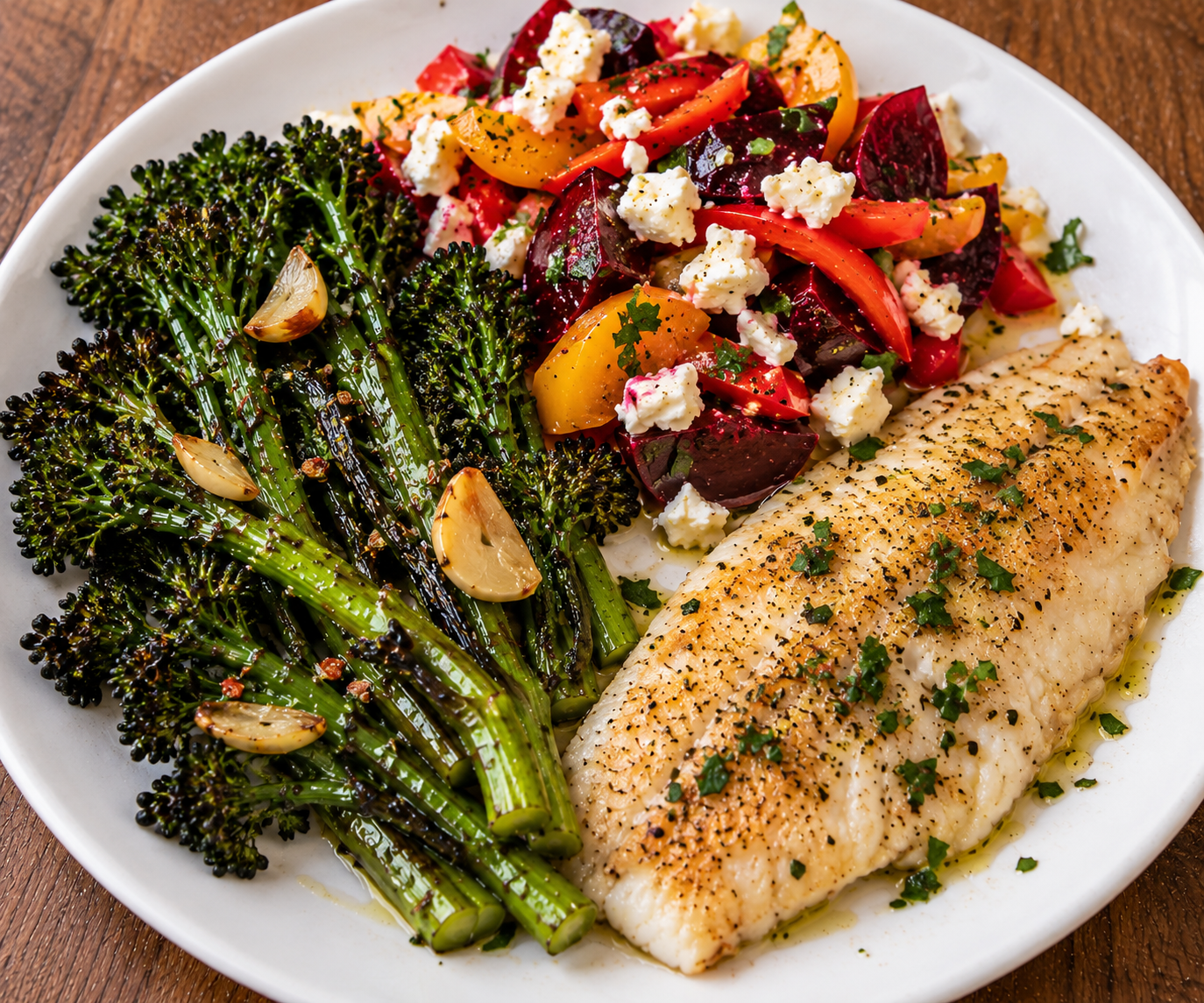
Blistered broccolini with slow-confited garlic and chili oil, a jewel-toned salad of roasted beets and peppers with champagne vinaigrette and sheep's milk feta, and your choice of pan-seared fish (branzino, sole, cod, or salmon) or shrimp. Colorful, mineral-rich, and full of Mediterranean flavor.
Yield: 4 servings · Active: 45 min · Total: 1 hr 30 min (allowing for beet roasting) · Year-round in California; best at North American farmers' markets late summer into early fall, when peppers and beets overlap · Best eaten: early evening
Complete Menu
Blistered Broccolini with Slow-Confited Garlic and Chili Oil
Rainbow Beet and Bell Pepper Salad with Champagne Vinaigrette and Feta
Your choice of fish or shrimp
Optional accompaniments: lemon wedges, fresh cilantro or parsley, flaky sea salt.
A note on protein choice
This bowl works with five different proteins, depending on what's freshest at the fishmonger and what you're in the mood for:
Pan-seared branzino. A Mediterranean classic (branzino is the Italian name for European sea bass), with sweet, mild, delicate flesh.
Pan-seared sole. Thin, delicate, and sweet.
Pan-seared or baked cod. A mild, flaky white fish that takes on the flavors around it.
Pan-seared salmon. Sockeye, king, or coho bring rich flavor and a gorgeous pop of color.
Seared shrimp. Quick, easy, and a coastal favorite.
All five plate beautifully with the broccolini and beet salad.
Recipe 1 — Blistered Broccolini with Slow-Confited Garlic and Chili Oil
Broccolini seared in a hot cast iron skillet until charred and tender, then finished with slow-confited garlic and a gently spicy chili oil. The confit is the star: whole garlic cloves cooked slowly in olive oil until buttery-soft and sweet, for spooning over the broccolini and anything else you like.
Yield: 4 servings · Active: 20 min · Total: 45 min (including the garlic confit, which can be made up to 4 days ahead)
Ingredients
Slow-confited garlic and chili oil
1 whole head garlic (about 12-15 cloves), peeled
1 cup extra virgin olive oil
3-4 dried whole chilies (such as Calabrian), or 1 tsp Aleppo pepper flakes (adjust to your heat preference)
1 sprig fresh rosemary
3 sprigs fresh thyme
2 bay leaves
½ tsp Baja Gold sea salt
Zest of ½ lemon (added at the end)
Blistered broccolini
1½ lb broccolini (2 bunches), trimmed (or broccoli rabe or gai lan)
2 tbsp extra virgin olive oil
1 tsp Baja Gold sea salt
½ tsp freshly cracked black pepper
3 tbsp of the garlic and chili oil, plus 4-5 confited garlic cloves
1 tbsp fresh lemon juice
2 tbsp fresh flat-leaf parsley, chopped
Flaky sea salt
Method
Make the garlic confit (up to 4 days ahead)
Combine. In a small saucepan, combine the garlic cloves, olive oil, chilies, rosemary, thyme, bay leaves, and salt.
Confit low and slow. Warm over the lowest possible heat (or in a 250°F oven in an oven-safe pan). You want tiny bubbles rising slowly, not a simmer. Cook 25-35 minutes, until the cloves are soft, buttery, and lightly golden. If they brown deeply, the heat is too high and they'll lose their mellow sweetness.
Cool. Turn off the heat, stir in the lemon zest, and let everything cool completely in the oil so the flavors can infuse. Transfer to a glass jar and refrigerate right away. It makes about 1 cup of oil with the confited cloves.
Blister the broccolini
Heat the skillet. Heat a large cast iron skillet over medium-high heat until very hot, 3-4 minutes.
Toss. Toss the broccolini with the olive oil, salt, and pepper.
Blister. Lay the broccolini in the hot skillet in a single layer (work in two batches if needed). Cook 3-4 minutes without moving it, until the underside blisters and chars. Toss and cook 2-3 minutes more, until charred in spots, tender through the stems, and still bright green.
Finish. Transfer to a warm platter. Spoon the garlic and chili oil and the confited cloves over the top, squeeze the lemon juice over, and toss gently.
Garnish with parsley and flaky salt, and serve warm.
Recipe 2 — Rainbow Beet and Bell Pepper Salad with Champagne Vinaigrette and Feta
A jewel-toned salad of roasted red and golden beets and fire-roasted red and yellow peppers, with red onion and baby spinach, finished with sheep's milk feta, a bright champagne vinaigrette, and fresh herbs.
Yield: 4 servings · Active: 25 min · Total: 1½ hr (including roasting, which can be done ahead)
Ingredients
Roasted beets (can be roasted a day ahead)
2 medium red beets, scrubbed
2 medium golden beets, scrubbed
Roasted bell peppers
1 large red bell pepper
1 large yellow bell pepper
Salad
4 cups baby spinach, or a mix of baby spinach and arugula
½ small red onion, thinly sliced
½ cup crumbled sheep's milk feta
¼ cup fresh flat-leaf parsley, roughly chopped
2 tbsp fresh basil or dill, torn (optional)
1 medium fennel bulb, thinly shaved (optional but beautiful; save the fronds)
Champagne vinaigrette
¼ cup extra virgin olive oil
2 tbsp champagne vinegar
1 tbsp fresh lemon juice
1 tsp Dijon mustard
1 tsp raw honey (optional, balances the acid)
1 small garlic clove, finely grated
½ tsp Baja Gold sea salt
¼ tsp freshly cracked black pepper
To finish
Extra crumbled sheep's milk feta
Flaky sea salt
A drizzle of your best olive oil
The reserved fennel fronds
Method
Roast the beets
Preheat the oven to 400°F.
Wrap and roast. Wrap each beet in parchment, keeping the red and golden beets separate so the red doesn't stain the gold, and set them on a sheet pan. Roast 45-60 minutes, until a knife slides in with no resistance.
Peel. Let them cool 10-15 minutes, then rub off the skins with a kitchen towel; they slip right off while warm.
Cut into thin wedges or ½-inch dice, keeping the colors separate until you assemble.
Roast the peppers
Char. Under the broiler or over a gas flame with tongs, char the peppers on all sides until blackened. Set them in a bowl covered with a plate for 10 minutes; the steam loosens the skins.
Peel and slice. Peel off the charred skin, remove the seeds and stems, and slice into thin strips.
Assemble
Combine. In a large bowl, combine the spinach (and arugula), red onion, beets, peppers, parsley, and optional herbs and fennel.
Make the vinaigrette. In a small jar, shake together the olive oil, vinegar, lemon juice, Dijon, optional honey, garlic, salt, and pepper.
Dress. Pour the vinaigrette over the salad and toss gently.
Plate. Transfer to a platter and scatter with feta and fennel fronds. Finish with flaky salt and a drizzle of your best olive oil.
Serve at room temperature.
Recipe 3 — Your Choice of Fish or Shrimp
Option A — Pan-Seared Branzino
Yield: 4 servings · Active: 15 min · Total: 20 min
4 whole branzino (about 1 lb each, cleaned and scaled), or 4 branzino fillets (about 6 oz each, skin on)
2 tbsp extra virgin olive oil
1½ tsp Baja Gold sea salt
½ tsp freshly cracked black pepper
Zest of 1 lemon
2 sprigs fresh rosemary
4 sprigs fresh thyme
1 lemon, sliced into ¼-inch rounds
3 garlic cloves, sliced
2 tbsp grass-fed butter (for basting)
Prep. For whole fish: Score each side with 3 shallow diagonal cuts. Season the cavity and outside with salt, pepper, and lemon zest, and stuff the cavity with lemon slices, rosemary, thyme, and garlic. For fillets: Pat dry, score the skin lightly, and season with salt, pepper, and lemon zest.
Heat the olive oil in a large cast iron or stainless skillet over medium-high heat until shimmering. (For 4 whole fish, use two skillets or cook in batches.)
Sear.
Whole fish: Sear 4-5 minutes per side, flipping once, until deeply golden and the flesh flakes easily at the thickest point. Add the butter and baste for the last 2 minutes.
Fillets: Sear skin-side down 4-5 minutes without moving. Add the butter, flip, and cook 1-2 minutes more, basting.
Rest on a warm plate for 3 minutes.
Option B — Pan-Seared Sole
Yield: 4 servings · Active: 15 min · Total: 20 min
4 sole fillets (about 6 oz each)
3 tbsp extra virgin olive oil
1 tsp Baja Gold sea salt
¼ tsp freshly cracked black pepper
Zest of ½ lemon
3 tbsp grass-fed butter
1 tbsp fresh flat-leaf parsley, chopped
Fresh lemon wedges
Prep. Pat the fillets completely dry and season lightly with salt, pepper, and lemon zest.
Heat the olive oil in a large, well-seasoned cast iron or nonstick skillet over medium-high heat.
Sear. Sole is delicate, so cook just 90 seconds to 2 minutes per side, until opaque and flaking easily. Add the butter for the last 30 seconds and gently baste.
Finish. Transfer to a warm plate, sprinkle with parsley, and squeeze lemon over. Serve right away; sole is best straight from the pan.
Option C — Pan-Seared or Baked Cod
Yield: 4 servings · Active: 15 min · Total: 20-25 min
4 wild-caught cod fillets (about 6-8 oz each, skin on or off)
2 tbsp extra virgin olive oil
1 tsp Baja Gold sea salt
½ tsp freshly cracked black pepper
Zest of 1 lemon
3 garlic cloves, thinly sliced
2 tbsp grass-fed butter
Fresh lemon wedges
Fresh flat-leaf parsley, chopped
Pan-searing (quick)
Prep. Pat the fillets dry and season with salt, pepper, and lemon zest.
Heat the olive oil in a large cast iron or stainless skillet over medium-high heat.
Sear. For skin-on cod, sear skin-side down 4-5 minutes without moving, then flip, add the garlic and butter, and cook 3-4 minutes more, basting, until the flesh is opaque and flakes easily (about 140°F). For skin-off cod, sear 3-4 minutes per side.
Baking (hands-off)
Preheat the oven to 400°F.
Season. Set the fillets in a baking dish and top with the olive oil, salt, pepper, lemon zest, and garlic. Tuck the butter and a few lemon slices around them.
Bake 15-18 minutes, until the flesh is opaque and flakes easily (about 140°F).
Finish with parsley and lemon wedges.
Option D — Pan-Seared Wild Salmon
Yield: 4 servings · Active: 15 min · Total: 20 min
4 wild-caught salmon fillets (about 6 oz each, skin on): sockeye, king, or coho
2 tbsp extra virgin olive oil
1 tsp Baja Gold sea salt
½ tsp freshly cracked black pepper
Zest of ½ lemon
1 tbsp grass-fed butter
Prep. Pat the salmon dry and season with salt, pepper, and lemon zest.
Heat the olive oil in a heavy stainless or cast iron skillet over medium-high heat until shimmering.
Sear skin-side down. Lay the fillets in skin-side down and press gently for 30 seconds so the skin stays flat. Cook 4-5 minutes without moving, until the skin is deeply crispy.
Flip and finish. Flip, add the butter, and cook 2-3 minutes more, basting, until the center reads about 125°F for a silky medium.
Rest 3-4 minutes.
Option E — Seared Shrimp
Yield: 4 servings · Active: 10 min · Total: 15 min
1½ lb large wild-caught shrimp (16-20 per lb), peeled and deveined, tails on
3 tbsp extra virgin olive oil
4 garlic cloves, thinly sliced
1 tsp Baja Gold sea salt
½ tsp freshly cracked black pepper
Zest of ½ lemon
1 tsp red pepper flakes (optional)
1 tbsp fresh lemon juice
2 tbsp fresh flat-leaf parsley, chopped
Fresh lemon wedges
Prep. Pat the shrimp dry and season with salt.
Heat the olive oil in a large cast iron skillet over medium-high heat.
Sear. Add the garlic for 30 seconds, until fragrant but not browned, then add the shrimp in a single layer.
Cook 1-2 minutes per side, until pink and curled into a loose "C." Don't overcook them; shrimp turn rubbery fast. Sprinkle with pepper, lemon zest, and the optional red pepper flakes.
Finish with lemon juice and parsley, and serve right away with lemon wedges.
Plating the Complete Meal
Build in warm, shallow bowls: pile the beet and pepper salad on one side, arrange the broccolini alongside with the confited garlic cloves showing, and lay your protein across the center. Spoon extra garlic oil over the broccolini and around the fish, then finish with parsley, lemon wedges, and flaky salt. It's a jewel-toned plate: deep red and golden beets, bright red and yellow peppers, charred green broccolini, and golden, crispy fish.
Sourcing (essential picks)
Broccolini — organic, with bright green stems and tightly closed florets, from a farmers' market. Broccoli rabe (more bitter) or gai lan works too
Garlic — organic hardneck garlic, from a farmers' market for the most complex flavor
Dried chilies — organic whole Calabrian chilies, or organic Aleppo pepper flakes, with nothing added
Rosemary, thyme, and bay leaves — organic, from a windowsill pot or farmers' market
Red and golden beets — organic, firm, with fresh greens attached
Red and yellow bell peppers — organic, firm, and unblemished
Baby spinach and arugula — organic
Fennel (optional) — organic, with a firm bulb and no browning at the base
Red onion — organic
Sheep's milk feta — organic when you can find it. Greek Feta PDO is at least 70% sheep's milk (the rest goat's), such as Dodoni or Mt. Vikos; Valbreso is 100% sheep's milk
Lemons — organic (you're using the zest)
Champagne vinegar — organic, naturally fermented, ideally from France's Champagne region
Dijon mustard — Edmond Fallot, stone-ground in Burgundy by a family mill since 1840, with no sugar (it also makes an organic line)
Raw honey (optional) — organic, local, and unfiltered
Fresh parsley, basil, dill, and cilantro — organic, from a farmers' market or windowsill pot
Fish and shrimp (wild seafood can't be certified organic, so look for sustainable, traceable sources):
Branzino — almost all branzino sold in the U.S. is farmed, mostly in Greece and Turkey. Choose responsibly farmed fish from a fishmonger you trust
Sole — U.S. West Coast petrale or Pacific Dover sole. Skip Atlantic sole and flounder, which Seafood Watch lists to avoid
Cod — wild Pacific cod from Alaska. Skip Atlantic cod from the Gulf of Maine and Georges Bank, which Seafood Watch lists to avoid
Salmon — wild Alaskan sockeye, king, or coho, from Vital Choice or a trusted fishmonger. Peak season April-September; frozen-at-sea is excellent year-round
Shrimp — wild-caught U.S. Gulf, U.S. Atlantic, or Argentine red shrimp, with no added sodium tripolyphosphate. Skip imported farmed shrimp from Southeast Asia
Grass-fed butter — organic, cultured butter from 100% grass-fed cows, or raw butter from a local dairy
Extra virgin olive oil — organic, single-estate, harvest-dated within the past year, in dark glass. Use a good everyday bottle for the confit and save your best for finishing
Baja Gold sea salt for cooking; fleur de sel de Guérande or Maldon for finishing
Storage
Garlic confit and chili oil: Refrigerated up to 4 days in a sealed glass jar. An honest note: homemade garlic-in-oil should always live in the fridge and be used within 4 days, since garlic can carry botulism spores that low-temperature cooking doesn't destroy. For longer storage, freeze the cloves and oil in an ice cube tray for up to 3 months. The oil firms up in the fridge and loosens again at room temperature. It's wonderful over roasted vegetables, grilled meats, eggs, or as a dip
Blistered broccolini: Refrigerated up to 3 days. Reheat briefly in a hot pan, or serve at room temperature
Roasted beets: Refrigerated up to 5 days
Roasted peppers: Refrigerated up to 4 days, covered in olive oil
Dressed beet and pepper salad: Refrigerated up to 2 days. It's even better after a few hours, once the flavors meld
Cooked fish or shrimp: Refrigerated up to 2 days. Best fresh, but lovely flaked cold over greens for lunch
Leftover transformations: Combine leftover broccolini and beet salad into a warm grain-free bowl; flake leftover fish over the salad for a next-day lunch; spoon the confited garlic and oil over next-day vegetables or eggs; scramble leftover shrimp with pastured eggs for a Mediterranean-style breakfast; blend confited garlic cloves into a cauliflower purée.
Support for the Female Infradian Rhythm
This bowl supports every phase of your cycle. Wild fish and shrimp bring complete protein, iodine for thyroid function, and selenium, and salmon in particular adds omega-3s (EPA and DHA, which help calm menstrual inflammation), astaxanthin, and vitamin D. Broccolini delivers glucosinolates, the precursors to sulforaphane and DIM, supporting estrogen metabolism through Phase 2 liver detoxification. Beets bring betalains, folate, and nitrates that support healthy blood flow, and they've long been valued as a blood-building food, especially welcome during heavier menstrual days. Red and yellow peppers deliver exceptional vitamin C and beta-carotene. Sheep's milk feta adds calcium and K2. Slow-confited garlic brings garlic's benefits in a mellow, gentle form. Olive oil helps you absorb all the fat-soluble carotenoids and omega-3s, and the fresh herbs support the liver's work of clearing used hormones. It's a bright, mineral-rich plate that satisfies without feeling heavy.
Nourishment Notes
Wild fish and shrimp — complete protein, iodine (essential for thyroid function), selenium, and B12. Wild salmon stands out for its omega-3s (EPA and DHA), astaxanthin (the carotenoid antioxidant behind its color), and vitamin D. Sole and cod are lean white fish, high in protein but low in omega-3s. Branzino falls in between, with moderate omega-3s and a mild flavor. Shrimp brings selenium, astaxanthin, and taurine.
Broccolini — glucosinolates (the precursors to sulforaphane and DIM), vitamin K, folate, vitamin C, and fiber. A quick, hot sear keeps it crisp and bright.
Slow-confited garlic — garlic's organosulfur compounds in a mellow, buttery form. Many people find the soft confited cloves easier to digest than raw garlic.
Chili-infused olive oil — gentle capsaicin from the chilies, plus oleic acid and polyphenols from the olive oil.
Red and golden beets — betalains (betacyanins give red beets their color, and betaxanthins give golden beets theirs), plus nitrates that support healthy blood flow, folate, potassium, and manganese. Beets have long been valued as a blood-building food.
Red and yellow bell peppers — vitamin C (one medium pepper delivers about 150-190 mg, more than a full day's worth), beta-carotene, capsanthin (the pigment behind their color), and quercetin. Fire-roasting brings out their sweetness and adds smoky depth.
Baby spinach — folate, plant iron, magnesium, potassium, and vitamin K.
Sheep's milk feta — calcium (about 500 mg per 100 g), K2, and complete protein. Sheep's milk carries mostly A2-type casein, which many people find easier to digest than conventional cow's milk.
Champagne vinegar — acetic acid for blood-sugar balance, with a bright, delicate flavor.
Dijon mustard — glucosinolates (sinigrin converts to isothiocyanates supporting Phase 2 detoxification).
Fresh lemon — d-limonene, hesperidin, and vitamin C, with the d-limonene concentrated in the zest.
Fresh herbs (parsley, dill, basil, cilantro) — vitamin K, chlorophyll, and aromatic oils: parsley's vitamin K, dill's carvone, and basil's eugenol. Cilantro is traditionally valued for heavy-metal binding.
Grass-fed butter — CLA, K2, butyrate, and beta-carotene.
Extra virgin olive oil — oleic acid and polyphenols. It helps you absorb the fat-soluble carotenoids in the beets and peppers, the omega-3s in the fish, and the vitamin K in the greens.
Raw honey (optional) — trace minerals and gentle sweetness.
Fennel (optional) — anethole, vitamin C, and fiber. It has long been used for digestion and is traditionally valued for hormone balance.
Red onion — quercetin (concentrated in the outer layers) and organosulfur compounds.
— Anna aka Food Marshall