Broccoli & Shiitake Fritters with Lemon-Dill Yogurt Sauce
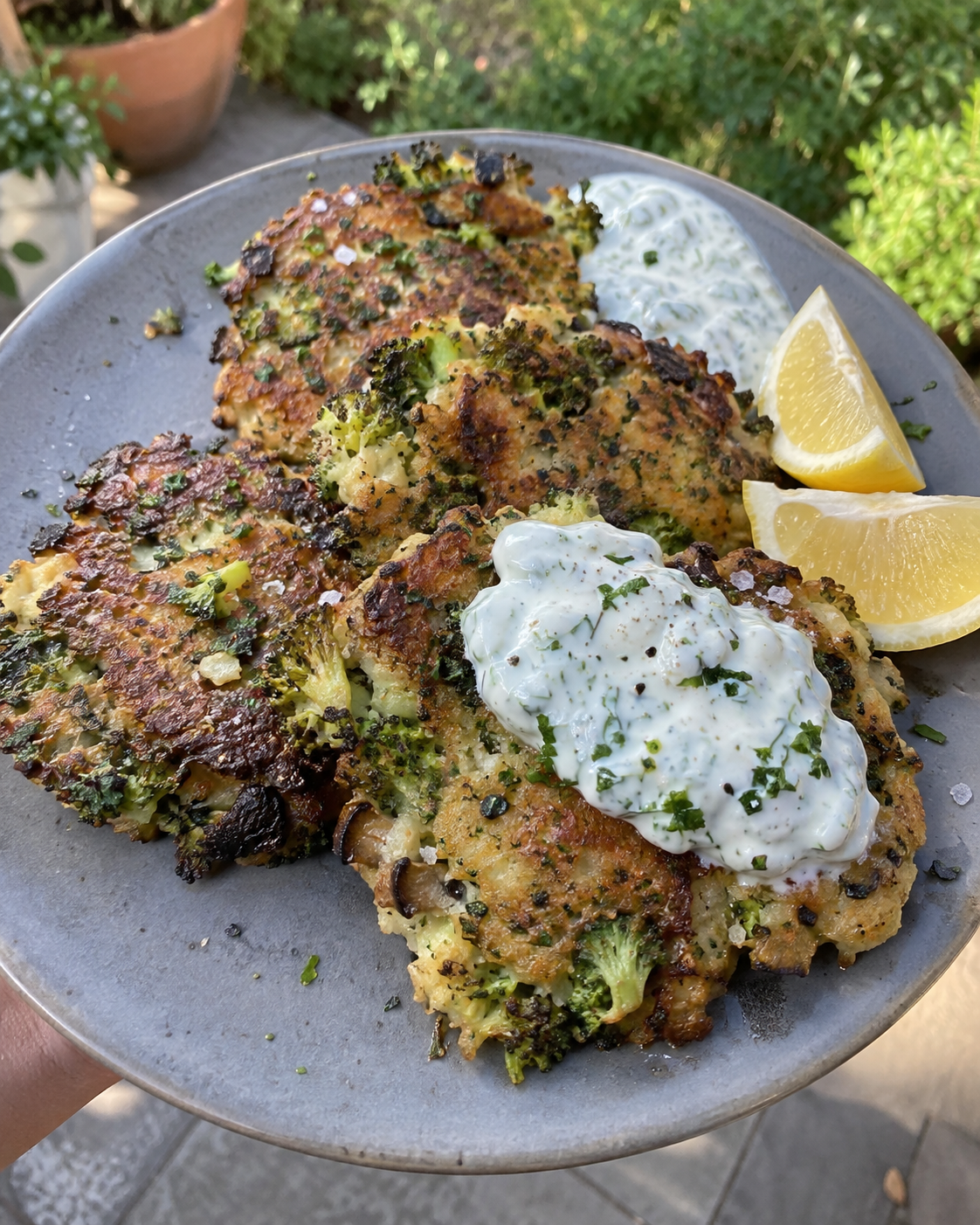
Crispy pan-fried broccoli and shiitake patties with a cool, fresh herb yogurt dip: the fritter that turns broccoli into dinner.
Yield: 10–12 fritters (serves 4 as a main, 6–8 as a side, 10+ as appetizers) · Active: 30 min · Total: 1 hr 15 min (includes the broccoli rest) · Season: broccoli is a cool-season crop, grown in home gardens spring and fall and from California’s Salinas Valley almost year-round; shiitakes are cultivated year-round · Cuisine: Mediterranean-inspired · Best eaten: midday or early evening
Every Mediterranean kitchen has its vegetable fritter: Greek kolokithokeftedes, Turkish mücver, Italian frittelle di verdura. India has pakora. A good fritter is crisp at the edges, tender inside and hearty enough to be a light meal on its own. It’s also the best trick I know for getting broccoli into kids and skeptical adults.
This one pairs broccoli with shiitake mushrooms, which add a deep, savory, almost meaty flavor, plus Parmigiano, fresh parsley and pastured eggs to bind it all. On the side is a quick lemon-dill yogurt sauce, like a cucumber-free tzatziki, to cool things down. Serve these with a big green salad for a light dinner, next to grilled fish or roast chicken, or on a board as an appetizer. They’re even good cold the next day.
Ingredients
Fritters
4 cups broccoli florets (about 1 medium head)
8 oz fresh shiitake mushrooms, stems removed, caps sliced
1 small yellow onion, finely diced
3 cloves garlic, minced
2 tbsp grass-fed butter or ghee
3 large pasture-raised eggs
½ cup cassava flour (or blanched almond flour)
½ cup freshly grated Parmigiano-Reggiano
¼ cup fresh flat-leaf parsley, finely chopped
½ tsp dried oregano (or 1½ tsp fresh)
Zest of 1 organic lemon (optional)
1 tsp Baja Gold sea salt
½ tsp freshly ground black pepper
Pinch of mustard powder (optional, for sulforaphane)
For frying
3–4 tbsp ghee, grass-fed tallow or coconut oil, enough for a thin film in the pan
Lemon-dill yogurt sauce (makes about 1¼ cups)
1 cup full-fat Greek yogurt or plain whole-milk yogurt, grass-fed
2 tbsp fresh dill, finely chopped
2 tbsp fresh lemon juice
½ tsp lemon zest
2 tbsp extra virgin olive oil
1 small clove garlic, finely grated
½ tsp Baja Gold sea salt
¼ tsp freshly ground black pepper
¼ tsp smoked Spanish paprika (pimentón de la Vera), optional
½ tsp raw honey, optional, to balance
To serve: lemon wedges, fresh dill sprigs, flaky sea salt and a drizzle of olive oil over the sauce
Swaps
Flour: cassava flour gives a lighter, more neutral fritter. Almond flour makes a richer, denser one.
Vegetables: use cremini instead of shiitake, cauliflower instead of broccoli, or basil, mint or cilantro instead of parsley.
Dairy-free: skip the Parmigiano (the eggs and flour still bind it) and make the sauce with cashew or coconut yogurt, such as Cocojune.
Method
Prep the vegetables
Chop and wait. Pulse the raw florets in a food processor into small bits, about ¼ inch (not a paste). Let them sit 30–40 minutes while you prep everything else. This rest gives sulforaphane time to form before heat slows the enzyme that makes it.
Steam. Steam the chopped broccoli 3 minutes, just until bright green. Spread it out to cool, then pile it into a clean kitchen towel and squeeze out as much water as you can. Dry broccoli makes fritters that hold together.
Cook the mushrooms. Melt the butter in a skillet over medium heat. Cook the onion 4–5 minutes, until soft. Add the shiitakes and cook 5–6 minutes, until they release their liquid, soak it back up and turn golden. Add the garlic and cook 30 seconds, until fragrant. Let it cool.
Mix
4. Combine. In a large bowl, mix the broccoli, mushroom mixture, eggs, cassava flour, Parmigiano, parsley, oregano, lemon zest, salt, pepper and mustard powder (if using). It should hold together when you press a spoonful. If it’s too wet, add a tablespoon or two more flour; if it’s too dry, add a splash of water.
5. Rest. Let it sit 5–10 minutes so the flour hydrates and the fritters hold together better.
Make the sauce
6. Whisk all the sauce ingredients together. Taste and adjust the lemon, salt or dill, then refrigerate. It gets better after 15–30 minutes.
Fry
7. Heat the fat. Warm the ghee, tallow or coconut oil in a large cast-iron or stainless skillet over medium heat until shimmering.
8. Form. Scoop ¼-cup portions into the pan and gently press each into a disc about ½ inch thick and 3 inches across. Cook 4–5 at a time; don’t crowd them.
9. Cook. Fry undisturbed for 3–4 minutes, until deeply golden underneath. The fritter is ready to flip when it lifts easily; flip too early and it breaks. Flip gently with a thin spatula and cook 3–4 minutes more.
10. Keep warm. Move them to a paper-towel-lined plate for a moment, then to a rack set on a sheet pan in a 200°F oven to stay crisp. Add more fat between batches as needed.
Serve
11. Pile the fritters on a platter with lemon wedges and dill sprigs and sprinkle with flaky salt. Serve the sauce in a bowl with a drizzle of olive oil. Plan on 2–3 fritters per person as a main.
Storage and make-ahead: The fritter mixture keeps in the fridge up to 4 hours. Cooked fritters keep 3 days refrigerated; re-crisp them at 375°F for 6–8 minutes. The sauce keeps 3–4 days. For 12+ guests, double the recipe, fry in batches and hold them in the 200°F oven.
Honey note: the optional honey stays raw since the sauce is never heated, but honey isn’t safe for babies under 12 months. Pregnancy note: choose pasteurized yogurt over raw-milk yogurt.
Nourishment Notes
Broccoli is one of the richest sources of glucosinolates, sulfur compounds that turn into sulforaphane when the plant is cut. Sulforaphane is one of the most studied plant compounds for its antioxidant and anti-inflammatory effects. The enzyme that makes it (myrosinase) is slowed by heat, so chopping first, waiting, then steaming briefly gives you the most. A pinch of mustard powder adds the enzyme back. Broccoli also brings vitamin C, vitamin K1, folate and fiber.
Shiitake mushrooms bring lentinan, a polysaccharide first isolated from shiitake in the 1970s and studied for immune support, plus B vitamins and guanylate, a savory compound that boosts the flavor of the whole dish. Sun-dried shiitakes have even more guanylate and more vitamin D2 than fresh, and they make a great pantry swap (soak in warm water for 20 minutes).
Pasture-raised eggs add about 18 grams of complete protein across the batch, along with choline and fat-soluble vitamins A, D, E and K2. They also bind the vegetables and flour together.
Cassava flour is the whole cassava root, dried and ground. It’s grain-free and neutral-tasting, and it makes a light fritter. Parmigiano-Reggiano adds salt, deep savory flavor, calcium and vitamin K2. Parsley brings a big dose of vitamin K1, plus chlorophyll and freshness.
The yogurt sauce brings protein, calcium and live cultures, since it’s never heated. Dill and yogurt is a traditional pairing across Eastern Europe, the Middle East and Scandinavia. Lemon adds vitamin C, olive oil brings polyphenols and smoked paprika adds carotenoids and a hint of smoke.
Ghee, tallow and coconut oil are traditional saturated fats that hold up to frying better than seed oils, which oxidize more easily under heat. Tallow gives the deepest golden crust, ghee is the most neutral, and coconut oil adds a faint coconut note (keep it at medium heat).
For your cycle: cruciferous vegetables like broccoli are often recommended during the follicular and luteal phases, since compounds like sulforaphane and indole-3-carbinol are studied for their role in healthy estrogen metabolism. The eggs and yogurt add protein to keep blood sugar steady all month.
Serve It With
As a main: a green salad, like my Seasonal Mixed Greens with Lemon-Dijon Vinaigrette, plus olives and sourdough or grain-free flatbread
As a side: grilled salmon or trout, roast chicken or seared lamb
As an appetizer: on a board with the sauce for dipping, plus cucumber, cherry tomatoes, olives and feta
To drink: sparkling water with lemon and cucumber, or mint tea. If you’d like wine, a chilled dry white like a Greek Assyrtiko or Portuguese Vinho Verde works well.
Sourcing
Broccoli: a farmers’ market in the cool seasons. Look for tight, dark green florets.
Shiitakes: Asian markets have the best prices and quality, or use dried shiitakes
Cassava flour: Otto’s Naturals
Almond flour: finely ground blanched almond flour, organic if possible
Eggs: pasture-raised, from a local farm or Pete & Gerry’s
Parmigiano-Reggiano: DOP-stamped, aged 24+ months
Greek yogurt: Maple Hill Creamery 100% Grass-Fed, Kalona SuperNatural or a local farmers’ market dairy
Smoked paprika: La Chinata (pimentón de la Vera)
Tallow and ghee: grass-fed, from a local farm or butcher
Lemons: organic. Meyer lemons in winter add a lovely floral note.
Sea salt: Baja Gold
— Anna aka Food Marshall