Caesar-Roasted Whole Snapper with Butternut Squash "Risotto", Wild Mushrooms, and Roasted Brussels Sprouts
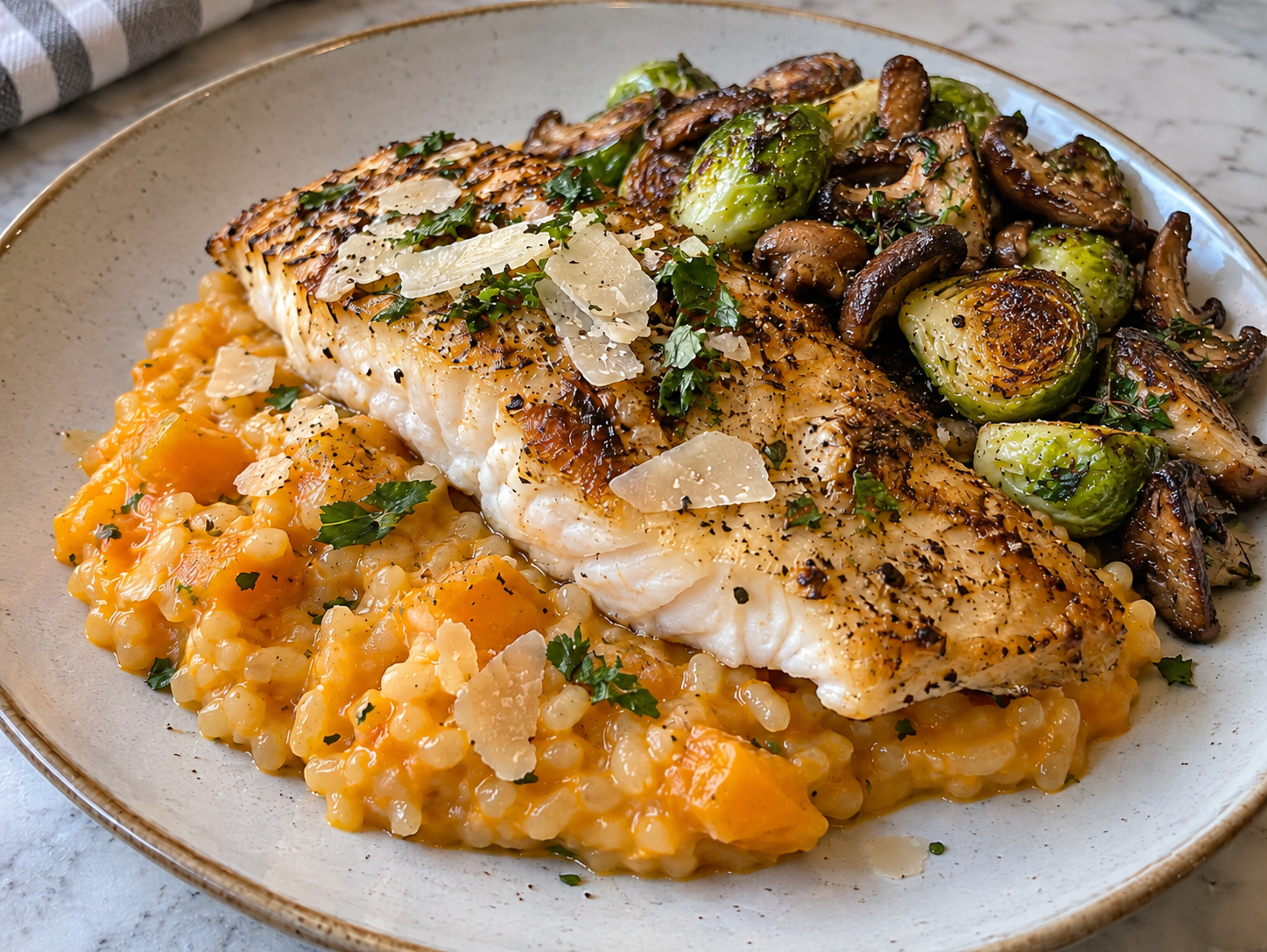
A whole roasted snapper brushed with a real Caesar treatment of anchovies, garlic, Dijon, lemon, and Parmigiano, served with a silky, grain-free butternut squash "risotto," golden wild mushrooms, and crispy Caesar-kissed Brussels sprouts. It looks stunning on the table, but it's mostly hands-off: the fish and sprouts roast while you stir the risotto.
Yield: 4-6 servings · Active: 50 min · Total: 55 min · Autumn · Best eaten: dinner party or Sunday supper
Complete Menu
Caesar-Roasted Whole Snapper
Butternut Squash "Risotto"
Sautéed Wild Mushrooms
Caesar Roasted Brussels Sprouts
Your Game Plan
About 55 min out: Heat the oven to 425°F. Dice the squash, make the Caesar treatment (set aside 2 tbsp for the sprouts before it touches the fish), prep the fish, and halve the sprouts.
About 40 min out: Brussels sprouts go into the oven.
About 35 min out: Start the risotto and keep it going, a ladle of broth at a time.
About 25 min out: Whole fish goes into the oven on the second rack. (Using fillets? Slide them in about 15 minutes out.)
About 12 min out: Sauté the mushrooms.
Last 5 min: Stir the cream and Parmigiano into the risotto, toss the sprouts with the reserved Caesar treatment, finish the fish, and bring everything to the table.
Recipe 1 — Caesar-Roasted Snapper
Yield: 4-6 servings · Active: 15 min · Total: 35 min
A whole snapper roasted with everything you love about a Caesar: salty anchovies, plenty of garlic, tangy Dijon, bright lemon, and nutty Parmigiano. It's big on flavor, beautiful to bring to the table, and easier than it looks.
Ingredients
2 whole wild-caught red snappers (2-2½ lb each), gutted and scaled, or 6 fillets (6 oz each)
3 tbsp extra virgin olive oil
1½ tsp Baja Gold sea salt
½ tsp freshly cracked black pepper
1 lemon, thinly sliced (plus extra wedges for serving)
6 sprigs fresh thyme
4 sprigs fresh rosemary
Caesar treatment
6 wild-caught anchovy fillets packed in olive oil, finely minced
6 garlic cloves, finely minced
3 tbsp fresh flat-leaf parsley, finely chopped
2 tbsp Dijon mustard
2 tbsp fresh lemon juice
Zest of 1 lemon
⅓ cup extra virgin olive oil
⅓ cup grated Parmigiano-Reggiano DOP
½ tsp freshly cracked black pepper
Optional: pinch of red pepper flakes
To finish
Extra grated Parmigiano-Reggiano DOP
Fresh lemon wedges
Fresh flat-leaf parsley, chopped
Flaky sea salt
A drizzle of extra virgin olive oil
Method
Preheat the oven to 425°F and line a large sheet pan with parchment.
Make the Caesar treatment. Whisk together the anchovies, garlic, parsley, Dijon, lemon juice and zest, olive oil, Parmigiano, pepper, and optional red pepper flakes.
Prep the fish. Pat the snappers completely dry inside and out. Make 3-4 diagonal slashes on each side so the Caesar flavors can sink into the flesh.
Season. Rub the fish inside and out with the 3 tbsp olive oil, salt, and pepper.
Stuff. Fill the cavities with the lemon slices, thyme, and rosemary.
Coat. Spread the Caesar treatment generously over both sides, working it into the slashes.
Roast. Lay the fish on the sheet pan and roast 20-25 minutes (12-15 minutes for fillets), until the flesh is opaque and flakes easily at the thickest point near the bone, about 135°F. If the Parmigiano browns too fast, tent loosely with parchment.
Finish. Move the fish to a warm platter and scatter with more Parmigiano, parsley, flaky salt, and a drizzle of olive oil. Serve with lemon wedges.
A note on whole vs. fillet: Roasting a whole fish keeps it juicier, since the bones and skin protect the delicate flesh, and it's the way coastal cooks across the Mediterranean have always done it. If a whole fish feels intimidating, fillets of snapper, branzino, sea bass, cod, or halibut all love the same Caesar treatment.
Recipe 2 — Butternut Squash "Risotto"
Yield: 6-8 servings · Active: 25 min · Total: 35 min
All the creamy, cozy comfort of risotto with no grain at all. Finely diced butternut squash is cooked slowly, a ladle of broth at a time, then finished with cream, butter, and Parmigiano.
Ingredients
1 medium butternut squash (about 3 lb), peeled, seeded, and cut into ¼-inch dice
4 tbsp grass-fed butter, divided
1 medium yellow onion, finely diced
4 garlic cloves, finely minced
2 sprigs fresh thyme
1 sprig fresh sage (optional)
3 cups chicken bone broth, warmed
½ cup heavy cream
1 cup grated Parmigiano-Reggiano DOP
2 tbsp fresh flat-leaf parsley, chopped
1 tsp Baja Gold sea salt
½ tsp freshly cracked black pepper
Pinch of freshly grated nutmeg
Optional: 2 tbsp toasted pumpkin seeds or pine nuts, and shaved Parmigiano, for garnish
Method
Make it rice-like. Pulse about half the diced squash in a food processor into rice-sized bits. The mix of tiny pieces and small cubes is what makes it feel like real risotto.
Sauté the aromatics. Melt 2 tbsp butter in a large heavy skillet or Dutch oven over medium heat. Add the onion and cook 6-8 minutes until soft. Add the garlic, thyme, and optional sage and cook 30 seconds until fragrant.
Add the squash. Stir in all the squash to coat it in the butter, and season with the salt, pepper, and nutmeg.
Cook it risotto-style. Add ½ cup warm broth and stir often until it's absorbed. Keep adding broth ½ cup at a time, letting each addition absorb before the next, for 20-25 minutes, until the squash is tender and creamy.
Finish. Remove the herb sprigs. Stir in the cream and remaining 2 tbsp butter, then fold in the Parmigiano. Taste and adjust the salt and pepper.
Serve in a warm bowl, scattered with parsley and the optional toasted seeds and shaved Parmigiano.
Recipe 3 — Sautéed Wild Mushrooms
Yield: 4-6 servings · Active: 12 min · Total: 12 min
Golden, meaty mushrooms with shallot, garlic, and thyme, spooned right over the risotto.
Ingredients
1 lb mixed wild or specialty mushrooms (chanterelles, maitake, oyster, shiitake, or cremini), cleaned and torn into bite-size pieces
1 tbsp extra virgin olive oil
2 tbsp grass-fed butter
1 shallot, finely minced
2 garlic cloves, minced
1 tbsp fresh thyme leaves
1 tsp sherry vinegar (or a squeeze of lemon)
½ tsp Baja Gold sea salt
¼ tsp freshly cracked black pepper
1 tbsp fresh flat-leaf parsley, chopped
Method
Sear. Heat the olive oil in a large skillet over medium-high heat until shimmering. Add the mushrooms in a single layer (work in batches if needed) and leave them alone 3-4 minutes, until deeply golden underneath. Crowding or stirring too soon makes them steam instead of brown.
Toss and season. Stir, cook 2-3 minutes more, then season with the salt and pepper. Salting after they've browned keeps them from going soggy.
Add the aromatics. Turn the heat to medium, add the butter, shallot, garlic, and thyme, and cook 1 minute until fragrant.
Finish. Splash in the sherry vinegar, toss, and scatter with parsley.
Recipe 4 — Caesar Roasted Brussels Sprouts
Yield: 4-6 servings · Active: 10 min · Total: 35 min
Crispy, caramelized sprouts tossed with a spoonful of the Caesar treatment and a shower of Parmigiano. Even Brussels skeptics come back for seconds.
Ingredients
1½ lb Brussels sprouts, trimmed and halved (quartered if large)
3 tbsp extra virgin olive oil
½ tsp Baja Gold sea salt
¼ tsp freshly cracked black pepper
2 tbsp reserved Caesar treatment (from Recipe 1)
2 tbsp grated or shaved Parmigiano-Reggiano DOP
Squeeze of fresh lemon
Method
Roast. Toss the sprouts with the olive oil, salt, and pepper and spread them cut-side down on a parchment-lined sheet pan. Roast at 425°F for 20-25 minutes, without stirring, until deeply caramelized on the cut side and tender.
Toss. While they're hot, toss with the reserved Caesar treatment. Set it aside before it ever touches the raw fish.
Finish with the Parmigiano and a squeeze of lemon.
Plating
Set the whole snapper on a big platter in the center of the table with lemon wedges tucked around it. Spoon the risotto into a warm bowl and pile the wild mushrooms on top, and serve the Brussels sprouts in their own bowl alongside, with extra Parmigiano, flaky salt, and a small pitcher of your best olive oil for drizzling. To serve, lift the top fillet off the bone in pieces, then lift away the backbone to reach the bottom fillet.
Sourcing
Wild-caught red snapper — from a trusted fishmonger, ideally Gulf Wild tagged snapper, which is individually traceable to the boat that caught it. Red snapper is one of the most commonly mislabeled fish in the U.S., so buy whole fish from someone you trust. Peak spring through autumn
Anchovies — Ortiz Cantabrian anchovies, hand-filleted and packed in olive oil
Parmigiano-Reggiano DOP — aged 24+ months, made from raw milk by law
Dijon mustard — Edmond Fallot, stone-ground in Burgundy by a family mill since 1840, with no sugar
Heavy cream — raw cream from a small pasture-raised dairy, or Kalona SuperNatural (grass-fed, low-temp vat-pasteurized, non-homogenized)
Grass-fed butter — cultured butter from 100% grass-fed cows, or raw butter from a local dairy
Chicken bone broth — homemade from pasture-raised bones, or Bonafide Provisions (organic, sold frozen)
Butternut squash — organic, heavy for its size, with a matte (not shiny) skin
Yellow onion, garlic, and fresh herbs (thyme, rosemary, sage, parsley) — organic
Lemons — organic (you're using the zest)
Pumpkin seeds or pine nuts (optional) — organic, raw or sprouted pumpkin seeds, or Mediterranean pine nuts
Nutmeg, black peppercorns, red pepper flakes — organic, non-irradiated, ground fresh
Single-estate extra virgin olive oil — harvest-dated within the past year, in dark glass
Baja Gold sea salt for cooking; fleur de sel de Guérande or Maldon for finishing
Wild mushrooms — from a farmers' market, a reputable forager, or a local specialty mushroom grower (maitake, oyster, and shiitake are beautifully cultivated). An honest note: never eat foraged mushrooms unless an expert has identified them. Peak autumn
Brussels sprouts — organic, small, tight, bright green heads. They're sweetest after the first frost, so peak late autumn into winter
Shallots — organic, firm
Sherry vinegar — Vinagre de Jerez DOP
Storage
Cooked snapper: Refrigerated up to 2 days. Best fresh, since reheating dries out the delicate flesh
Butternut squash risotto: Refrigerated up to 4 days. Reheat gently on the stovetop with a splash of broth
Caesar treatment (uncooked): Refrigerated up to 1 week
Sautéed wild mushrooms: Refrigerated up to 3 days. Rewarm in a hot skillet
Roasted Brussels sprouts: Refrigerated up to 4 days. Reheat at 400°F for 5 minutes to recrisp
Leftover transformations: Flake cold snapper over greens and use the leftover Caesar treatment as a dressing for a next-day lunch salad; stir leftover risotto into pastured eggs for a rich frittata; roll cold risotto into small patties and pan-fry them in butter until golden.
Nourishment Notes
Wild-caught red snapper — lean complete protein, iodine, selenium, B12, and some omega-3s. Roasting it whole keeps the flesh moist and the flavor deep.
Anchovies — rich in omega-3s (EPA and DHA), plus B12, niacin, and selenium. Small fish at the bottom of the food chain carry very little mercury.
Parmigiano-Reggiano DOP — concentrated calcium (about 1,180 mg per 100 g), K2, and complete protein. The long aging breaks down most of the lactose.
Butternut squash — beta-carotene (fat-soluble, so the butter and cream help you absorb it), potassium, vitamin C, fiber, and slow, steady carbohydrate.
Heavy cream and grass-fed butter — fat-soluble vitamins A, D, E, and K2, plus butyrate and CLA.
Chicken bone broth — gelatin, glycine, proline, trace minerals.
Dijon mustard — glucosinolates (sinigrin converts to isothiocyanates supporting Phase 2 liver detoxification).
Yellow onion and garlic — quercetin, prebiotic fibers, allicin, and organosulfur compounds.
Fresh herbs (thyme, rosemary, parsley, sage) — aromatic oils, polyphenols, vitamin K, chlorophyll.
Fresh lemon — d-limonene, hesperidin, vitamin C.
Extra virgin olive oil — oleic acid, hydroxytyrosol, oleuropein, oleocanthal.
Baja Gold sea salt — over 90 trace minerals.
Wild mushrooms — ergothioneine (found in mushrooms in far higher amounts than any other food), beta-glucans for immune support, B vitamins, copper, and selenium. Mushrooms grown in or exposed to sunlight also carry vitamin D.
Brussels sprouts — glucosinolates (the precursors to sulforaphane and DIM), vitamin C, vitamin K, folate, and fiber.
— Anna aka Food Marshall