Cauliflower Fried Rice with Pork (or Your Favorite Protein)
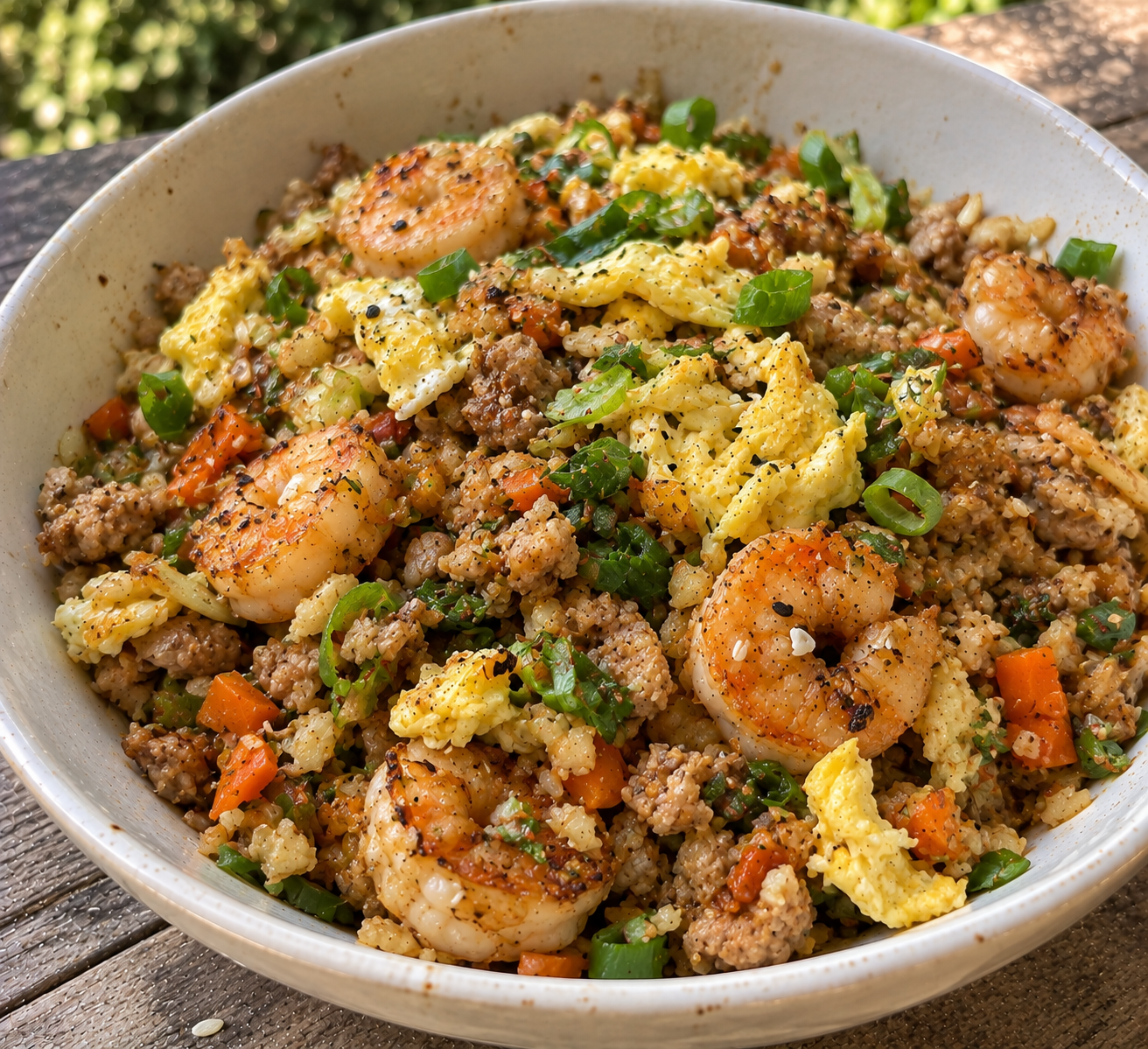
The takeout classic made grain-free: grated cauliflower stir-fried hot and fast with pasture-raised pork, carrots, scallions, ginger, garlic, and egg, seasoned with coconut aminos and finished with toasted sesame oil.
Yield: Serves 4–5 as a main, or 6–8 as a side · Active: 15 min · Total: 30 min · Year-round · Cuisine: Pan-Asian, grain-free · Best eaten: midday or early evening
The method is simple: brown the protein, then soften the vegetables in the same pan, add the cauliflower, return the protein, season, and scramble in the eggs. Once you’ve made it, it becomes a weeknight staple you can make without a recipe.
For fried rice with meatballs, see my Asian Meatballs Three Ways.
Ingredients
Cauliflower rice
1 large head cauliflower (about 2½ lbs), for about 5 cups grated
Protein (choose one)
1½ lbs pasture-raised pork loin, cut into ½-inch cubes
Or diced chicken thighs, peeled wild shrimp, ground beef or lamb, wild salmon, or 4 cups leftover roast chicken or pork
1 tsp Baja Gold sea salt and ½ tsp black pepper
Aromatics and vegetables
4 tbsp grass-fed ghee or avocado oil, divided
1 bunch scallions, thinly sliced (whites and greens separated)
1 large carrot, finely diced
Optional: ½ red bell pepper and ½ yellow onion, finely diced
4 garlic cloves, minced
1 tbsp fresh ginger, finely grated
Seasoning
4 tbsp coconut aminos, plus more to taste
2 pasture-raised eggs, beaten
1–2 tsp toasted sesame oil
Optional: 1 tbsp raw apple cider vinegar, for brightness
To finish
The scallion greens
1 tbsp toasted sesame seeds
Optional: fresh cilantro, chili flakes, or sriracha
Method
Grate the cauliflower. Cut the cauliflower into florets, and grate them on the largest holes of a box grater, or pulse them in a food processor in about 6 short bursts, until rice-sized (don’t let it turn to mush). If you can, let it sit 30 minutes before cooking (see the Nourishment Notes).
Prep everything. Fried rice cooks fast, so have all your ingredients chopped and ready before you start.
Brown the protein. Heat 2 tbsp ghee in a large wok or heavy skillet over medium-high heat. Add the pork, season with salt and pepper, and cook 5–7 minutes, stirring now and then, until browned and 145°F inside. (Chicken thighs take about 8 minutes, to 175°F; shrimp, 2–3 minutes; leftover meat just needs warming at step 6.) Move it to a plate.
Soften the vegetables. Add the remaining 2 tbsp ghee to the pan. Add the scallion whites, carrot, and bell pepper and onion (if using), and cook 3–4 minutes, stirring, until softened. Add the garlic and ginger, and cook 30 seconds, until fragrant.
Add the cauliflower. Raise the heat to high, add the cauliflower, and stir-fry 4–5 minutes, until tender but still with some bite.
Bring it together. Return the protein to the pan, add the coconut aminos, and stir-fry 2–3 minutes more, until the cauliflower browns lightly in spots.
Scramble the eggs. Push everything to one side of the pan. Pour the eggs into the empty space, let them set for 30 seconds, then scramble until just cooked, and fold them in, breaking up any big pieces.
Finish. Drizzle with the sesame oil and vinegar (if using), and toss once or twice. Taste, and add more coconut aminos if needed.
Serve right away, topped with the scallion greens, sesame seeds, and cilantro or chili, if you like.
Serve It With
Kimchi, a quick cucumber salad with apple cider vinegar and sesame, sliced avocado, or a soft-boiled egg. Hot green, jasmine, or oolong tea is lovely alongside.
Storage
Leftovers: refrigerated up to 3 days. Reheat in a hot skillet (not the microwave) to bring back the texture.
Make ahead: Grate the cauliflower and cook the protein up to 1 day ahead. Stir-fry everything together just before serving.
For a crowd: For 12 or more, double or triple the recipe, and cook in two pans, so the cauliflower fries instead of steams.
Nourishment Notes
Cauliflower — more than half your daily vitamin C in a cooked cup, plus vitamin K, folate, fiber, and glucosinolates, which your body turns into sulforaphane, supporting estrogen metabolism. The enzyme that makes sulforaphane (myrosinase) is destroyed by heat, even brief cooking, so grate the cauliflower and let it sit 30 minutes first, which gives the sulforaphane time to form. A pinch of mustard powder stirred in at the end helps, too.
Pasture-raised pork — thiamine (B1, which pork is one of the richest sources of), zinc, selenium, and B vitamins, plus more vitamin D than conventional pork, since the pigs live outdoors in the sun. Pork loin is one of the leaner cuts.
Other proteins — chicken thighs bring more flavor and iron than breast; wild shrimp bring iodine, selenium, B12, and astaxanthin, an antioxidant carotenoid.
Pasture-raised eggs — protein, choline, and vitamins A, D, E, and K2.
Ginger — gingerols, long used across Asia to warm the body and support digestion, and studied for easing nausea and inflammation.
Garlic and scallions — quercetin, sulfur compounds, and prebiotic fiber.
Carrots — beta-carotene, better absorbed with the ghee.
Coconut aminos — a savory, soy-free, gluten-free seasoning made from coconut sap and sea salt, a little sweeter and lower in sodium than soy sauce.
Toasted sesame oil and seeds — a little goes a long way. Toasted sesame oil’s flavor fades with high heat, so it’s added at the end. Sesame seeds bring calcium, magnesium, and lignans studied for their antioxidant effects.
As a circadian food, this is a satisfying, protein-rich meal for midday or an early dinner. It’s a year-round dish, and a perfect way to use up leftover roast meat and odds and ends of vegetables.
For your cycle: With glucosinolates from the cauliflower, which support estrogen metabolism, plus protein and B vitamins, this is a lovely meal in any phase, and especially in the follicular and luteal phases.
Sourcing
Cauliflower — organic, with tight, creamy-white florets (pre-riced organic cauliflower works in a pinch, but freshly grated has better texture)
Pork loin — pasture-raised, from a local farm or Seven Sons (buy a whole loin and cut it yourself for the best price)
Chicken, shrimp, beef, or lamb (if using) — pasture-raised, wild-caught, or 100% grass-fed
Eggs — organic and pasture-raised, from a local farm
Scallions, carrots, garlic, ginger, and peppers — organic, from a farmers’ market or Asian market (Asian markets often have the freshest ginger)
Ghee or avocado oil — grass-fed ghee, like Pure Indian Foods, or organic cold-pressed avocado oil
Coconut aminos — organic and soy-free, like Coconut Secret
Toasted sesame oil — 100% pure toasted sesame oil, not a blend, like Kadoya or Sempio
Sesame seeds — organic (or toast raw seeds in a dry skillet for 2–3 minutes)
Raw apple cider vinegar (optional) — organic, with the mother (Bragg)
Salt — Baja Gold sea salt
— Anna aka Food Marshall