Colorful Carrots with Pepita Pesto
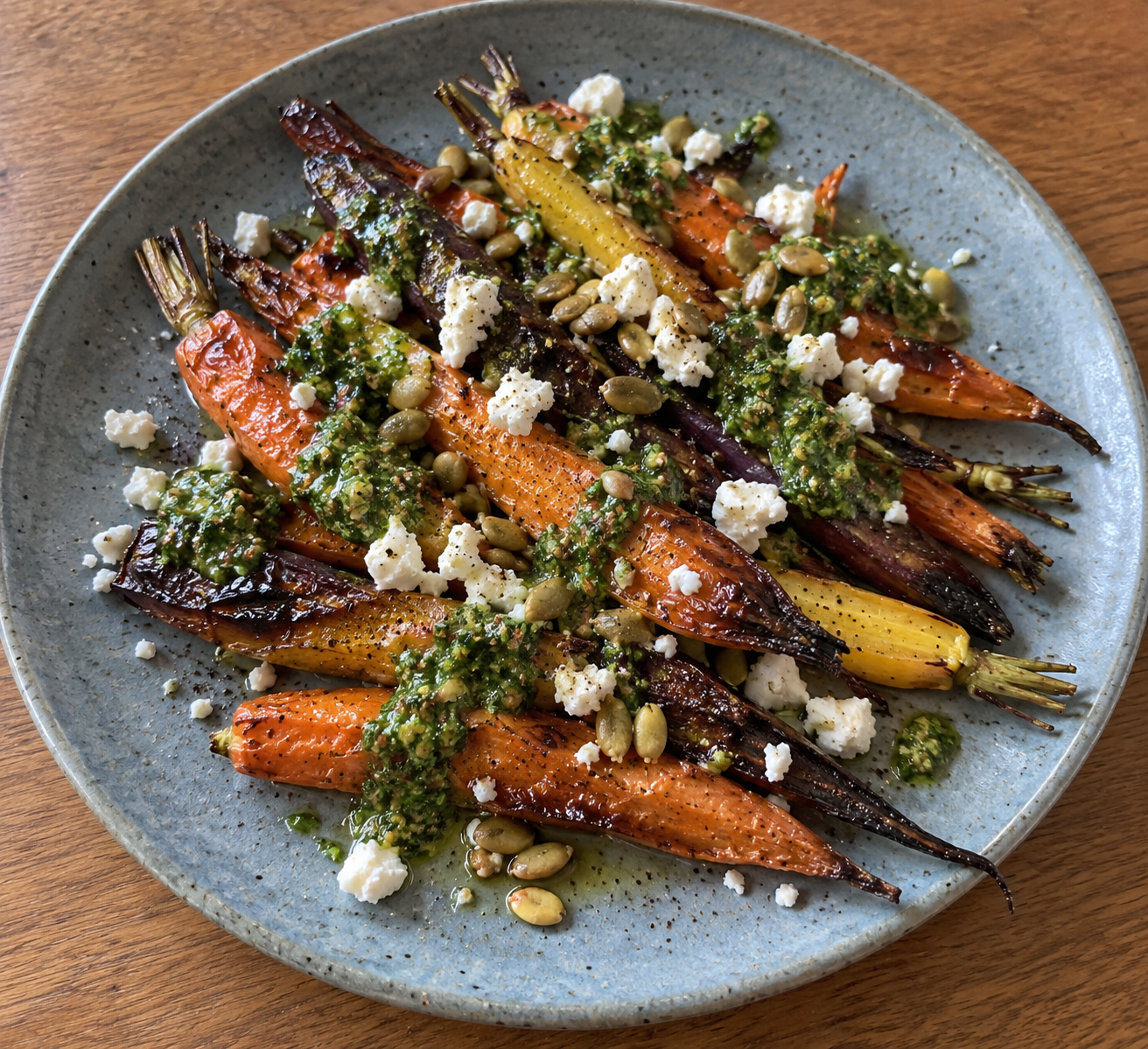
Roasted rainbow carrots with a pumpkin-seed and carrot-top pesto
Yield: Serves 4
Time: 20 min active · 45 min total
Peak spring-autumn for rainbow carrots
A note from the kitchen
This is a recipe that honors the whole carrot — root, tops, and all. Most home cooks discard carrot greens automatically, not realizing they carry their own distinct flavor (faintly carrot-and-parsley, closer to an herb than a vegetable) and meaningful nutritional density. Here the carrot tops become the green base of a pesto, blended with pepitas, hemp seeds, citrus zest, and olive oil — a sauce that suits roasted root vegetables better than a typical basil pesto would.
Roasted rainbow carrots are one of the most photogenic vegetable dishes you can put on a table — purple, yellow, white, orange, and red roots caramelized at the edges and bright with citrus-pepita pesto. The colors aren't just visual; each pigment delivers a different family of compounds (anthocyanins in purple, beta-carotene in orange, lutein in yellow, lycopene in red). Eating the rainbow on a single plate captures all four.
Best made when carrots are freshly pulled from the ground or recently harvested at a farmers' market — the greens are at their peak before they wilt or yellow."
Ingredients
Roasted carrots
2 lb rainbow carrots (purple, yellow, orange)
2 tbsp extra virgin olive oil
½ tsp sea salt
fresh black pepper, to taste
Pepita pesto
1 cup carrot tops, washed (reserved from the carrots above)
1 cup fresh flat-leaf parsley
½ cup raw pepitas (pumpkin seeds)
2 tbsp hemp seeds
1 small shallot, roughly chopped
1 garlic clove
2 tsp aged balsamic vinegar
zest of 1 orange
zest of 1 lemon
1 tsp ground coriander
½ cup extra virgin olive oil
½ tsp sea salt
Optional addition: grass-fed crumbled feta or chevre
Method
Preheat the oven to 400°F.
Trim the tops from the carrots, reserving 1 cup of the leafy greens (use the most tender, lightest-colored ones; discard any tough or yellowed leaves). Wash the tops thoroughly.
Scrub the carrots well — leave the skin on. Halve any thick carrots lengthwise so they cook evenly.
Toss the carrots with olive oil, salt, and pepper on a parchment-lined sheet pan.
Roast 25–30 minutes, turning once, until tender and slightly caramelized at the edges.
Make the pepita pesto. While the carrots roast, place the carrot tops, parsley, pepitas, hemp seeds, shallot, garlic, balsamic vinegar, orange zest, lemon zest, ground coriander, and salt in a food processor or high-powered blender. Pulse until coarsely chopped. With the motor running, stream in the olive oil until the pesto comes together — it should be coarse and chunky, retaining visible texture. Don't over-process to a smooth purée.
Taste and adjust salt or balsamic as needed.
Plate and serve. Arrange the roasted carrots on a wide serving platter — overlapping or fanned for visual contrast. Spoon the pepita pesto generously over the top, allowing some carrots to remain visible. Finish with a pinch of flaky sea salt, a drizzle of high-quality olive oil, and crumbled chèvre or feta if using. Serve warm or at room temperature.
Variations
With cheese topping: Crumble 2-3 oz fresh chèvre or grass-fed feta over the carrots before spooning on the pesto. Adds tangy richness.
With toasted nuts: Top with toasted slivered almonds, chopped hazelnuts, or additional toasted pepitas for crunch.
With pomegranate seeds: Scatter ¼ cup pomegranate arils over the finished dish for jewel-toned color and bright acidity. Especially beautiful in autumn and winter.
With other roasted root vegetables: Add 1 lb parsnips, beets, or sweet potato to the sheet pan alongside the carrots. The pesto works beautifully across all root vegetables.
Make ahead: The carrots can be roasted up to 2 days ahead and refrigerated. The pesto can be made up to 4 days ahead and kept refrigerated in a sealed glass jar with a thin layer of olive oil on top to prevent oxidation. Combine just before serving and warm the carrots briefly in the oven if desired.
With added protein on top: Serve the carrots and pesto alongside grilled chicken thighs, pan-seared scallops, or roasted lamb chops for a complete dinner.
Pesto as a sauce for other dishes: The pepita-carrot-top pesto works beautifully spooned over roasted wild salmon, grilled chicken, scrambled eggs, or used as a sandwich/lettuce-wrap spread.
Pairs Well With
Serve alongside grilled wild fish, pan-seared scallops, slow-roasted chicken, or lamb chops for a complete dinner. As part of a vegetable-forward dinner spread with grilled romaine hearts, roasted Brussels sprouts, and a simple bitter greens salad.
Sourcing
Rainbow carrots. Look for fresh, recently pulled carrots with green tops still attached — the greens are the signal of freshness. Farmers' markets, CSA shares, and organic produce sections carry rainbow varieties (purple, yellow, white, red, orange). Bunched carrots with tops are typically smaller and sweeter than the bagged carrots without tops. Heirloom varieties (Purple Haze, Atomic Red, Solar Yellow, Lunar White) have distinct flavor profiles.
Raw pepitas (hulled pumpkin seeds). Look for raw, unsalted, single-ingredient pumpkin seeds. Go Raw (sprouted), Anthony's Goods, or Terrasoul. Sprouted pepitas are more easily digestible. Store in the refrigerator or freezer — pepitas oxidize quickly due to their high oil content.
Hemp seeds (hemp hearts). Single-ingredient raw hulled hemp hearts. Manitoba Harvest, Nutiva, or Anthony's Goods.
Aged balsamic vinegar. Look for "Aceto Balsamico Tradizionale di Modena DOP" if accessible (genuinely aged 12+ years, dense and syrupy). For accessible options, Bionaturae or aged Modena IGP work. Avoid commercial "balsamic vinegar" — most contain caramel coloring and unfermented grape concentrate.
Single-estate extra virgin olive oil. Harvest-dated within the last 12 months, in a dark glass bottle. Italian or Spanish single-origin works beautifully here.
Organic oranges and lemons. Zest is essential — buy organic to avoid wax and pesticide residue on the peel.
Fresh flat-leaf parsley. Italian flat-leaf, not curly. From a farmers' market or windowsill pot.
Optional cheese. For the optional topping: raw grass-fed feta (Greek sheep + goat milk) or fresh chèvre (Vermont Creamery, Cypress Grove, or local farmers' market goat dairy).
Sea salt. Baja Gold mineral sea salt for cooking, fleur de sel for finishing
Nourishment Notes
Carrot tops are one of the most-discarded edible greens despite carrying their own distinct flavor and substantial nutritional density. The greens taste faintly carrot-and-parsley — closer to an herb than a vegetable — and they carry chlorophyll, vitamin K, and a slightly bitter compound that balances beautifully against the sweetness of the roasted root.
Pepitas — hulled raw pumpkin seeds — are the key choice here that gives the pesto its body. Where a classic Italian basil pesto uses pine nuts, this version uses pepitas for a different flavor profile and a higher zinc and magnesium content. Hemp seeds add a soft creaminess and complete protein. The combination produces a pesto with more body and less oil, which suits roasted root vegetables better than a thinner basil pesto would.
Rainbow carrots are not a single varietal but a collection — purple, yellow, white, and red carrots that pre-date the dominant orange variety by centuries. The orange carrot is a relatively recent (17th-century Dutch) breeding selection; the original wild carrot from Central Asia was purple. Each color carries different pigments: purple carrots concentrate anthocyanins, orange carrots concentrate beta-carotene, yellow carrots concentrate lutein, and red carrots concentrate lycopene. Eating the rainbow on a single plate captures all four.
Storage
Roasted carrots: Refrigerated up to 4 days, sealed. Reheat in a 350°F oven for 8-10 minutes or serve at room temperature.
Pepita pesto: Refrigerated up to 4 days in a sealed glass jar with a thin layer of olive oil on top to prevent oxidation. Stir well before using.
Whole assembled dish: Best served immediately after combining, but leftovers keep up to 2 days refrigerated.
— Anna aka Food Marshall