Crispy Roasted Duck with Butternut Squash Purée, Apple Cider Vinaigrette, Grilled Broccolini, and Blueberry Glaze
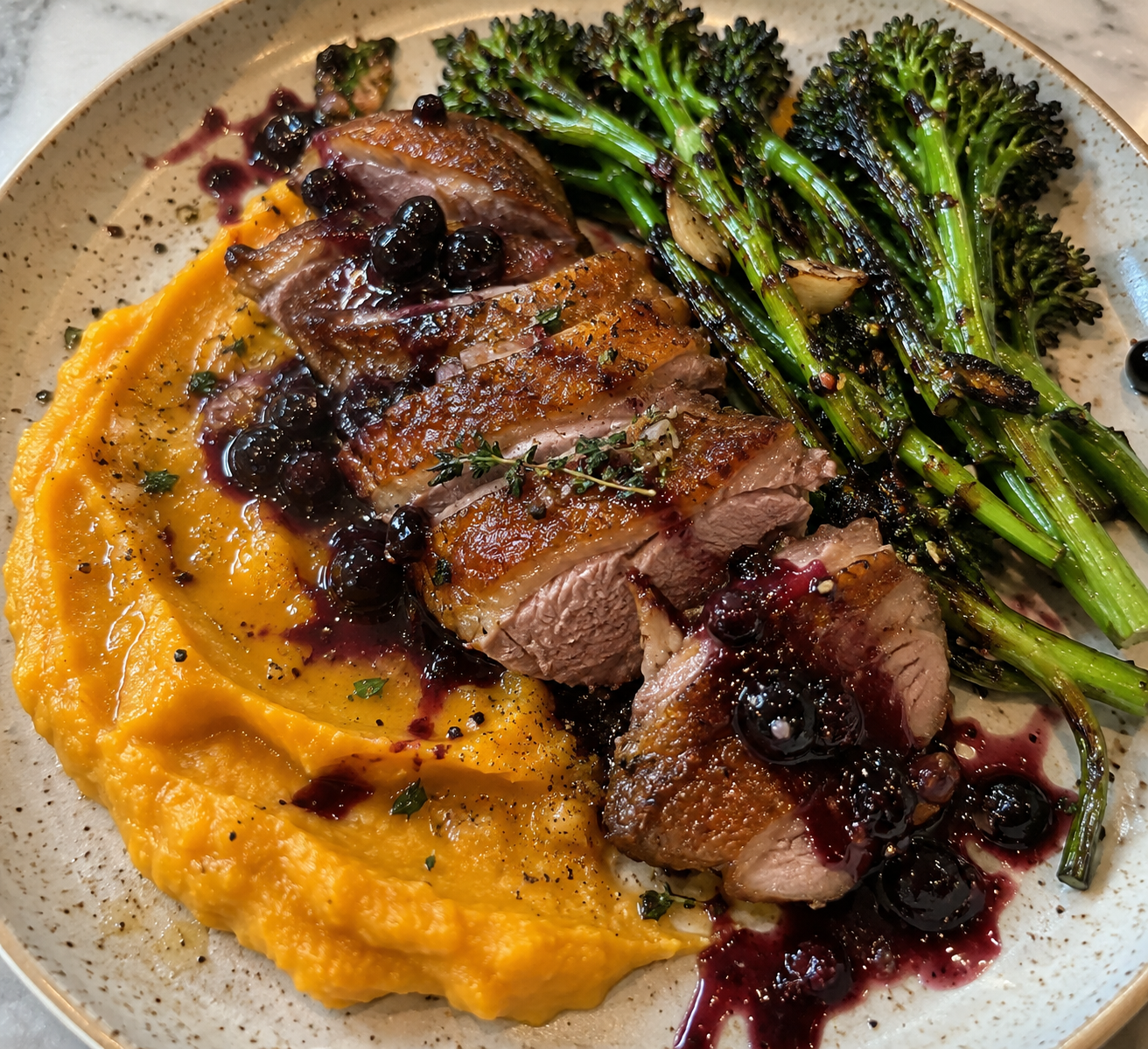
Duck sounds fancy, but a duck breast cooks a lot like a steak, and it's one of the easiest ways to make dinner feel special at home. Pasture-raised duck cooked until the skin is impossibly crispy, served with a velvety butternut squash purée, a bright apple cider vinaigrette, char-grilled broccolini, and a jewel-toned blueberry glaze. Deeply nourishing and seriously beautiful.
Yield: 4 servings · Active: 30 min · Total: 1 hr 45 min (plus 2-24 hours to dry brine) · Peak autumn through winter · Best eaten: Sunday supper or dinner party
Your Game Plan
The day before (or at least 2 hours ahead): Score and season the duck and pop it in the fridge.
About 45 min out: Pull the duck from the fridge, heat the oven to 400°F, shake up the vinaigrette, start the blueberry glaze simmering, and get the squash steaming.
About 30 min out: Start rendering the duck in a cold skillet.
About 15 min out: Duck goes into the oven. Blend the purée with a couple spoonfuls of the rendered duck fat and keep it warm. Get the broccolini on the grill.
While the duck rests: Finish the glaze with butter, toast the garlic for the broccolini, and plate.
Recipe 1 — Crispy Roasted Duck
Ingredients
4 pasture-raised duck breasts (about 8 oz each, skin on)
OR 1 whole pasture-raised duck (about 5-6 lb) for a full-family preparation
1 tbsp Baja Gold sea salt
1 tsp freshly cracked black pepper
2 tbsp fresh thyme leaves
1 tsp ground fennel seeds
4 garlic cloves, minced
Zest of 1 orange (optional but traditional)
Method for duck breasts
Score the skin. With a sharp knife, score the duck skin in a diamond pattern, cutting through the skin and fat but not into the meat. This is essential for crispy skin, because it lets the fat melt out and the salt sink in.
Season. Rub the salt all over, working it into the scored skin. Mix the pepper, thyme, ground fennel, garlic, and orange zest, and rub that on the meat side only. Garlic and herbs on the skin would burn while it renders. Refrigerate uncovered 2-24 hours (dry brine) for much crispier skin.
Take the chill off. Pull the duck out of the fridge 30 minutes before cooking, heat the oven to 400°F, and pat the skin dry.
Render the fat. Lay the duck breasts skin-side down in a cold cast iron skillet, then turn the heat to medium-low. Let them cook slowly for 12-15 minutes as the fat renders and the skin turns deeply golden-brown and impossibly crispy. Starting cold is the secret: the fat melts out gently before the skin has a chance to burn. Pour off the fat as it renders and save it for the squash purée (and for roasting potatoes another night; duck fat is honestly one of the best cooking fats out there).
Finish in the oven. Flip the duck breasts skin-side up, slide the skillet into the oven, and roast 6-8 minutes until the internal temperature reads 130°F (medium-rare) or 135°F (medium). Duck breast is served pink, just like a good steak.
Rest. Transfer to a warm plate and let it rest 5-8 minutes.
Slice against the grain.
Method for whole duck (alternative)
Score the skin all over (not into the meat) and season it the same way, tucking the herbs, garlic, and zest into the cavity instead of onto the skin. Dry brine 12-24 hours, then roast breast-side up on a rack at 300°F for 1½-2 hours, pouring off the fat now and then. Finish at 425°F for 15 minutes for crispy skin. It's done when the thickest part of the thigh reads 175°F.
Recipe 2 — Velvety Butternut Squash Purée
Yield: 4 servings · Active: 10 min · Total: 30 min
Ingredients
1 medium butternut squash (about 2½ lb), peeled, seeded, and cut into 1-inch cubes (about 5-6 cups), OR 2 lb sweet potatoes, peeled and cubed
2 tbsp rendered duck fat (saved from Recipe 1), or pastured butter
¼-½ cup warm grass-fed bone broth (or raw cream for an extra-rich version)
½ tsp Baja Gold sea salt, plus more to taste
Optional: a pinch of freshly grated nutmeg or a few fresh thyme leaves
Method
Steam. Set a steamer basket over an inch of simmering water, add the squash, cover, and steam 15-20 minutes, until a fork slides through with no resistance.
Let it steam dry. Tip the squash into a colander and let it sit for 2 minutes. Letting the extra moisture escape is what keeps your purée from turning watery.
Blend. Add the squash to a blender or food processor with the duck fat, salt, and ¼ cup of the warm broth. Blend 1-2 minutes until velvety smooth, adding more broth a splash at a time until it's silky and spoonable. (If you're using a blender, crack the lid vent and cover it with a towel so the steam can escape.)
Taste and keep warm. Adjust the salt, add the nutmeg or thyme if you like, and keep it covered over the lowest heat until you plate.
Want a deeper, sweeter flavor? Roast the cubed squash with a little duck fat or olive oil at 425°F for 30-35 minutes, then blend the same way.
Recipe 3 — Apple Cider Vinaigrette
Ingredients
3 tbsp raw apple cider vinegar
1 tbsp fresh apple cider (or replace with additional vinegar)
½ cup extra virgin olive oil
2 tbsp raw honey
1 tbsp Dijon mustard
1 small shallot, finely minced
1 tsp fresh thyme leaves
½ tsp Baja Gold sea salt
¼ tsp freshly cracked black pepper
Method
Add everything to a small jar, screw on the lid, and shake hard until it turns creamy and emulsified. It keeps in the fridge for about a week. Let it sit out for 10 minutes and give it another shake before using.
Recipe 4 — Grilled Broccolini
Ingredients
2 bunches broccolini (about 1½ lb), tough stem ends trimmed
3 tbsp extra virgin olive oil, divided
4 garlic cloves, thinly sliced
1 tsp Baja Gold sea salt
½ tsp freshly cracked black pepper
Pinch of red pepper flakes
Zest and juice of 1 lemon
Flaky sea salt
Method
Toss. Toss the broccolini with 2 tbsp olive oil, salt, pepper, and red pepper flakes.
Grill or char. Grill over medium-high heat 6-8 minutes, tossing occasionally, until charred and tender-crisp (lay the stalks across the grates so they don't fall through). Or blister them in a hot cast iron skillet.
Finish with garlic and lemon. If you're using a skillet, add the remaining 1 tbsp olive oil and the sliced garlic for the last minute. If you're grilling, toast the garlic in the oil in a small pan for 30-60 seconds until just golden, then spoon it over. Squeeze the lemon juice over the top and add the lemon zest.
Plate. Transfer to a warm platter and scatter with flaky sea salt.
Recipe 5 — Blueberry Glaze
Ingredients
2 cups fresh or frozen wild blueberries
1 cup grass-fed beef bone broth or duck stock
2 tbsp raw apple cider vinegar
2 tbsp raw honey
1 tsp fresh thyme leaves
1 shallot, finely minced
1 tbsp pastured butter, divided
½ tsp Baja Gold sea salt
¼ tsp freshly cracked black pepper
Optional: 1 tsp arrowroot powder (dissolved in 1 tbsp cold water) if you want a thicker glaze
Method
Sauté the shallot. In a small saucepan, melt 1 tsp of the butter (or a spoonful of the rendered duck fat) over medium heat. Add the minced shallot and cook 3-4 minutes until softened.
Add the blueberries. Add the blueberries, bone broth, apple cider vinegar, raw honey, thyme, salt, and pepper. Bring to a simmer.
Reduce. Simmer 15-20 minutes until reduced by half and thickened into a glossy, jammy consistency. As it simmers, mash some of the blueberries with a wooden spoon to release their juices.
Optional thickening. For a thicker glaze, whisk in the arrowroot slurry and simmer 2 minutes more.
Finish. Remove from the heat and whisk in the remaining butter for a glossy finish. Taste and adjust the salt or honey.
Plating
Spoon a generous swoosh of butternut squash purée onto each warm plate and fan the sliced duck over it, skin-side up to show off the crispy skin. Spoon the blueberry glaze generously around the duck, with just a little over the meat, so the skin stays crispy. Arrange the grilled broccolini alongside. Pass the apple cider vinaigrette at the table for the broccolini or duck.
Sourcing
Truly pasture-raised duck — White Oak Pastures (Georgia, ships nationwide) or Circle C Farm (Florida, ships nationwide). Locally at farmers' markets when available. Note that Grimaud Farms, Maple Leaf Farms, and D'Artagnan are barn-raised (indoor climate-controlled barns, not pasture) — a meaningfully better option than commodity confinement duck if truly pasture-raised isn't accessible, but not the same standard
Butternut squash — organic, heavy for its size, with a matte (not shiny) skin. Peak autumn through winter
Sweet potatoes (alternate) — organic, firm, no soft spots
Fresh broccolini — bright green, tightly closed florets
Wild blueberries (fresh or frozen) — Wyman's, Cascadian Farm, or Whole Foods 365 Organic
Grass-fed beef bone broth — Bonafide Provisions, Bare Bones, Kettle & Fire
Raw apple cider vinegar — with the mother, Bragg's
Fresh apple cider — from a farmers' market or organic producer, no preservatives
Raw honey — local, unfiltered
Fresh shallots — organic, firm
Dijon mustard — single-ingredient (mustard seeds, vinegar, salt), no sugar
Oranges and lemons — organic, since you're using the zest
Whole nutmeg (optional) — organic, grated fresh
Arrowroot powder (optional) — organic
Grass-fed butter — Kerrygold, Vermont Creamery
Single-estate extra virgin olive oil
Baja Gold sea salt
Support for the Female Infradian Rhythm
Pasture-raised duck delivers exceptional iron, B vitamins (particularly B12), zinc, and CLA, making it especially restorative during menstruation. Duck fat delivers oleic acid and traditional French cellular nourishment. Wild blueberries deliver anthocyanins (among the highest anthocyanin content of any food). Broccolini delivers sulforaphane. Apple cider vinegar delivers acetic acid and blood-sugar regulation. Butternut squash adds beta-carotene and gentle, grounding carbohydrate. Deeply grounding during autumn and winter menstrual phases; the jewel-toned blueberry finish adds ovulatory-phase antioxidant support.
Nourishment Notes
Pasture-raised duck — iron, B12, zinc, CLA, complete protein. Duck delivers much more iron than chicken.
Duck skin and rendered duck fat — oleic acid (similar to olive oil), traditional French cooking fat with excellent stability.
Butternut squash — beta-carotene, vitamin C, potassium, fiber. Blending it with duck fat helps your body absorb its fat-soluble carotenoids.
Sweet potato (alternate) — beta-carotene, potassium, vitamin B6, fiber.
Wild blueberries — anthocyanins, vitamin C, quercetin. Wild blueberries deliver far more anthocyanins per gram than cultivated blueberries.
Broccolini — sulforaphane, vitamin K, folate, vitamin C.
Raw apple cider vinegar — acetic acid, live cultures, blood-sugar regulation.
Fresh apple cider — quercetin, pectin, gentle sweetness.
Raw honey — trace minerals and antimicrobial enzymes.
Grass-fed bone broth — gelatin, glycine, proline, hydroxyproline, trace minerals.
Grass-fed butter — CLA, K2, butyrate, beta-carotene.
Fresh thyme — thymol, carvacrol, traditional Mediterranean support.
Fennel seed — anethole, traditional digestive support.
Fresh garlic — allicin and organosulfur compounds.
Orange zest and lemon — d-limonene, hesperidin, vitamin C.
Dijon mustard — sinigrin, a glucosinolate that converts to isothiocyanates supporting Phase 2 detoxification.
Fresh shallots — quercetin, organosulfur compounds.
Extra virgin olive oil — oleic acid, polyphenols.
Baja Gold sea salt — over 90 trace minerals.
— Anna aka Food Marshall