Fall Harvest Centerpiece Salad with Roasted Herb Turkey Breast and Maple-Orange Cranberry Sauce
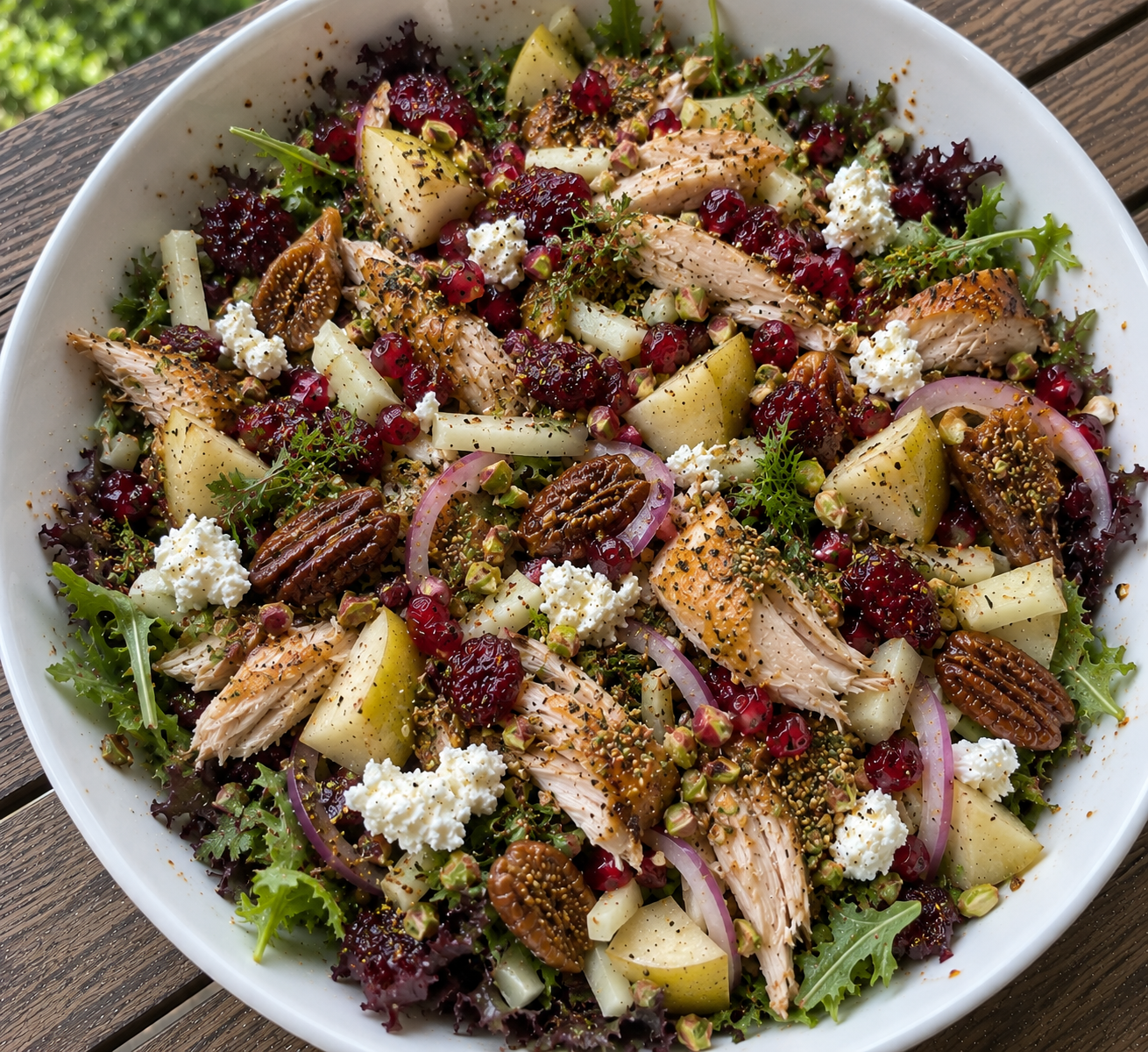
The holiday-table fall salad: candied pecans, pistachio dukkah, a balsamic-shallot dressing, and every fall fruit on one platter, served with herb-roasted turkey breast and a bright cranberry sauce.
Yield: Serves 12 · Active: 1 hr · Total: 2½ hours (most can be made ahead) · September through November, when pears, pomegranates, cranberries, and fennel all peak in temperate climates · Cuisine: American and Mediterranean · Best eaten: as the centerpiece of a fall dinner or Thanksgiving
This is the salad for a gathering: the big wooden bowl in the middle of the Thanksgiving table, the showpiece for a dinner of twelve, the salad that tells everyone the season has arrived. It’s built from fall’s most colorful foods (pears, pomegranate, cranberries, figs, red onion, and fennel) and finished with two homemade toppings that make it special: candied pecans, toasted with coconut sugar, cinnamon, and maple, and pistachio dukkah, an Egyptian nut-and-spice blend with sesame, cumin, coriander, and fennel seeds. A balsamic-shallot dressing brings it all together.
Serve it with a juicy herb-roasted turkey breast and a simple maple-orange cranberry sauce, and you have a complete holiday meal that’s lighter and easier than a whole bird.
The secret to feeding a crowd is making the pecans, dukkah, dressing, and cranberry sauce days ahead. They all keep beautifully, and the salad comes together in ten minutes. This is the kind of dish that turns a gathering into an event.
Want a lighter, everyday version? See my Seasonal Mixed Greens with Lemon-Dijon Vinaigrette.
Make-Ahead Game Plan
Up to 2 weeks ahead: Make the candied pecans.
Up to 1 week ahead: Make the pistachio dukkah and the cranberry sauce.
Up to 5 days ahead: Make the dressing.
The day of: Roast the turkey breast (about 2 hours, mostly hands-off), and assemble the salad while the turkey rests.
The Salad
Salad (in a large wooden serving bowl)
3 (16 oz) containers mixed greens
6 ripe pears (Anjou or Bartlett), cored and chopped
2 red onions, very thinly sliced
2 cups dried cranberries, sweetened with apple juice or unsweetened
1 cup unsulfured dried figs, sliced (optional)
16 oz pomegranate arils (about 3 cups)
16 oz fresh chèvre (goat cheese), crumbled
2 fennel bulbs, finely chopped
3 cups candied pecans (recipe below)
2 cups pistachio dukkah (recipe below)
Balsamic-shallot dressing
⅔ cup balsamic vinegar of Modena (IGP)
1½ cups extra virgin olive oil
4 shallots, finely minced
1 tbsp Dijon mustard
1 tbsp raw honey or maple syrup
2 tbsp raw apple cider vinegar
Juice of 1 lemon
Baja Gold sea salt and black pepper
Candied pecans (keep 2 weeks airtight)
3 cups pecans
2 tbsp coconut oil, melted
3 tbsp coconut sugar
1 tsp ground Ceylon cinnamon
½ tsp freshly grated nutmeg
½ tsp Baja Gold sea salt
2 tbsp maple syrup (added after baking)
Pistachio dukkah (keeps 2 weeks airtight)
1 cup pistachios
4 tbsp sesame seeds
3 tbsp coriander seeds
2 tbsp cumin seeds
1 tbsp fennel seeds
Baja Gold sea salt and black pepper
Swaps:
Nuts: walnuts instead of pecans; almonds or hazelnuts instead of pistachios in the dukkah
Cheese: aged Manchego or shaved Parmigiano-Reggiano instead of goat cheese
Method
Candied pecans (up to 2 weeks ahead). Heat the oven to 350°F. Toss the pecans with the coconut oil, coconut sugar, cinnamon, nutmeg, and salt, and spread them on a parchment-lined sheet pan. Roast 12–15 minutes, until fragrant and slightly darker. Drizzle with the maple syrup right away, and toss. Let them cool completely on the pan, so they crisp, then store them airtight.
Pistachio dukkah (up to 2 weeks ahead). Toast the pistachios, sesame, coriander, cumin, and fennel seeds in a dry skillet for 2–3 minutes, until fragrant. Let cool, then pulse in a food processor with salt and pepper, to a coarse, sandy texture (not a paste). Store airtight.
Dressing (up to 5 days ahead). Shake all the dressing ingredients in a jar until emulsified. Taste and adjust: more balsamic for tang, more honey for sweetness, or more salt for balance.
Assemble (just before serving). Add the greens, pears, red onion, cranberries, figs, fennel, pomegranate, and half the pecans to a large wooden bowl. Drizzle with about half the dressing, and toss gently. Top with the goat cheese and the rest of the pecans. Set out the dukkah and the remaining dressing in small bowls, so guests can add more to taste.
Serve It With
Roasted Herb Turkey Breast
Serves 12 · Active: 20 min · Total: about 2 hours
2 bone-in, skin-on turkey breasts (5–6 lb each), or 1 for a smaller table
6 tbsp grass-fed butter, softened
2 tbsp fresh sage, finely chopped
1 tbsp fresh rosemary, finely chopped
1 tbsp fresh thyme leaves
4 garlic cloves, grated
Zest of 1 orange
2 tsp Baja Gold sea salt and 1 tsp black pepper
1 onion, 2 carrots, and 2 celery stalks, roughly chopped
1 cup bone broth
Prep. Take the turkey out of the fridge 1 hour before roasting, and pat it very dry. Heat the oven to 425°F.
Make the herb butter. Mash the butter with the herbs, garlic, orange zest, salt, and pepper.
Season. Gently loosen the skin, and rub half the herb butter underneath it, right on the meat. Rub the rest over the skin.
Roast. Scatter the onion, carrots, and celery in a roasting pan, pour in the broth, and set the turkey on top. Roast 20 minutes at 425°F, then lower the heat to 350°F and roast another 1¼–1¾ hours, basting once or twice, until the thickest part reaches 160°F. (It will rise to 165°F as it rests.) If the skin browns too fast, tent it loosely with foil.
Rest 20 minutes before carving; this is when you assemble the salad. Strain the pan juices and spoon them over the sliced turkey.
Maple-Orange Cranberry Sauce
Makes about 2½ cups · 15 minutes · keeps 1 week in the fridge
12 oz fresh or frozen cranberries
½ cup maple syrup or honey
Zest and juice of 1 orange (about ½ cup juice)
¼ cup water
1 cinnamon stick
Pinch of Baja Gold sea salt
Simmer. Combine everything in a saucepan, and bring to a simmer over medium heat.
Cook 10–12 minutes, stirring now and then, until most of the berries have burst and the sauce thickens.
Cool. Remove the cinnamon stick. The sauce thickens a lot as it cools; serve it at room temperature.
Storage
Candied pecans: airtight, up to 2 weeks.
Pistachio dukkah: airtight, up to 2 weeks.
Dressing: refrigerated, up to 5 days.
Cranberry sauce: refrigerated, up to 1 week.
Roasted turkey: refrigerated, up to 4 days, or frozen up to 3 months.
The tossed salad doesn’t keep, so assemble it just before serving.
For 16 or more: Use 8 pears, double the candied pecans, and set out the dukkah and dressing in two bowls, so they can go around the table.
Use the extras: The dukkah is delicious on roasted root vegetables and avocado toast, the candied pecans are lovely on a cheese board, and the dressing goes on everything. Leftover turkey and cranberry sauce make the best next-day lettuce wraps or salad bowls.
A note on honey: The raw honey stays raw in the dressing, but it’s no longer raw once simmered in the cranberry sauce. Honey shouldn’t be given to babies under 12 months.
Nourishment Notes
Pears — pectin, a soluble fiber that supports healthy digestion, plus quercetin.
Pomegranate — punicalagins, polyphenols that gut bacteria turn into urolithins, which are studied for supporting the mitochondria.
Cranberries — proanthocyanidins, known for helping keep bacteria from sticking to the urinary tract, plus vitamin C (more in the fresh cranberry sauce than in the dried berries).
Dried figs — fiber, potassium, magnesium, and more calcium than most fruits.
Pecans — zinc, manganese, vitamin E, and monounsaturated fats. The candying adds a little coconut sugar and maple syrup, balanced by the cinnamon and nutmeg.
Pistachios — lutein and zeaxanthin, the yellow pigments that collect in the center of the retina and help filter blue light, plus vitamin B6, copper, and potassium.
Sesame seeds — calcium, copper, and the lignans sesamin and sesamolin, studied for their antioxidant and cholesterol-supporting effects.
Cumin, coriander, and fennel seeds — the classic digestive spice trio of Mediterranean and Middle Eastern cooking, traditionally used to help digest a big meal. That makes dukkah a nourishing condiment, not just a flavor.
Balsamic vinegar — acetic acid and polyphenols from the grapes. IGP balsamic is right for dressings; save the thick, long-aged traditional (DOP) balsamic for drizzling.
Raw shallots — quercetin and allicin.
Extra virgin olive oil — oleocanthal, a polyphenol with well-documented anti-inflammatory effects, plus it helps you absorb the salad’s fat-soluble nutrients.
Goat cheese — calcium and vitamin K2, and often easier to digest than cow’s milk cheese.
Turkey breast — lean, complete protein, B3, B6, B12, selenium, and zinc, plus tryptophan.
Fresh sage, rosemary, and thyme — rosmarinic acid, carnosic acid, and thymol, aromatic compounds studied for their antioxidant effects.
As a seasonal food, this is the meal for a fall gathering: Thanksgiving, a fall equinox dinner, or a family reunion. The fat and fiber from the pecans, dukkah, cheese, and olive oil, along with the turkey’s protein, balance the natural sugars in the fruit, for a gentler effect on blood sugar than all that sweetness might suggest.
For your cycle: This is a lovely meal in the luteal phase, when your body asks for more fuel. The turkey’s protein, B6, and tryptophan support mood and steady energy, the pistachios and pecans bring magnesium and zinc, and the fiber helps clear used estrogen.
Sourcing
Turkey breast — pasture-raised and heritage breed, from a local farm or Mary’s Free Range Turkey
Greens, pears, red onions, fennel, shallots, herbs, carrots, celery, and oranges — organic, from a farmers’ market or CSA
Pomegranates — organic and California-grown, from a farmers’ market or Frog Hollow Farm
Cranberries — organic fresh cranberries; dried cranberries sweetened with apple juice or unsweetened
Dried figs — organic and unsulfured, from a farmers’ market or Bautista Family Organic
Pecans and pistachios — organic, from a small grower
Sesame seeds and whole spices — organic and non-irradiated
Ceylon cinnamon and whole nutmeg — organic
Coconut oil and coconut sugar — organic and unrefined
Goat cheese — fresh chèvre from a local goat dairy, or Cypress Grove or Vermont Creamery
Grass-fed butter — organic, cultured butter from 100% grass-fed cows
Bone broth — homemade or Kettle & Fire
Balsamic vinegar — organic Aceto Balsamico di Modena IGP, with no added caramel coloring or thickeners
Raw apple cider vinegar — organic, with the mother (Bragg)
Dijon mustard — organic, like Delouis Fils or Maison Orphée
Raw honey and maple syrup — organic, local, unfiltered raw honey; organic Grade A dark maple syrup
Extra virgin olive oil — organic, single-estate, harvest-dated, in dark glass
Salt — Baja Gold sea salt
— Anna aka Food Marshall