Ferment Foundations: Lacto-Fermented Carrots and Sauerkraut (Plus Seven Kraut Variations)
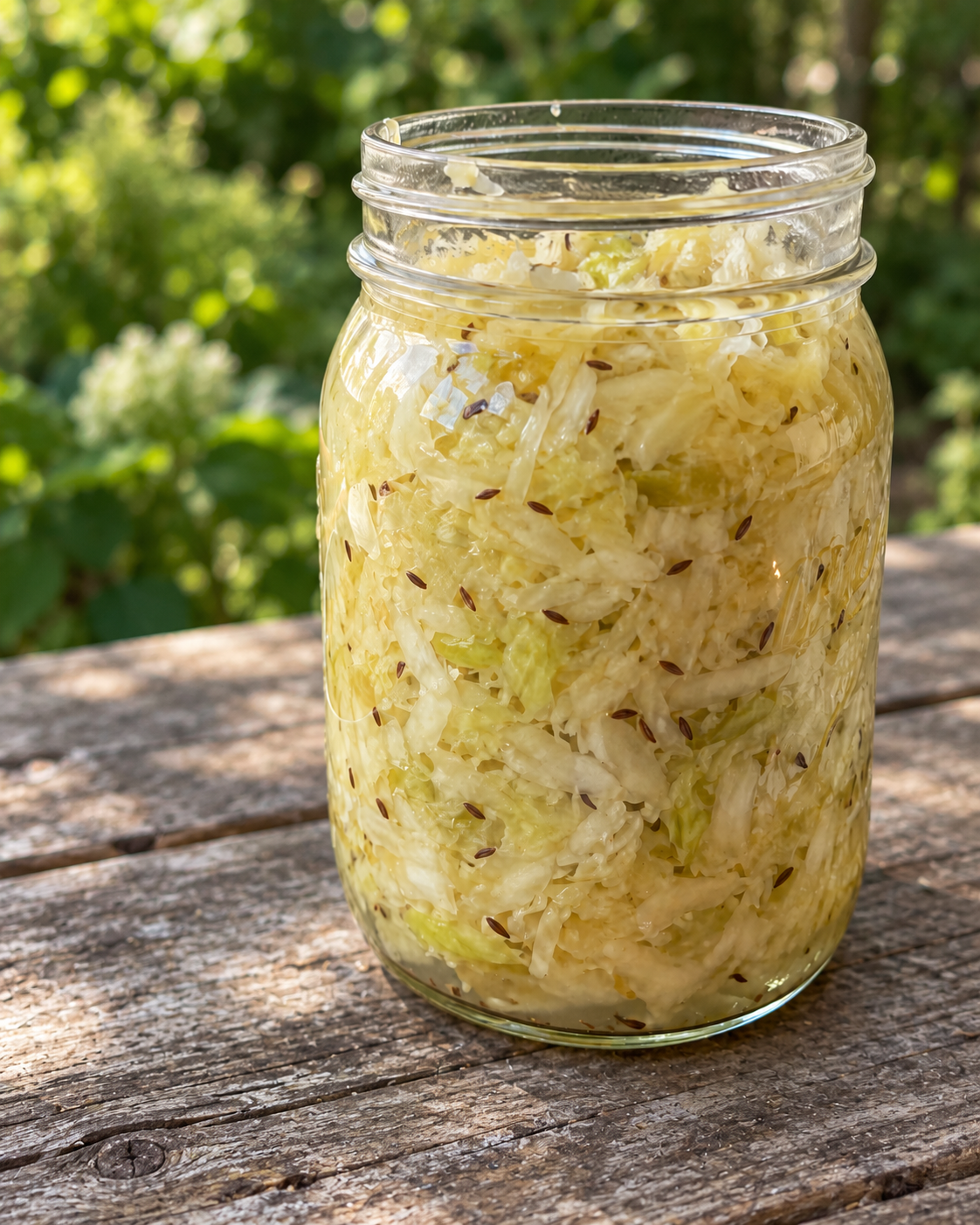
Yield: Carrots make 1 quart; basic sauerkraut makes about 1 quart per 2 lb cabbage · Active: 15-30 min · Ferment: 5-14 days at room temperature (up to 4 weeks for deeper flavor) · Year-round (in North America, cabbage and carrots peak late summer into fall and store well through winter) · Best eaten: 1-2 tbsp alongside your daytime meals
Lacto-fermented carrots are the easiest possible entry point: no massaging, just a jar, a brine, and a few days' patience, and you get a crisp, tangy, lightly funky pickle. Sauerkraut is the deeper ancestral classic, and once you know the basic method, you can take it in endless directions.
What Is Lacto-Fermentation?
Lacto-fermentation is one of the oldest ways humans have preserved food. Beneficial lactic acid bacteria live naturally on the surface of fresh vegetables. When you submerge those vegetables in salt and keep the air out, the salt holds back the bad microbes while these good bacteria get to work, eating the vegetables' natural sugars and turning them into lactic acid. That lactic acid gives ferments their bright, tangy flavor and preserves the vegetables for months, with no vinegar, canning, or heat. The result is food that's alive, full of beneficial bacteria, and easier to digest.
How Ferments Support Your Gut
Your gut is home to trillions of microbes, and they help digest your food, make vitamins, train your immune system, and protect your gut lining. About 70% of your immune system lives in and around your gut, so a healthy gut supports your whole body.
Raw, unpasteurized ferments bring living microbes into that ecosystem. Several species of lactic acid bacteria have been identified in fermented vegetables, including Leuconostoc mesenteroides, which starts the ferment, and Lactiplantibacillus plantarum and Levilactobacillus brevis, which take over as it sours. Fermented foods also bring lactic acid and other byproducts that help keep the gut a friendly home for good bacteria. Research has found that eating fermented foods regularly can increase the diversity of the gut microbiome, which is one of the clearest markers of a healthy gut.
Fermentation also makes vegetables easier to digest, since the bacteria begin breaking them down for you, and it helps preserve their vitamins through the winter.
Your Gut Runs on a Clock, Too
Your gut has its own circadian rhythm. The microbes living there shift in number and activity across the day and night, and they take their timing cues largely from when you eat, while your brain's master clock takes its cues from light. When you eat in daylight and rest from food at night, your gut clock and your brain clock stay in sync. Late-night eating pulls them apart.
Your gut is also a major hormone factory. About 90% of your body's serotonin is made in the gut, by specialized cells in the gut lining, and gut microbes help regulate how much is made. This gut serotonin doesn't travel to the brain; it works right where it's made, keeping digestion moving smoothly. But the gut and brain are in constant conversation through the vagus nerve, which is part of why a healthy gut and a steady mood so often go together. The gut also makes melatonin, in far greater total amounts than the brain's pineal gland, where it helps protect the gut lining and coordinate digestion with the day-night cycle.
That's why I recommend eating ferments with your daytime meals: a spoonful of sauerkraut with breakfast or lunch, or a few carrot spears on the side. You're feeding your gut's microbes while their daytime digestive rhythm is at its strongest, and letting your gut rest overnight. Pair that with morning sunlight, and you're supporting both clocks at once.
Fermenting Basics (for both ferments)
Filtered water. Chlorine and chloramine in tap water can stall fermentation. Letting tap water sit out overnight removes chlorine but not chloramine, which many cities now use, so filtered or spring water is safest.
Unrefined sea salt, with no iodine or anti-caking agents. Baja Gold, Celtic sea salt, or Redmond Real Salt all work.
Organic vegetables. The good bacteria live on the vegetable's surface, so start with organic produce, ideally from a farmers' market. Don't scrub or peel them too aggressively.
Glass jars. Use glass, not plastic or reactive metal. Wide-mouth quart jars are ideal. They don't need to be sterilized the way canning jars do, since the good bacteria and the salty, acidic brine protect the ferment, but they should be very clean. Wash the jars, lids, and weights in hot soapy water and rinse them thoroughly so no soap is left behind, or run them through a hot dishwasher cycle. For extra peace of mind, you can sterilize them in boiling water for 10 minutes. Start with clean hands, bowls, and utensils too.
Keep it submerged. Vegetables exposed to air can mold instead of ferment. Use a glass fermentation weight, a small jar, or a folded cabbage leaf to hold everything under the brine.
Let it breathe. Fermentation makes carbon dioxide, especially in the first few days, when the bacteria are most active. An airlock lid lets the gas escape on its own, so it's the easiest option. With a regular lid, keep it loosely screwed on, or close it and "burp" the jar once or twice a day: open it briefly to release the built-up gas, press the vegetables back under the brine, and close it again. Once the jar moves to the fridge, fermentation slows way down, so you'll only need to burp it occasionally for the first week or so.
Catch the overflow. Bubbling brine can spill over the top, so leave about 1 inch of headspace and set your jars on a plate or small tray while they ferment.
Room temperature. 65-75°F is ideal. Warmer ferments faster, and cooler is slower but often tastier.
Troubleshooting: yeast vs. mold. A flat, white film on top of the brine is usually kahm yeast. It's harmless, so just skim it off. Fuzzy, raised spots in blue, green, black, or pink are mold, and that batch should be thrown out. Keeping vegetables fully submerged prevents both.
Treatment 1 — Lacto-Fermented Carrots
The easiest possible entry point: crisp, tangy, and lightly funky.
Yield: 1 quart · Active: 15 min · Ferment: 5-14 days at room temperature
Ingredients
1 lb carrots, peeled and cut into spears or rounds
4 garlic cloves, smashed
1 tbsp fresh dill (or 1 tsp dried)
1 tsp whole black peppercorns
1 tsp coriander seeds
1 tsp mustard seeds
1 bay leaf
Optional: a 1-inch piece of fresh ginger, sliced, or 1 small dried chile
Brine
4 cups filtered water
2 tbsp unrefined sea salt (never iodized table salt)
Method
Make the brine. Stir the salt into the water until it dissolves completely.
Add the aromatics. Put the garlic, dill, peppercorns, coriander, mustard seeds, bay leaf, and optional ginger and chile in the bottom of a clean 1-quart wide-mouth jar.
Pack the carrots. Pack the carrots in tightly, standing upright, leaving about 1 inch of headspace.
Add the brine. Pour the brine over the carrots until they're completely covered.
Weigh them down. Set a glass fermentation weight or small jar on top to keep every carrot under the brine.
Cover with a lid (loosely, or close it and burp it daily) or an airlock lid.
Ferment at room temperature 5-14 days. Start tasting after day 3, and when they're as tangy as you like, move them to the fridge, where fermentation slows way down.
Treatment 2 — Basic Sauerkraut Foundation
The simplest sauerkraut there is: just cabbage and salt. Master this, then try the variations below.
Yield: About 1 quart · Active: 20-30 min (including massaging) · Ferment: 5-14 days at room temperature (up to 4 weeks for deeper flavor)
Ingredients
1 medium head green or purple cabbage (about 2 lb)
1 tbsp unrefined sea salt (about 2% of the vegetables' weight; use 1½ tsp per additional pound of vegetables)
Method
Prep the cabbage. Peel off one or two clean outer leaves and set them aside. Quarter and core the cabbage, then slice it thinly.
Salt and massage. Toss the cabbage with the salt in a large bowl, then massage and squeeze it with clean hands for 5-10 minutes, until it softens and releases a pool of liquid in the bottom of the bowl. That liquid is your brine.
Pack the jar. Pack the cabbage tightly into a clean wide-mouth jar, pressing down hard with your fist or a tamper to push out air bubbles and bring the brine up over the top.
Top up if needed. If the brine doesn't cover the cabbage, add a little 2% brine (1 tsp salt dissolved in 1 cup filtered water).
Seal it in. Tuck a reserved outer leaf over the surface, then set a weight on top to keep everything submerged.
Cover with a lid (loosely, or close it and burp it daily) or an airlock lid.
Ferment at room temperature 5-14 days, or up to 4 weeks for a deeper, more sour kraut. Press it down daily if it rises above the brine. Start tasting after day 5, and when you love the flavor, move it to the fridge.
Tip: Save a couple of tablespoons of brine from a successful batch and add it to your next one. It gives the new batch a head start and a more reliable flavor.
Seven Ways to Build on Your Basic Sauerkraut
For each variation, follow the basic method, adding the extra vegetables, aromatics, and spices to the bowl with the cabbage. Weigh all your vegetables together and use about 1½ tsp salt per pound.
Ruby Ginger-Turmeric Kraut
Purple cabbage with 2 shredded carrots, 1 small shredded beet, ½ thinly sliced yellow onion, 1 tbsp grated fresh ginger, 4 minced garlic cloves, and 1 tsp ground turmeric (or 1 tbsp grated fresh turmeric). Jewel-toned, earthy, and warming. It makes about 1½-2 quarts.
Rainbow Garden Kraut
Half a head each of green and purple cabbage, with 1 small shredded beet, 2 shredded carrots, 6 minced garlic cloves, 4-5 thinly sliced radishes, 2 tbsp chopped fresh dill, 1 tsp caraway seeds, and the zest of 1 lemon. Confetti-colored, crunchy, and fresh, with a gentle, peppery bite. For more color and flavor, try adding thinly sliced red onion, a shredded apple, ribbons of kale or collards, a little fresh ginger, or a pinch of red pepper flakes. It makes about 1½-2 quarts.
Classic Caraway Kraut
Green cabbage with 1 tbsp caraway seeds and a few crushed juniper berries. This is the traditional German-style kraut, wonderful with sausages and roasted meats.
Salvadoran Curtido
Green cabbage with 2 grated carrots, ½ thinly sliced onion, 1 tbsp dried Mexican oregano, and 1 minced jalapeño (or a pinch of red pepper flakes). Bright and lightly spicy, it's the classic tangy slaw served with pupusas, and great with eggs and tacos.
Simple Kimchi-Style Kraut
Napa cabbage with 4 sliced scallions, 1 grated carrot, 1 tbsp grated fresh ginger, 5 minced garlic cloves, and 1-2 tbsp gochugaru (Korean red pepper flakes), adjusted to your heat preference. This is a simplified take on kimchi using the kraut method. Traditional recipes often add fish sauce or salted shrimp for savory depth, if you'd like to try them.
Apple-Fennel Kraut
Green cabbage with 1 thinly sliced fennel bulb, 1 grated tart apple (like Granny Smith), and 1 tsp fennel seeds. Lightly sweet and fragrant, beautiful with pork and fish.
Garlic-Dill Kraut
Green cabbage with 6 sliced garlic cloves, 2 tbsp chopped fresh dill (or 1 tbsp dill seed), and 1 tsp black peppercorns. It tastes like a dill pickle in sauerkraut form.
How to Eat Your Ferments
Enjoy 1-2 tablespoons alongside your daytime meals: on eggs at breakfast, over salads and grain-free bowls at lunch, or next to roasted meats, sausages, and fish. Lacto-fermented carrots make a great snack, and they're lovely with charcuterie, sandwiches, and salads. Ferments have traditionally been eaten alongside rich, fatty, or protein-heavy meals to help with digestion.
Keep them alive: Always eat ferments raw and cold, and add them to warm food at the very end. Heat kills the live cultures.
Nourishment Notes
Lacto-fermented carrots bring beta-carotene, potassium, and fiber, plus live cultures. Fermentation turns the carrots' natural sugars into tangy lactic acid. The spices add their own goodness: dill's carvone, garlic's allicin, coriander's linalool, mustard seed's glucosinolates, ginger's gingerols, and chile's capsaicin.
Sauerkraut brings live cultures, fiber, vitamin C, and vitamin K, plus small amounts of vitamin K2 made by the fermenting bacteria. Fermentation also breaks down some of cabbage's glucosinolates into isothiocyanates, compounds that support the liver's detoxification pathways. Purple cabbage adds anthocyanins, and carrots and beets add beta-carotene and betalains. Radishes bring vitamin C and their own glucosinolates, and fresh dill adds carvone.
The history. Fermented cabbage has been eaten for centuries across Europe and Asia, from German sauerkraut and French choucroute to Korean kimchi and Chinese pickled vegetables. In Central and Eastern Europe, it was one of the most important sources of vitamin C through long winters without fresh produce. It even sailed the world: Captain James Cook brought barrels of sauerkraut on his 18th-century voyages, and along with fresh greens and other foods, it helped keep his crews remarkably free of scurvy for the era.
Seasonally, ferments are year-round foods, but they shine brightest in winter. That's when fermented vegetables traditionally stood in for fresh produce, and when their live cultures give your gut, and the immune system that lives there, extra support through the darker months.
Sourcing
Carrots, cabbage, and all vegetables — organic, from a farmers' market or a trusted source, since the good bacteria live on the vegetables' surface
Radishes and lemons — organic, from a farmers' market (you're using the lemon zest)
Fresh herbs, garlic, ginger, and turmeric — organic
Whole spices (peppercorns, coriander, mustard seed, caraway, juniper, fennel seed, dill seed, Mexican oregano, gochugaru) — organic and non-irradiated
Salt — unrefined sea salt with no iodine or anti-caking agents: Baja Gold, Celtic sea salt (Selina Naturally Light Grey), or Redmond Real Salt from Utah
Water — filtered through activated carbon or reverse osmosis, or clean spring water
Jars — wide-mouth glass quart or half-gallon Mason jars (Ball or Kerr)
Fermentation weights and airlocks (optional) — glass weights and airlock lids from Masontops or Kraut Source make fermenting easier and more foolproof. For big batches, a traditional ceramic fermentation crock is a beautiful investment
Storage
Lacto-fermented carrots: Refrigerated 3+ months. They stay crisp, and their flavor deepens over time
Sauerkraut and variations: Refrigerated 6+ months, mellowing over time. Always use a clean utensil
Scaling up: Use half-gallon jars or a ceramic fermentation crock for bigger batches. Your first batch will teach you what you like, and each batch after gets easier
— Anna aka Food Marshall