Fermented Foods 101: Make Your Own Probiotic Vegetables
A jar, some vegetables, a spoonful of good salt, and a few days of patience give you a living food your gut has been missing.
Fermented foods are nutritional alchemy. You start with a humble carrot or a head of cabbage, add salt and time, and end up with something tangier, longer-lasting, and alive. Food cultures around the world have kept some version of this on the table, from German sauerkraut to Korean kimchi to Salvadoran curtido.
This post expands on my Ferment Foundations: Lacto-Fermented Carrots and Sauerkraut (Plus Seven Kraut Variations) recipe, and on the dairy side, my Raw Milk Kefir: A Living Daily Ferment. Below you’ll find how fermentation works, what it can do for you, how to shop for the real thing, and my own DIY pickled veggies and fermented carrots.
The Bacteria Were There All Along
Lacto-fermentation is fermentation driven by lactic acid bacteria (often shortened to LAB), a family of friendly microbes that includes the lactobacilli. These bacteria already live on the surface of fresh vegetables, which is why organic produce that hasn’t been scrubbed too hard works so well. You don’t add them. You give them the right conditions and they multiply.
Salt is what tips the balance. A salty brine holds back the spoilage microbes while the salt-tolerant LAB thrive. They eat the vegetables’ natural sugars and turn them into lactic acid, the same tangy acid that makes the brine sour and keeps the food from spoiling. In sauerkraut, a bacterium called Leuconostoc mesenteroides starts the job, and as the jar grows more acidic, the tougher Lactobacillus plantarum takes over and finishes it (Johanningsmeier et al., 2007).
Scientists define fermented foods as “foods made through desired microbial growth and enzymatic conversions of food components” (Marco et al., 2021). A probiotic is a living microbe that benefits your health when you eat enough of it. Raw, unheated ferments give you both, a fermented food and a living dose of the lactobacilli family scientists study as probiotics.
What a Living Jar Can Do for You
Friendly bacteria like lactobacilli help improve digestion, bowel health, and overall immunity. The clearest human evidence comes from Stanford. Researchers put 36 healthy adults on either a high-fermented-food diet (yogurt, kefir, kimchi and other fermented vegetables, vegetable brine drinks, and kombucha) or a high-fiber diet for 10 weeks. The fermented-food group’s gut microbiome grew more diverse, and 19 inflammatory proteins in their blood went down, including interleukin-6 (IL-6), a messenger linked to rheumatoid arthritis, type 2 diabetes, and chronic stress. The high-fiber group saw neither change (Wastyk et al., 2021). Larger servings brought bigger gains in diversity.
You may hear that fermented-food bacteria “colonize” your gut. Many of them pass through more like visitors than permanent residents, though some may linger for a while, and researchers are still mapping which ones stay (Leeuwendaal et al., 2022). That is the case for eating them often. A spoonful a day keeps the visitors coming.
A boosted immune system can help reduce common ailments like asthma, eczema, and yeast infections. The research here is still young, and most of it tests probiotic strains rather than sauerkraut itself. One 2022 analysis of eight trials covering 2,575 infants linked probiotics with a lower rate of atopic dermatitis (the most common type of eczema), and its authors call for more studies to confirm it (Pan & Su, 2022). For vaginal yeast infections, a 2017 Cochrane review found that adding probiotics to standard antifungal treatment raised short-term cure rates, though it didn’t change cure rates over the longer term (Xie et al., 2017).
Fermented foods can also have increased levels of nutrients. Depending on the bacterial strains, fermentation has raised B vitamins like riboflavin (B2) and folate (B9) in vegetables, though this has been studied far less than you’d expect (Paramithiotis et al., 2022).
Then there is mood. About 90 percent of your body’s serotonin, the messenger chemical linked to mood and depression, is made in your gut, and Caltech researchers found that gut bacteria help drive that production (Yano et al., 2015). Gut serotonin can’t cross the blood-brain barrier, the protective filter around your brain, so your brain makes its own supply (Bektaş et al., 2020). Your gut still talks to your brain in other ways, especially through the vagus nerve, a long nerve running from your belly to your brain. In mice, a lactobacillus strain lowered anxious and depressive behavior and changed brain chemistry, and the effect vanished when the vagus nerve was cut (Bravo et al., 2011). A healthy gut is part of a healthy mood.
Shop for Ferments That Are Still Alive
Many fermented-looking foods on grocery shelves aren’t alive. Vinegar is commonly used in industrialized pickles, and its sharp acidity kills bacteria, including the good ones. Shelf-stable jars are also usually pasteurized (heated), which kills all of the beneficial bacteria. Real ferments live in the refrigerated section, often near the cheese, in glass jars, with labels that say “raw,” “unpasteurized,” “fermented,” or “live cultures” and no vinegar in the ingredients (Stanford Lifestyle Medicine, n.d.). Bubbles in the brine are a good sign.
| Rating | Fermented food | What to look for |
|---|---|---|
| Best | Lacto-fermented vegetables (sauerkraut, kimchi, curtido, pickles, carrots) | Raw, unheated, organic, made with unrefined salt, no vinegar, refrigerated, glass jars. Homemade is easiest |
| Best | Kefir and yogurt | Raw, from grass-fed animals, plain (no added sugar). Next best is organic grass-fed |
| Good | Kombucha | Raw, organic, low in sugar |
| Good | Kvass | Beet kvass (lacto-fermented beets, salt, and water) |
| Traditional, not probiotic | Sourdough bread | Fermented, but baking kills the live cultures |
| Skip | Vinegar pickles, shelf-stable sauerkraut, pasteurized “fermented” products | No living bacteria left |
A few notes on that table. Kombucha is sweetened tea fermented by a SCOBY (a symbiotic culture of bacteria and yeasts), and the sugar is food for the culture. The yeasts eat much of it and make a little alcohol, which the bacteria turn into acids. Kombucha usually stays under 0.5 percent alcohol, though it can run higher (University of Georgia Extension, n.d.). I look for raw, organic bottles with the least sugar left. Traditional Russian kvass is made from rye bread, so on my grain-free table, beet kvass is the one I pour. Sourdough is a beautiful traditional ferment that makes bread easier on digestion, and once it’s baked, the live cultures are gone.
My DIY Pickled Veggies
This is the simplest ferment I make, and it works with almost any firm vegetable.
What you need (one wide-mouth quart jar)
- Radishes, carrots, shredded cabbage, cucumbers, or other veggies of choice, chopped
- 1 tbsp unrefined sea salt (Baja Gold Mineral Sea Salt, fine grind); never iodized table salt
- Filtered water
- Optional: whole peeled garlic cloves, black peppercorns, whole bay leaves, and other whole spices of choice
- A clean glass mason jar with a lid, a glass fermentation weight (Masontops) or small jar to keep the veggies under the brine, and a small dish to set the jar in
Method
- Chop and stuff. Chop your veggies and stuff them into the clean jar along with any garlic and spices.
- Salt and fill. Add 1 tbsp sea salt over the veggies, then pour in filtered water until it reaches about 1 inch from the top of the jar. For even salting, you can dissolve the salt in the water first.
- Weigh them down. Set a weight on top so every piece stays under the brine. Anything poking above the water can mold.
- Close and set in a dish. Close the lid tightly and place the jar in a dish, just in case any liquid bubbles out.
- Ferment. Place it in a dark, room-temperature cabinet for 5 days, or longer for a stronger ferment.
- Burp daily. Check the jar every day and open it to let the gas escape, then close the lid very tightly again. An airlock lid lets the gas out on its own.
- Chill and enjoy. Taste it, and when you love the tang, move it to the fridge. Voilà.
Cucumbers soften the fastest, so they do well with a little more salt, about 1½ tbsp per quart.
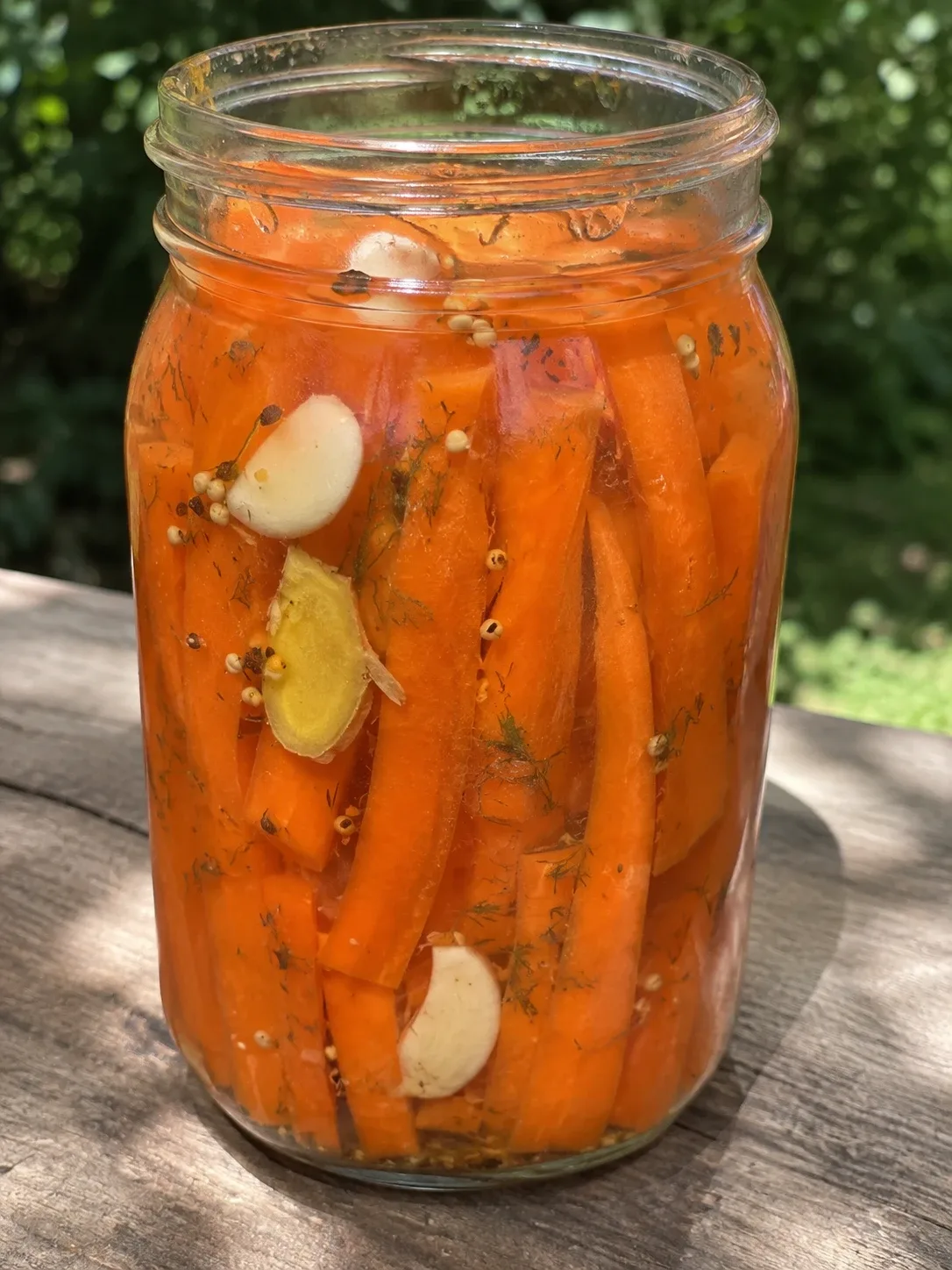
My Fermented Carrots
These are bright, gingery, and gorgeous next to a fatty roast. Instead of a poured brine, the carrots make their own juice.
What you need (one wide-mouth quart jar)
- About 4 cups peeled, julienned organic carrots (roughly 1 lb), enough to tightly pack the jar
- 1 tbsp unrefined sea salt (Baja Gold Mineral Sea Salt, fine grind)
- Optional: 1 tbsp freshly grated ginger and a few cloves of peeled garlic
- Pure, filtered water, as needed
Method
- Mix. Toss the carrots, salt, and ginger and garlic (if using) together in a bowl.
- Pound. Pound with your fist or a wooden pounder to release the juices.
- Pack. Pack the carrots into the jar and press down until their juices cover them. If they fall short, top up with a little filtered water (or 2 percent brine, 1 tsp salt dissolved in 1 cup water).
- Leave room. Keep more than 1 inch between the carrots and the lid.
- Ferment. Cover tightly and leave at room temperature, around 72°F, for 3 days.
- Release the pressure. If the carrots begin to bubble, open the lid to let off the pressure several times a day.
- Store cold. Move the jar to a cool, dark place for long-term storage, ideally around 40°F (your fridge or a root cellar). The flavor deepens with time.
- Serve. Enjoy about 2–3 tbsp with meals.
Get the Salt Right
Salt is the one measurement that matters. Fermenters talk about salt as a percent of the total weight of the vegetables and water, and most vegetable ferments land between 2 and 3 percent. Too little and the vegetables go soft or spoil (Oregon State University Extension, n.d.), and too much stalls the bacteria.
One tablespoon of fine-grind Baja Gold weighs about 18 grams (Baja Gold Salt Co., 2024). In a packed quart jar holding roughly 800 to 950 grams of vegetables and water, that works out to roughly a 2 percent brine, right where you want it. In the carrot jar, where about a pound of carrots makes most of its own brine, the same tablespoon lands around 3 to 3½ percent, on the salty side, which keeps the carrots crisp. For a milder jar, use 2 teaspoons. Baja Gold’s coarser, damper natural grain measures differently by the spoon, so a kitchen scale takes out the guesswork. Weigh your vegetables and water together, multiply by 0.02, and use that many grams of salt.
Read the Signs of a Healthy Ferment
Your jar will tell you how it’s doing. Ferments are happiest between about 70°F and 75°F, and they slow down in the 60s. Above 75°F they can turn soft, and below 60°F they may barely ferment at all (National Center for Home Food Preservation, n.d.).
| What you see or smell | What it means | What to do |
|---|---|---|
| Bubbles, cloudy brine, a pleasantly sour smell, white sediment on the bottom | A happy, active ferment | Keep going |
| Garlic turning blue or green | A harmless reaction between garlic’s sulfur compounds and the acid (Tasting Table, n.d.) | Eat it |
| A flat, white, filmy layer on top | Usually kahm yeast, a harmless wild yeast that grows where air reaches the brine (Mountain Feed, n.d.) | Skim it off, press the veggies back under, and top up with brine |
| Fuzzy, raised spots in blue, green, black, or pink | Mold | Throw the batch out |
| Slimy texture or a rotten smell | Spoilage, often from too little salt or too much heat (Oregon State University Extension, n.d.) | Throw the batch out |
Make It a Daily Ritual
A little goes a long way. I serve 2–3 tablespoons with meals, especially breakfast and lunch, beside rich, fatty, protein-heavy food, the way ferments have traditionally been eaten. If you’re new to them, start with a teaspoon or two and build up. Add them to warm food at the very end, since heat kills the live cultures.
For inspiration, try raw kraut on my Grass-Fed Strip Steak with Kabocha Purée, Sautéed Mushrooms, Wilted Greens, and Raw Sauerkraut, my Steak Tartare with Beet Cream, Raw Sauerkraut, and Parmesan-Arugula Salad, or my German Winter Plate. Fermenting is one of the practices I cover in Cooking for Nutrient Optimization: How You Cook Is Part of How You Heal.
Fermented foods are nutritional alchemy, and the alchemist is a jar on your counter.
With Love, Light, and Health,
Anna (aka Food Marshall)
Resources
- Baja Gold Salt Co. (2024). Baja Gold mineral sea salt nutrition facts. https://cdn.shopify.com/s/files/1/0749/6538/5526/files/Baja_Gold_Mineral_Sea_Salt_Nutrition_Facts_05-03-24.pdf
- Bektaş, A., Erdal, H., Ulusoy, M., & Uzbay, İ. T. (2020). Does seratonin [sic] in the intestines make you happy? Turkish Journal of Gastroenterology, 31(10), 721–723. https://doi.org/10.5152/tjg.2020.19554
- Bravo, J. A., et al. (2011). Ingestion of Lactobacillus strain regulates emotional behavior and central GABA receptor expression in a mouse via the vagus nerve. Proceedings of the National Academy of Sciences, 108(38), 16050–16055. https://doi.org/10.1073/pnas.1102999108
- Johanningsmeier, S., McFeeters, R. F., Fleming, H. P., & Thompson, R. L. (2007). Effects of Leuconostoc mesenteroides starter culture on fermentation of cabbage with reduced salt concentrations. Journal of Food Science, 72(5), M166–M172. https://ars.usda.gov/ARSUserFiles/60701000/Pickle%20Pubs/p348.pdf
- Leeuwendaal, N. K., Stanton, C., O’Toole, P. W., & Beresford, T. P. (2022). Fermented foods, health and the gut microbiome. Nutrients, 14(7), 1527. https://research.ucc.ie/en/publications/fermented-foods-health-and-the-gut-microbiome/
- Marco, M. L., et al. (2021). The International Scientific Association for Probiotics and Prebiotics (ISAPP) consensus statement on fermented foods. Nature Reviews Gastroenterology & Hepatology, 18(3), 196–208. https://isappscience.org/resource/expert-consensus-document-the-international-scientific-association-for-probiotics-and-prebiotics-isapp-consensus-statement-on-fermented-foods/
- Mountain Feed. (n.d.). Fermentation FAQ: What is the cloudy film in my ferment? https://www.mountainfeed.com/blogs/learn/149018247-fermentation-faq-what-is-the-cloudy-film-in-my-ferment-is-it-safe
- National Center for Home Food Preservation. (n.d.). Sauerkraut. https://nchfp.uga.edu/how/ferment/recipes/sauerkraut
- Oregon State University Extension. (n.d.). Sauerkraut: Problems and solutions. https://extension.oregonstate.edu/food/preservation/sauerkraut-problems-solutions-sp-50-745
- Pan, H., & Su, J. (2022). Association of probiotics with atopic dermatitis among infant: A meta-analysis of randomized controlled trials. Oxidative Medicine and Cellular Longevity, 2022, 5080190. https://doi.org/10.1155/2022/5080190
- Paramithiotis, S., Das, G., Shin, H.-S., & Patra, J. K. (2022). Fate of bioactive compounds during lactic acid fermentation of fruits and vegetables. Foods, 11(5), 733. https://pmc.ncbi.nlm.nih.gov/articles/PMC8909232
- Stanford Lifestyle Medicine. (n.d.). In a pickle? Unveiling gut-friendly pickles for your health. https://lifestylemedicine.stanford.edu/in-a-pickle-unveiling-gut-friendly-pickles-for-your-health
- Tasting Table. (n.d.). The scientific reason your pickled garlic turns blue. https://www.tastingtable.com/1462242/science-pickled-garlic-turn-blue
- University of Georgia Extension. (n.d.). What’s the word on homemade kombucha? (Circular 1312). https://fieldreport.caes.uga.edu/publications/C1312/whats-the-word-on-homemade-kombucha/
- Wastyk, H. C., Fragiadakis, G. K., Perelman, D., et al. (2021). Gut-microbiota-targeted diets modulate human immune status. Cell, 184(16), 4137–4153. https://doi.org/10.1016/j.cell.2021.06.019
- Xie, H. Y., Feng, D., Wei, D. M., Mei, L., Chen, H., Wang, X., & Fang, F. (2017). Probiotics for vulvovaginal candidiasis in non-pregnant women. Cochrane Database of Systematic Reviews, 11, CD010496. https://doi.org/10.1002/14651858.CD010496.pub2
- Yano, J. M., et al. (2015). Indigenous bacteria from the gut microbiota regulate host serotonin biosynthesis. Cell, 161(2), 264–276. https://doi.org/10.1016/j.cell.2015.02.047
More Articles & Other Posts



Get new recipes and essays
Seasonal recipes and writing on light, circadian health, and living with nature.
Subscribe on Substack