Roasted King Salmon with Horseradish Herb Cream and Seasonal Vegetables
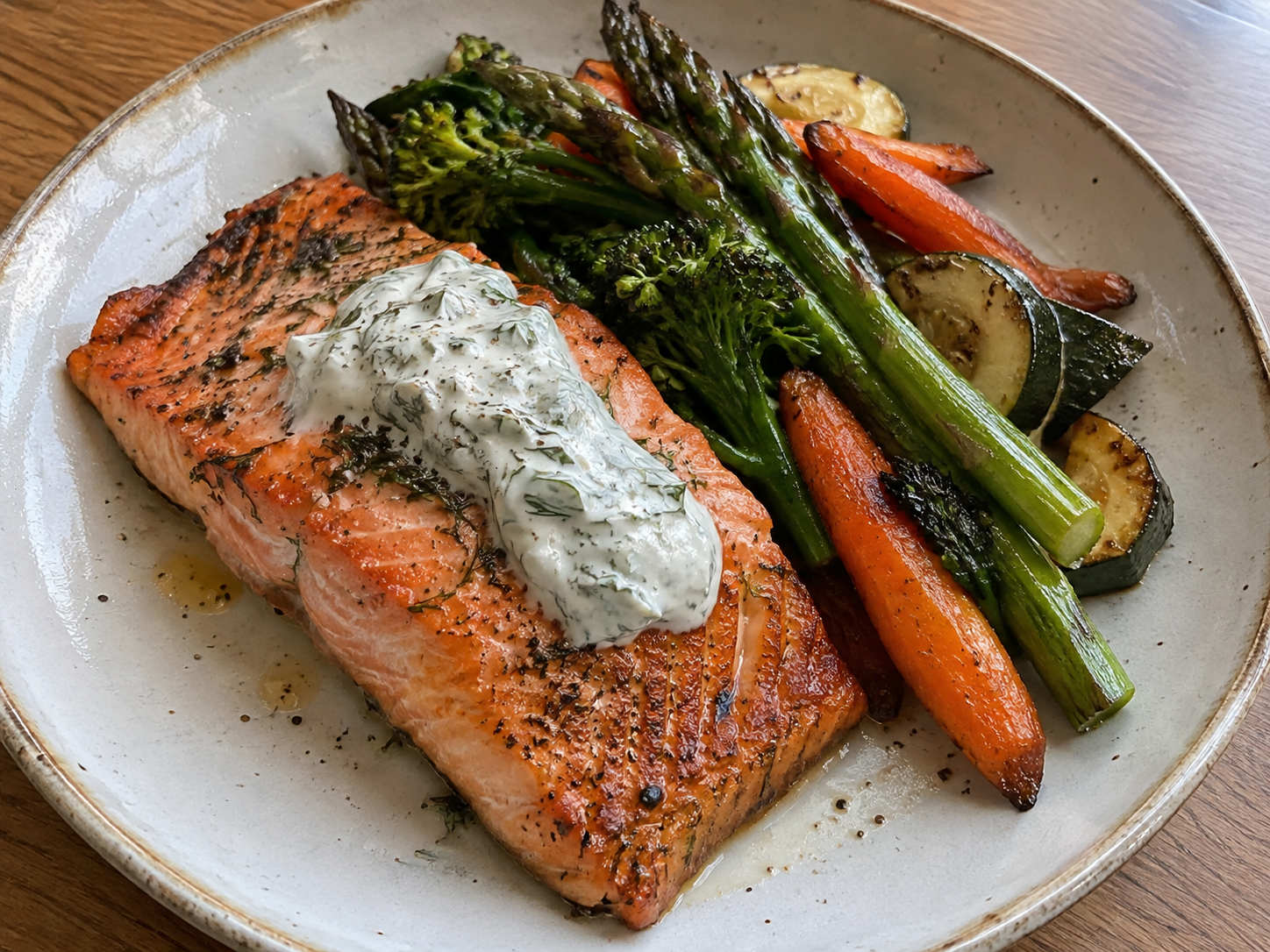
Rich, buttery wild king salmon roasted until just silky, with a cool, zippy horseradish-herb cream and a sheet pan of caramelized asparagus, broccolini, zucchini, and carrots. Simple and elegant, and on the table in under an hour.
Yield: Serves 2 (easily doubled) · Active: 15 min · Total: 45 min · Best in North America in late spring and early summer, when wild king salmon, asparagus, and zucchini overlap (frozen-at-sea king salmon works year-round) · Best eaten: early evening
Complete Menu
Roasted King Salmon
Horseradish Herb Cream
Roasted Seasonal Vegetables
Your Game Plan
About 45 min out: Heat the oven to 425°F. Pull the salmon from the fridge, and prep the vegetables.
About 40 min out: The carrots go into the oven.
About 30 min out: The broccolini and zucchini join them. Stir together the horseradish cream and chill it.
About 18 min out: The asparagus goes in.
About 12 min out: Take the vegetables out and keep them warm. Lower the oven to 400°F and roast the salmon.
Plate with the sauce on the side, and finish with dill and lemon.
Recipe 1 — Roasted Seasonal Vegetables
Ingredients
3 medium carrots, halved lengthwise (or quartered if thick)
1 bunch broccolini, trimmed
1 medium zucchini, cut into ½-inch half-moons
1 bunch asparagus, tough ends snapped off
3 tbsp extra virgin olive oil, divided
½ tsp Baja Gold sea salt
¼ tsp freshly cracked black pepper
Method
Start the carrots. Heat the oven to 425°F. Toss the carrots with 1 tbsp olive oil and a pinch of salt, spread them on a large parchment-lined sheet pan, and roast 10 minutes. They're the densest, so they need a head start.
Add the broccolini and zucchini. Toss them with another 1 tbsp olive oil and a pinch of salt, add them to the pan, and roast 12 minutes more.
Add the asparagus. Toss it with the remaining olive oil and a pinch of salt, add it to the pan, and roast 8-10 minutes more, until everything is tender and caramelized at the edges. Spread everything out so it roasts instead of steams; use two pans if needed.
Season with pepper and keep the vegetables warm on the stovetop while the salmon roasts.
Recipe 2 — Roasted King Salmon
Ingredients
2 wild king salmon fillets (6 oz each, about 1 inch thick, skin on)
1 tbsp extra virgin olive oil
½ tsp Baja Gold sea salt
¼ tsp freshly cracked black pepper
Method
Take the chill off. Pull the salmon from the fridge 20-30 minutes before cooking, and pat it completely dry.
Season. Rub the fillets with olive oil and season with salt and pepper.
Lower the oven. Once the vegetables come out, turn the oven down to 400°F. Crack the door for a minute or two to help it cool faster.
Roast. Set the salmon skin-side down on a parchment-lined sheet pan and roast 8-12 minutes, depending on thickness, until it just flakes at the thickest point and the center reads about 120-125°F. King salmon is so rich that it's best just barely cooked, silky and moist.
Rest 2-3 minutes.
Recipe 3 — Horseradish Herb Cream
Ingredients
⅓ cup plain sheep's or goat's milk yogurt
1-2 tbsp prepared horseradish (or 1-2 tsp freshly grated horseradish root)
1 tsp Dijon mustard
1-2 tsp fresh lemon juice
1 tbsp fresh dill, chopped
1 tbsp fresh chives, thinly sliced
Pinch of Baja Gold sea salt
Method
Stir everything together in a small bowl. Start with 1 tbsp horseradish and add more to taste; freshly grated horseradish is much stronger than prepared.
Chill until you're ready to serve. It thickens a little as it sits.
Plating
Set a salmon fillet on each warm plate with a generous pile of roasted vegetables alongside. Spoon the horseradish cream next to the fish rather than over it, so the crisp skin and silky salmon shine and each bite gets as much sauce as you like. Finish with extra dill and a lemon wedge.
Storage
Cooked salmon: Refrigerated up to 2 days. It's lovely flaked cold over greens with a spoonful of the horseradish cream
Horseradish cream: Refrigerated up to 4 days
Roasted vegetables: Refrigerated up to 4 days. Reheat at 400°F for 5 minutes
Leftover transformations: Flake cold salmon into a salad with the roasted vegetables and a drizzle of horseradish cream thinned with lemon; fold it into pastured eggs for a breakfast scramble; or tuck it into lettuce cups with the cream and fresh dill.
Support for the Female Infradian Rhythm
This plate is supportive in every phase of your cycle. Wild king salmon is one of the richest sources of omega-3s (EPA and DHA), which help calm menstrual inflammation and cramps, plus vitamin D, selenium for thyroid health, and B12. Broccolini and horseradish bring glucosinolates, which support estrogen metabolism through Phase 2 liver detoxification. Asparagus offers folate and inulin, a prebiotic fiber, and the live cultures in the yogurt support a healthy gut, which also plays a role in clearing used hormones.
Nourishment Notes
Wild king salmon (also called chinook) is the richest and fattiest of the Pacific salmon, which makes it one of the best food sources of omega-3 fatty acids EPA and DHA. It also brings vitamin D, selenium, B12, complete protein, and astaxanthin, the antioxidant that gives it its deep color.
Horseradish is a cousin of mustard and wasabi, and its fiery bite comes from glucosinolates that turn into isothiocyanates (like allyl isothiocyanate) when it's grated, the same family of compounds that makes cruciferous vegetables so prized.
Sheep's and goat's milk yogurt brings live cultures, calcium, and protein, and its casein is mostly the A2 type, which many people find easier to digest. Since the sauce is never heated, the cultures stay alive.
Asparagus — folate (one of the best food sources), vitamin K, and inulin, a prebiotic fiber that feeds your gut bacteria.
Broccolini — glucosinolates, vitamin C, and vitamin K.
Carrots — beta-carotene, which becomes more absorbable when roasted in olive oil.
Zucchini — potassium, vitamin C, and gentle hydration.
Dill and chives — carvone from the dill, plus vitamin K and the gentle allium compounds of chives.
Lemon — vitamin C and d-limonene.
Extra virgin olive oil — oleic acid and polyphenols.
Sourcing
King salmon — wild Alaskan king (chinook), ideally troll-caught, from Vital Choice or a trusted fishmonger. Fresh wild king is in season roughly May through September; frozen-at-sea is excellent year-round (wild seafood can't be certified organic)
Sheep's or goat's milk yogurt — organic, plain, unsweetened, and full-fat, with live cultures; raw from a local dairy if you can find it
Horseradish — fresh organic horseradish root, grated just before using, or prepared horseradish made with just horseradish, vinegar, and salt (many brands add oils, sugar, or preservatives, so check the label)
Dijon mustard — organic, with no preservatives or sugar; Delouis Fils and Maison Orphée both make organic Dijon from just mustard seeds, vinegar, water, and salt
Asparagus, broccolini, zucchini, and carrots — organic, from a farmers' market in season
Fresh dill and chives — organic
Lemons — organic
Extra virgin olive oil — organic, single-estate, harvest-dated within the past year, in dark glass
Baja Gold sea salt
— Anna aka Food Marshall