Fig-Harissa Roast Chicken with Broccolini and Parsnip Two Ways
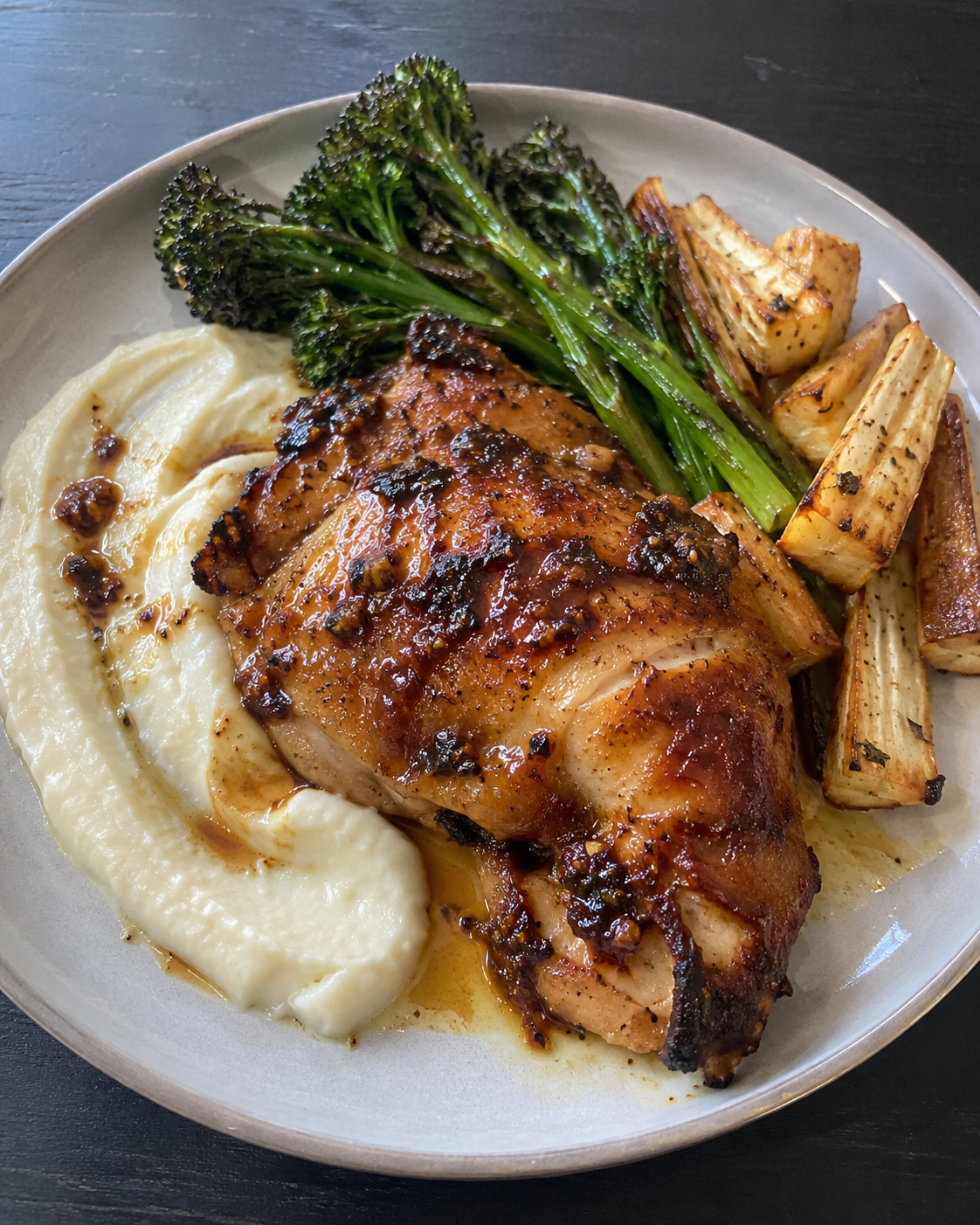
Juicy, bone-in chicken brushed with a smoky-sweet glaze of harissa, dried figs, and lemon, then roasted until caramelized at the edges. It's served over a silky parsnip purée, with charred broccolini and a tangle of crispy roasted parsnip and carrot ribbons on top. One root vegetable, two textures, and a whole lot of flavor.
Yield: Serves 4 · Active: 35 min · Total: 1 hr 15 min · Best in North America from fall through winter, when parsnips turn sweetest after the first frosts (dried figs keep year-round) · Best eaten: early evening
Complete Menu
Fig-Harissa Roast Chicken
Silky Parsnip Purée
Crispy Parsnip and Carrot Ribbons
Charred Broccolini
Your Game Plan
About 1 hr 15 min out: Heat the oven to 400°F. Season the chicken and make the fig-harissa glaze.
About 1 hr out: The chicken goes in.
About 35 min out: Simmer the parsnips for the purée. Shave the ribbons.
About 25 min out: Brush the glaze onto the chicken. The ribbons go into the oven.
About 15 min out: The broccolini goes in. Blend the purée.
Plate: purée, chicken, broccolini, then crispy ribbons on top.
Recipe 1 — Fig-Harissa Roast Chicken
Ingredients
2½–3 lb pasture-raised bone-in, skin-on chicken thighs or breasts
1½ tsp Baja Gold sea salt
2 garlic cloves, finely grated
1 tsp ground cumin
1 tsp ground coriander
½ tsp freshly cracked black pepper
Fig-harissa glaze
2 tbsp harissa paste (store-bought or homemade, below)
2 dried figs, stemmed and finely chopped
1 tbsp extra virgin olive oil
1–2 tsp fresh lemon juice
Method
Season. Pat the chicken completely dry, then rub it all over with the salt, garlic, cumin, coriander, and pepper. For the crispiest skin, season it a few hours ahead (or the night before) and refrigerate it uncovered.
Make the glaze. Stir together the harissa, figs, olive oil, and lemon juice. For a smoother glaze, mash it with a fork or give it a quick blitz in a small blender.
Roast. Set the chicken skin-side up on a parchment-lined sheet pan and roast at 400°F for 15–20 minutes.
Glaze. Brush the fig-harissa glaze generously over the chicken and keep roasting another 20–25 minutes, until the glaze is caramelized at the edges. Waiting until partway through keeps the figs' natural sugars from burning.
Check doneness. Breasts are done at 165°F in the thickest part. Thighs are safe at 165°F but are even more tender at 175°F.
Rest 5–10 minutes before serving.
Quick homemade harissa: Many store-bought harissas are made with seed oils, so homemade is a lovely option. Toast 1 tsp each cumin, coriander, and caraway seeds in a dry skillet until fragrant, then grind them. Soak 4–6 dried chiles (like guajillo or New Mexico, plus a chile de árbol or two for heat), stems and seeds removed, in hot water for 20 minutes. Drain, then blend with the ground spices, 3 garlic cloves, 1 tbsp tomato paste, 2 tbsp lemon juice, ¼ cup extra virgin olive oil, and ½ tsp salt until smooth. It keeps refrigerated, under a thin layer of olive oil, up to 2 weeks.
Recipe 2 — Silky Parsnip Purée
Ingredients
1½ lb parsnips, peeled and chopped (core out any woody centers from large ones)
½–¾ cup chicken bone broth, warm
2 tbsp grass-fed butter or extra virgin olive oil
½ tsp Baja Gold sea salt, plus more to taste
Method
Simmer. Cover the parsnips with salted water, bring to a boil, and simmer 12–15 minutes, until completely tender.
Drain well.
Blend with the butter, salt, and broth, adding the broth a splash at a time, until silky and smooth. Taste and adjust. Keep warm.
Recipe 3 — Crispy Parsnip and Carrot Ribbons
Ingredients
2 medium parsnips, peeled
2 medium carrots, peeled
1–2 tbsp extra virgin olive oil
Pinch of Baja Gold sea salt
Method
Shave. Use a vegetable peeler to shave the parsnips and carrots into long, thin ribbons.
Toss lightly with the olive oil and salt, just enough to coat.
Roast. Spread the ribbons in a single layer on a parchment-lined sheet pan, with plenty of space between them. Roast at 400°F for 10–15 minutes, tossing once, until browned and crisp at the edges. Watch closely toward the end, since thin ribbons go from golden to burnt quickly. They crisp up more as they cool.
Recipe 4 — Charred Broccolini
Ingredients
2 bunches broccolini, trimmed
1 tbsp extra virgin olive oil
Pinch of Baja Gold sea salt
Squeeze of fresh lemon
Method
Toss the broccolini with the olive oil and salt, spread it on a sheet pan, and roast at 400°F for 12–15 minutes, until charred at the tips and tender at the stems. Finish with a squeeze of lemon.
Plating
Spoon a generous swoosh of parsnip purée onto each plate. Set the fig-harissa chicken on top, lean the charred broccolini alongside, and pile the crispy parsnip and carrot ribbons over everything. Finish with a squeeze of lemon and a pinch of flaky salt.
Storage
Cooked chicken: Refrigerated up to 4 days
Parsnip purée: Refrigerated up to 4 days. Rewarm gently with a splash of broth
Broccolini: Refrigerated up to 3 days
Crispy ribbons: Best the day they're made. Store leftovers at room temperature in an airtight container and recrisp in a 350°F oven for 3–4 minutes
Homemade harissa: Refrigerated up to 2 weeks, under a thin layer of olive oil
Leftover transformations: Shred leftover chicken over greens with a spoonful of harissa thinned with lemon and olive oil, or tuck it into lettuce cups with the purée and broccolini.
Support for the Female Infradian Rhythm
This is a warming, grounding plate, especially welcome in the luteal and menstrual phases. Pasture-raised chicken brings complete protein, B vitamins, zinc, and some iron. Parsnips and carrots offer steady, satisfying carbohydrate and fiber, which is especially welcome in the luteal phase. Broccolini delivers glucosinolates, which support estrogen metabolism through Phase 2 liver detoxification, and figs add calcium, magnesium, and potassium.
Nourishment Notes
Pasture-raised chicken — complete protein, B vitamins, selenium, and zinc. Bone-in, skin-on cuts add collagen and glycine.
Harissa — capsaicin from the chiles, plus cumin, coriander, and caraway, traditionally used to support digestion.
Dried figs — fiber, potassium, magnesium, and calcium (dried figs are among the richest fruit sources), plus natural sweetness for the glaze.
Parsnips — fiber, folate, potassium, and vitamin C, with a natural sweetness that deepens after frost.
Carrots — beta-carotene, which becomes more absorbable when roasted with olive oil.
Broccolini — glucosinolates, vitamin C, and vitamin K.
Garlic, cumin, and coriander — allicin, cuminaldehyde, and linalool.
Chicken bone broth — gelatin, glycine, and minerals.
Grass-fed butter — CLA, K2, butyrate, and beta-carotene.
Extra virgin olive oil and lemon — oleic acid, polyphenols, and vitamin C.
Sourcing
Chicken — pasture-raised, bone-in, skin-on, from a local farm raising birds on pasture, or White Oak Pastures
Harissa — homemade (above), or an organic harissa made with olive oil rather than seed oils, with no added sugar or preservatives. Check the label
Dried chiles (for homemade harissa) — organic guajillo, New Mexico, or chile de árbol, from a Mexican grocer or spice shop
Dried figs — organic and unsulfured
Parsnips, carrots, and broccolini — organic, from a farmers' market. Look for small to medium parsnips, which are sweeter and less woody
Chicken bone broth — homemade from pasture-raised chicken, or Bonafide Provisions (organic, sold frozen)
Grass-fed butter — organic, cultured butter from 100% grass-fed cows, or raw butter from a local dairy
Garlic and lemons — organic, hardneck garlic
Spices (cumin, coriander, caraway, black peppercorns) — organic and non-irradiated; buy whole and grind fresh
Extra virgin olive oil — organic, single-estate, harvest-dated within the past year, in dark glass
Salt — Baja Gold sea salt; Maldon or fleur de sel de Guérande for finishing
— Anna aka Food Marshall