German Winter Plate: Bratwurst, Braised Red Cabbage, and Apple-Bacon Sauerkraut
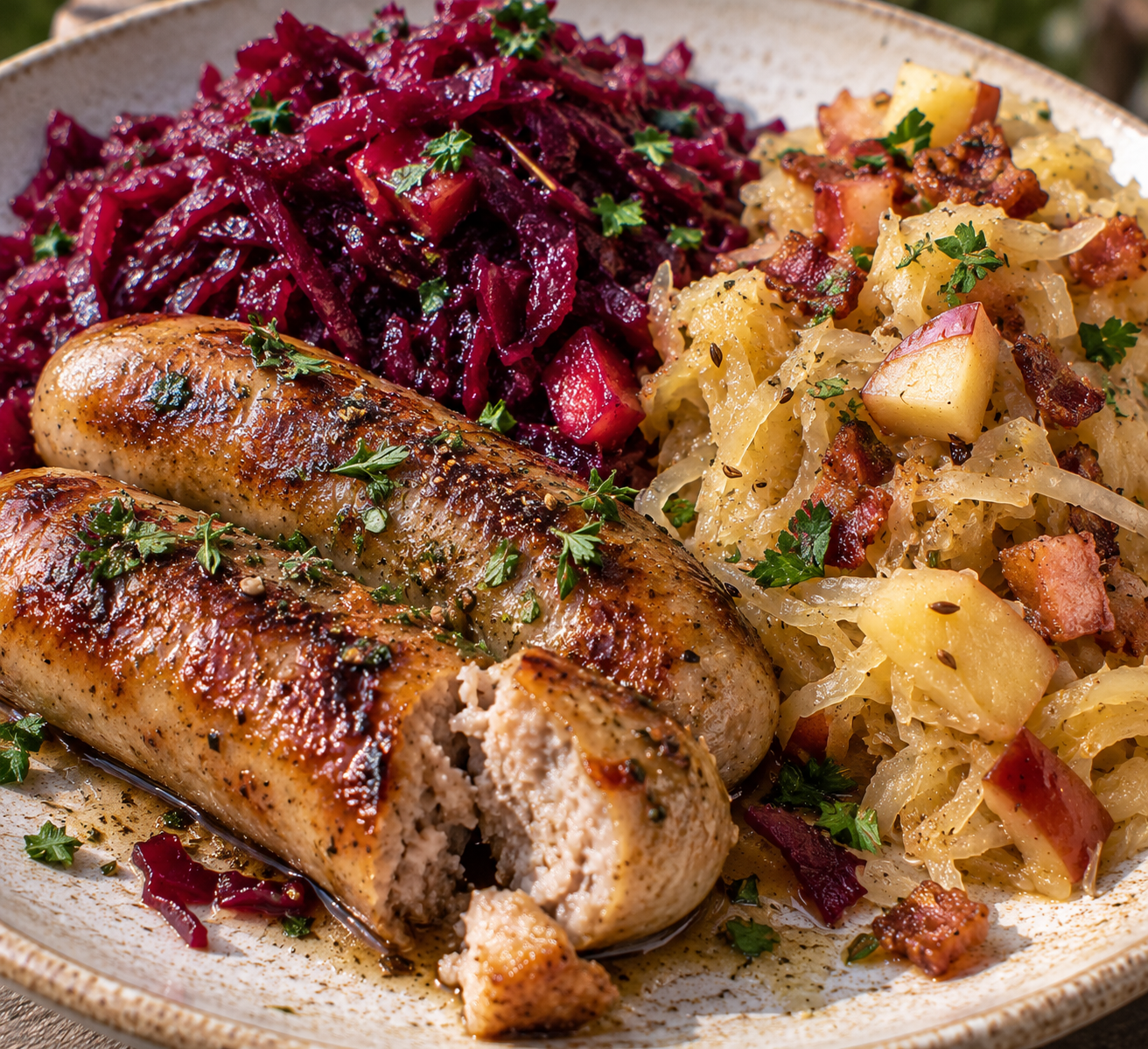
Classic German home cooking for the cold months: meltingly tender red cabbage, slowly braised with apples, red wine, and warming spices, golden pan-seared pasture-raised bratwurst, and live sauerkraut with crispy bacon and sautéed apple.
Yield: Serves 4 · Active: 30 min · Total: 1 hr 15 min · Best in North America in late fall and winter · Best eaten: early evening.
A note on the sauerkraut: Live sauerkraut is full of beneficial bacteria, but they're sensitive to heat, and start to die off at around 115°F, well below a simmer. So in this recipe, the sauerkraut is never cooked. It's folded into the warm bacon and apples off the heat, just enough to take the chill off. Choose raw, unpasteurized sauerkraut from the refrigerated section. Shelf-stable jarred sauerkraut has been heat-treated, so it no longer has live cultures.
Ingredients
Braised red cabbage
2 tbsp grass-fed butter
1 small yellow onion, finely chopped
2 medium apples (like Honeycrisp or Pink Lady), peeled and grated
1 medium head red cabbage, cored and thinly sliced
½ cup dry red wine (or ¼ cup apple cider plus ¼ cup bone broth, for alcohol-free)
¼ cup raw apple cider vinegar
2 tbsp raw honey
½ tsp ground cloves (or 3 whole cloves)
1 cinnamon stick
2 bay leaves
Baja Gold sea salt and freshly cracked black pepper
Bratwurst
4 pasture-raised German-style bratwurst, in natural casings
2 tbsp grass-fed butter
Apple-bacon sauerkraut
4 slices pasture-raised bacon, diced
1 tbsp grass-fed butter
1 small yellow onion, finely chopped
1 small tart apple (like Granny Smith), peeled and diced
2 cups raw, unpasteurized sauerkraut, lightly drained
To serve: fresh parsley, chopped, and whole-grain mustard
Swaps: Italian fennel sausage or Polish kielbasa work in place of the bratwurst. For dairy-free, use bacon fat in place of the butter. Green cabbage works in place of red, but you'll lose its deep color and anthocyanins.
Method
Start the cabbage. Melt the butter in a large Dutch oven over medium heat, and cook the onion 5 minutes, until soft. Add the apples, cabbage, wine, vinegar, honey, cloves, cinnamon stick, bay leaves, salt, and pepper, and stir well.
Braise. Cover, lower the heat, and simmer gently 45–60 minutes, stirring occasionally, until the cabbage is meltingly tender and the liquid has reduced to a glossy glaze. Remove the bay leaves, cinnamon stick, and whole cloves.
Make the apple-bacon base. While the cabbage braises, cook the bacon in a skillet over medium heat for 5–7 minutes, until crisp. Lift it out with a slotted spoon, and pour off all but 1 tbsp of the fat. Add the butter, onion, and apple, and sauté 5–7 minutes, until soft.
Fold in the sauerkraut. Take the pan off the heat, and let it cool for a minute. Then fold in the sauerkraut and bacon, so the sauerkraut is just warmed through, without cooking. (Or serve the sauerkraut cool, on the side.)
Cook the bratwurst. Melt the butter in a separate skillet over medium heat, and cook the bratwurst 12–15 minutes, turning often, until deep golden and cooked through (160°F inside).
Plate. Spoon the braised cabbage onto each plate, and top it with the bratwurst and apple-bacon sauerkraut. Garnish with parsley, and serve with whole-grain mustard.
Storage
The braised cabbage keeps refrigerated up to 5 days, and it's even better the next day; it also freezes up to 2 months. The cooked bratwurst keeps up to 3 days, and opened sauerkraut keeps refrigerated for months. It's a great make-ahead meal: braise the cabbage on Saturday for Sunday dinner. For 8 or more, double the cabbage and use 8 sausages, in a larger Dutch oven.
A note on honey: The honey in the cabbage is simmered, so it's no longer raw. Honey shouldn't be given to babies under 12 months.
Nourishment Notes
Red cabbage is a winter cruciferous vegetable, rich in anthocyanins (the same purple-red pigments found in berries), glucosinolates, vitamin C, and vitamin K. The vinegar in the braise does more than add flavor: anthocyanins change color with pH, turning blue in alkaline conditions and red in acidic ones, so the acid keeps the cabbage a vivid ruby red. Cloves and cinnamon bring eugenol and cinnamaldehyde, warming spices long used in European winter cooking.
Sauerkraut is one of Europe's oldest fermented foods. Raw, unpasteurized sauerkraut brings live lactic acid bacteria, vitamin C, and a little vitamin K2, made by the bacteria as they ferment. Fermentation also partly predigests the cabbage, making it easier to digest. That's why this recipe never cooks it. Sauerkraut has a famous place in history, too: Captain James Cook famously carried barrels of it on his voyages to help prevent scurvy, and German immigrants brought their sauerkraut traditions to the Americas.
Pasture-raised bratwurst brings complete protein, B vitamins, and zinc, and pasture-raised pork has more vitamin D and a better fat profile than conventional pork. Bacon adds B vitamins, selenium, and choline. Apples bring pectin and quercetin, and raw apple cider vinegar brings acetic acid, which helps balance blood sugar.
Together, this is what northern European winters have always called for: hearty protein, good fat, warming spices, and the live cultures of fermented vegetables, through the dark season.
As a circadian and seasonal food, this is a winter family dinner, best enjoyed in the early evening. Serve it with sparkling water and a squeeze of lemon, which cuts through the richness of the plate.
For your cycle: The bratwurst and bacon's B vitamins and zinc and the sauerkraut's live cultures make this especially grounding in the luteal and menstrual phases, and the cabbage's glucosinolates support estrogen metabolism.
Sourcing
Bratwurst — pasture-raised, German-style, in natural casings, from a local German butcher, US Wellness Meats, or Niman Ranch
Bacon — pasture-raised, with no added sugar, from a local farm or US Wellness Meats
Sauerkraut — raw and unpasteurized, from the refrigerated section, like Bubbies, Olive My Pickle, Wildbrine, or a local fermenter
Red cabbage, onions, and apples — organic, from a farmers' market in fall and winter (Honeycrisp or Pink Lady for the braise, Granny Smith for the sauerkraut)
Red wine (optional) — organic, dry, with low added sulfites
Raw apple cider vinegar — organic, with the mother (Bragg)
Raw honey — organic, local, and unfiltered
Grass-fed butter — organic, cultured butter from 100% grass-fed cows
Cloves, cinnamon, and bay leaves — organic and non-irradiated
Whole-grain mustard — organic, with no preservatives or sugar; Delouis Fils or Maison Orphée, or a good German Senf
Parsley — organic
Salt — Baja Gold sea salt
— Anna aka Food Marshall