"General Sal's" Chicken with Sesame-Cabbage Stir-Fry and Cauliflower Rice
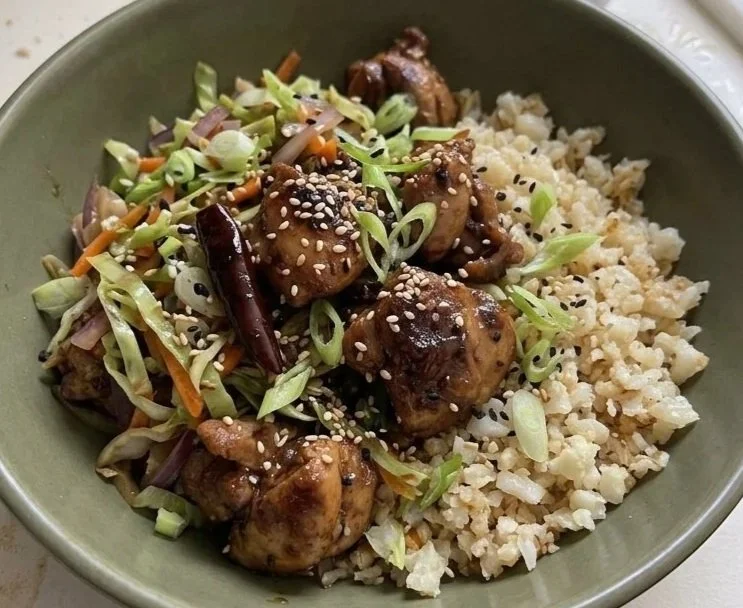
All the sticky, sweet-spicy fun of takeout General Tso's, made at home: crispy almond-flour chicken tossed in a glossy orange-ginger coconut aminos glaze, with a quick sesame cabbage stir-fry and fluffy cauliflower rice. No soy, no refined sugar, no seed oils.
Yield: 4 servings · Active: 50 min · Total: 1 hr · Year-round · Best eaten: early evening
Complete Menu
"General Sal's" Chicken with Coconut Aminos Glaze
Sesame-Cabbage Stir-Fry with Coconut Aminos
Cauliflower Rice
Optional accompaniments: toasted sesame seeds, sliced scallions, fresh cilantro, sliced fresh chili, orange wedges.
Your Game Plan
About 1 hr out: Whisk up the sauce, prep the vegetables, rice the cauliflower, and dredge the chicken.
About 35 min out: Cook the cauliflower rice and keep it covered off the heat.
About 25 min out: Stir-fry the cabbage and set it aside.
About 20 min out: Fry the chicken in batches.
Last 5 min: Glaze the chicken and plate everything while it's crispy.
Recipe 1 — "General Sal's" Chicken with Coconut Aminos Glaze
Yield: 4 servings · Active: 25 min · Total: 35 min
Ingredients
Chicken
2 lb pasture-raised boneless skinless chicken thighs (or breasts), cut into 1½-inch chunks
1 tsp Baja Gold sea salt
½ tsp freshly cracked black pepper
2 pasture-raised eggs, lightly beaten
1 cup blanched almond flour
2 tbsp arrowroot starch (or tapioca starch)
1 tsp garlic powder
¼ cup extra virgin olive oil or pasture-raised lard (for pan-frying), plus more as needed
"General Sal's" sauce
⅓ cup coconut aminos
¼ cup fresh orange juice
2 tbsp raw honey
2 tbsp raw apple cider vinegar
2 tbsp rice vinegar (unseasoned)
1 tbsp toasted sesame oil
1 tbsp Dijon mustard (no sugar added)
4 garlic cloves, finely minced
2 tbsp fresh ginger, finely grated
Zest of 1 orange
1-2 tsp red pepper flakes (adjust to preferred heat)
1 tsp arrowroot or tapioca starch (for thickening)
Stir-fry base (for the sauce and finishing)
2 tbsp extra virgin olive oil
3 scallions, cut into 1-inch pieces
1 red bell pepper, cut into 1-inch pieces (optional)
2 dried whole chilies (optional, traditional; remove the seeds for less heat)
To finish
2 tbsp toasted white or black sesame seeds
3 scallions, thinly sliced (green parts)
Fresh cilantro
Orange wedges
Method
Prep the chicken. Pat the chicken dry, then season with salt and pepper.
Set up the dredging station. Put the beaten eggs in one bowl. In a second bowl, whisk together the almond flour, arrowroot starch, and garlic powder.
Dredge the chicken. Working in batches, dip the chicken pieces into the egg, then coat them in the almond flour mixture. Press gently so the coating sticks. Place on a plate.
Make the sauce. In a small bowl, whisk together the coconut aminos, orange juice, honey, both vinegars, sesame oil, Dijon, garlic, ginger, orange zest, red pepper flakes, and the 1 tsp arrowroot. Set aside.
Pan-fry the chicken. Heat ¼ cup olive oil (or lard) in a large cast iron skillet or wok over medium heat until shimmering. Add the chicken in a single layer (work in batches; don't crowd the pan). Cook 3-4 minutes per side until deeply golden and crispy, with an internal temperature of 165°F. Almond flour browns faster than wheat flour, so keep the heat at medium and add a little more fat between batches if the pan looks dry. Transfer to a wire rack set over a sheet pan (not paper towels; trapped steam softens the coating).
Wipe the skillet. Wipe out any browned bits. Reduce the heat to medium.
Sauté the aromatics. Add 2 tbsp fresh olive oil. Add the scallion pieces, optional red bell pepper, and optional dried chilies. Stir-fry 2 minutes until the vegetables start to soften.
Add the sauce. Whisk the sauce again to redistribute the starch, then pour it into the skillet. Bring to a simmer, whisking constantly. Cook 1-2 minutes until the sauce thickens and turns glossy.
Return the chicken. Add the chicken back to the skillet. Toss gently to coat every piece and cook 30 seconds, just long enough to glaze.
Serve immediately. Transfer to a warm platter. Garnish generously with sesame seeds, scallion greens, cilantro, and orange wedges.
Recipe 2 — Sesame-Cabbage Stir-Fry with Coconut Aminos
Yield: 4 servings · Active: 10 min · Total: 15 min
Ingredients
½ medium napa cabbage or 1 small green cabbage (about 1½ lb), thinly sliced
2 tbsp extra virgin olive oil, ghee, or pasture-raised lard
3 garlic cloves, thinly sliced
1 tbsp fresh ginger, finely grated
2 tbsp coconut aminos
1 tsp rice vinegar (unseasoned)
1 tsp toasted sesame oil
1 tbsp toasted sesame seeds
2 scallions, thinly sliced
Pinch of red pepper flakes (optional)
Pinch of Baja Gold sea salt
Method
Sear. Heat the fat in a large skillet or wok over high heat. Add the cabbage, spread it out, and let it sit 2 minutes without stirring so it picks up a little char.
Toss. Stir-fry 2-3 minutes more, until crisp-tender.
Add the aromatics. Push the cabbage aside, add the garlic and ginger to the open spot, and cook 30 seconds until fragrant, then toss everything together.
Season. Add the coconut aminos and rice vinegar and toss 30 seconds.
Finish. Take the pan off the heat and add the sesame oil, sesame seeds, scallions, red pepper flakes, and salt to taste.
Recipe 3 — Cauliflower Rice
Yield: 4 servings · Active: 10 min · Total: 15 min
Ingredients
1 large head cauliflower (about 4 cups riced)
2 tbsp ghee or extra virgin olive oil
2 scallions, white parts finely minced
½ tsp Baja Gold sea salt
Optional: 1 tsp toasted sesame oil
Method
Rice the cauliflower. Cut it into florets and pulse in a food processor, in batches, until it looks like rice. Stop before it turns mushy.
Cook. Heat the ghee in a large skillet over medium-high heat. Add the scallion whites and cook 30 seconds, then add the cauliflower and spread it out. Cook 5-7 minutes, stirring occasionally, until tender with a few golden bits. Leave the lid off; covering it steams the rice soft.
Season with the salt and the optional sesame oil. Keep it covered off the heat until you're ready to serve.
Plating the Complete Meal
Build in warm shallow bowls: pile the cauliflower rice on one side, and add the sesame-cabbage stir-fry alongside. Top the whole bowl with the glazed "General Sal's" chicken. Drizzle any extra sauce from the pan over everything. Garnish with more sesame seeds, scallions, cilantro, and orange wedges. Serve immediately, since the crispy chicken is best fresh from the pan.
Sourcing (essential picks)
Pasture-raised chicken thighs or breasts — from a local farm raising birds on pasture, or White Oak Pastures
Pasture-raised eggs — from a local farm where the hens truly range on pasture, ideally on soy-free feed, or Alexandre Family Farm (Regenerative Organic Certified). Yolk color alone isn't proof, since some feeds add marigold or paprika to deepen it
Blanched almond flour — organic, finely ground, and fresh (keep it in the fridge or freezer). U.S. almonds are pasteurized by law, even when labeled "raw," so the gold standard is blanching and grinding your own from organic, unpasteurized Spanish almonds, like Terrasoul's
Arrowroot starch or tapioca starch — organic, single-ingredient
Coconut aminos — Coconut Secret (organic, made from just coconut sap and sea salt)
Raw honey — local, unfiltered, single-origin
Raw apple cider vinegar — with the mother (Bragg)
Rice vinegar — unseasoned and naturally brewed; Eden Foods Organic Brown Rice Vinegar, in glass
Toasted sesame oil — organic and single-ingredient, in glass; Eden Foods Organic Toasted Sesame Oil
Sesame seeds — organic; unhulled seeds keep far more of their calcium
Dijon mustard — mustard seed, vinegar or wine, and salt, with no sugar
Fresh orange — organic (you're using the zest)
Fresh ginger and garlic — organic, hardneck garlic
Cabbage and cauliflower — organic, heavy for their size, with tight heads
Fresh scallions, cilantro, red bell pepper (optional) — organic
Dried whole chilies (optional) — Tianjin (tien tsin) chilies, the traditional choice, from an Asian grocer
Pasture-raised lard (for frying) — render your own from pastured leaf fat, or buy from a local farm raising pigs on pasture. It's a traditional, heat-stable frying fat
Ghee — Ancient Organics, or homemade from grass-fed butter
Single-estate extra virgin olive oil — harvest-dated within the past year, in dark glass
Baja Gold sea salt for cooking; fleur de sel de Guérande or Maldon for finishing
Whole and ground spices (organic, non-irradiated) — red pepper flakes, garlic powder, black peppercorns
Storage
Cooked "General Sal's" chicken: Refrigerated up to 3 days, sealed. The almond flour coating loses its crunch on reheating, so it's best fresh. It's still delicious cold over cauliflower rice or salad for lunch
Sauce (before use): Refrigerated up to 1 week in a sealed jar
Sesame-cabbage stir-fry and cauliflower rice: Refrigerated up to 3 days; reheat in a hot skillet
Dredged raw chicken (before cooking): Best cooked immediately. If needed, refrigerate up to 4 hours
Leftover chicken transformations: Cold over cauliflower rice with fresh cilantro and orange wedges for a next-day lunch; sliced into butter lettuce cups with sesame seeds; folded into a soup with bone broth for a quick "leftover soup"; scrambled with eggs and cabbage for a hearty breakfast.
Support for the Female Infradian Rhythm
This meal is well-suited across cycle phases, particularly during the follicular and ovulatory phases when brighter, more energizing foods are welcome. Pasture-raised chicken delivers B12, complete protein, and choline. Coconut aminos deliver umami without soy inflammation. Real honey delivers gentle sweetness with trace minerals, a real upgrade from the refined sugar in commercial takeout versions. Almond flour delivers vitamin E and magnesium, which are especially helpful for luteal-phase mood support. Fresh ginger delivers documented anti-inflammatory support for menstrual cramping. Cabbage and cauliflower deliver glucosinolates, the precursors to sulforaphane and DIM, supporting estrogen metabolism through Phase 2 liver detoxification. Fresh orange zest delivers d-limonene supporting liver detoxification. Toasted sesame seeds deliver lignans, calcium, and magnesium. During heavier menstrual bleeding days, warmer, more grounding meals may feel more restorative; from Day 3 onward, this bright, tangy, gently spicy meal becomes appealing again.
Nourishment Notes
Pasture-raised chicken — B12, complete protein, and choline. Chicken thighs carry more iron, zinc, and B12 than breast meat.
Almond flour (grain-free coating) — vitamin E, magnesium, monounsaturated fats. Blanched almond flour delivers alpha-tocopherol (vitamin E), magnesium (essential for luteal-phase mood and cramp prevention), copper, and monounsaturated fats. It's a much better nutritional profile than the wheat flour or cornstarch coating in commercial takeout versions.
Arrowroot or tapioca starch (grain-free thickener) — Both are traditional, minimally processed, grain-free starches: arrowroot comes from a tropical root long used across the Caribbean, and tapioca comes from cassava. They give the coating its crunch and the sauce its gloss, and you only need a spoonful or two.
Coconut aminos — subtle umami without soy inflammation. Made from aged coconut sap and sea salt, with no gluten, no soy, and no additives. A world away from commercial teriyaki or General Tso's sauces.
Raw honey — trace minerals, small amounts of B vitamins, and a gentler sweetness than refined sugar. An honest note: simmering the sauce means the raw enzymes don't survive, so any good local honey works here. Save your raw honey for drizzling.
Fresh orange zest — d-limonene, flavonoids, and vitamin C. Concentrated in the zest, d-limonene supports Phase 2 liver detoxification.
Fresh ginger — gingerols, shogaols, anti-inflammatory support. One of the best-studied anti-inflammatories for menstrual pain.
Fresh garlic — allicin and organosulfur compounds. Cardiovascular and antimicrobial support.
Cabbage and cauliflower — glucosinolates, vitamin C, vitamin K, folate, fiber. A quick, high-heat stir-fry keeps the cabbage crisp and bright.
Scallions and cilantro — quercetin, vitamin K, chlorophyll, aromatic oils.
Raw apple cider vinegar — acetic acid and live cultures. Blood-sugar regulation.
Toasted sesame oil and seeds — lignans, calcium, magnesium, vitamin E. Sesame lignans support hormone balance.
Dijon mustard — glucosinolates and pungent aromatics. Digestive support.
Extra virgin olive oil (or pasture-raised lard) — oleic acid and monounsaturated fats, plus vitamin D from lard when the pigs live outdoors. Amplifies absorption of the fat-soluble compounds throughout the meal.
— Anna aka Food Marshall