Grain-Free Savory Crepes with Steak, Wild Mushrooms, and Cheese
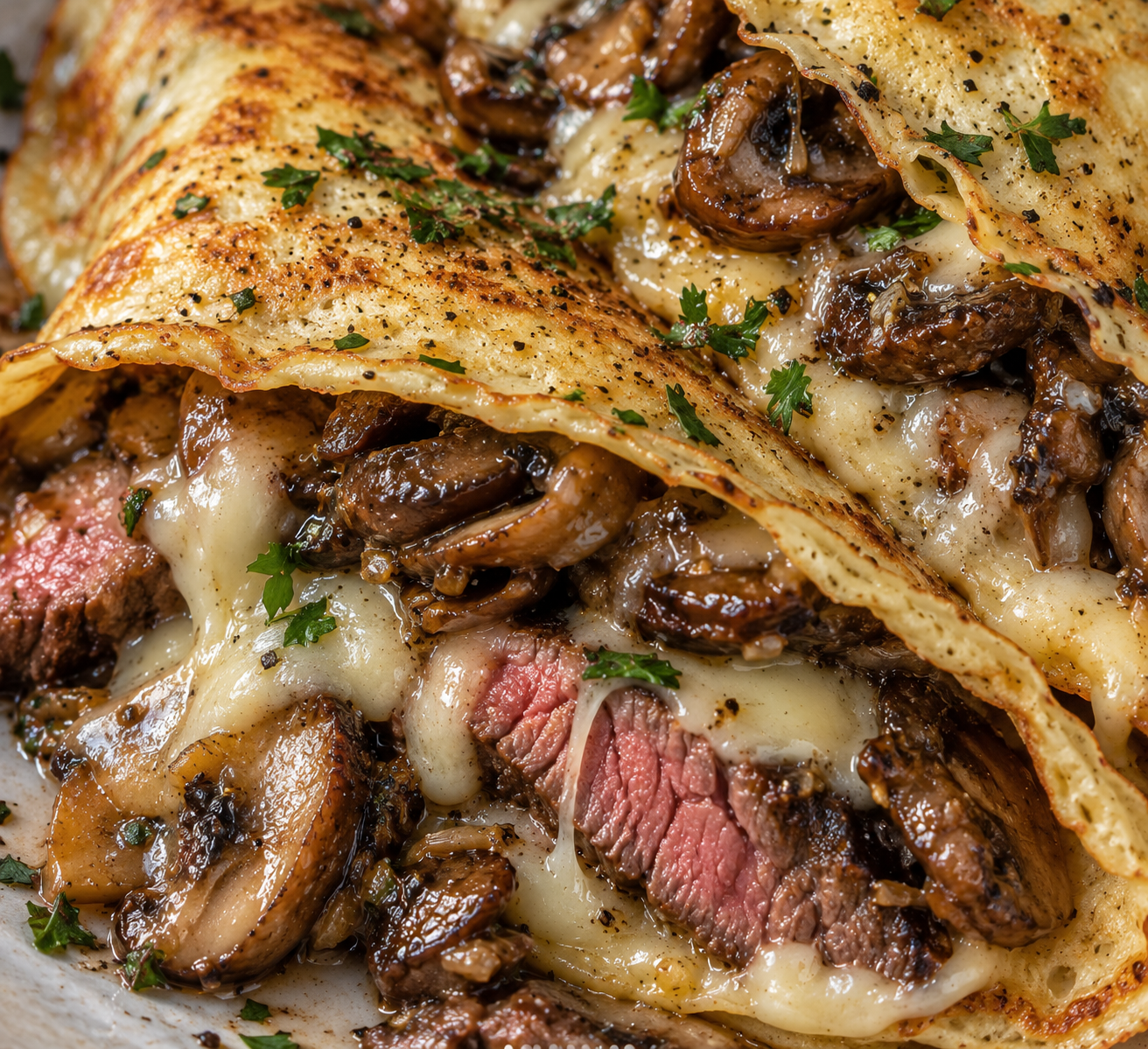
Yield: 6–8 crepes, serves 4 as a main or 6 as an appetizer · Active: 35 min · Total: 1 hour, including salting the steak · Year-round · Best eaten: midday or early evening
A note on the batter: Coconut flour absorbs an exceptional amount of liquid compared to other flours. A typical wheat crepe batter might use 1 cup of flour to 1 cup of liquid, but this one uses just 3 tablespoons of coconut flour, along with the eggs and milk. The coconut flour hydrates fully during a short rest, and the result is a crepe that holds together beautifully, surprisingly thin, and lightly sweet from the coconut.
The crepes can be made ahead and kept warm in a low oven, or made right as the filling cooks. I prefer the latter: it makes the crispiest crepes, and a lovely hands-on meal where everyone builds their own.
Serve them for dinner with a simple green salad and sparkling water with lemon, as a special brunch for company, or as a quick weeknight dinner from ingredients you already have. The whole meal is on the table in under an hour, and it tastes like a French bistro at half the cost.
Ingredients
Grain-free crepes (makes 6–8)
3 large pasture-raised eggs
½ cup raw grass-fed whole milk
3 tbsp coconut flour
½ tsp Baja Gold sea salt
Optional: 1 tsp minced fresh herbs (thyme or parsley), for herbed crepes
1–2 tbsp grass-fed butter, for cooking
Steak
2 grass-finished ribeye steaks (6 oz each), or New York strip or tenderloin
1 tsp Baja Gold sea salt
½ tsp freshly ground black pepper
1 tbsp extra virgin olive oil
Mushroom-onion sauté
2 tbsp grass-fed butter, divided
½ yellow onion, thinly sliced
1½ cups wild mushrooms (chanterelles, shiitakes, oyster mushrooms, or cremini), sliced
1 garlic clove, finely minced
1 cup leafy greens (spinach, arugula, baby kale, or Swiss chard), roughly chopped
1 tbsp fresh thyme leaves
1–2 tbsp aged balsamic vinegar
½ tsp Baja Gold sea salt and black pepper
To finish
¼ cup cheese, thinly sliced or crumbled: fresh goat cheese, brie, or aged raw-milk Gouda or cheddar (or a mix)
Fresh flat-leaf parsley, chopped
Flaky sea salt and freshly ground black pepper
Optional: a drizzle of balsamic reduction or good olive oil
To serve: a simple green salad with lemon vinaigrette
Swaps: For dairy-free crepes, use full-fat coconut milk in place of the milk, and skip the cheese; the crepes still cook beautifully. For a seafood version, swap the steak for sautéed wild shrimp or smoked salmon. The crepe is the foundation, and the filling is endlessly variable.
Method
1. Salt the steaks (30 minutes before cooking). Pat the steaks completely dry, and season both sides generously with salt and pepper. Let them sit uncovered at room temperature for 30 minutes.
2. Make the batter. Whisk the eggs, milk, coconut flour, salt, and herbs (if using). It will look thin at first. Let it rest 10 minutes, so the coconut flour can fully hydrate. It should thicken noticeably, but still pour freely, like heavy cream rather than pancake batter.
3. Cook the steak.
Heat a heavy cast iron or stainless skillet over high heat for 2–3 minutes, until very hot, then add the olive oil.
Sear the steaks 3 minutes without moving them, then flip and cook 2–3 minutes more, until they reach 125–130°F for medium-rare.
Rest them 8–10 minutes, loosely tented, so they hold onto their juices.
4. Make the mushroom filling.
Lower the heat to medium, and melt 1 tbsp butter in the same skillet. Cook the onion 5–6 minutes, until soft and starting to caramelize, then add the garlic for 30 seconds.
Add the remaining butter and the mushrooms. Leave them undisturbed for 2–3 minutes, so they brown, then stir and cook 4–5 minutes more, until deeply caramelized.
Add the greens and thyme, and cook 2–3 minutes, just until wilted. Season with salt and pepper, stir in the balsamic, and cook 30 seconds more. Take it off the heat.
5. Slice the steak thinly against the grain, into ¼-inch strips.
6. Cook the crepes.
Heat a well-seasoned cast iron or carbon steel skillet (8–10 inches) over medium heat. Add 1 tsp butter, and swirl to coat.
Pour in ¼ cup of batter, and immediately tilt and swirl the pan to spread it into a thin, even round, about 6 inches across.
Cook 1½–2 minutes, until the edges curl slightly, the top looks set, and the bottom is golden. If the pan is too hot, the crepe scorches before it sets; too cool, and it turns out pale and limp. Your first crepe may take some adjusting (by tradition, the cook gets to eat it).
Flip it carefully with a thin spatula, and cook 1 minute more, until lightly golden.
Stack the cooked crepes on a plate, covered with a clean towel, adding a little butter to the pan between crepes.
7. Assemble and serve.
Lay a warm crepe flat, and spoon a generous portion of the mushroom filling across the center. Top with 3–4 slices of steak and a little cheese.
Fold it in half into a half-moon, or fold the sides in over the filling, for a classic French envelope.
Drizzle with balsamic or the pan juices, scatter with parsley, and finish with flaky salt and pepper. Serve right away, with a green salad.
Storage
Unfilled crepes keep refrigerated up to 2 days; reheat them in a dry skillet for 30 seconds per side. The filling keeps up to 3 days. You can also make the crepes up to 4 hours ahead: wrap the stack and keep it warm in a 200°F oven. For 12 guests, double the batter and filling; for 20 or more, triple it.
Nourishment Notes
Grass-finished ribeye has a better fatty acid profile than grain-finished beef, with more omega-3s, CLA, and vitamin E, plus heme iron, B12, zinc, and fat-soluble vitamins. Ribeye has the most marbling of the common steak cuts, which makes it deeply satisfying in small portions; two steaks, sliced thin, generously fill 6–8 crepes.
The crepes: Pasture-raised eggs, raw milk, and coconut flour make a crepe that's far more nourishing than a wheat version. Coconut flour is the defatted, dried, ground meat of the coconut, about 39% fiber by weight, and naturally grain-free. Raw grass-fed milk brings its natural enzymes (like lipase and phosphatase, which pasteurization destroys), fat-soluble vitamins, butyrate, and calcium. And the three eggs bring about 18 grams of complete protein to the batter, much more than a wheat crepe.
Wild mushrooms bring different compounds depending on the variety: lentinan from shiitakes, beta-glucans from oyster mushrooms, and ergothioneine from all of them. Mixing varieties gives you a wider range, plus B vitamins, copper, and selenium.
The cheese: Fresh goat cheese has mostly A2-type casein, which many people find easier to digest than conventional cow's milk. Brie contains vitamin K2, made by the bacteria that ripen it, and Gouda is one of the richest K2 cheeses there is. Aged raw-milk cheeses keep some of raw milk's enzymes and cultures.
Aged balsamic vinegar: True Aceto Balsamico Tradizionale from Modena or Reggio Emilia is made from cooked grape must aged in wooden barrels for at least 12 years, a world apart from supermarket balsamic. A small drizzle brings polyphenols and acetic acid, along with incredible depth. For everyday use, look for Balsamic Vinegar of Modena IGP, with at least 6% acidity and no added caramel coloring.
Grass-fed butter brings butyrate, CLA, and vitamins A and K2.
Altogether, this meal delivers about 30 grams of protein per serving, from the steak, eggs, milk, and cheese, plus fat-soluble vitamins from several sources, mushroom compounds, and real satisfaction. A French bistro dinner at home.
As a circadian food, this is a midday or early-evening meal, when your digestion is at its strongest.
For your cycle: The ribeye's heme iron, zinc, and B12 make this especially restorative during the menstrual phase, and the greens bring folate and magnesium.
Sourcing
Ribeye — grass-finished, from White Oak Pastures, US Wellness Meats, or a local farm
Raw milk — from a farmer you know and trust (find one at realmilk.com), or organic, grass-fed whole milk, like Organic Valley Grassmilk or Maple Hill
Eggs — organic and pasture-raised
Coconut flour — organic and finely ground; use it within 6 months of opening, for freshness
Mushrooms, onion, garlic, greens, thyme, and parsley — organic, from a farmers' market (wild mushrooms from a trusted forager)
Goat cheese — fresh chèvre from Cypress Grove, Laura Chenel, or a local dairy
Brie — Cowgirl Creamery Mt Tam or Fromager d'Affinois
Gouda or cheddar — aged raw-milk Gouda or cheddar, or Beemster Classic Gouda
Aged balsamic vinegar — Giusti, Ritrovo Gran Riserva, or a Balsamic Vinegar of Modena IGP with no added caramel
Grass-fed butter — organic, cultured butter from 100% grass-fed cows, or raw butter from a trusted farm
Extra virgin olive oil — organic, single-estate, harvest-dated, in dark glass
Salt — Baja Gold sea salt; Maldon for finishing
— Anna aka Food Marshall