Grass-Fed Carne Asada with Chimichurri and Arugula-Fig Salad with Hazelnuts
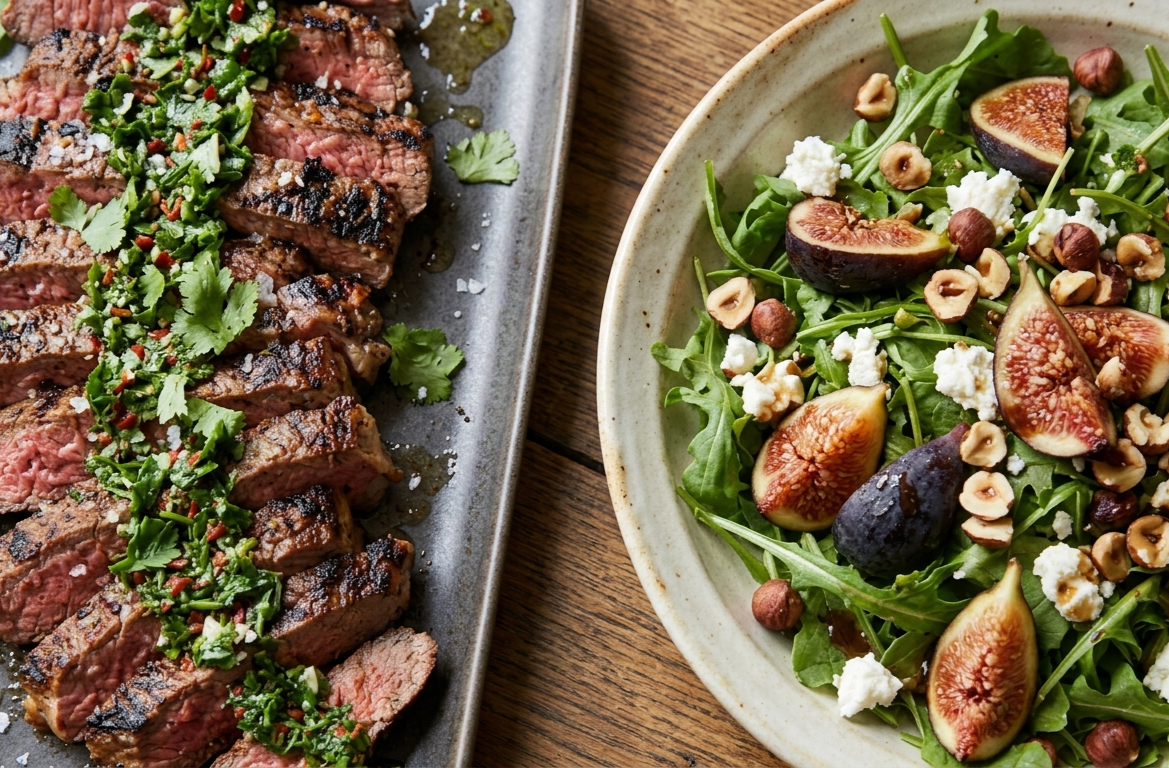
Yield: 4 servings · Active: 40 min · Total: 1 hr (plus 30 min steak marinade) · Late summer through autumn (peak fig season August-October) · Best eaten: early evening
Complete Menu
Grass-Fed Carne Asada with Chimichurri
Arugula & Fig Salad with Toasted Hazelnuts, Radicchio, and Balsamic
Optional accompaniments: extra chimichurri at the table, lime wedges, sliced avocado, butter lettuce cups for wrapping the steak.
A note on carne asada and chimichurri
Carne asada (Spanish for "roasted meat") is the Latin American technique for grilled beef — traditionally skirt steak or flank steak, marinated in citrus, garlic, and olive oil, then grilled hot and fast over an open flame. The tradition spans Mexico, Argentina, Uruguay, Colombia, and Chile, with each country adapting the technique to local tastes.
Chimichurri is the Argentinian foundational sauce — chopped fresh parsley, garlic, red wine vinegar, olive oil, oregano, and chili flakes. Traditionally served alongside grilled meats, chimichurri is Argentina's answer to Italian salsa verde or French sauce verte. The bright acid and fresh herbs cut through the richness of grilled beef beautifully.
Recipe 1 — Grass-Fed Carne Asada
Yield: 4 servings · Active: 15 min · Total: 30 min (plus 30 min marinade)
Ingredients
Steak
1½ lb grass-fed skirt steak or flank steak (about 1 inch thick)
3 tbsp extra virgin olive oil
3 tbsp fresh lime juice
Zest of 1 lime
5 garlic cloves, finely minced
¼ cup fresh cilantro, finely chopped
1½ tsp sea salt
1 tsp freshly cracked black pepper
1 tsp ground cumin
½ tsp red pepper flakes (optional)
Method
Marinate. In a shallow dish, combine olive oil, lime juice, lime zest, minced garlic, chopped cilantro, salt, pepper, cumin, and optional chili flakes. Add steak and turn to coat. Marinate at room temperature 30 minutes (or refrigerate up to 4 hours).
Bring to room temperature. If refrigerated, remove 30 minutes before cooking.
Preheat grill or cast iron skillet. Heat grill to high (500°F+) or a cast iron skillet over medium-high heat until smoking.
Grill or sear. Grill skirt steak 2-3 minutes per side for medium-rare; flank steak 3-4 minutes per side. Internal temperature 125-130°F. For cast iron: sear the steak 2-3 minutes per side without moving.
Rest. Transfer to a cutting board. Rest 8-10 minutes. Skirt and flank steaks require resting to redistribute juices.
Slice against the grain. Both skirt and flank steak have long muscle fibers — always slice thinly against the grain (perpendicular to the visible fibers) for tender bites. Slice at a slight angle for maximum tenderness.
Plate. Arrange slices on a warm serving platter. Spoon chimichurri generously over the top.
Recipe 2 — Argentinian Chimichurri Sauce
Yield: about ¾ cup · Active: 8 min · Total: 8 min
Ingredients
1 cup fresh flat-leaf parsley, packed (leaves and tender stems)
¼ cup fresh cilantro (optional — traditional Argentinian versions use just parsley; the cilantro adds brightness)
3 tbsp fresh oregano leaves (or 1 tbsp dried oregano)
4 garlic cloves, finely minced
2 tbsp raw red wine vinegar (or raw apple cider vinegar)
1 tbsp fresh lime juice
½ cup extra virgin olive oil
1 tsp sea salt
½ tsp red pepper flakes (or more for heat)
½ tsp freshly cracked black pepper
Optional: 1 tsp raw honey (to balance the acid)
Method
Chop by hand (traditional) or pulse in food processor. Very finely chop the parsley, optional cilantro, oregano, and garlic. Traditional Argentinian technique is hand-chopping for a rustic texture. A food processor works but pulse briefly — don't blend into a smooth paste.
Combine in a bowl. Transfer chopped herbs to a bowl. Add red wine vinegar, lime juice, olive oil, salt, chili flakes, black pepper, and optional honey.
Rest. Stir well and let sit at room temperature 15-30 minutes before serving. The flavors meld and the acid tempers the raw garlic.
Serve drizzled generously over the carne asada. Also excellent over grilled vegetables, roasted potatoes, or grilled fish. Serve extra chimichurri in a small bowl at the table.
Recipe 3 — Arugula & Fig Salad with Toasted Hazelnuts, Radicchio, and Balsamic
Yield: 4 servings · Active: 15 min · Total: 20 min
Ingredients
Salad
5-6 cups baby arugula (about 5 oz)
1 small head radicchio, roughly torn
8 ripe fresh figs (Black Mission, Brown Turkey, or Kadota), stemmed and quartered
½ cup raw hazelnuts
¼ cup fresh flat-leaf parsley, roughly chopped
2 tbsp fresh basil leaves (optional)
Balsamic vinaigrette
¼ cup extra virgin olive oil
2 tbsp aged balsamic vinegar (traditional 12+ year DOP from Modena, Italy)
1 tbsp fresh lemon juice
1 tsp Dijon mustard
1 small garlic clove, finely grated
1 tsp raw honey (optional — balances the acid)
½ tsp sea salt
¼ tsp freshly cracked black pepper
To finish
Flaky sea salt
A drizzle of high-quality olive oil
Additional balsamic (optional)
Optional: shaved Parmigiano-Reggiano or crumbled goat cheese
Method
Toast the hazelnuts:
Toast. Spread hazelnuts on a small sheet pan. Toast at 350°F for 10-12 minutes until the skins darken and split. Transfer to a clean kitchen towel and rub together to remove most of the skins. Roughly chop.
Assemble:
Combine base. In a large salad bowl, combine arugula, torn radicchio, chopped parsley, and optional basil.
Make the vinaigrette. In a small jar, whisk together olive oil, balsamic vinegar, lemon juice, Dijon mustard, grated garlic, optional honey, salt, and pepper.
Add figs. Gently add quartered figs to the salad base — handle gently, they're delicate.
Dress. Drizzle vinaigrette over the salad. Toss gently to avoid crushing the figs.
Finish. Transfer to a serving platter. Scatter toasted chopped hazelnuts across the top. Finish with flaky sea salt, a drizzle of high-quality olive oil, and optional shaved Parmigiano-Reggiano or crumbled goat cheese.
Plating the Complete Meal
Present family-style: place the sliced carne asada on a warm platter with chimichurri drizzled generously over and pooled on the sides; place the arugula-fig salad on a separate serving bowl. Add lime wedges and extra chimichurri in a small bowl at the table for drizzling. Real Argentinian meals are meant to be shared, slowly enjoyed, and paired with good conversation.
Sourcing (essential picks)
Grass-fed skirt or flank steak — from a farmers' market, local butcher, or shipped grass-fed producer. Skirt steak (from the diaphragm area) is more traditional for carne asada, richer in flavor. Flank steak is leaner. Both benefit from slicing against the grain
Fresh flat-leaf parsley, oregano, cilantro, basil — Italian flat-leaf parsley (not curly), vibrant green, windowsill pot or farmers' market
Fresh baby arugula — vibrant green, from a farmers' market or organic produce section
Radicchio — firm heads, dense magenta-purple leaves, no browning
Fresh figs (Black Mission, Brown Turkey, or Kadota) — soft, plump, unblemished. Peak season August-October. Look for figs at farmers' markets or from a Mediterranean grocer. Skin should give slightly when gently squeezed
Raw hazelnuts — organic, single-ingredient, from a specialty nut supplier or Turkish/Italian grocer
Fresh garlic — organic hardneck for more complex flavor
Fresh limes and lemons — organic when using zest
Raw red wine vinegar — traditionally fermented, single-ingredient. If avoiding wine vinegar entirely, raw apple cider vinegar works beautifully
Aged balsamic vinegar — 12+ year traditional DOP from Modena, Italy. Look for the "Aceto Balsamico Tradizionale di Modena" certification. This is one of the ingredients where quality matters most
Dijon mustard — single-ingredient (mustard seeds, vinegar, salt), no sugar
Raw honey (optional) — local, unfiltered, single-origin
Optional Parmigiano-Reggiano DOP or goat cheese (chèvre) — 24+ month aged Parm; fresh chèvre from a small dairy
Single-estate extra virgin olive oil — Portuguese, Italian, Spanish, or Greek. This meal uses substantial olive oil throughout the chimichurri, vinaigrette, and steak marinade — use quality but accessible for the chimichurri, reserve your best for the finishing drizzle
Baja Gold sea salt for cooking; fleur de sel or Maldon for finishing
Whole and ground spices (organic, non-irradiated, single-origin) — cumin, chili flakes, oregano. Ground fresh from whole seeds for meaningfully brighter flavor
Storage
Cooked carne asada: Refrigerated up to 3 days, sealed. Best eaten fresh; excellent cold sliced over salads or into wraps
Chimichurri sauce: Refrigerated up to 2 weeks in a sealed jar. Actually improves after 24 hours as flavors meld. Excellent over any grilled protein, roasted vegetables, or eggs
Arugula-fig salad (dressed): Best within 2 hours of dressing — arugula wilts. Undressed components refrigerated up to 24 hours
Fresh figs alone: Refrigerated up to 4 days when ripe. Room temperature 1-2 days
Toasted hazelnuts: Room temperature up to 2 weeks in a sealed jar
Leftover transformations: Slice cold carne asada onto grain-free tacos with fresh cilantro and lime; toss with chimichurri and greens for a Latin American-inspired lunch salad; scramble with pastured eggs and chimichurri for a hearty breakfast.
Support for the Female Infradian Rhythm
This meal is deeply restorative for the menstrual and luteal phases (Days 18-5) when protein and iron become especially important. Grass-fed beef delivers exceptional bioavailable heme iron (essential for menstrual iron replenishment), B12, zinc, and CLA. Fresh figs deliver potassium (about 116mg per fig), fiber, calcium, magnesium, and small but meaningful amounts of iron. Cruciferous arugula and radicchio deliver sulforaphane for estrogen metabolism. Fresh herbs (parsley, oregano, cilantro) deliver chlorophyll, vitamin K, and aromatic oils supporting liver hormone metabolism. Toasted hazelnuts deliver vitamin E, magnesium, and copper — meaningful for luteal-phase mood support. Raw red wine vinegar delivers polyphenols and acetic acid supporting blood-sugar regulation. Aged balsamic delivers polyphenols developed over 12+ years of traditional fermentation. Extra virgin olive oil amplifies fat-soluble compound absorption throughout the meal.
Nourishment Notes
Grass-fed skirt or flank steak — heme iron, B12, zinc, and CLA. Grass-fed beef delivers concentrated heme iron (15-35% more bioavailable than plant iron), B12, zinc, and conjugated linoleic acid (substantially higher in grass-fed vs. grain-fed animals). Grass-fed beef has a fundamentally different fatty acid profile than commodity feedlot beef — meaningfully more omega-3s and lower inflammatory omega-6.
Fresh flat-leaf parsley (in chimichurri) — vitamin K, chlorophyll, and folate. Parsley delivers exceptional vitamin K (one of the highest food sources), chlorophyll, and folate. The generous amount in the chimichurri (a full cup packed) delivers real medicinal nutrient support.
Fresh oregano — thymol, carvacrol, and antimicrobial compounds. Traditional Mediterranean and Latin American ingredient for both flavor and gentle antimicrobial support.
Fresh garlic — allicin and organosulfur compounds. Raw chopped garlic in the chimichurri delivers maximum allicin content (formed within minutes of crushing).
Fresh figs — potassium, fiber, calcium, and traditional Mediterranean depth. Fresh figs deliver about 116mg potassium per fig, fiber (both soluble and insoluble), calcium (small but meaningful amount for fresh fruit), magnesium, and polyphenols. Peak-season figs ripened outdoors under real sunlight develop deeper polyphenol profiles.
Baby arugula — sulforaphane, folate, vitamin K. Cruciferous compound supports estrogen metabolism.
Radicchio — chicoric acid, inulin, and traditional Italian depth. Radicchio delivers chicoric acid (a polyphenol), inulin (a prebiotic fiber supporting gut microbiome), and vitamin K.
Toasted hazelnuts — vitamin E, magnesium, copper. Meaningful for luteal-phase mood and cramp prevention.
Aged balsamic vinegar — polyphenols and organic acids. Traditional 12+ year balsamic develops concentrated polyphenols during long fermentation — supporting blood-sugar regulation and gentle antioxidant activity.
Raw red wine vinegar (or apple cider vinegar) — polyphenols and acetic acid. Blood-sugar regulation and gentle probiotic support.
Fresh lime and lemon — d-limonene and vitamin C.
Dijon mustard — glucosinolates and pungent aromatics stimulating digestion.
Extra virgin olive oil — oleic acid and polyphenols. Amplifies absorption of fat-soluble carotenoids, curcumin (if using), and fat-soluble vitamins.
Raw honey — trace minerals and gentle sweetness.
Optional Parmigiano-Reggiano or goat cheese — concentrated calcium, K2, and A2 casein (goat).
Cumin, chili flakes — anti-inflammatory aromatic oils.
— Anna aka Food Marshall