Santa Maria-Style Grass-Fed Tri-Tip with Two-Color Beet Salad
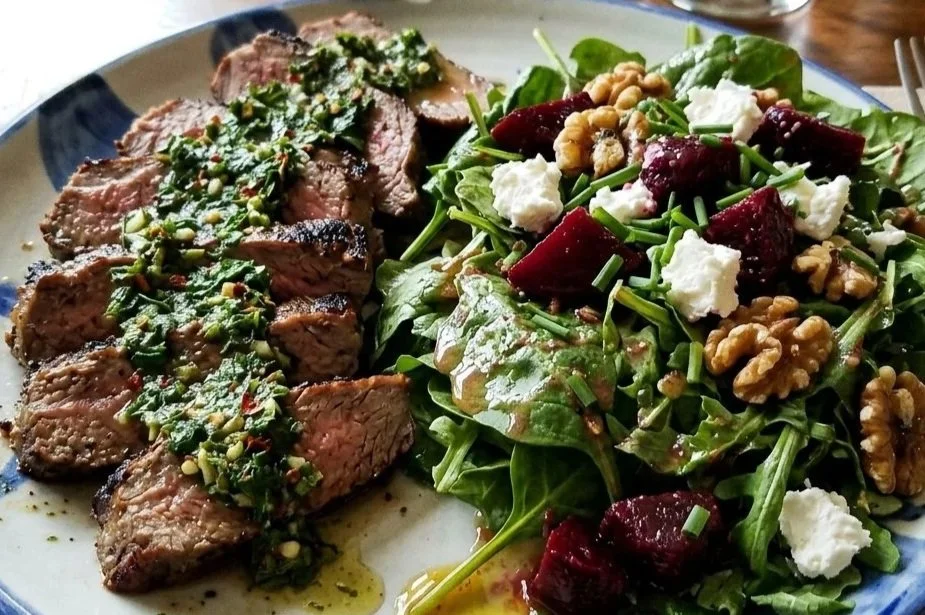
A grass-fed tri-tip rubbed with garlic, pepper, and herbs, slow-roasted low and then seared hot over the biggest fire you've got, so it's rosy and juicy edge to edge. Alongside: a jewel-toned salad of red and golden beets with orange, walnuts, and spinach, and a bright chimichurri for spooning over everything. Simple ingredients, and the technique does the work.
Yield: 6 servings · Active: 30 min · Total: 2 hr 30 min (plus 12-24 hours to dry brine; the beets can roast a day ahead) · Year-round · Best eaten: Sunday supper
A note on tri-tip
Tri-tip (also called bottom sirloin roast, California cut, or Santa Maria steak) is a triangular cut from the bottom sirloin. It's honestly one of the most flavorful cuts on the animal: richly beefy, nicely marbled, and very affordable for how good it is. It was mostly ground into hamburger until a Santa Maria, California, butcher in the 1950s started roasting it whole, and today it's a cornerstone of California barbecue. Traditionally, it's cooked over red oak and seasoned simply with salt, pepper, and garlic. This version adds a few herbs.
Tri-tip is lean, with very little connective tissue, which is why it shines cooked to medium-rare and sliced thin against the grain.
Grass-fed tri-tip brings a cleaner nutritional profile than commodity feedlot beef: more omega-3s, a better omega-6 to omega-3 ratio, plus more CLA and beta-carotene from the pasture-based diet. Look for 100% grass-fed and grass-finished (see Sourcing).
Your Game Plan
The day before: Rub the tri-tip and refrigerate it uncovered. Roast the beets too, if you like; they keep beautifully.
About 2 hr 30 min out (if roasting the beets today): Roast the beets at 400°F, then let them cool, peel, and dress them.
About 1 hr 30 min out: Pull the tri-tip from the fridge, oil it, and heat the oven (or the cool side of the grill) to 250°F.
About 1 hr 15 min out: Tri-tip goes in. Roast to 120°F in the center, 45-60 minutes.
About 20 min out: Rest the roast and make the chimichurri. Get your grill or cast iron skillet ripping hot.
Last 15 min: Sear, rest again, slice, and assemble the salad.
Recipe 1 — Reverse-Seared Santa Maria Tri-Tip
Yield: 6 servings · Active: 15 min · Total: 1 hr 30 min (plus 12-24 hours to dry brine)
Ingredients
1 grass-fed tri-tip, 2½-3 lb, fat cap trimmed to ¼ inch (leave it on; that's where the flavor and fat-soluble vitamins live)
2 tbsp extra virgin olive oil
Santa Maria-inspired rub
1 tbsp coarse Baja Gold sea salt
2 tsp freshly cracked coarse black pepper
1 tbsp garlic powder
1 tbsp sweet paprika
2 tsp dried oregano
1 tsp dried rosemary (or 1 tbsp fresh, chopped)
1 tsp dried thyme (or 1 tbsp fresh, chopped)
Optional: 1 tsp ground cumin
Method
Rub and dry brine (12-24 hours ahead). Pat the tri-tip dry. Mix the rub and press it all over the roast. Refrigerate uncovered on a rack or plate.
Take the chill off. About an hour before cooking, rub the roast with the olive oil and let it come toward room temperature. Heat the oven, or the cool side of your grill, to 250°F.
Slow-roast. Cook until the center reads 120°F, roughly 45-60 minutes depending on thickness. Pull it and rest it 10 minutes.
Sear. Sear over the hottest fire you have, or in a smoking-hot cast iron skillet, about 90 seconds per side, until deeply browned. The final temperature lands around 130-133°F, right where grass-fed beef tastes like itself. Push it to 145°F and you've bought yourself an expensive piece of shoe leather.
Rest 10 more minutes.
Slice it right. Tri-tip has two grain directions that meet in a rough V. Find that seam, cut the roast in two along it, then slice each half thinly against its own grain. Cut it the wrong way and even a perfectly cooked roast eats like rope.
Make it a pot roast (slow cooker or Dutch oven)
For a cozy, braised Sunday pot roast, sear the rubbed tri-tip hard in 3 tbsp olive oil, 3-4 minutes per side, and set it aside. In the same pot, soften 1 large sliced yellow onion for 5-7 minutes, then add 5 smashed garlic cloves, 2 rosemary sprigs, 4 thyme sprigs, and 2 bay leaves for 1 minute. Stir in 1½ cups beef bone broth, 1 tbsp raw apple cider vinegar, 1 tbsp coconut aminos, 1 tbsp Dijon, and an optional 1 tbsp tomato paste, scraping up the browned bits. Nestle the roast on the onions, then cook covered on LOW 6-8 hours in a slow cooker, or 3-4 hours in a 300°F oven. To finish, strain and reduce the liquid by half, then whisk in 2 tbsp butter and an optional 1 tsp raw honey.
An honest note: tri-tip is lean, so it braises into a tender, sliceable pot roast rather than true fall-apart shreds. For a pot roast you can pull apart with a fork, chuck roast, with its generous connective tissue, is the better cut.
Recipe 2 — Chimichurri
Yield: about 1 cup · Active: 10 min · Total: 30 min
The bright, garlicky Argentine herb sauce is a natural partner for any grilled beef. (Santa Maria tradition serves tri-tip with fresh tomato salsa and pinquito beans, which are lovely here too.)
Ingredients
1 cup fresh flat-leaf parsley, packed and finely chopped
2 tbsp fresh oregano, finely chopped (or 2 tsp dried)
4 garlic cloves, finely minced
½ tsp red pepper flakes
¼ cup red wine vinegar
½ cup extra virgin olive oil
½ tsp Baja Gold sea salt
¼ tsp freshly cracked black pepper
Method
Stir everything together in a bowl and let it sit 20-30 minutes so the flavors can come together. Spoon it generously over the sliced tri-tip.
Recipe 3 — Two-Color Beet Salad with Orange and Walnuts
Yield: 6 servings · Active: 20 min · Total: 1 hr 30 min (beets can roast a day ahead)
Red and golden beets, walnuts, spinach, and an orange dressing that turns the whole bowl the color of a sunset if you're careless with the mixing. Be careless.
Ingredients
1½ lb red beets
1 lb golden beets
3 cups baby spinach
¾ cup walnut halves, toasted
⅓ cup fresh orange juice
2 tbsp red wine vinegar
⅓ cup extra virgin olive oil
1 tsp Baja Gold sea salt
½ tsp freshly cracked black pepper
2 tbsp fresh chives, sliced
Method
Roast the beets. Wrap them whole in parchment, then foil, and roast at 400°F for 50-70 minutes, until a knife slides in without complaint.
Peel and cut. While they're still warm, rub off the skins with a towel you don't love. Cut them into ¾-inch wedges, keeping the two colors in separate bowls.
Dress. Whisk the orange juice, vinegar, oil, salt, and pepper. Dress each color of beet separately and let them sit 20 minutes.
Assemble at the last moment. Pile the beets over the spinach and scatter with the walnuts and chives.
Plating
Fan the sliced tri-tip across a warm platter and spoon the chimichurri over the top. Set the beet salad alongside, with flaky sea salt and extra chimichurri at the table.
Suggested Sides
Add one or two of these from my recipe library to round out the meal:
Roasted Fingerling Potatoes with Parmigiano-Reggiano, Garlic, and Rosemary — fingerling potatoes, extra virgin olive oil, garlic, fresh rosemary, Parmigiano-Reggiano, and sea salt. A classic with roast beef.
Roasted Rainbow Carrots with Fresh Herbs — rainbow carrots, olive oil or ghee, fresh thyme, parsley, and dill, with a touch of raw honey and sea salt. Deeply seasonal.
Coco-Lime Sautéed Cabbage — green cabbage, coconut oil, fresh lime juice and zest, garlic, cilantro, and sea salt. A bright, tangy counterpoint.
Marinated Fennel and Red Onion in Champagne Vinegar — shaved fennel, red onion, champagne vinegar, extra virgin olive oil, fennel fronds, and sea salt. Sharp, pickled brightness that cuts through the richness.
Golden Beet Salad with Sheep's Milk Feta, Arugula, and Sherry Vinaigrette — golden beets, sheep's milk feta, arugula, and a sherry vinaigrette of sherry vinegar, olive oil, Dijon, and shallot. A jewel-toned alternative to the beet salad above.
Mediterranean Broccoli Salad — for a clean, bright plate.
Wilted Mighty Greens — kale, chard, and other hearty greens wilted with garlic, olive oil, and lemon. The traditional roast-dinner green.
Sourcing (essential picks)
Grass-fed tri-tip — 100% grass-fed and grass-finished, from a local regenerative ranch, Alderspring Ranch (certified organic, 100% grass-fed), or White Oak Pastures. Look for deep red meat, a clean smell, and visible marbling
Beef bone broth (for the pot roast) — homemade from grass-fed bones simmered 24-48 hours, or Bonafide Provisions (organic, sold frozen). The label should read just bones, water, salt, and herbs, with no yeast extract or gums
Coconut aminos (for the pot roast) — Coconut Secret (organic, made from just coconut sap and sea salt)
Dijon mustard (for the pot roast) — Edmond Fallot, stone-ground in Burgundy by a family mill since 1840, with no sugar
Tomato paste (optional) — organic, in glass: Bionaturae or Jovial
Red and golden beets — organic, firm, with fresh greens attached if possible, from a farmers' market
Walnuts — organic, raw or sprouted, and kept in the fridge so their delicate oils stay fresh. Soaking or sprouting reduces their phytic acid
Oranges — organic
Baby spinach, parsley, oregano, chives, rosemary, thyme, and bay leaves — organic, from a farmers' market or your own garden
Garlic and yellow onion — organic, hardneck garlic
Red wine vinegar — organic and naturally fermented
Raw apple cider vinegar — with the mother (Bragg)
Grass-fed butter — cultured butter from 100% grass-fed cows, or raw butter from a local dairy
Raw honey (optional) — local, unfiltered
Spices (garlic powder, paprika, oregano, black pepper, cumin) — organic and non-irradiated; buy whole peppercorns and seeds and grind them fresh
For grilling — red oak, the traditional Santa Maria wood, if you can find it
Single-estate extra virgin olive oil — harvest-dated within the past year, in dark glass
Baja Gold sea salt for cooking; fleur de sel de Guérande or Maldon for finishing
Storage
Cooked tri-tip: Refrigerated up to 4 days. Slice it cold for salads and wraps, or warm it gently in a covered skillet with a splash of broth
Pot roast variation: Refrigerated up to 4 days in its sauce, where it only gets better. It also freezes beautifully up to 3 months
Rubbed raw tri-tip: Refrigerated up to 24 hours before cooking
Chimichurri: Refrigerated up to 5 days
Roasted beets (undressed): Refrigerated up to 5 days. Dress and assemble the salad just before serving
Leftover transformations: Slice cold tri-tip over grain-free tacos with avocado, cilantro, and lime; toss it into scrambled eggs with sautéed onions for a hearty breakfast; layer it into lettuce wraps with the Marinated Fennel and Red Onion and a spoonful of chimichurri; slice it over greens with leftover beets and sherry vinaigrette for a substantial lunch salad.
Support for the Female Infradian Rhythm
This deeply nourishing meal is especially restorative during the menstrual and luteal phases, when protein, iron, and warming, grounding foods matter most. Grass-fed beef delivers heme iron (the body absorbs about 15-35% of heme iron, compared with roughly 2-20% of the iron in plants), plus B12, zinc, creatine, and CLA, all supporting menstrual iron replenishment. Beets bring dietary nitrates and folate, and their deep pigments are antioxidant powerhouses. Walnuts add ALA omega-3s and magnesium. The fresh herbs in the chimichurri bring vitamin K and chlorophyll, and parsley's apigenin. It's real ancestral restoration cooking: the kind of Sunday meal that has supported women through menstruation, postpartum, and cold winter months for generations.
Nourishment Notes
Grass-fed tri-tip — heme iron, B12, zinc, creatine, carnitine, CLA, and complete protein. Grass-fed beef carries more omega-3s and a better omega-6 to omega-3 ratio than feedlot beef, and the fat cap holds its fat-soluble vitamins, so trim it thin rather than off. Cooking to medium-rare rather than well-done also keeps heterocyclic amine formation low, an honest reason to stop at 130°F beyond the fact that it tastes better.
Beets — dietary nitrates that convert to nitric oxide, which widens blood vessels and improves oxygen delivery to working muscles, plus folate and fiber. Golden beets bring betaxanthins, while red beets bring betacyanins, so using both gives you a wider range of pigments.
Walnuts — ALA omega-3s, polyphenols, magnesium, and copper.
Oranges — vitamin C, d-limonene, and hesperidin. Vitamin C also helps the body absorb the plant iron in the spinach and beets.
Baby spinach — folate, magnesium, vitamin K, and iron.
Chimichurri herbs (parsley, oregano) — apigenin and vitamin K from parsley, carvacrol from oregano, and chlorophyll.
Fresh garlic — allicin and organosulfur compounds.
Rosemary and thyme — rosmarinic acid and carnosic acid from rosemary, thymol and carvacrol from thyme.
Beef bone broth (pot roast) — gelatin, glycine, proline, and trace minerals.
Dijon mustard (pot roast) — glucosinolates (sinigrin converts to isothiocyanates supporting Phase 2 liver detoxification).
Grass-fed butter — CLA, K2, butyrate, beta-carotene.
Extra virgin olive oil — oleic acid, hydroxytyrosol, polyphenols.
Baja Gold sea salt — over 90 trace minerals.
— Anna aka Food Marshall