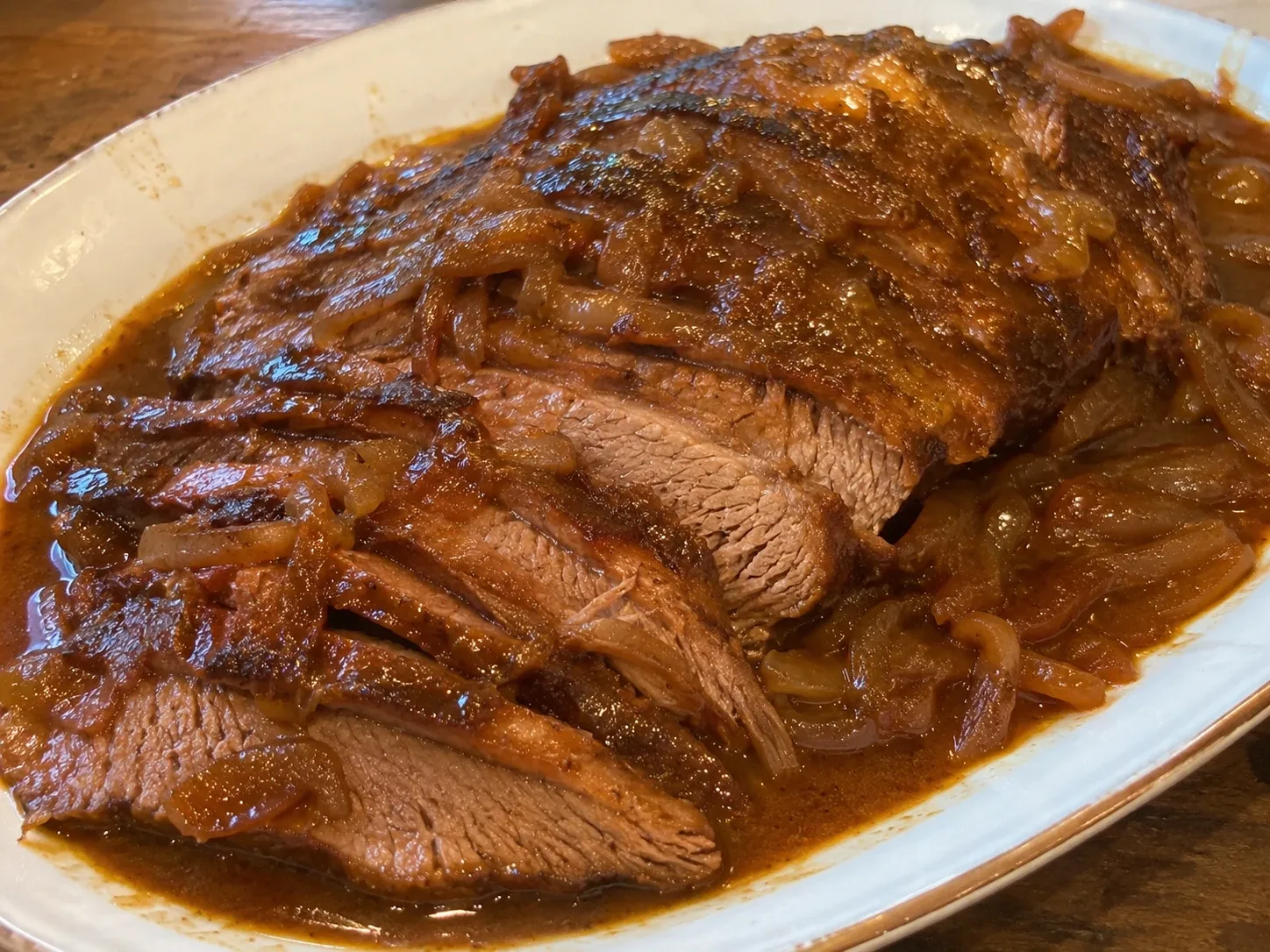
Holiday Brisket
The classic holiday brisket, braised low and slow on a deep bed of onions with red wine, beef stock, and a touch of honey and vinegar for that sweet-and-sour gravy. No ketchup, no brown sugar, and it’s even better made a day ahead.
Yield: Serves 6, with leftovers · Active: 45 min · Total: 4½ hr, plus overnight chilling · Season: Best in North America in fall and winter, for Rosh Hashanah, Hanukkah, and every cold-weather gathering in between · Best eaten: evening, at a holiday or Sunday dinner
Ingredients
For the brisket
- 1 grass-fed beef brisket, first (flat) cut, about 4 lbs, with a ¼-inch fat cap
- 2 tsp sea salt
- 1 tsp freshly cracked black pepper
- 2 tsp sweet paprika
- 2 tbsp beef tallow or schmaltz (rendered chicken fat)
For the braise
- 4 large yellow onions (about 3 lbs), halved and thinly sliced
- 8 garlic cloves, smashed
- 3 tbsp tomato paste
- 1 cup dry red wine
- 2 cups beef stock, homemade if you can
- 2 tbsp raw honey
- 2 tbsp raw apple cider vinegar or red wine vinegar
- 4 carrots, peeled and cut into 2-inch pieces
- 2 bay leaves
- 4 sprigs fresh thyme
- ½ cup pitted prunes (optional, but traditional in many families)
To finish
- 2 tbsp chopped fresh flat-leaf parsley
- Freshly grated horseradish, to serve (optional)
Method
- Season ahead. The day before, or at least 1 hour before cooking, pat the brisket dry and rub it all over with the salt, pepper, and paprika. Refrigerate uncovered if salting overnight; let it sit at room temperature for 45 minutes before searing.
- Heat the oven. Heat the oven to 325°F.
- Sear. Melt the tallow in a large Dutch oven or heavy roasting pan over medium-high heat. Sear the brisket 5–6 minutes per side, until deeply browned. Move it to a platter. If your brisket is too long for the pot, cut it in half crosswise.
- Cook the onions. Lower the heat to medium. Add the onions and a pinch of salt and cook, stirring and scraping up the browned bits, 15–20 minutes, until soft and golden. Add the garlic and tomato paste and cook 2 minutes, until the paste darkens.
- Build the braise. Pour in the wine and let it bubble 2–3 minutes, scraping the bottom. Stir in the stock, honey, and vinegar.
- Braise. Nestle the brisket into the onions, fat side up, and spoon some onions over the top. Tuck the carrots, bay leaves, thyme, and prunes (if using) around it. The liquid should come about halfway up the meat. Cover tightly with the lid, or with parchment and then foil, and braise 3–3½ hours, until a fork slides in and twists easily. Check once or twice and add a splash of stock if it looks dry.
- Chill overnight. Let it cool in the pot, then refrigerate overnight. This is the secret to classic brisket: the flavor deepens, the fat sets on top so you can lift it off, and cold brisket slices cleanly instead of shredding.
- Slice. The next day, lift off the hardened fat (save it for roasting vegetables). Take out the brisket and slice it against the grain, about ¼ inch thick.
- Make the gravy. Remove the bay leaves and thyme stems. Set the carrots and prunes aside. Blend about half the onions and liquid with an immersion blender for a thicker gravy, or leave it all chunky. Taste and adjust with salt, a little more vinegar, or a little more honey to get the sweet-sour balance you like.
- Rewarm. Lay the slices back in the pot, overlapping, with the carrots and prunes, and spoon the gravy over. Cover and reheat in a 325°F oven 35–45 minutes, until hot through.
- Serve. Arrange on a platter, spoon over plenty of gravy, and scatter with parsley. Pass fresh horseradish at the table.
Storage
Refrigerate sliced brisket in its gravy, covered, up to 5 days. Freeze in its gravy up to 3 months; thaw overnight in the fridge and reheat covered at 325°F. Leftovers make wonderful hash with roasted roots and a fried egg.
Variations
- Alcohol-free: Replace the wine with an equal amount of beef stock plus 1 extra tbsp vinegar and 2 tbsp pomegranate juice, for a little fruit and color.
- Nightshade-free: Leave out the paprika and tomato paste, and add 1 more tbsp vinegar and a pinch of extra pepper.
- Slow cooker: After searing and building the braise, cook on Low 8–10 hours.
- Second cut: The point cut is fattier and richer; braise it 30–45 minutes longer, and shred rather than slice.
- Spiced or fruited: For a Sephardic-spiced brisket with dried apricots and sweet potatoes, see my Slow-Braised Grass-Fed Brisket with Bone Broth, Dried Fruit & Roasted Garlic.
- The stock: My 24-Hour Beef Stock makes the richest gravy here.
- Sides: Serve with my Root Medley with Lamb Fat and a bright Cranberry-Orange Relish.
Season & Circadian Timing
Brisket became the centerpiece of Jewish holiday tables because it’s an inexpensive cut that turns tender and generous with a long, slow braise, and because it reheats beautifully, so it could be made before the holiday began. A touch of honey makes it a natural fit for Rosh Hashanah, when sweet foods welcome a sweet new year, and it’s on the table again at Hanukkah and on cold Shabbat evenings through winter. Serve it at dinner, when there’s time to linger around the table.
Nourishment Notes
- Grass-fed brisket — Complete protein, rich in heme iron, zinc, and vitamin B12, with more omega-3s and CLA than grain-finished beef.
- Beef stock — Gelatin, glycine, and proline from the bones, which also give the gravy its body.
- Onions and garlic — A full three pounds of onions melt into the gravy, bringing sulfur compounds, quercetin, and natural sweetness.
- Carrots and prunes — Beta-carotene from the carrots; fiber, potassium, and natural sweetness from the prunes.
- Raw honey and vinegar — Just enough to give the classic sweet-sour balance without any refined sugar.
Sourcing
- Brisket — 100% grass-fed and finished, from a local ranch or butcher
- Beef stock — homemade from grass-fed bones, or organic and sold frozen (Bonafide Provisions)
- Beef tallow — from grass-fed beef, rendered at home or from a local ranch (Fatworks)
- Red wine — organic or biodynamic, low-sulfite, dry
- Raw honey — organic, local, and unfiltered
- Raw apple cider vinegar — organic, with the mother (Bragg)
- Prunes — organic and unsulfured
- Tomato paste — organic, in glass jars
- Spices — organic and non-irradiated
- Salt — unrefined sea salt (Baja Gold)
- Fruits, vegetables, and herbs — organic, from a farmers’ market or local farm
With Love, Light, and Health,
Anna (aka Food Marshall)
Food Marshall Approved. Grain-free, seed-oil-free and refined-sugar-free, made from organic, local and seasonal ingredients. Our standards
More Meat
Get new recipes and essays
Seasonal recipes and writing on light, circadian health, and living with nature.
Subscribe on Substack