Lamb and Pistachio Patties with Sumac Yogurt Sauce
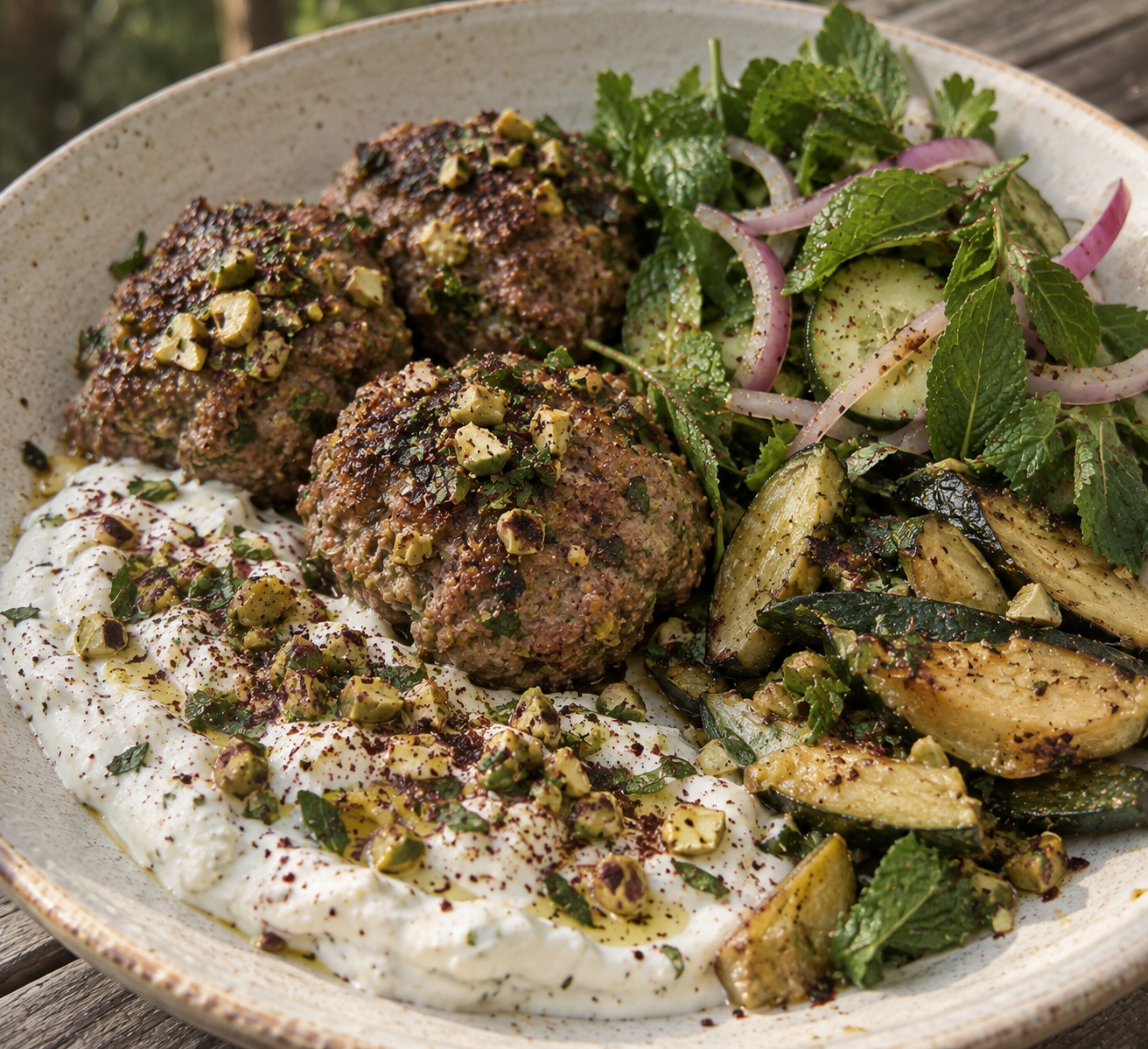
Yield: Serves 4 (or 6–8 as part of a mezze spread) · Active: 20 min · Total: 45 min · Best in North America in spring and early summer, during lamb season · Best eaten: midday or early afternoon
Ingredients
Lamb and pistachio patties
1 lb pasture-raised, grass-finished ground lamb
½ cup pistachios, finely chopped (set aside 2 tbsp for garnish)
1 small red onion, finely grated
3 garlic cloves, minced or grated
¼ cup fresh flat-leaf parsley, finely chopped
2 tbsp fresh mint, finely chopped
1 tsp ground cumin
1 tsp ground coriander
½ tsp ground Ceylon cinnamon
Optional: ½ tsp ground sumac (it also goes on top)
1 tsp Baja Gold sea salt and ¼ tsp freshly ground black pepper
Optional: a pinch of cayenne
Optional: 1 pasture-raised egg yolk, for binding
2 tbsp ghee or avocado oil, for searing
About the egg yolk: It helps the patties hold together cleanly, but it isn't essential. If you skip it, work the mixture a little longer to help it bind, and shape the patties slightly smaller.
Sumac yogurt sauce
1 cup raw, grass-fed yogurt (A2/A2) or strained labneh
2 tbsp fresh lemon juice
1 small garlic clove, grated or crushed to a paste with salt
1 tbsp extra virgin olive oil
1 tbsp fresh mint, very finely chopped
1–2 tsp ground sumac, plus more for finishing
Baja Gold sea salt, to taste
To serve: a bed of butter lettuce, arugula, or fresh spring greens, torn mint and parsley, the reserved pistachios, lemon wedges, and extra sumac, for dusting
Method
Make the yogurt sauce first. Whisk the yogurt, lemon juice, garlic, olive oil, mint, sumac, and a pinch of salt. Taste and adjust: it should be bright, gently garlicky, and speckled with red. Refrigerate it while you make the patties; even 15 minutes of rest helps the flavors meld.
Mix the lamb. Combine the lamb, pistachios, onion, garlic, parsley, mint, spices, salt, pepper, and the cayenne and egg yolk (if using). Work it gently with your hands, just until combined; overworked ground meat turns dense and tough.
Shape. Divide the mixture into 8 portions, and shape each one into a flattened oval about ¾ inch thick. Press a shallow dimple into the center of each with your thumb, so they cook flat instead of puffing up. If you have time, chill them 15–20 minutes, which firms them up for searing.
Sear. Heat the ghee in a heavy skillet (cast iron is ideal) over medium-high heat until shimmering. Sear the patties in batches, without crowding, for 3–4 minutes, until a deep brown crust forms, then flip and cook 3–4 minutes more, until they reach 160°F in the center (or a little less, for a blush of pink, if your lamb is from a farmer you know and trust). Lamb dries out quickly, so watch them closely. Let them rest on a plate.
Plate. Spread the greens on a platter, and arrange the patties on top, slightly overlapping. Spoon the sumac yogurt around and over them, and scatter with the reserved pistachios, torn herbs, and a final dusting of sumac. Tuck lemon wedges around the edge.
Serve It With
A shaved asparagus salad, grilled asparagus, or charred broccolini, in spring (see my Shaved Asparagus Salad with Roasted Cauliflower)
A chopped spring salad, like a grain-free fattoush: cucumber, radishes, tomato, red onion, parsley, and mint, tossed with lemon, olive oil, and a generous dusting of sumac
My Loaded Turmeric-Roasted Cauliflower, or simple cauliflower rice
Cumin-honey roasted carrots: rainbow carrots roasted at 425°F with olive oil, cumin, and a drizzle of honey
Garlicky spinach with lemon, quickly wilted in olive oil
Storage
Leftover patties keep refrigerated up to 3 days. Reheat them gently in a dry skillet over low heat, or crumble them cold over a salad with the leftover yogurt; they're even better on day two. The lamb mixture can be made up to 24 hours ahead, and the flavors improve. The yogurt sauce keeps up to 2 days.
For a crowd: For a retreat or dinner party of 16, double the recipe, or triple it for 24. Mix and shape the patties the morning of, then sear them in batches just before serving.
Nourishment Notes
Lamb is one of the most ancestral proteins we have. Sheep are still small ruminants built to graze on varied forage, and a well-raised pasture lamb is much like the lamb your great-great-grandmother would have known. But many lambs today are still finished on grain, which is why "grass-finished," not just "grass-fed," is the label that matters most. Lamb is rich in iron, zinc, B12, and selenium, and grass-finished lamb carries more CLA and omega-3s.
Pistachios bring vitamin B6, potassium, and lutein, along with a little magnesium and small amounts of naturally occurring melatonin.
Raw, grass-fed yogurt is the element most worth taking seriously. Its live cultures help break down lactose, which is part of why many people who can't tolerate milk do well with yogurt. Raw yogurt from a farm you trust also tends to carry a wider variety of cultures, and A2/A2 milk is easier for many people to digest. If you can't find raw yogurt, strained whole-milk, grass-fed yogurt, like Maple Hill or Kalona SuperNatural, is a close second.
Sumac deserves a full paragraph. This deep red spice comes from the dried, ground berries of Rhus coriaria, which grows wild across the Mediterranean and Middle East. It's been used for thousands of years, mentioned in Roman texts, beloved in Persian and Levantine cooking, and still foraged by hand in southern Turkey and Lebanon. It's rich in antioxidant tannins and anthocyanins, and its bright, gentle tartness helps balance rich foods, which is why it pairs so naturally with lamb. The flavor is hard to describe: tart like lemon, but rounder, a little berry-like, and savory. Once it's on your spice shelf, you'll reach for it constantly: on yogurt, roasted vegetables, eggs, avocado, and more.
Cumin and Ceylon cinnamon are warming spices that bridge the seasons, a gentle continuity between autumn and spring. Fresh mint and parsley are the brightness of the dish. Parsley is one of the richest food sources of vitamin K and folate, and a traditional spring tonic in European and Middle Eastern cooking, while mint is traditionally used to support digestion and cools the warmth of the spices. Use more of both than you think you need.
As a circadian and seasonal food, this is best at midday or in the early afternoon, when your digestion is strongest. If you serve it for dinner, keep the portion moderate, and lean into the yogurt and greens. Spring is a transitional season, and traditional kitchens around the world have answered it the same way: bitter greens, pungent herbs, lighter proteins, and gently sour flavors. Lamb, because it's the traditional spring protein, rich in iron and zinc. Pistachios and fresh herbs, for their minerals and brightness. Sumac, for its gentle tartness. And yogurt, because spring is when grazing animals return to new grass, and their milk is at its richest. It's a simple dish. It's also, in its quiet way, medicine.
For your cycle: The lamb's heme iron, zinc, and B12 make this especially restorative during the menstrual phase, and the lemon and herbs bring vitamin C to help your body absorb that iron. It's light enough to enjoy in the follicular phase too.
Sourcing
Ground lamb — pasture-raised and grass-finished, from a local farm, US Wellness Meats, or White Oak Pastures
Pistachios — organic, California or Sicilian, kept in the fridge
Yogurt or labneh — raw A2/A2 yogurt from a farmer you know and trust, or organic, strained, grass-fed whole-milk yogurt, like Maple Hill or Kalona SuperNatural
Eggs (optional) — organic and pasture-raised
Red onion, garlic, parsley, mint, greens, and lemons — organic, from a farmers' market in spring
Sumac — organic and non-irradiated, with no added salt
Cumin, coriander, Ceylon cinnamon, and cayenne — organic and non-irradiated
Ghee or avocado oil — grass-fed ghee, or cold-pressed avocado oil, third-party tested for purity
Extra virgin olive oil — organic, single-estate, harvest-dated, in dark glass
Salt — Baja Gold sea salt
— Anna aka Food Marshall