Orange & Thyme Cake with Crème Fraîche & Honey Thyme Syrup
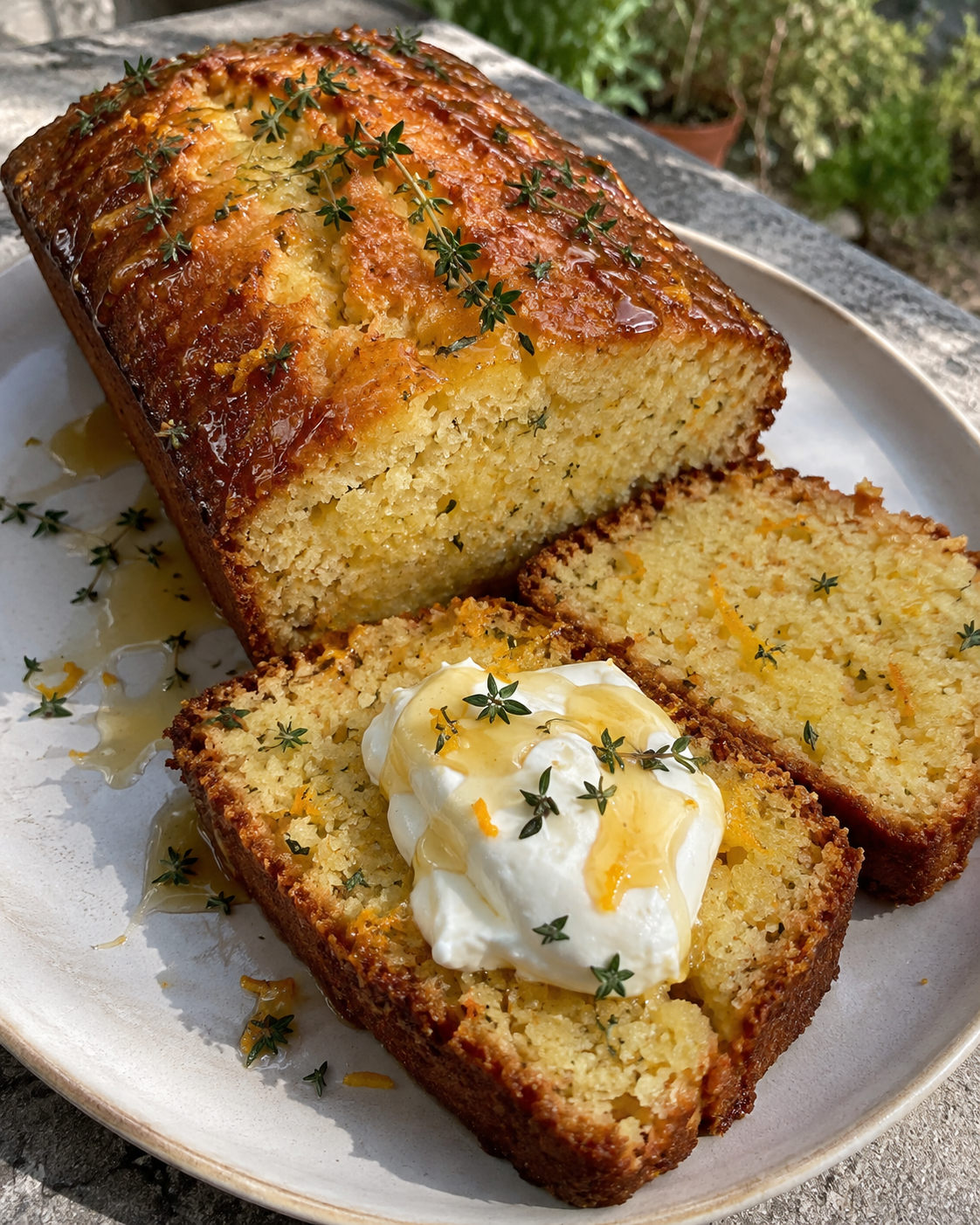
An almond-flour citrus-and-herb cake sweetened with honey, finished with crème fraîche and a thyme-infused honey syrup.
Yield: one 8-inch round, one 9×5 loaf, or 3 mini loaves (serves 8–10) · Active: 20 min · Total: 1 hr 30 min (includes cooling) · Citrus peaks in winter: navel oranges December–April from California and Florida, with Cara Caras and blood oranges in between; thyme year-round · Cuisine: European · Best eaten: as an afternoon-tea cake, winter into spring
This is a citrus-and-herb cake in the European tradition. It’s made with ground almonds instead of wheat flour, sweetened with honey instead of refined sugar, and topped with cultured crème fraîche instead of whipped cream. It’s inspired by The Caker (Jordan Rondel).
Orange, thyme, honey and crème fraîche make a grown-up dessert. You get bright citrus zest, savory-floral thyme, the round sweetness of honey and a little tang from the cream. The honey-thyme syrup is the chef’s touch that takes it from simple to memorable.
The cake travels well, keeps for 3 days and is even better on day 2. Serve it with strong black tea or espresso for afternoon tea, a winter or spring brunch, a dinner-party dessert, or a quiet weekend treat. Want more citrus? Try my coconut-flour Orange Pistachio Loaf or the Orange and Chocolate Tart.
Ingredients
Cake
2 cups finely ground blanched almond flour
3 large pasture-raised eggs, at room temperature
⅓ cup honey
⅓ cup grass-fed butter, melted and cooled
Zest of 1 large organic orange
2 tbsp fresh orange juice (from the same orange)
1 tsp fresh lemon juice
3 tsp fresh thyme leaves
¾ tsp baking soda
¼ tsp Baja Gold sea salt
Honey Thyme Syrup
¼ cup honey
¼ cup filtered water
5 sprigs fresh thyme
Topping
½ cup crème fraîche, cold
Fresh thyme sprigs, for garnish
Optional: thin strips of orange zest
Swaps
Lemon zest and juice in place of orange gives you a sharper, brighter cake.
Lavender or rosemary work in place of thyme. Use about half as much lavender, since it gets soapy fast.
Dairy-free: use melted coconut oil in place of butter. Top with whipped coconut cream instead of crème fraîche: chill a can of full-fat coconut milk overnight, scoop off the solid cream and whip it with 1 tbsp honey.
Method
Preheat and prep. Heat the oven to 350°F (325°F convection). Line an 8-inch round pan, a 9×5 loaf pan, or 3 mini loaf pans with parchment.
Mix the wet ingredients. In a large bowl, whisk the eggs, honey, melted butter, orange zest, orange juice, lemon juice and thyme leaves until smooth.
Add the dry ingredients. Add the almond flour, baking soda and salt. Stir until just combined and no dry pockets remain. Don’t overmix.
Bake. Pour the batter into the pan(s) and smooth the top. Bake until golden and springy and a skewer comes out clean:
Mini loaves: 25–30 minutes
8-inch round: 28–35 minutes
9×5 loaf: 35–40 minutes
Honey browns fast, so if the top is getting dark before the center is set, tent it loosely with foil.
Cool. Cool 10 minutes in the pan, then turn the cake out onto a rack and let it cool completely. Almond-flour cakes are fragile while warm.
Make the honey thyme syrup while the cake bakes. Warm the honey and water in a small saucepan over low heat until just bubbling. Take it off the heat, add the thyme sprigs and steep 10 minutes. Strain, discard the thyme and let the syrup cool.
Want to keep the honey raw? Steep the thyme in ¼ cup just-boiled water for 10 minutes and strain. Once the water has cooled to warm (comfortable to the touch), stir in the honey. The syrup will be a little thinner.Finish just before serving. Whisk the cold crème fraîche for 20–30 seconds, just until it thickens enough to hold a dollop. If you keep going it turns grainy. Pipe or dollop it on the cooled cake, drizzle with the honey thyme syrup and garnish with thyme sprigs and orange zest.
Storage: Keep the plain cake covered at room temperature for 1 day, or in the fridge for up to 3 days. Once it’s topped with crème fraîche, refrigerate it and eat within 2 days. The syrup keeps 2 weeks in the fridge and is excellent on yogurt parfaits, grain-free pancakes or roasted stone fruit.
For a crowd (20+): Double the recipe and bake in two 9×5 loaves or one 9×13 pan. Start checking the 9×13 at 35 minutes; it usually takes 35–45.
Honey note: honey is no longer raw once it’s baked or heated to a simmer, but it still brings its flavor. Use the raw-syrup option above if you want the raw benefits on top. Honey isn’t safe for babies under 12 months.
Nourishment Notes
Almond flour brings vitamin E, magnesium, fiber and monounsaturated fats, along with some plant protein. That fat and fiber means a slice sits steadier than a wheat-and-sugar cake.
Pasture-raised eggs bring complete protein, choline and the fat-soluble vitamins A, D, E and K2. Their lecithin is a natural emulsifier, which is what gives this cake its fine, tender crumb.
Honey is still a sugar, so it’s used modestly here. It brings more flavor and trace minerals than refined sugar, and it browns beautifully. The orange and lemon juice react with the baking soda to give the cake its lift.
Orange zest is where the citrus oils live, so it carries most of the orange flavor. Use only the colored part of the peel and skip the bitter white pith underneath. Go organic, since you’re eating the skin.
Thyme contains thymol and carvacrol, aromatic compounds traditionally used to support digestion. Thyme has been part of European cooking since Roman times, and thyme-and-honey pairings show up across old European herbal traditions.
Crème fraîche is a French cultured cream, thickened by bacterial cultures until it’s rich and slightly tangy. It brings calcium and fat-soluble vitamins, plus butyrate, a short-chain fat found in butterfat. Brands that are cultured and left unheated afterward may still have live cultures. It’s richer and milder than American sour cream and doesn’t split when it meets warm food.
The honey-thyme syrup echoes the thyme honeys of Greece, Italy and France, where bees forage on wild thyme. Infusing fresh thyme into honey gets you close to that flavor at home.
When to eat it: As a circadian food, this is an afternoon-tea cake. Have a slice with strong black tea or espresso mid-afternoon or after a good midday meal, rather than late at night.
For your cycle: In the luteal phase, the magnesium in almond flour and the protein and fat in eggs and butter make this a steadier way to answer premenstrual sweet cravings than a sugar-and-flour treat. In the follicular phase, the bright citrus and herbs fit the lighter, fresher energy.
Sourcing
Almond flour: finely ground blanched almond flour, organic if you can find it
Eggs: Pete & Gerry’s or a local farm
Honey: a local small producer. Orange-blossom, wildflower or thyme honey all work well here.
Butter: grass-fed butter, from a local farm if possible
Sea salt: Baja Gold
Oranges and lemons: organic, since you’re using the zest and conventional citrus skins carry spray residue
Fresh thyme: a windowsill pot or the farmers’ market
Crème fraîche: Vermont Creamery or Bellwether Farms (US), or Isigny Sainte-Mère (French import)
— Anna aka Food Marshall