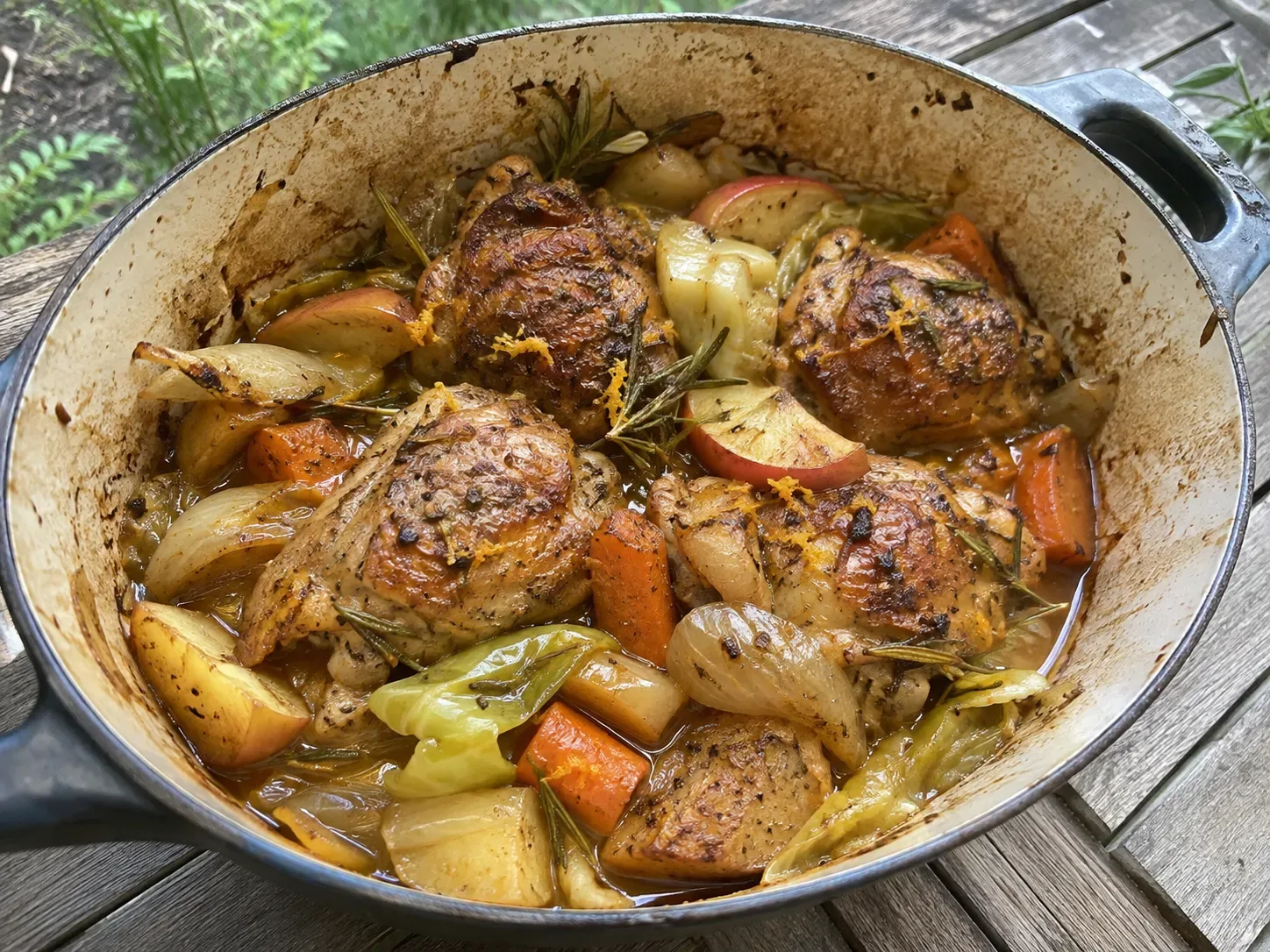
Orange-Rosemary Dutch Oven Chicken or Duck with Apples, Cabbage, and Root Vegetables
A whole chicken or duck slow-roasted in a covered Dutch oven with citrus, rosemary, and Dijon tucked inside. Apples, carrots, onions, and cabbage join it partway through and soak in the juices, then the lid comes off and the bird goes under the broiler for crackling-crisp skin.
Yield: Serves 4–6 · Active: 25 min · Total: about 2 hr for chicken, 2 hr 45 min for duck · Season: Best in North America in fall and winter, when apples, cabbage, and citrus are at their peak · Best eaten: early evening
Ingredients
For the bird (choose one)
- Chicken: 1 whole pasture-raised chicken (4–5 lb), plus 3 tbsp grass-fed butter
- Duck: 1 whole pasture-raised duck (5–6 lb). Duck makes plenty of its own fat, so you don’t need butter.
- 2 tsp sea salt (Baja Gold), plus more for the vegetables
- ½ tsp freshly cracked black pepper
For the cavity
- 1 orange, cut into wedges
- 1 lemon, cut into wedges
- 4 sprigs fresh rosemary
- 1 tbsp Dijon mustard
- 4 garlic cloves, smashed
For the pot
- ½ cup filtered water for chicken, or ¾ cup for duck
For the vegetables
- 2 apples (Honeycrisp, Pink Lady, or Granny Smith), cored and cut into thick wedges
- 4 carrots, cut into 2-inch pieces
- 2 parsnips, cut into 2-inch pieces
- 2 yellow onions, cut into wedges, or 12 oz pearl onions, peeled
- ½ small green cabbage, cut into 4 wedges through the core
- 1 orange, sliced into rounds (optional, for the pot)
- 2 sprigs fresh rosemary
For the pan sauce (optional)
- 1 tsp Dijon mustard
- Juice of ½ orange
Method
- Heat the oven. Preheat to 325°F. Pat the bird completely dry with a towel. Dry skin is what crisps under the broiler later.
- Fill the cavity. Spread the Dijon inside the cavity, then stuff it with the orange and lemon wedges, rosemary, and garlic.
- Salt it all. Season the bird generously all over, inside and out, with the salt and pepper.
- Prep the pot.
- Chicken: Rub 1 tbsp butter over the skin, put the remaining butter in the bottom of the Dutch oven, and add ½ cup water.
- Duck: Prick the skin all over with a sharp knife, especially over the fatty breast and thighs, without cutting into the meat. This lets the fat render out. Add ¾ cup water to the pot.
- Roast covered. Set the bird breast side up in the Dutch oven, cover with the lid, and roast 1 hour.
- Add the vegetables. Take out the pot, lift the lid, and tuck the apples, carrots, parsnips, onions, cabbage wedges, orange slices (if using), and rosemary around the bird, nestling them into the juices. Season the vegetables with a pinch of salt. For duck, spoon off some of the fat first if there’s a lot, and save it in a jar. Cover again.
- Keep cooking. Roast covered until the vegetables are tender and the bird is cooked through:
- Chicken: 45–60 minutes more, until the thigh reaches 175°F.
- Duck: 1¼–1½ hours more, until the thigh reaches at least 165°F. It’s most tender at 175–180°F.
- Crisp the skin. Take the lid off and move a rack to the upper third of the oven, so the top of the bird sits about 6 inches below the broiler. Broil 4–8 minutes, watching closely, until the skin is deep golden and crackling. Leave the lid out of the oven: enameled cast iron pots are broiler-safe, but many lid knobs aren’t.
- Rest. Let the bird rest 10–15 minutes before carving.
- Make the pan sauce (optional). Tilt the pot and spoon off the extra fat from the juices (save duck fat for roasting vegetables). Whisk the Dijon and orange juice into the remaining juices.
- Serve. Carve the bird and serve with the vegetables, spooning the juices over everything.
Storage
- Leftovers: Refrigerate up to 4 days. Reheat covered at 325°F with a splash of the juices.
- Pan juices: Strain, chill, and lift off the fat once it sets. The jelly underneath is concentrated broth, so use it in soups or sauces.
- Duck fat: Keep in a glass jar in the fridge up to 6 months.
- The carcass: Simmer it into broth (see my Broths 101: A Foundation).
Variations
- Pears instead of apples: Use firm Bosc pears.
- Brussels sprouts: Swap the cabbage for halved Brussels sprouts.
- More roots: Add quartered turnips or celery root with the carrots.
- Summer version: Swap the parsnips for 1 medium zucchini, cut into thick half-moons, and add it for the last 15–20 minutes so it stays tender.
- Uncovered duck: For a classic open roast, see my Slow-Roasted Whole Pastured Duck with Orange, Herbs, and Shallots.
Season & Circadian Timing
Apples, cabbage, and citrus all come into their best in fall and winter, so this is a one-pot dinner for the cold months. Slow-roasted poultry with vegetables makes a warming, grounding early-evening meal. Give yourself a few hours to digest before bed.
Nourishment Notes
- Pasture-raised chicken — Protein, B vitamins, zinc, and selenium. Roasting it whole on the bone gives you collagen-rich juices too.
- Duck — More iron, B12, and zinc than chicken, and about half its fat is monounsaturated, the same kind as in olive oil.
- Duck fat and grass-fed butter — Stable fats for cooking, with fat-soluble vitamins.
- Cabbage — Vitamin C, vitamin K, and glucosinolates. The juices make it silky.
- Apples — Pectin, a soluble fiber that feeds your gut bacteria, plus quercetin.
- Carrots, parsnips, and onions — Beta-carotene, which the fat helps you absorb, plus fiber, quercetin, and sulfur compounds.
- Citrus and rosemary — Vitamin C and aromatic compounds that perfume the meat from the inside.
Sourcing
- Chicken — pasture-raised, from a local farm (White Oak Pastures)
- Duck — pasture-raised, from a local farm or butcher
- Butter — organic, grass-fed, or raw butter from a local dairy
- Dijon mustard — organic, with no preservatives or sugar (Delouis Fils or Maison Orphée)
- Apples, cabbage, carrots, parsnips, onions, and rosemary — organic, from a farmers’ market or local farm
- Oranges and lemons — organic (you’re using the peel)
- Water — filtered
- Salt — unrefined sea salt (Baja Gold)
You might also like: Broths 101: A Foundation · Velvet Vegetable Purées: A Foundation
With Love, Light, and Health,
Anna (aka Food Marshall)
Food Marshall Approved. Grain-free, seed-oil-free and refined-sugar-free, made from organic, local and seasonal ingredients. Our standards
More Poultry
Get new recipes and essays
Seasonal recipes and writing on light, circadian health, and living with nature.
Subscribe on Substack