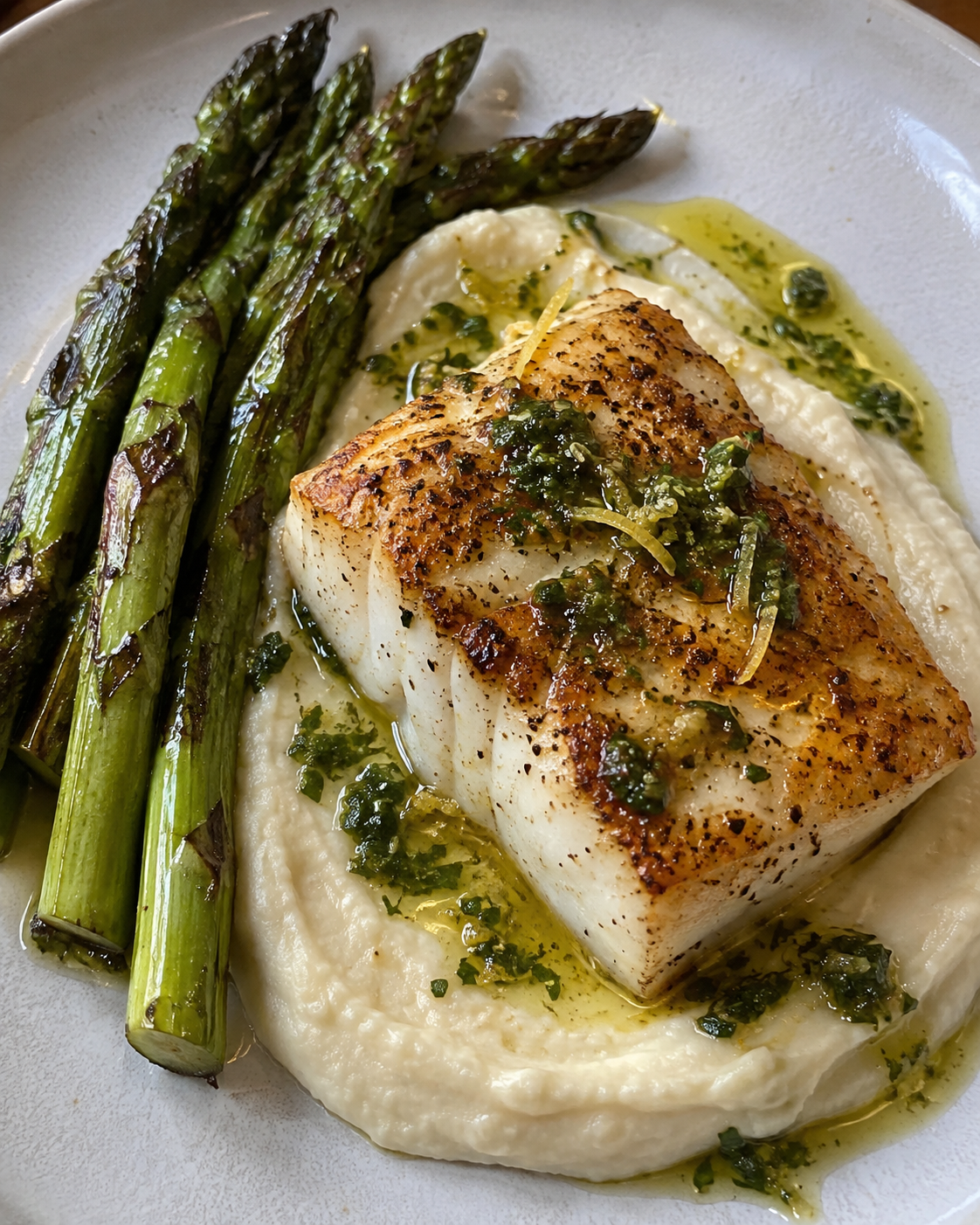
Pan-Seared Wild Halibut with Brown Butter Cauliflower Purée, Grilled Asparagus, and Lemon-Basil Oil
Yield: 4 servings · Active: 35 min · Total: 45 min · Peak spring through early summer · Best eaten: dinner party or special weeknight
Complete Menu
Pan-Seared Wild Halibut
Brown Butter Cauliflower Purée
Grilled Asparagus
Lemon-Basil Oil
Your Game Plan
About 45 min out: Make the lemon-basil oil. Pull the halibut from the fridge 20 minutes before cooking.
About 35 min out: Steam the cauliflower, brown the butter, and blend the purée. Keep it covered over the lowest heat.
About 15 min out: Grill the asparagus.
About 10 min out: Sear the halibut.
Plate and drizzle.
Recipe 1 — Pan-Seared Wild Halibut
Ingredients
4 wild-caught Alaskan halibut fillets (about 6 oz each, skin off)
2 tbsp extra virgin olive oil
2 tbsp grass-fed butter
1 tsp Baja Gold sea salt
½ tsp freshly cracked black pepper
Zest of 1 lemon
4 sprigs fresh thyme
Method
Take the chill off. Pull the halibut from the fridge 20 minutes before cooking.
Season. Pat the halibut completely dry, then season it with salt and pepper.
Sear. Heat the olive oil in a large cast iron skillet over medium-high heat until shimmering. Lay the halibut fillets in, presentation side down, and sear 3-4 minutes without moving them, until deeply golden.
Flip and butter-baste. Flip the halibut. Add the butter and thyme sprigs. Tilt the pan and spoon the melted butter over the fish again and again for 2-3 minutes, until it's just cooked through and opaque in the center, about 130-135°F. Halibut is lean and overcooks quickly, so pull it as soon as it's there.
Rest. Transfer to warm plates and let it rest 2-3 minutes. Finish with the lemon zest; added now, it stays bright instead of scorching in the pan.
Recipe 2 — Brown Butter Cauliflower Purée
Ingredients
1 large head cauliflower, cut into florets (about 6 cups)
2 garlic cloves, peeled
4 tbsp grass-fed butter
2-4 tbsp of the steaming water, as needed (or a splash of cream for extra richness)
1 tsp Baja Gold sea salt
¼ tsp freshly cracked white pepper (or black)
Pinch of freshly grated nutmeg
Optional: 2 tbsp grated Parmigiano-Reggiano DOP
Method
Steam the cauliflower. Steam the florets and garlic 10-12 minutes until very tender. Let them steam dry in a colander for 2 minutes so the purée doesn't turn watery.
Brown the butter. In a small skillet, melt the butter over medium heat. Cook 3-5 minutes, swirling often, until deeply golden-brown and nutty-smelling. Watch closely, because it can burn quickly.
Blend. In a high-speed blender or food processor, combine the cauliflower and garlic, brown butter (scrape in all the browned milk solids; that's where the flavor lives), salt, pepper, and nutmeg. Blend on high 60-90 seconds until silky smooth, adding the steaming water (or cream) a splash at a time until it's velvety and spoonable.
Taste. Adjust the seasoning, and fold in the optional Parmigiano.
Recipe 3 — Grilled Asparagus
Ingredients
1½ lb fresh asparagus, tough ends trimmed
2 tbsp extra virgin olive oil
1 tsp Baja Gold sea salt
½ tsp freshly cracked black pepper
Juice of ½ lemon
Flaky sea salt
Method
Toss the asparagus with the olive oil, salt, and pepper.
Grill over medium-high heat (or in a cast iron grill pan) 4-6 minutes, turning once, until charred and tender-crisp. Lay the spears across the grates so they don't fall through.
Finish. Squeeze the lemon juice over the top and scatter with flaky sea salt.
Recipe 4 — Lemon-Basil Oil
Ingredients
1 cup fresh basil leaves, packed
½ cup extra virgin olive oil
Zest of 2 lemons
2 tbsp fresh lemon juice
½ tsp Baja Gold sea salt
Optional: 1 small garlic clove
Method
Blanch the basil. Dip the basil in boiling water for 5-10 seconds, then transfer it to ice water. This keeps the green color vivid. Pat it dry.
Blend. In a blender, combine the basil, olive oil, lemon zest, lemon juice, salt, and optional garlic. Blend 30-45 seconds until bright green and smooth. It will separate a little as it sits; just stir before drizzling.
Strain (optional). For a silky, glossy finish, strain it through a fine-mesh strainer. Skip this for a more rustic texture.
Plating
Spoon the warm cauliflower purée in a wide swoosh across warm plates. Rest the halibut on top. Arrange the asparagus alongside. Drizzle the lemon-basil oil generously around the plate. Finish with flaky sea salt, a lemon wedge, and a fresh basil leaf.
Sourcing (essential picks)
Wild-caught Alaskan halibut — hook-and-line-caught Pacific halibut from Alaska, from a trusted fishmonger or Vital Choice. Skip Atlantic halibut, which is depleted and on Seafood Watch's "avoid" list. Peak season March-November; frozen-at-sea is excellent year-round
Fresh asparagus — bright green, firm stalks, from a farmers' market. Thicker spears are easiest to grill. Peak spring
Cauliflower — organic, tight compact head
Fresh basil — organic, bright green
Grass-fed butter — cultured butter from 100% grass-fed cows, or raw butter from a local dairy
Cream (optional) — raw cream from a small pasture-raised dairy, or Kalona SuperNatural (grass-fed, low-temp vat-pasteurized, non-homogenized)
Parmigiano-Reggiano DOP (optional) — aged 24+ months, made from raw milk by law
Fresh lemons — organic (you're using the zest)
Fresh thyme and garlic — organic, hardneck garlic
Whole nutmeg and white and black peppercorns — organic, non-irradiated, ground fresh
Single-estate extra virgin olive oil — harvest-dated within the past year, in dark glass
Baja Gold sea salt for cooking; fleur de sel de Guérande or Maldon for finishing
Storage
Cooked halibut: Refrigerated up to 2 days. Best fresh, since reheating dries out the delicate flesh. Flake it cold over salad instead
Cauliflower purée: Refrigerated up to 4 days. Rewarm gently on the stovetop with a splash of water or broth
Grilled asparagus: Refrigerated up to 3 days
Lemon-basil oil: Refrigerated up to 4 days. An honest note: homemade oil with fresh garlic should always live in the fridge and be used within 4 days. Let it come to room temperature and stir before using
Leftover transformations: Flake cold halibut over greens with grilled asparagus and a drizzle of lemon-basil oil for a next-day lunch; fold leftover purée into pastured eggs for a creamy scramble; chop grilled asparagus into a frittata.
Nourishment Notes
Wild halibut — lean complete protein, B12, selenium, iodine, and some omega-3s.
Cauliflower — glucosinolates, choline, vitamin C, vitamin K.
Grass-fed brown butter — CLA, K2, butyrate, beta-carotene. Browning develops nutty aromatic compounds, and butter's stable fats hold up beautifully to the heat.
Cream (optional) — fat-soluble vitamins A, D, E, and K2.
Fresh asparagus — folate (one of the highest food sources), vitamin K, glutathione precursors, inulin.
Fresh basil — eugenol, aromatic oils, traditional Mediterranean support.
Fresh thyme and garlic — thymol, allicin, and organosulfur compounds.
Parmigiano-Reggiano DOP (optional) — concentrated calcium, K2, and complete protein.
Fresh lemon — d-limonene, hesperidin, vitamin C.
Extra virgin olive oil — oleic acid, hydroxytyrosol, polyphenols.
Baja Gold sea salt — over 90 trace minerals.
— Anna aka Food Marshall