Pork Loin with Blackberry Sauce, Indian-Spiced Potatoes, Citrus Beets, and Crunchy Kale and Apple Slaw
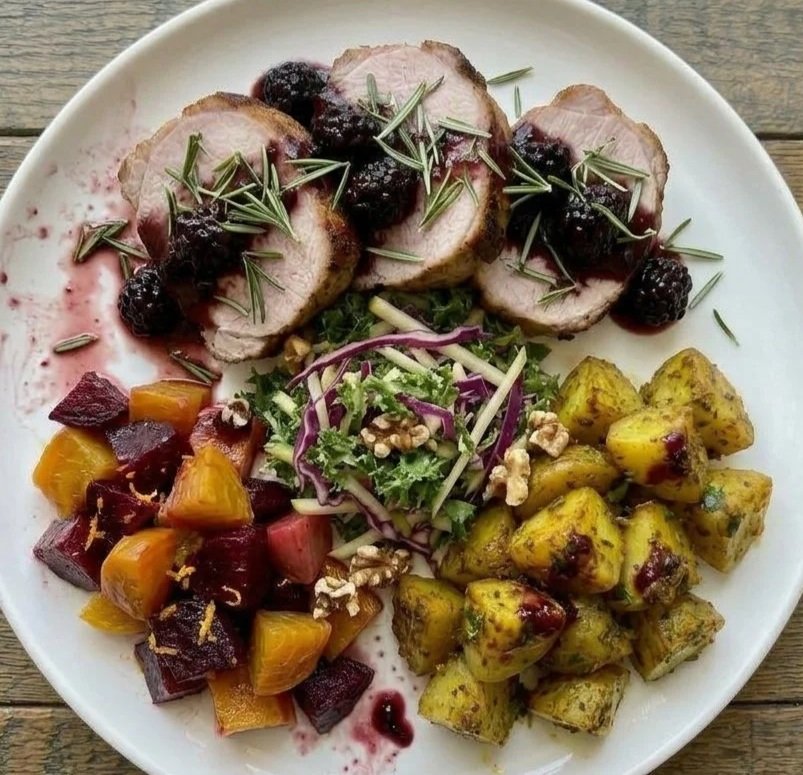
A juicy herb-crusted pork loin with a glossy, jammy blackberry pan sauce, warm turmeric-and-cumin roasted potatoes, jewel-toned citrus beets, and a crunchy kale and apple slaw to keep it all fresh and bright. A cozy feast for a Sunday supper or dinner party.
Yield: 6 servings · Active: 1 hr · Total: 2 hr (plus 2-24 hours to dry brine the pork; the beets can roast a day ahead) · Best in North America from autumn into winter, when beets, kale, apples, and storage potatoes are at their peak (blackberries peak in summer, so use frozen off-season) · Best eaten: Sunday supper or dinner party
Complete Menu
Pork Loin with Blackberry Sauce
Indian-Spiced Potatoes
Citrus Beets
Crunchy Kale and Apple Slaw
Your Game Plan
Everything roasts at 400°F, so the whole feast shares one oven.
The day before (or at least 2 hours ahead): Dry brine the pork. Roast the beets, too, if you like.
About 2 hr out (if roasting the beets today): Roast the beets.
About 1 hr 30 min out: Pull the pork from the fridge and heat the oven to 400°F.
About 1 hr 15 min out: Sear the pork and slide it into the oven.
About 1 hr out: The potatoes go in on the second rack.
About 30 min out: Make the citrus dressing and toss the beets. Make the kale slaw.
When the pork comes out: Rest it 10-15 minutes while you make the blackberry sauce in the same skillet.
Slice and plate.
Recipe 1 — Pork Loin with Blackberry Sauce
Yield: 6 servings · Active: 25 min · Total: 1 hr 15 min (plus 2-24 hours to dry brine)
Ingredients
Pork loin
3 lb pasture-raised boneless pork loin roast
1½ tsp Baja Gold sea salt, divided
3 tbsp extra virgin olive oil
4 garlic cloves, minced
2 tbsp fresh rosemary, finely chopped
2 tbsp fresh thyme leaves
1 tbsp Dijon mustard
1 tsp freshly cracked black pepper
Zest of 1 lemon
2 tbsp grass-fed butter (for basting)
Blackberry pan sauce
2 cups fresh or frozen blackberries
1 shallot, finely minced
3 tbsp grass-fed butter, divided
1½ cups beef or chicken bone broth
3 tbsp raw apple cider vinegar
3 tbsp honey
2 sprigs fresh thyme
1 sprig fresh rosemary
1 tsp Dijon mustard
Pinch of ground allspice (optional, adds warmth)
½ tsp Baja Gold sea salt
¼ tsp freshly cracked black pepper
Optional: 1 tsp arrowroot powder dissolved in 1 tbsp cold water, for a thicker sauce
To finish
Fresh thyme sprigs
Extra fresh blackberries
Flaky sea salt
Method
Dry brine (2-24 hours ahead). Pat the pork dry, rub it with 1 tsp of the salt, and refrigerate uncovered on a rack.
Take the chill off. Pull the pork from the fridge 45 minutes before cooking, and heat the oven to 400°F.
Rub. Stir together the olive oil, garlic, rosemary, thyme, Dijon, the remaining ½ tsp salt, pepper, and lemon zest, and rub it all over the pork.
Sear. Heat a large cast iron skillet over medium-high heat. Sear the pork 3-4 minutes per side, until golden all over.
Roast. Slide the skillet into the oven and roast 35-45 minutes, until the center reads 140°F. Dot the top with butter for the last 5 minutes. The temperature will climb to a juicy, blush-pink 145°F as it rests.
Rest. Move the pork to a cutting board, tent it loosely with parchment, and rest 10-15 minutes. Don't skip this; it keeps the juices in the meat.
Start the sauce. In the same skillet, with the pork drippings, melt 1 tbsp butter over medium heat. Cook the shallot 3-4 minutes until soft.
Simmer. Add the blackberries, broth, vinegar, honey, thyme, rosemary, Dijon, optional allspice, salt, and pepper. Simmer 12-15 minutes, mashing some of the berries, until reduced by half and glossy.
Thicken (optional). For a thicker sauce, whisk in the arrowroot slurry and simmer 2 minutes more.
Strain (optional). For a silky sauce, press it through a fine-mesh strainer, or leave it rustic with whole berries.
Finish. Off the heat, whisk in the remaining 2 tbsp butter and remove the herb stems. Taste and adjust.
Slice and plate. Slice the pork against the grain into ½-inch slices, fan them on warm plates, and spoon the sauce over and around. Finish with thyme, fresh blackberries, and flaky salt.
A note on pork and fruit: Pork and dark fruit is a classic pairing across French cooking (think pork with prunes from the Loire Valley). The fruit's tang cuts through the richness of the pork, and the pork's savory fat balances the fruit.
Recipe 2 — Indian-Spiced Potatoes
Yield: 6 servings · Active: 15 min · Total: 50 min
Warm, golden roasted potatoes with turmeric, cumin, coriander, cardamom, and ginger, finished with fresh cilantro and lime.
Ingredients
2½ lb Yukon Gold or baby potatoes, halved (quartered if large)
4 tbsp ghee (or grass-fed butter or extra virgin olive oil)
1 tbsp ground turmeric
1 tbsp ground cumin (or whole seeds, toasted and ground fresh)
1½ tsp ground coriander (or whole seeds, toasted and ground fresh)
1 tsp ground cardamom
1 tsp fresh ginger, finely grated
4 garlic cloves, thinly sliced
1 tsp Baja Gold sea salt
½ tsp freshly cracked black pepper (it helps your body absorb the turmeric)
Pinch of cayenne (optional)
¼ cup fresh cilantro, chopped
2 tbsp fresh mint, chopped (optional)
Fresh lime juice
Flaky sea salt
Method
Preheat the oven to 400°F and line a large sheet pan with parchment.
Toast the whole spices (optional). If using whole seeds, toast the cumin and coriander in a dry skillet 60-90 seconds until fragrant, then grind.
Bloom the spices. Melt the ghee in a small saucepan over low heat. Add the turmeric, cumin, coriander, cardamom, and ginger and warm 60-90 seconds until deeply fragrant. Blooming spices in fat releases their aromatic oils, so they coat every potato with flavor.
Toss the potatoes with the spiced ghee, salt, pepper, and optional cayenne.
Roast cut-side down in a single layer for 20 minutes.
Add the garlic. Flip the potatoes, scatter the garlic over them, and roast another 15-20 minutes, until golden and crisp. Adding the garlic now keeps it from burning.
Finish with cilantro, optional mint, a squeeze of lime, and flaky salt.
Recipe 3 — Citrus Beets
Yield: 6 servings · Active: 15 min · Total: 1 hr (including roasting; the beets can roast a day ahead)
Roasted beets in a bright orange-lemon dressing with fresh thyme. Jewel-toned and beautiful on the table.
Ingredients
2 lb medium beets (red, golden, Chioggia, or a mix), scrubbed
½ tsp Baja Gold sea salt
¼ tsp freshly cracked black pepper
Citrus dressing
⅓ cup fresh orange juice (from 1-2 oranges)
Zest of 1 orange (blood orange, Cara Cara, or Valencia)
3 tbsp fresh lemon juice
Zest of 1 lemon
¼ cup extra virgin olive oil
1 tbsp raw apple cider vinegar
1 tbsp raw honey
1 tbsp Dijon mustard (optional)
2 tbsp fresh thyme leaves
½ tsp Baja Gold sea salt
¼ tsp freshly cracked black pepper
To finish
3 tbsp fresh flat-leaf parsley, chopped
2 tbsp fresh chives, thinly sliced
Optional: 2 oz crumbled goat chèvre or sheep's milk feta
Optional: ¼ cup toasted pistachios or walnuts, roughly chopped
Optional: fresh orange segments
Flaky sea salt
Method
Roast. Wrap each beet in parchment (red beets separately, so they don't stain the others) and roast at 400°F for 45-60 minutes, until a knife slides in easily.
Peel and cut. Let them cool 10-15 minutes, rub off the skins with a towel, and cut into ¾-inch wedges or ½-inch dice.
Make the dressing. Shake all the dressing ingredients together in a small jar.
Dress. Season the beets with the salt and pepper, pour the dressing over, and toss gently. Let them sit 15-20 minutes so the flavors soak in.
Finish with parsley, chives, and the optional cheese, nuts, and orange segments, plus a pinch of flaky salt.
A note on beet varieties: Red beets bring the classic deep color (and stain everything they touch). Golden beets are milder and won't stain. Chioggia beets reveal candy-cane stripes when sliced. A mix of all three makes the prettiest plate.
Recipe 4 — Crunchy Kale and Apple Slaw
Yield: 6 servings · Active: 15 min · Total: 25 min
A fresh, crunchy counterpoint to the rich pork and roasted sides. Apples and pork are a classic match.
Ingredients
1 bunch lacinato kale, stems removed, leaves sliced into thin ribbons
2 cups purple cabbage, thinly sliced
1 carrot, julienned or coarsely grated
1 crisp apple (Honeycrisp or Pink Lady), cut into matchsticks
¼ cup toasted pepitas or sunflower seeds
2 tbsp fresh parsley, chopped
Dressing
3 tbsp extra virgin olive oil
2 tbsp raw apple cider vinegar
1 tbsp fresh lemon juice
1 tsp Dijon mustard
1 tsp raw honey
½ tsp Baja Gold sea salt
¼ tsp freshly cracked black pepper
Method
Massage the kale. Put the kale ribbons in a large bowl with a pinch of salt and a squeeze of the lemon, and massage with your hands for 1-2 minutes, until the leaves darken and soften.
Make the dressing. Shake all the dressing ingredients together in a jar.
Toss. Add the cabbage, carrot, apple, and parsley to the kale, pour the dressing over, and toss well.
Rest 10 minutes, then scatter with the toasted seeds just before serving so they stay crunchy.
Plating the Feast
Fan the sliced pork across a warm platter and spoon the blackberry sauce over the top, finishing with fresh berries and thyme. Pile the golden potatoes in one bowl, the jewel-toned citrus beets in another, and the kale slaw in a third. Set out lime and lemon wedges, extra herbs, and flaky salt.
Sourcing (essential picks)
Pork loin — pasture-raised, ideally from a heritage breed (like Berkshire or Red Wattle), from a local farm raising pigs on pasture, or White Oak Pastures
Blackberries — organic; fresh in summer, or frozen organic year-round
Bone broth — homemade from pasture-raised bones, or Bonafide Provisions (organic, sold frozen)
Potatoes — organic Yukon Gold or baby potatoes, firm, with no green spots
Beets — organic red, golden, or Chioggia, with fresh greens attached
Oranges — organic; North American citrus (California and Florida) is at its best in winter and early spring
Kale, purple cabbage, carrots, apples, and shallots — organic, from a farmers' market
Spices (turmeric, cumin, coriander, cardamom, allspice, cayenne) — organic and non-irradiated. Burlap & Barrel and Diaspora Co. source single-origin spices directly from small farms
Ginger and garlic — organic
Fresh herbs (rosemary, thyme, cilantro, mint, parsley, chives) — organic
Lemons and limes — organic (you're using the zest)
Ghee — Ancient Organics, or homemade from organic grass-fed butter
Grass-fed butter — organic, cultured butter from 100% grass-fed cows, or raw butter from a local dairy
Dijon mustard — Edmond Fallot, stone-ground in Burgundy by a family mill since 1840, with no sugar (it also makes an organic line)
Raw apple cider vinegar — organic, with the mother (Bragg)
Honey — organic, local, and unfiltered (in the blackberry sauce it's simmered, so any good local honey works)
Arrowroot (optional) — organic
Goat chèvre or sheep's milk feta (optional) — organic when you can find it; a farmstead chèvre from a local goat dairy, or Greek Feta PDO such as Dodoni or Mt. Vikos
Pistachios, walnuts, pepitas, and sunflower seeds — organic, raw or sprouted
Extra virgin olive oil — organic, single-estate, harvest-dated within the past year, in dark glass
Baja Gold sea salt for cooking; fleur de sel de Guérande or Maldon for finishing
Storage
Cooked pork loin: Refrigerated up to 4 days
Blackberry sauce: Refrigerated up to 5 days
Indian-spiced potatoes: Refrigerated up to 4 days. Reheat at 400°F for 5-6 minutes to recrisp
Citrus beets (dressed): Refrigerated up to 4 days. They're even better after a day
Roasted beets (undressed): Refrigerated up to 5 days
Citrus dressing: Refrigerated up to 1 week
Kale slaw: Refrigerated up to 3 days (add the seeds just before serving)
Leftover transformations: Slice cold pork over greens with a drizzle of blackberry sauce as dressing; fold leftover potatoes into pastured eggs for a breakfast hash; toss leftover citrus beets over greens with goat cheese for a light lunch; pile pork, slaw, and beets into lettuce cups for a quick lunch.
Nourishment Notes
Pasture-raised pork — thiamine (pork is one of the best food sources of B1), B6, B12, zinc, selenium, and complete protein. Pigs raised outdoors in the sun also store more vitamin D in their fat.
Blackberries — anthocyanins (the source of their deep purple color), vitamin C, ellagic acid, vitamin K, manganese, and fiber.
Potatoes — potassium, vitamin C, and B6. Cooled and reheated potatoes form resistant starch, which feeds your gut bacteria.
Turmeric — curcumin. Blooming it in ghee and pairing it with black pepper both help your body absorb it.
Cumin, coriander, and cardamom — cuminaldehyde, linalool, and cineole, all traditionally used to support digestion. Cardamom is especially welcome for luteal-phase bloating.
Ginger — gingerols and shogaols, well studied for calming inflammation and easing menstrual cramps.
Beets — betalains (betacyanins in red, betaxanthins in golden), nitrates that support healthy blood flow, folate, potassium, and manganese. Beets have long been valued as a blood-building food.
Oranges and lemons — vitamin C, hesperidin, folate, and d-limonene.
Kale and purple cabbage — vitamin K, vitamin C, and anthocyanins (in the cabbage). Eaten raw, they keep their myrosinase enzyme, so sulforaphane forms as you chew.
Apples — pectin and quercetin, concentrated in the skin.
Pepitas and sunflower seeds — zinc, magnesium, and vitamin E.
Bone broth — gelatin, glycine, and minerals.
Ghee and grass-fed butter — CLA, K2, butyrate, and beta-carotene.
Raw apple cider vinegar — acetic acid for blood-sugar balance.
Dijon mustard — glucosinolates (sinigrin converts to isothiocyanates supporting Phase 2 detoxification).
Extra virgin olive oil — oleic acid and polyphenols, which help you absorb the meal's fat-soluble nutrients.
Baja Gold sea salt — over 90 trace minerals.
— Anna aka Food Marshall