Raw Caramel Apple Rose Tart
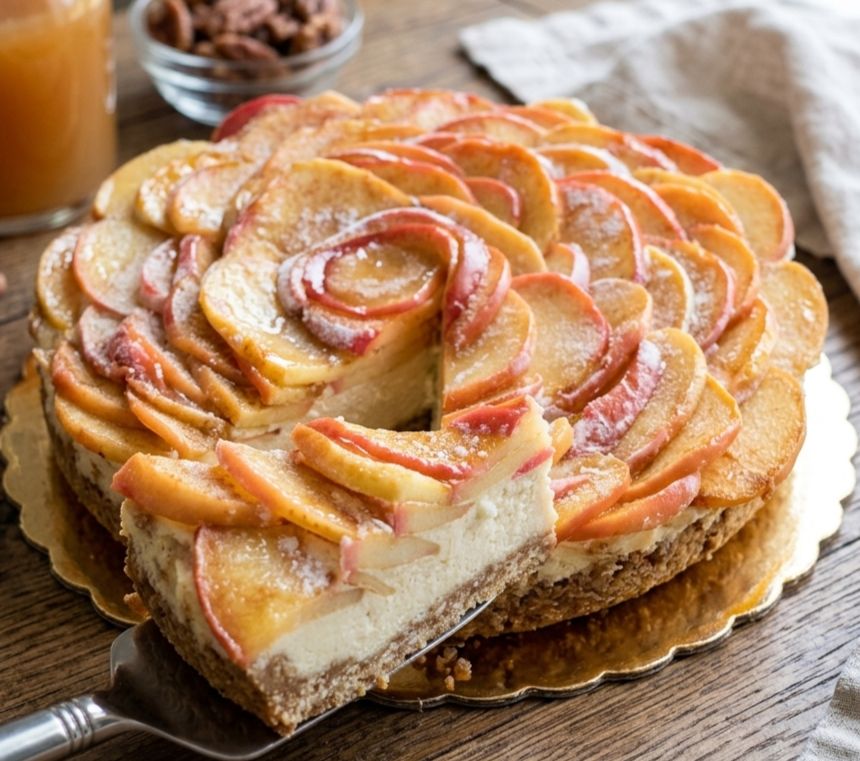
The autumn dinner-party showpiece — a pecan-coconut crust, vanilla cashew cream filling, and a hand-arranged apple rose top with warm caramel drizzle. Raw, refined-sugar-free, dairy-free, and visually stunning.
Season: Autumn · early winter
Cuisine: Raw · Plant-based · Refined-sugar-free · Grain-free · Dairy-free
Yield: One 9-inch round tart (serves 10–12)
Active: 60 min (includes apple rose arrangement)
Total: 4 hours, including setting time
Best eaten: Afternoon, slightly thawed
The apple rose tart is the dessert that stops conversation when it arrives at the table. The thinly sliced apples — slightly softened in spiced lemon water, then arranged in concentric circles to form a rose pattern across the top — produce the kind of visual that turns a Sunday dessert into a moment. Underneath the rose: a creamy vanilla-cashew cheesecake filling layered with caramel, sitting on a pecan-almond-coconut crust. Drizzled with a homemade caramel sauce, finished with a light dusting of cinnamon.
This is the tart for a dinner party, an autumn anniversary, a Thanksgiving dessert table that wants something beyond pumpkin pie, or any occasion that asks for a dessert that looks like art. The apple-rose technique takes 20 extra minutes — and it is worth every one.
The tart is raw, plant-based, refined-sugar-free, grain-free, and dairy-free. It is also one of the most quietly luxurious things a kitchen can produce.
Ingredients
For the crust:
1 cup raw almonds
1 cup raw pecans
1 cup unsweetened coconut shreds
1 cup (about 8) Medjool dates, pitted
2 tbsp coconut sugar
2 tbsp coconut oil, melted
Pinch sea salt
For the cashew vanilla cream filling:
1½ cups raw cashews, soaked 4-6 hours and rinsed
1 cup full-fat coconut cream (or 1 cup coconut yogurt)
½ cup pure maple syrup
4 Medjool dates, pitted (or 2 tbsp additional maple syrup)
½ apple, peeled and chopped (optional, can reserve only for the apple-rose top and leave filling purely vanilla cream flavor)
2 tbsp fresh lemon juice
¼ cup coconut oil, melted
1 tsp pure vanilla extract (or seeds from ½ vanilla bean)
Pinch sea salt
Pinch Ceylon cinnamon
Pinch ground ginger
For the apple rose top:
3 medium apples (Pink Lady, Honeycrisp, or a mix), quartered, cored, and very thinly sliced (use a mandoline)
Juice of 1 lemon
4 cups cold water (for the lemon water bath)
1½ tsp ground Ceylon cinnamon
½ tsp freshly grated nutmeg
½ tsp ground ginger
¼ cup coconut sugar (for the spice toss)
For the caramel sauce:
¾ cup almond butter (or sunflower seed butter for nut-free)
¼ cup pure maple syrup
¼ cup coconut sugar
⅓ cup coconut oil, melted
2-3 tbsp lucuma powder (optional, deepens caramel notes)
¼ cup filtered water (more as needed for consistency)
Pinch sea salt
Optional: a dash of vanilla extract
To finish:
A drizzle of warm caramel sauce
A light dusting of Ceylon cinnamon
Optional: a pinch of flaky sea salt
Optional: small handful of crushed pecans for textural contrast
A note on substitutions:
For nut-free: Replace almonds and pecans in the crust with an equal amount of sunflower seeds and additional coconut. Replace cashews with sunflower seeds (soaked) and almond butter with sunflower seed butter. Texture will be slightly different but works.
For coconut sugar: Can be replaced with an equal amount of additional Medjool dates blended into a paste, or pure maple syrup (reduce other liquid slightly).
For lucuma powder: Optional but recommended — adds caramel depth without additional sugar. If skipping, the caramel still works; just slightly simpler in flavor.
Method
1. Soak the cashews.
Place 1½ cups cashews in a bowl, cover with filtered water, and soak 4–8 hours (or overnight in the refrigerator). Drain and rinse before using.
2. Make the crust.
Line a 9-inch round tart pan with a removable bottom (or a 9-inch springform pan) with parchment paper.
In a food processor, pulse the almonds, pecans, and coconut shreds until you have a coarse crumb texture — keep some larger pieces for textural variation. Add the dates, coconut sugar, coconut oil, and salt. Process until the mixture sticks together when pressed between your fingers.
Press the crust evenly into the bottom and up the sides of the tart pan, compacting firmly. Place in the freezer while you make the filling.
3. Make the cashew vanilla cream.
In a high-speed blender, combine the soaked and rinsed cashews, coconut cream (or yogurt), maple syrup, dates, chopped apple, lemon juice, vanilla, salt, cinnamon, and ginger. Blend on high until completely smooth and silky — at least 2–3 minutes, scraping down the sides as needed.
Add the melted coconut oil and blend another 30 seconds until fully incorporated.
4. Pour the filling.
Pour the cashew cream into the chilled crust and smooth into an even layer with an offset spatula. Tap the pan gently against the counter to release any air pockets. Return to the freezer for at least 2 hours (or refrigerate for 4 hours) to set fully.
5. Prepare the apple roses.
While the filling sets, prepare the apples. Quarter and core 3 apples. Using a mandoline, slice each quarter very thinly — about 1–2mm. Immediately drop the slices into a large bowl of cold water with the juice of 1 lemon to prevent browning.
6. Soften and spice the apple slices.
In a small bowl, mix the cinnamon, nutmeg, ginger, and coconut sugar.
Drain the apple slices and pat lightly dry with a clean kitchen towel. Toss gently in the spice-sugar mixture until each slice is lightly coated.
Spread the spiced slices in a single layer on a parchment-lined baking sheet. Bake at 350°F for 5–7 minutes, just until pliable enough to roll without breaking. They should still hold their shape but bend without snapping. Remove and cool 5 minutes.
(Alternative cold method: soak the apple slices in warm water for 10 minutes until pliable. The baked method gives better flavor; the cold method keeps the tart fully raw.)
7. Arrange the apple rose top.
Remove the set tart from the freezer. The cashew filling should be firm enough to support the apple slices without sinking.
Take 5–6 apple slices and arrange them slightly overlapping in a row, like a fanned line of dominoes. Starting from one end, roll them up tightly into a spiral. This is your center rose. Stand the spiral upright in the center of the tart, pressing down slightly into the cashew cream to anchor.
Continue arranging individual apple slices in concentric circles around the center spiral, slightly overlapping each previous slice and angling the slices outward to create the rose pattern. Build the pattern outward to the edge of the tart, layering and adjusting until the entire surface is covered.
The arrangement should look like a single large rose viewed from above — the center tightly furled, the outer petals fanning open. Don't worry about perfection; the natural variation in apple slice shape and size is what makes it beautiful.
8. Make the caramel sauce.
In a high-speed blender or food processor, combine the almond butter, maple syrup, coconut sugar, melted coconut oil, lucuma powder (if using), water, salt, and optional vanilla. Blend until completely smooth. Adjust water by 1 tbsp at a time until you reach your desired drizzling consistency — thick enough to coat a spoon, thin enough to drizzle.
Reserve about ⅓ cup of the caramel in a small dish for serving. The rest will be drizzled over the apple roses.
9. Glaze and finish.
Drizzle the caramel sauce gently over the apple rose top — just enough to glaze the petals and create a glossy finish without obscuring the rose pattern. Use a small spoon or a piping bag with a small opening for control.
Dust lightly with Ceylon cinnamon. Add an optional pinch of flaky sea salt for the salted-caramel finish, and a few crushed pecans around the edge for textural contrast.
10. Serve.
Return to the refrigerator until ready to serve. Let sit at room temperature 15–20 minutes before slicing — the filling is at its best when slightly soft but still cool.
Slice with a sharp knife dipped in hot water, wiping between cuts. Serve with a small dish of the reserved caramel on the side for guests to spoon over individual slices.
Nourishment Notes
The apple rose tart is a deeply nourishing dessert built entirely from whole-food ingredients. The cashews provide complete plant protein, magnesium, copper, and zinc. Almonds and pecans contribute vitamin E, manganese, and beneficial monounsaturated fats. Coconut cream and coconut oil bring medium-chain triglycerides (MCTs) and lauric acid — fats the body uses efficiently for energy without spiking insulin. Dates carry potassium, magnesium, and a complete spectrum of polyphenols that survive the no-cook preparation completely intact.
The apples are the star, and the choice of variety matters. Peak-season, heritage-variety apples (Pink Lady, Honeycrisp, Northern Spy, Macoun, Cortland) deliver pectin (a soluble fiber that supports gut microbiome and binds heavy metals), quercetin, and the catechin-epicatechin polyphenol complex concentrated in apple skins — roughly 5× the polyphenol density of the flesh alone. Eating peak-season apples within a few weeks of harvest delivers dramatically more polyphenol load than long-storage cold-room apples in March. The thin-sliced rose presentation specifically keeps the skins on, preserving the highest-density nutrient layer.
The autumn spice palette does more than flavor. Cinnamon (Ceylon variety) contributes chromium and proanthocyanidins that actively support post-meal blood sugar regulation — particularly useful in a dessert with multiple natural sugar sources. Nutmeg adds aromatic compounds traditionally used in autumn baking for digestive support; ginger contributes warming and digestive-supportive compounds. Together they form a classic carminative trio supporting the digestion of the rich, fruit-and-fat-dense filling.
Lucuma powder is the unsung hero of raw caramel work. Lucuma — from a South American fruit traditionally called "the gold of the Incas" — adds maple-caramel depth without any glycemic impact, alongside meaningful contributions of beta-carotene, iron, niacin, and zinc. Traditional Indigenous American cultures have used it for centuries as a nutritive sweetener. In raw desserts, it elevates the caramel from "sweetened" to "deeply complex."
The fat-and-protein structure of this tart prevents the spike-and-crash pattern of conventional desserts. Cashews, almond butter, and coconut deliver substantial fat alongside the natural sugars from dates, maple, and apples; the result is a glycemic curve that stays gentle and a satiety profile that means a small slice genuinely satisfies. Compared to a conventional apple tart with a butter-flour crust, refined sugar filling, and dairy-cream topping, this version delivers roughly half the sugar load, zero refined ingredients, and a dramatically richer micronutrient profile.
Sourcing
Apples: Local orchard or farmers' market during peak harvest (mid-September through late October). For the rose presentation, look for medium-sized apples with smooth, unblemished skin — Pink Lady is ideal because the skin is thin and uniform. Honeycrisp or a Pink Lady-Honeycrisp mix also work beautifully. Heritage varieties (Northern Spy, Macoun, Cortland) are exceptional in flavor but the skin can be thicker — fine for the cheesecake, slightly trickier for the rose top.
Raw cashews: Big Tree Farms organic, Anthony's Goods raw organic, or Terrasoul Superfoods. Look for whole, unbroken cashews. Raw only — not roasted or salted.
Almonds and pecans: Raw, organic, soaked or sprouted if possible. One Degree Organic Foods sprouted almonds are exceptional. U.S. Wellness Meats for Texas regenerative pecans. Raw only.
Coconut cream / coconut yogurt: Native Forest Organic Simple for cans, COYO or Cocojune for high-quality coconut yogurt. Avoid lite coconut milk and brands with guar gum or carrageenan.
Coconut oil: Nutiva organic virgin coconut oil, Dr. Bronner's fair-trade organic, or Garden of Life raw extra-virgin. Cold-pressed, unrefined.
Coconut shreds: Let's Do Organic unsweetened coconut, Big Tree Farms organic, or Anthony's Goods organic. Unsweetened only.
Coconut sugar: Big Tree Farms, Madhava, or Wholesome organic coconut sugar.
Medjool dates: Joolies (organic California Medjool), Natural Delights, or local farmers' market sources.
Almond butter / sunflower seed butter: Big Spoon Roasters organic almond butter is exceptional (single-ingredient, sprouted), or Once Again organic. SunButter for sunflower seed butter (no added sugars or oils version).
Maple syrup: Grade A dark or amber from a Northeastern producer — Crown Maple, Sap! Maple, Coombs Family Farms, or local farmers' market sources.
Lucuma powder: Navitas Organics, Sunfood Superfoods, or Terrasoul Superfoods. Look for raw, unprocessed Peruvian lucuma.
Ceylon cinnamon: Burlap & Barrel Royal Cinnamon, Frontier Co-op Ceylon, or Diaspora Co. Pragati. The "true" cinnamon — softer, sweeter, lower in coumarin.
Whole nutmeg and ginger: Burlap & Barrel or Diaspora Co. for whole spices. Freshly grated nutmeg is dramatically more flavorful than pre-ground.
Vanilla: Heilala Vanilla, Singing Dog Vanilla, or Nielsen-Massey for pure Madagascar or Tahitian vanilla. Whole vanilla beans from Heilala or Beanilla for the highest impact.
Storage
Refrigerated up to 4 days, lightly covered with parchment to allow air circulation (a tight cover will trap moisture and soften the apple roses). The apple rose top is at its visual peak within 24 hours of assembly — slightly less photogenic on day 3 but still delicious.
The cheesecake base (without the apple rose top) freezes well up to 1 month. To freeze for later assembly, complete through step 4, freeze tightly wrapped, then thaw 4 hours in the refrigerator before adding the apple rose top fresh.
Caramel sauce keeps separately in a sealed jar in the refrigerator for up to 2 weeks. Re-warm gently in a hot water bath before drizzling.
Pairs Well With
For the table: A pot of fresh-brewed loose-leaf tea — Earl Grey, Lapsang Souchong, or chai with cardamom and cinnamon — for afternoon presentation. For adults, a small pour of apple brandy (Calvados or American craft applejack), Tawny Port, or a late-harvest dessert wine like Sauternes is transcendent. For a non-alcoholic option, hot apple cider with cinnamon stick, clove, and orange peel.
For the gathering: A board of additional fresh-cut apples, pecans, and figs alongside the tart for an autumn dessert table. An additional small dish of warm caramel sauce in the center for guests to spoon over their slice. A sprinkle of pomegranate seeds across the platter for visual contrast and brightness.
For the meal context: This is the dinner-party finale. Pair with a roast chicken with herbs, a slow-braised short rib, a cassoulet, or any autumn dinner that asks for an elegant close. The visual drama of the apple rose makes this the dessert that gets photographed before it gets eaten.
Why This Tart
The conventional bakery tart is built on industrial flour, refined sugar, hydrogenated shortening, and apples that have been in cold storage for months. The apple rose, when it appears at all, is a decorative gesture sitting on top of a structurally compromised base.
This tart is rebuilds the format around real ingredients. Soaked cashews and coconut cream instead of conventional dairy. Pecans and almonds instead of refined flour. Dates and maple syrup instead of refined sugar. Real apples — peak-season, heritage variety — sliced fresh on the day of assembly, arranged by hand into a rose that no factory could replicate.
The apple rose is the visual signature of a tart that earns its place at the center of the autumn dessert table. The 20 extra minutes of arrangement is the moment where the kitchen becomes art — where a dessert stops being food and becomes a transmission of care.
Make this when the apples are at their peak, when the orchards are full, when the people you love are gathered around a table that asks for something that says I made this for you. The autumn harvest window is short.