Jicama-Wrapped Beef Tacos with Tropical Salsa, Crema & Guacamole
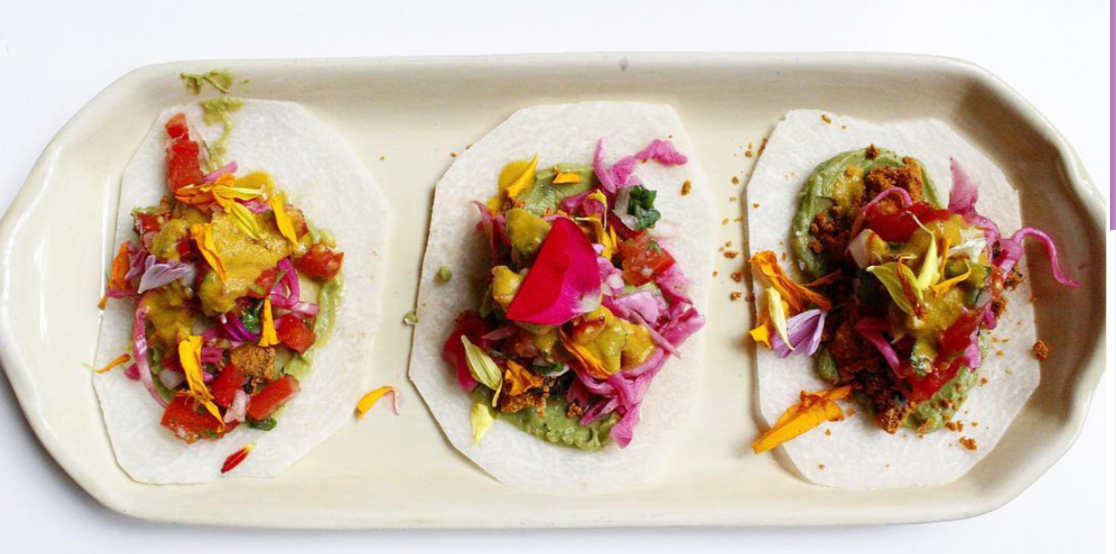
Crisp jicama rounds wrapped around spiced pasture-raised beef, a bright tropical salsa, and three sauce options — raw dairy crema, sour cream, or cashew cream — finished with fresh guacamole and edible flowers. The taco rebuilt with whole foods, ancestral protein, and the brightness of the tropics.
Yield: 12–15 tacos · Active: 30 min · Total: 45 min · Year-round (peak summer in temperate climates; year-round in subtropical) · Cuisine: Modern Mexican-Yucatecan, Tropical · Lunch or early dinner
A note from the kitchen
The conventional taco has become one of the most over-engineered foods in modern American cooking — refined corn or wheat tortillas, factory-farmed ground beef, processed cheese, sour cream stabilized with gums, salsa from a jar with sugar and preservatives. The format itself is genuinely beautiful, but the ingredient industry has hollowed out what was once one of Mexico's most nourishing peasant foods.
In this recipe, crisp jicama rounds replace the tortilla — adding crunch, hydration, and a clean sweet vegetal flavor that sets off the spices in the beef beautifully. Pasture-raised ground beef seasoned with cumin, coriander, chili powder, and lime — the way an ancestral Mexican kitchen actually built flavor before industrial spice blends. A bright tropical salsa with mango, coconut, heirloom tomatoes, and avocado that brings brightness. Three sauce options: raw dairy crema (the most traditional), sour cream (the everyday option), or cashew cream (the dairy-free version). Plus, of course— fresh guacamole.
This is the kind of meal that is great for guests since they can build their own tacos. It's also one of the most accessible ways to introduce someone to ancestral-omnivore eating: real meat, real fat, real spices, real vegetables, no refined flour, no industrial dairy, no compromise on flavor.
— Anna aka Food Marshall
Ingredients
For the jicama tortillas:
1 large jicama (about 2 lbs), peeled Juice of 2 limes ½ tsp sea salt ½ tsp chili powder (optional, for marinated tortillas)
For the spiced beef filling:
1 lb pasture-raised ground beef (85/15 or 80/20 — the fat matters; avoid lean ground beef for this) 1 tbsp grass-fed butter or extra-virgin olive oil (for searing) 1 small yellow onion, finely diced 3 cloves garlic, finely minced 1 small jalapeño, finely minced (deseeded for less heat) 1 tbsp ground cumin 1 tbsp ground coriander 1 tbsp chili powder (ancho or mild) 1 tsp smoked paprika (optional, adds depth) ½ tsp dried oregano (Mexican oregano if you can find it) 1 tsp sea salt ½ tsp freshly cracked black pepper 2 sun-dried tomatoes, finely chopped (or 1 tbsp tomato paste) Juice of 1 lime 2 tbsp fresh cilantro, finely chopped (stirred in at the end)
For the tropical salsa:
1 cup fresh young coconut meat, sliced into thin strips (or substitute additional mango if unavailable) 2 large heirloom tomatoes, diced ½ cup purple cabbage, finely shredded 1 small red onion, diced (or pickled — see variations) 1 large ripe avocado, cut into chunks 1 ripe mango, cut into chunks 1 tsp ground cumin 1 tsp ground coriander Juice of 1 lime Pinch sea salt
For the guacamole:
2 ripe avocados ⅓ cup fresh cilantro, finely chopped 1 jalapeño, finely minced (deseeded for less heat) ¼ cup red onion, finely diced Juice of 1 lemon Juice of 1 lime Pinch sea salt
For the crema (choose one of three options):
Option 1 — Raw dairy crema (the ancestral Mexican version)
1 cup raw heavy cream from grass-fed cows 1 tbsp fresh lemon or lime juice 1 small clove garlic, grated (optional) ¼ tsp sea salt Pinch freshly cracked black pepper
Option 2 — Sour cream (the everyday version)
1 cup full-fat sour cream (look for cultured, grass-fed sources — Kalona Organic, Maple Hill Creamery, Wallaby Organic, or local creamery) 1 tbsp fresh lemon or lime juice (optional, adds brightness) 1 small clove garlic, grated (optional) ¼ tsp sea salt 2 tbsp filtered water (optional, to thin to drizzle consistency)
Option 3 — Cashew cream (the dairy-free version)
1 cup raw cashews, soaked at least 2 hours and drained 1 cup filtered water Juice of 1 lemon 1 garlic clove 1 tsp onion powder Pinch sea salt
For garnish:
Edible flowers (rose petals, calendula, nasturtium, marigold) Fresh cilantro Lime wedges Toasted pepitas (optional, for crunch) Flaky sea salt
Method
Make the jicama tortillas. Slice the peeled jicama into thin rounds (about ¼-inch thick) using a mandoline or sharp knife. Squeeze lime juice over each round to prevent browning and add brightness. For an authentic taquería flavor, sprinkle the rounds lightly with sea salt and chili powder, and let them sit 10 minutes before serving — they'll absorb the seasoning and develop the sauce-soaked quality of a real soft taco shell.
Make the spiced beef filling. Heat the butter or olive oil in a wide skillet over medium-high heat. Add the ground beef in a single layer and let it brown undisturbed for 2–3 minutes, then break it apart with a wooden spoon and continue cooking until evenly browned, about 5–6 minutes total. Don't drain the fat — it carries the flavor and the fat-soluble vitamins.
Add the diced onion to the beef and cook 3–4 minutes until translucent. Add the minced garlic and jalapeño and cook 30 seconds more, until fragrant.
Sprinkle the cumin, coriander, chili powder, smoked paprika, oregano, salt, and pepper over the beef. Stir to coat evenly and toast the spices for 30–60 seconds — you'll smell them bloom.
Stir in the chopped sun-dried tomatoes (or tomato paste) and the lime juice. Cook 1–2 more minutes to integrate the flavors and reduce any liquid.
Remove from heat. Stir in the chopped fresh cilantro. Taste and adjust salt, lime, or chili powder to your preference.
Make the tropical salsa. In a medium bowl, combine the coconut strips, diced heirloom tomatoes, purple cabbage, red onion, avocado chunks, mango chunks, cumin, coriander, lime juice, and salt. Stir gently to combine without breaking up the avocado or mango. Taste and adjust lime and salt to your preference.
Make the guacamole. In a separate bowl, mash the avocados with a fork until well-combined but still chunky. Stir in the cilantro, jalapeño, red onion, lemon juice, lime juice, and salt. Taste and adjust.
Make your crema (choose one):
For the raw dairy crema: Whisk the cream with the lemon (or lime) juice, garlic (if using), salt, and pepper. Let stand at room temperature 4–8 hours to lightly thicken and culture (the citrus acid will gently tang the cream). Refrigerate before serving. The result is a clean, slightly thickened crema with a mild tang — the way Mexican home cooks have made it for generations.
For the sour cream version: Whisk the sour cream with the lemon (or lime) juice (if using), garlic (if using), and salt. Add 1–2 tbsp filtered water if you want a more pourable drizzle consistency. Refrigerate until ready to serve.
For the cashew cream version: Blend the soaked cashews, filtered water, lemon juice, garlic, onion powder, and salt in a high-speed blender until completely smooth, about 2 minutes. Adjust water for desired consistency. Refrigerate until ready to serve.
Serve. Lay the jicama rounds on a serving platter. Provide bowls of the spiced beef, tropical salsa, guacamole, and crema for diners to assemble their own tacos. Garnish each filled tortilla with edible flowers, fresh cilantro, lime wedges, and an optional sprinkle of toasted pepitas and flaky sea salt.
Variations
Yucatecan-style: Add 1 tsp achiote (annatto) paste to the spice mix in the beef filling. Vibrant red-orange color and the traditional Yucatán Peninsula flavor.
Carnitas-style: Substitute pasture-raised ground pork or slow-cooked shredded pork shoulder for the ground beef. The richer pork fat is exceptional with the bright lime and tropical fruit.
Lamb variation: Substitute pasture-raised ground lamb for the beef. Add 1 tsp ground cinnamon and a pinch of allspice — produces a Middle Eastern-meets-Mexican fusion flavor that's genuinely transcendent with the tropical salsa.
Wild fish variation: For a lighter version, substitute the beef with 1 lb wild Alaskan salmon, halibut, or mahi-mahi — pan-seared simply with salt, pepper, and a sprinkle of cumin. Flake into the tacos. Excellent for warm-weather summer eating.
Pickled red onions instead of raw: Quick-pickle thinly sliced red onions in lime juice + apple cider vinegar + pinch of sea salt for 30 minutes. Brighter color, more authentic taquería flavor.
Chipotle-cashew or chipotle-sour-cream variation: Add 1 chipotle pepper in adobo to the chosen crema. Smoky-spicy variation that's structurally Mexican.
Tomatillo salsa verde: Make a quick raw salsa verde — 4 tomatillos + 1 jalapeño + ¼ onion + cilantro + lime + salt blended. Bright green sauce for color contrast on the platter.
Charred corn addition: Add ½ cup fresh sweet corn kernels to the tropical salsa (charred lightly in a dry pan if you want a hint of cooked element). Sweetness and texture variation.
Sourcing
Jicama: Local Latin American grocery (significantly fresher and cheaper than supermarket) or local farmers' market in subtropical regions. Look for jicama that's firm and unblemished, with intact skin.
Pasture-raised ground beef: Local farm whenever possible. White Oak Pastures, U.S. Wellness Meats, Force of Nature, or Crowd Cow for shipped options. Look for 100% grass-fed and grass-finished — the second part matters, as many "grass-fed" cattle are finished on grain. The deeply red color and substantial fat content are the indicators of real pasture-raised beef.
Wild young coconut: Local Asian or Latin American grocery. Look for fresh young Thai coconuts (the white outer ones with the pointy top). The meat should be soft, slightly translucent, and easy to scoop out with a spoon. If unavailable, substitute additional mango.
Heirloom tomatoes: Local farmers' market during peak season (July–September). Heirloom varieties (Brandywine, Cherokee Purple, Sun Gold, Black Krim) carry significantly more flavor than commercial.
Avocados: Local source if possible. Mexican Hass avocados from California, Florida, or Mexico are the standard. Look for slightly soft to the touch (yields gently when pressed).
Mango: Local farmers' market in subtropical regions, or Latin American grocery. In subtropical regions, backyard mango trees are productive perennials worth planting. Look for fragrant, slightly soft fruit. Honey, Ataulfo (Champagne), or Kent varieties are excellent.
Limes and lemons: Local farmers' market or backyard tree (USDA 9+). Avoid waxed conventional limes — the wax interferes with zesting and contains residues. If only conventional are available, scrub thoroughly with a little baking soda and warm water before zesting.
Sun-dried tomatoes: Gustiamo's Sicilian, Bella Sun Luci, or local farmers' market vendor. Look for sun-dried tomatoes packed in olive oil with no added sugar or preservatives.
Spices (cumin, coriander, chili powder, oregano, smoked paprika): Diaspora Co. (single-origin from regenerative farms), Burlap & Barrel (single-origin), or Spicewalla. Pre-ground spices lose their volatile oils within months — buy whole when possible (whole cumin seeds, whole coriander seeds, whole peppercorns) and grind fresh.
Mexican oregano: Diaspora Co. or Burlap & Barrel for the highest quality. Mexican oregano is a different plant from Mediterranean oregano (it's actually in the verbena family) and has a more citrusy, slightly grassy flavor that's distinctively Mexican.
Achiote/annatto paste (for Yucatecan variation): Local Latin American grocery, or Whole Foods. Look for traditional Yucatán-style achiote paste — typically a brick-red paste containing achiote seeds, garlic, vinegar, and citrus.
Heirloom hardneck garlic: Local farmers' market in summer (peak garlic harvest is July). Heirloom hardneck varieties (German Extra-Hardy, Music, Spanish Roja) carry significantly more flavor than commercial.
Fresh cilantro: From a windowsill pot if possible — fresh cilantro is dramatically more flavorful than refrigerated grocery store cilantro. Local farmers' market alternative.
Tomatillos (for the salsa verde variation): Local Latin American grocery or farmers' market. Look for tomatillos with intact husks; gently squeeze to ensure they're firm.
Raw heavy cream: realmilk.com directory for raw dairy producers across the US. Alexandre Family Farm (California, A2/A2 Jersey), Organic Pastures Dairy (California), Hartzler Family Dairy (Ohio), or local raw dairy farm.
Sour cream: Look for cultured, grass-fed sources. Kalona Organic sour cream, Maple Hill Creamery, Wallaby Organic, or local creamery sources. Avoid commercial sour cream with stabilizers, gums, or additives.
Raw cashews: Big Tree Farms organic, Anthony's Goods raw organic, Terrasoul Superfoods, or One Degree Organic Foods.
Grass-fed butter: Vital Farms butter, Organic Valley Pasture Butter, or Kalona Organic. Imported European butters (Beurre d'Isigny, Lurpak Pastor, Kerrygold) are also exceptional.
Extra-virgin olive oil: First cold-pressed from a single estate. Frantoia (Sicilian), Castelvetrano, McEvoy Ranch (California), Brightland for shipped options. Look for harvest date on the bottle (within the last 12 months) and dark glass packaging.
Sea salt: Selina Naturally Celtic Sea Salt or Maldon flake for finishing. Avoid table salt, which is bleached and stripped of its mineral content.
Apple cider vinegar (for pickled onions): Bragg's organic with the mother — non-pasteurized, contains the beneficial bacteria.
Edible flowers: Local farmers' market vendor specifically labeled food-grade, or grown at home. Common safe edible flowers: rose petals, calendula, nasturtium, marigold, pansy, violet, chive blossom. Avoid grocery-store decorative flowers — typically heavily sprayed with pesticides.
Toasted pepitas: Go Raw sprouted pepitas, or toast raw pepitas in a dry skillet over medium heat for 3–4 minutes until golden and fragrant.
Storage
Components store separately for maximum freshness:
The spiced beef filling keeps refrigerated up to 4 days. Reheats beautifully for second-day tacos.
The tropical salsa is best the day made — within 24 hours. The avocado will brown after that.
The guacamole keeps refrigerated 1 day with plastic wrap pressed directly onto the surface to prevent oxidation.
The raw dairy crema keeps refrigerated 5–7 days, and the flavor improves on day 2 as the culture deepens.
The sour cream keeps according to its package date.
The cashew cream keeps refrigerated 5 days.
The jicama tortillas are best within a few hours of slicing — they begin to dry out and lose their crispness after that. Slice fresh just before serving.
Pairs Well With
For the table: A pitcher of fresh-pressed limeade with mint and a tiny pinch of sea salt. Sparkling water with cucumber and lime.
For the gathering: This is one of the best build-your-own meals — set up a taco bar with all the components in separate bowls, let guests assemble their own. A platter of additional tropical fruit (mango, papaya, pineapple, dragon fruit) on the side. A small bowl of toasted pepitas for crunch.
For the meal context: This is a complete meal as written — pasture-raised protein, healthy fats from avocado and coconut, complex carbohydrates from the jicama and tropical fruit, full vitamin and mineral spectrum from the vegetables and herbs. For a more substantial spread, serve alongside a simple bowl of cilantro-lime cauliflower "rice," black beans (if including legumes), or sweet potatoes roasted with cumin and lime. For a brunch or lunch presentation, accompany with fresh fruit and a pitcher of cold-pressed juice.
Why These Tacos
The conventional taco — even the "healthy" version — has been hollowed out by industrial food production. Refined corn or wheat flour tortillas. Factory-farmed ground beef finished on industrial grains. Pre-shredded cheese with cellulose anti-caking agents. Sour cream stabilized with gums and stabilizers. Salsa from a jar with high-fructose corn syrup and preservatives. The format remains beloved, but the ingredients no longer match the format's potential.
This is the same dish, made well. Crisp jicama rounds replace refined tortillas — adding hydration, fiber, and a clean vegetal sweetness. Pasture-raised ground beef replaces industrial protein, with all the K2-rich fat-soluble vitamins, omega-3s, and complete amino acid profile that grass-fed-and-finished cattle provide. Real spices ground fresh from whole seeds. Heirloom tomatoes and tropical fruit at peak season. Three traditional sauce options that all honor real food: raw dairy crema (ancestral), cultured sour cream (everyday), or cashew cream (dairy-free).
What this collection rebuilds is the way Mexican home cooks have actually made tacos for generations — with what was in season, with what came from the local market, with patience and care and good ingredients. No industrial shortcuts. No gum-stabilized sauces. No factory-farmed shortcuts. Just real food, assembled with intention, served at a table where everyone builds their own.
The taco tradition belongs to all of us — we just need to take it back from the industrial supply chain and rebuild it with food that knows what it's doing.