Raw Milk Kefir — A Living Daily Ferment
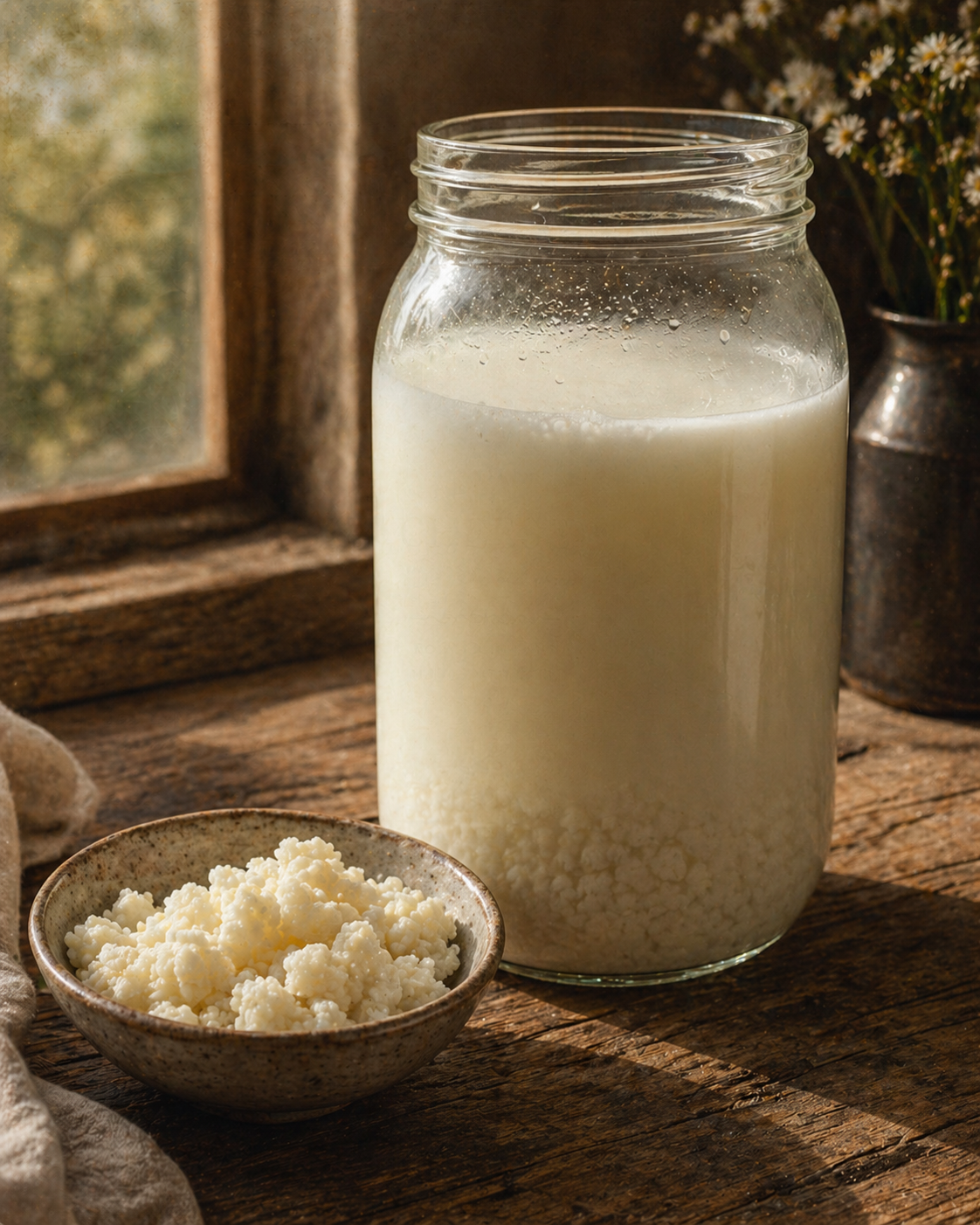
Foundational · Cuisine: Traditional Fermentation · Eastern European/Caucasus origins
Yields about 1 quart per day · 5 min daily active · 12–24 hr fermentation · year-round · daily morning or midday
Why Kefir is Worth Doing
Kefir is structurally one of the most rewarding daily food projects available. Once your grains are established, the ferment becomes a remarkably resilient daily companion — five minutes of attention, a fresh pour of raw milk, and you have a quart of probiotic-rich, mineral-dense, deeply nourishing fermented dairy ready by the next morning. Unlike yogurt cultures that need to be replenished, kefir grains continuously multiply and live indefinitely with proper care.
This isn't a single recipe so much as a foundational practice — once you have kefir grains alive in your kitchen, you have the raw material for kefir cheese, second-fermented soda-like kefir, kefir smoothies, kefir-based dressings and sauces, and the simple bowls of kefir-with-fresh-fruit that anchor breakfast across the Caucasus, Central Asia, and increasingly the modern wellness world.
Sourcing the Grains — The First Critical Step
Milk kefir grains are a living symbiotic culture of bacteria and yeasts (SCOBY). True kefir grains must come from an active source — they cannot be created from scratch:
A trusted local farmer or homesteader (the gold standard — ideally from someone whose grains have been continuously cultured for years or decades)
A reputable raw-milk fermentation supplier — Cultures for Health is genuinely high-quality and well-established
Someone already fermenting raw milk successfully in your local food community
Healthy grains appear plump, opaque, and cauliflower-like. Avoid powdered "starter cultures" if your goal is long-term, self-perpetuating kefir — those are finite cultures and behave more like yogurt.
The Acclimation Phase (First 7–10 Days)
New kefir grains require time to adapt to your milk source, your local mineral content, and your ambient temperature. During this period, kefir may smell yeasty, be thinner than expected, and separate whey quickly. This is normal. Early batches may be discarded or used for animal feed. Once established, grains stabilize rapidly.
Equipment Needed
Glass mason jars (quart or half-gallon)
Paper towel + rubber band, or sprouting lids (never airtight)
Fine-mesh strainer (plastic or stainless steel — avoid reactive metals like aluminum or copper)
Wooden spoon or spatula
Bowl for straining
Avoid soap residue on equipment — kefir grains are sensitive. Rinse with non-chlorinated water; air-dry.
Daily (or Every-Other-Day) Method
Add kefir grains to fresh raw milk. Standard ratio: 1 tablespoon grains per 1 quart milk. Adjust based on ambient temperature, desired thickness, and fermentation time.
Cover loosely to allow airflow (paper towel + rubber band, or sprouting lid — never airtight).
Ferment at room temperature for 12–24 hours. Ideal range: 68–78°F (20–26°C).
Strain grains out using a fine-mesh strainer (plastic or stainless steel). Use a wooden spoon to gently press kefir through.
Transfer kefir to a glass jar for refrigeration or immediate consumption.
Add fresh milk back to the grains to begin the next ferment.
Once established, this becomes an automatic 5-minute daily rhythm.
Temperature: The Invisible Variable
Fermentation speed, flavor, and texture are entirely temperature-dependent.
Below ~65°F: Slow fermentation, thin kefir
68–78°F (ideal): Balanced ferment, thick and creamy
Above ~82°F: Over-acidification, yeast dominance, sharp or alcoholic notes
Seasonal shifts naturally affect kefir — adjust time and grain quantity accordingly. In Florida summer, ferment 12–14 hours; in Wisconsin winter, ferment 20–24 hours.
Why Raw Milk Matters
Raw milk provides native enzymes (lactase, lipase, phosphatase, alkaline phosphatase), intact milk fats and proteins, bioavailable minerals (calcium, magnesium, potassium), and a compatible environment for kefir microbes. Pasteurization — particularly ultra-pasteurization at 280°F — denatures the enzymes and damages the protein structure to the point where kefir grains weaken over time.
Best practice: Use fresh, raw, room-temperature milk.
Gold standard: Milk straight from the cow's teats that morning → filter → pour into glass mason jars. Cold milk slows fermentation and weakens culture balance.
Mineral Dependency (Often Overlooked)
Kefir grains require minerals — especially calcium, magnesium, and potassium — to maintain structure and vitality. Raw milk naturally supplies these; ultra-pasteurized or low-fat milk weakens grains over time. If grains stall or shrink, switch to fresh raw milk or add a splash of raw cream — minerals are the structural skeleton of the grains themselves.
Lactose Tolerance and the Kefir-Dairy Reconnection
For most people sensitive to commercial dairy, kefir is often well-tolerated and can serve as a gentle reentry point to traditional dairy. There are several structural reasons:
Microbes consume most of the lactose. During fermentation, the bacterial cultures break down most of the milk sugar (lactose) into lactic acid and other organic compounds. A 24-hour ferment can reduce lactose content by 50–70%; longer ferments reduce it further. People who cannot tolerate a glass of milk often digest a glass of kefir without difficulty.
The bacterial colonization itself supports digestive function. Kefir contains 8–12+ microbial strains (compared to yogurt's typical 2–3). These probiotics colonize the gut, support the mucosal lining, produce short-chain fatty acids that nourish enterocytes (intestinal lining cells), and gradually rebuild the digestive ecosystem of someone whose gut has been compromised by antibiotics, processed food, or chronic stress.
The fermented protein is partially predigested. The bacterial cultures partially break down casein proteins during fermentation, making them substantially more digestible than fresh dairy. This is structurally similar to how cultured cheeses (aged cheddars, parmesan) are often tolerated by people who cannot tolerate fresh milk — the aging process predigests the proteins.
The fermented fats become more bioavailable. The lipase enzymes in raw kefir partially break down milk fats during fermentation, making the fat-soluble vitamins (A, D, E, K2) and short-chain fatty acids more absorbable. The Wulzen factor — preserved only in unpasteurized dairy from grass-fed cows — supports joint and nervous system health.
Many people who eliminate dairy due to "intolerance" can reintroduce it successfully through raw kefir. Start with a small amount (1–2 tbsp daily) and gradually increase. The body's tolerance often improves substantially over 4–6 weeks of consistent kefir consumption as the gut microbiome rebalances. This is not a guarantee for everyone — true milk allergy, casein hypersensitivity, or severe lactose intolerance may persist — but for many, kefir is the gateway back to ancestral dairy nourishment.
Why Kefir is Superior to Yogurt
Kefir contains beneficial bacteria and yeasts (8–12+ microbial strains); yogurt typically contains 2–3 strains (mostly Lactobacillus and Acidophilus). Kefir ferments more completely, supports broader gut ecology, and has more time-tested traditional medical use across the Caucasus, Eastern Europe, and Central Asia for digestive, immune, and longevity support.
Whey Separation, Cream Trapping, and Texture Control
As fermentation completes, clear or yellowish whey pools naturally. To encourage separation: slide a spatula or curd knife down the jar sides — this releases trapped whey and thickens curds.
Raw milk cream sometimes traps grains: spoon off cream and ferment milk portion separately, OR gently stir mid-fermentation. Use the strained cream for butter or kefir cream cheese.
Storage & Breaks
Short break (1–2 weeks): Submerge grains in milk in the fridge; refresh milk weekly.
Long break: Avoid freezing unless necessary — the bacterial cultures lose vitality. If freezing, gradually rehydrate in fresh milk for 7–14 days before resuming regular fermentation.
Safety Notes
Kefir does not spoil like fresh milk. Sour ≠ unsafe. The acidity and bacterial dominance prevents most pathogens from growing. Mold (rare) → discard everything and start fresh with new grains. Trust your nose and common sense.
Sourcing the milk: Raw cow's milk from a local farm or Amish creamery is the structural foundation — Amish farms across Pennsylvania, Ohio, Indiana, and Wisconsin produce exceptional raw fresh milk through cow-shares, roadside stands, and Amish-run grocery markets. The Weston A. Price Foundation's raw-milk finder (realmilk.com) is the best resource for locating one near you. Where raw milk is illegal, look for vat-pasteurized (low-temperature, 145°F) glass-bottled milk from a small-scale producer like Snowville Creamery (Ohio), Sassy Cow Creamery (Wisconsin), or local farm-share programs. Avoid ultra-pasteurized milk at all costs — the structural protein damage prevents proper coagulation and weakens kefir grains over time. Kefir grains: Cultures for Health (well-established small US company), local Weston A. Price chapters, or homestead networks. Glass mason jars: Ball or Le Parfait. Sprouting lids: Masontops or Kilner. Fine-mesh strainers: avoid aluminum and copper — use BPA-free plastic or food-grade stainless steel.
A2/A2 Jersey Cow Milk — The Structural Gold Standard: Beyond raw vs. pasteurized, the genetic profile of the cow itself matters. Most modern commercial dairy comes from Holstein cows producing primarily A1 beta-casein protein — a relatively recent genetic mutation (within the last few thousand years) that breaks down during digestion into a peptide called BCM-7, which has been studied for inflammatory effects on the gut lining and connections to dairy intolerance symptoms. A2/A2 milk — produced by cows carrying only the ancestral A2 beta-casein gene — digests cleanly without producing BCM-7, and is structurally closer to the dairy that humans consumed for thousands of years before industrial breeding. Jersey cows, the heritage breed prized across England, France, and traditional homesteading communities, are predominantly A2/A2 (particularly when sourced from breeders specifically selecting for the trait). Jersey milk is also dramatically richer than Holstein milk — naturally higher in butterfat (often 5%+ vs. 3.5% for Holstein), beta-carotene (the source of its golden cream color), and bioavailable minerals. For kefir specifically, A2/A2 Jersey milk produces a thicker, creamier ferment with a sweeter, less acidic profile, and the higher mineral and fat content directly nourishes the kefir grains themselves, keeping them plump, vital, and continuously multiplying. If you have access to A2/A2 raw Jersey milk through a local farm, this is the gold standard — both for the ferment quality and for your own digestion.
RAW KEFIR WITH BANANA, MULBERRY, AND BEE POLLEN
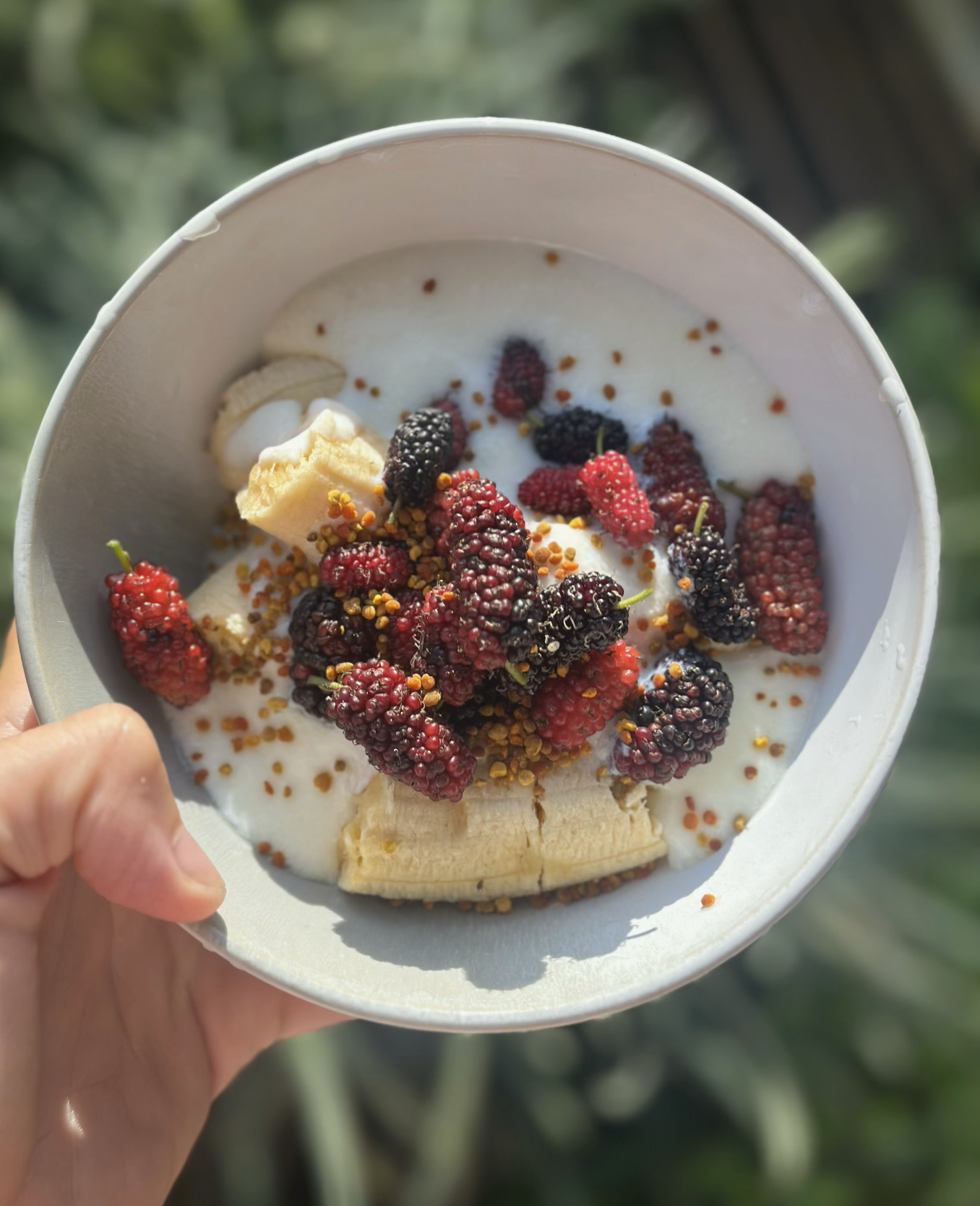
Serves 1 · 5 min active · 5 min total · best in mulberry season (varies by region — see below) · morning
A Note on Mulberry Season by Region
Mulberry season is one of the more geographically variable harvest windows. In subtropical and tropical regions (USDA 9–11 — South Florida, the Gulf Coast, Hawaii, Costa Rica, the Caribbean, parts of Mexico and Central America), mulberry trees often produce two harvests — a primary spring harvest March through May and a secondary smaller crop in late autumn. In temperate regions (USDA 5–8 — most of the continental US, including the Northeast, Midwest, and Pacific Northwest), the season runs late May through July, peaking in June. In Mediterranean climates (USDA 8–10 — Southern California, parts of Texas, Arizona) the season runs April through June. Outside the harvest window, fresh mulberries are essentially impossible to source — they don't ship well due to their fragile structure, which is why they're rare in commercial markets and dramatically more flavorful when foraged or backyard-harvested at peak. If mulberries aren't in season for you, substitute fresh blackberries, black raspberries, or boysenberries, which carry similar wild dark-berry flavor profiles — or use soaked dried Turkish/Persian black or white mulberries (see sourcing).
Ingredients
1 cup raw milk kefir (well-strained, about 24 hours fermented)
1 ripe banana, sliced thickly
½ cup fresh mulberries (red, white, and black mixed if possible)
1 tbsp raw bee pollen
Optional: 1 tsp raw honey, drizzled
Method
Pour kefir into a wide shallow bowl.
Layer banana slices across the bottom; pile mulberries on top.
Scatter bee pollen across the surface.
Optional: drizzle a small thread of raw honey.
Eat immediately with a wooden or ceramic spoon (avoid metal — reactive with kefir's live cultures over extended contact).
Enhancement Suggestions
Multi-variety mulberry mix. If you can find or grow more than one mulberry variety, mix them — Persian/Turkish Morus nigra (black mulberry, wine-like complexity), Morus alba (white mulberry, honey-sweet), and Morus rubra (red mulberry, the wild American with bright berry tartness). The varietal contrast is structurally what elevates this from a simple bowl to something sophisticated. See the Sourcing notes below for varietal background.
Toasted buckwheat groats sprinkled on top for crunch and additional nutrition.
Fresh mint leaves torn across the surface for aromatic complexity.
A drizzle of raw cream if using lower-fat kefir — adds richness and structural fat-soluble vitamin support.
Bee pollen + crushed walnut + raw honey combination scattered across — Caucasus / Persian-style breakfast bowl elevation.
Soaked dried Turkish black mulberries (kara dut) plumped briefly in warm water — for the off-season version that captures the wine-like Persian flavor profile.
Banana-mulberry-cardamom variation. A pinch of ground cardamom across the surface — distinctly Persian flavor pairing.
Sourcing:Raw milk kefir: see the Foundational Kefir Post on the Food Marshall blog for full sourcing of raw milk and kefir grains. Bananas: organic from a local Latin American grocery or co-op; backyard banana plants are productive perennials in USDA 9+ (the Cavendish you find at supermarkets is one of dozens of edible varieties — Manzano, Burro, and Red Cuban bananas all carry distinct flavor profiles worth seeking out at Latin American markets). Local apiarist bee pollen from within 30 miles, ideally — bee pollen carries trace amounts of regional pollen, and local pollen has been studied for seasonal allergy support; for shipped, Stakich (small Michigan apiary) is the genuinely high-quality option. Skip mass-market bee pollen brands. Raw honey: local apiarist within 30 miles, or Really Raw Honey shipped.
Mulberries — variety matters here: Three heritage species, each with a distinct flavor profile, all worth knowing:
Morus nigra — Black mulberry (the gold standard). Native to ancient Persia, Turkey, Lebanon, and Anatolia, where it has been cultivated continuously for over 4,000 years. The fruit is large, deep purple-black, juicy almost to the point of fragility, and carries a wine-like, complex flavor — sweet with a tart edge, faintly resinous, with notes of blackberry, raspberry, and red wine. This is the variety featured in Persian cuisine, Lebanese mezze tables, and Turkish desserts. In Persian tradition, fresh black mulberries (toot siah) are eaten in summer alongside fresh feta and cucumber for breakfast, dried into chewy sweet snacks for winter, or boiled into a thick syrup (sharbat-e toot) used to flavor traditional rosewater drinks. In Turkey, the dried black mulberry (kara dut) is a staple in winter pantries, often pressed into thick fruit leather called pestil. Increasingly available from specialty nurseries; produces in USDA zones 6+.
Morus alba — White mulberry (the honey-sweet variety). Native to China, where it has been cultivated for over 4,000 years primarily as the food source for silkworms — the entire global silk industry historically depended on white mulberry trees. The fruit is dramatically sweeter than other species, often compared to honey or caramel, with a pale ivory-to-pale-pink color and a soft, almost cloying sweetness without much tart counterpoint. This is the variety dried into the chewy honey-flavored white mulberries sold across Persian and Turkish groceries (toot khoshk in Persian; beyaz dut in Turkish), often eaten as candy with no added sugar. The village of Pertek in eastern Anatolia is particularly famous for white mulberry production.
Morus rubra — Red mulberry (the American native). The species native to eastern North America, growing wild from southern Canada down to Florida and west to Texas. The fruit ranges from deep red to dark purple-black at full ripeness, with a flavor profile in between white and black mulberry — sweet but with more berry-like tartness than white, brighter and less wine-like than black. This is the species most North Americans encounter as wild mulberries — the trees that drop pounds of fruit on suburban driveways every June. Backyard red mulberry trees are productive perennials in USDA zones 4–9 and continue producing for 50+ years from a single planting.
Sourcing fresh mulberries: Backyard tree (the structurally best source — productive perennials in most US zones); local farmers' market or pick-your-own farm; foraged from trail edges and old fence lines (always identify carefully and confirm the spot is unsprayed). Modern hybrids worth knowing: Pakistani mulberry (Morus alba × Morus rubra, produces extraordinarily long fruits up to 4 inches with raspberry-like flavor; USDA 7+), Illinois Everbearing (large dark-purple fruit over a long season; USDA 4–9), and Black Beauty (a true Morus nigra selection bred for North American gardens; USDA 6+).
Sourcing dried mulberries: Persian or Turkish grocery stores carry both kara dut (dried black mulberry) and toot khoshk (dried white mulberry) — typically from family-scale producers in Anatolia and Iran. Sadaf, Ziyad, and Kalmyk are the small-batch widely-available US imports. Both work beautifully in this bowl when fresh mulberries are out of season — soak briefly in warm water to plump.
Raw Kefir with Wild Berries and Dulce de Leche Caramel
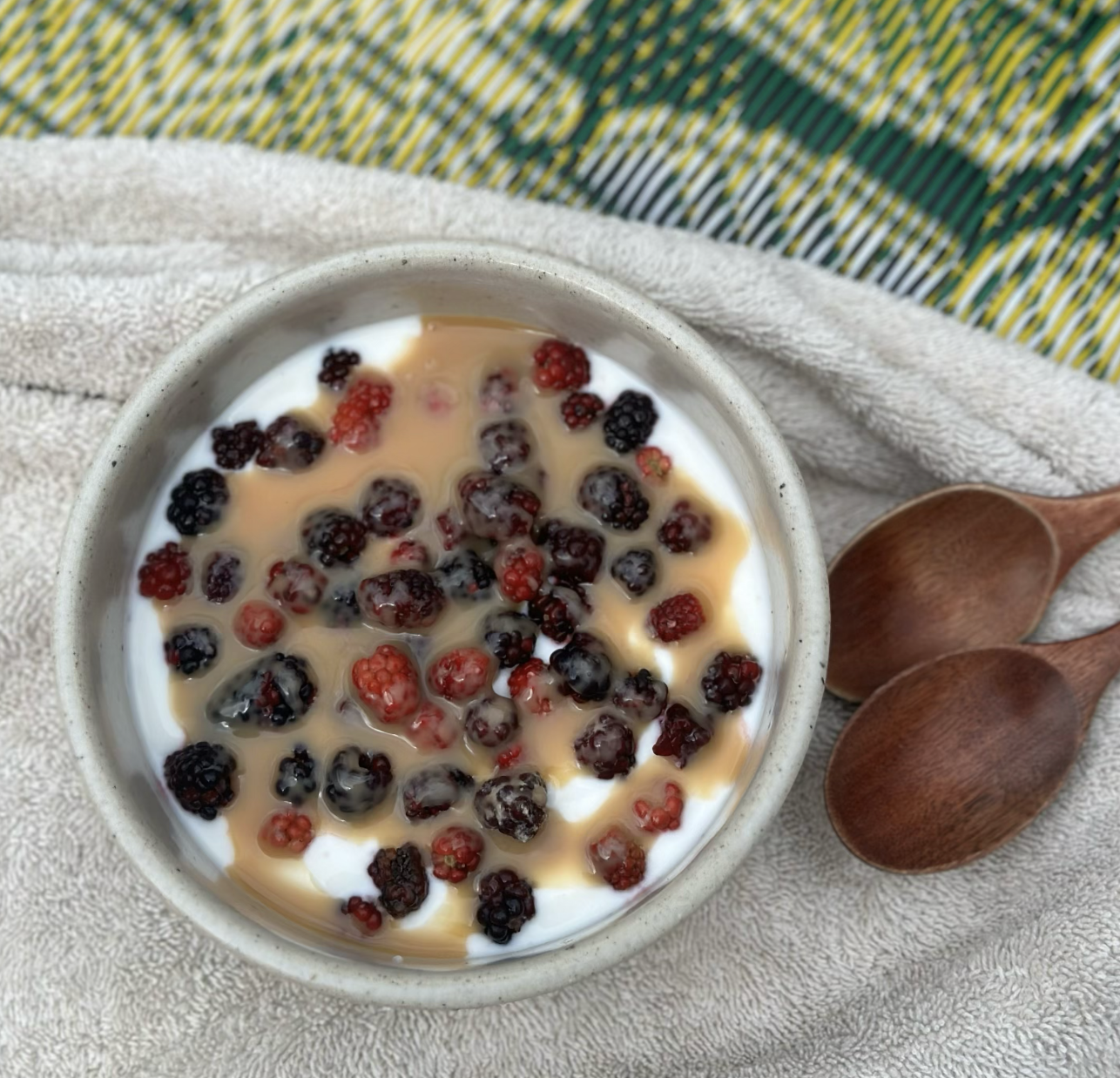
A simple summer breakfast bowl elevated by a slow-simmered caramel made from raw cream, tapa dulce, and raw honey
Serves 1–2 · 10 min active · 30 min total (incl. caramel cooking) · spring–summer · morning or afternoon
Ingredients
Kefir bowl
1½ cups raw milk kefir (24-hour fermented, well-strained)
1 cup mixed fresh wild berries (mulberries, raspberries, blackberries, fraises des bois if available)
Dulce de leche caramel (raw cream version)
1 cup raw heavy cream
½ cup tapa dulce (also sold as panela, piloncillo, rapadura, chancaca, or jaggery), finely grated
¼ cup raw honey
1 tsp pure vanilla bean extract (or seeds of ½ vanilla bean)
¼ tsp sea salt
Method
Make the caramel. In a heavy-bottomed saucepan over medium-low heat, combine cream, finely grated tapa dulce, raw honey, vanilla, and salt.
Stir constantly until the tapa dulce dissolves completely and the mixture begins to thicken — about 15 minutes. Don't boil — keep at a gentle simmer; rapid boiling will cause the cream to separate.
Continue cooking, stirring frequently, until the caramel has reduced to a pourable consistency (it will thicken further as it cools) — about 10 more minutes. This is a "warm caramel" version that preserves more of the raw cream's enzymes than a traditional dulce de leche. For a deeper, more concentrated caramel, cook 5–10 minutes longer until it reaches a darker amber color.
Cool to room temperature (or refrigerate to chill).
Plate the bowl. Pour kefir into wide shallow bowls. Top with mixed wild berries.
Drizzle the cooled caramel generously over the top.
Storage: Caramel keeps refrigerated 2 weeks in a glass jar.
Enhancement Suggestions
Browned cream technique. Cook the cream alone for 5 minutes before adding the tapa dulce — develops Maillard browning compounds that elevate the caramel's depth. Restaurant-level move.
A splash of dark rum. 1–2 tbsp dark rum stirred in at the end adds a Caribbean-Spanish dulce de leche authenticity.
Toasted hazelnuts or pecans scattered on top — texture contrast against the soft kefir-and-berries.
Fresh thyme or lemon balm leaves scattered across — herbaceous brightness against the rich caramel.
Lavender-honey variation. Infuse the cream with 1 tsp dried culinary lavender during the cooking — distinctly Provençal.
Cardamom-cinnamon variation. Add ¼ tsp ground cardamom + ¼ tsp Ceylon cinnamon to the caramel — Persian-Indian flavor profile that pairs exquisitely with both kefir and berries.
Drizzle over kefir cheese instead of plain kefir for a thicker dessert-leaning version — the caramel pools beautifully on the firmer surface.
Nourishment Notes
This is the simplest possible summer breakfast — raw kefir, fresh fruit, and a slow-cooked caramel — but every component is doing meaningful structural work. The kefir delivers the live bacterial cultures, partially predigested proteins, and fat-soluble vitamins of properly fermented raw milk; the wild berries deliver concentrated polyphenols, vitamin C, and the deep pigment compounds (anthocyanins) that give them their dramatic color; and the caramel — when made from genuine tapa dulce rather than refined sugar — delivers minerals, complexity, and the structural sweetness of whole sugar cane rather than the one-note glycemic spike of refined sucrose.
Mulberries deserve specific mention. Across most of the United States, mulberry trees grow wild and prolifically — productive perennials that drop pounds of fruit during a 4–6 week window from late spring to early summer. The fruit is rarely sold commercially because it bruises within hours of picking, but for anyone with access to a backyard tree, a foraging spot, or a local farmer's market vendor, this is one of the genuinely seasonal foods worth orienting your spring-summer eating around. Red, white, and black mulberry varieties all carry distinct flavor profiles; mixed varieties produce the most complex result. Fraises des bois (alpine wild strawberries), if you can find or grow them, add an aromatic perfume that transforms the bowl from simple to sophisticated.
The caramel is the structural innovation here. Traditional dulce de leche is made by slow-simmering sweetened condensed milk for hours until it caramelizes — a process that uses commodity refined sugar and pasteurized condensed milk, both of which have been industrially fractionated from their original whole-food forms. The version here walks the architecture backward: raw cream from grass-fed cows (not condensed, not heat-damaged), unrefined whole-cane sugar (not centrifuged, not bleached), and raw honey to round the flavor. The result is dramatically more complex on the palate — molasses depth, faint vanilla notes, mineral undertones from the whole cane — and structurally closer to what humans were eating across Latin America, the Caribbean, and the Iberian colonial world for centuries before industrial sugar refining became standard in the late 1800s.
A Note on Tapa Dulce — and Why It Matters
If you spend time in Costa Rica, the Caribbean, parts of Mexico, Florida, Louisiana, or any of the world's sugar cane regions during harvest season (typically October through March), you'll witness one of the most dramatic agricultural cycles on the planet. The fields burn before harvest — controlled fires set deliberately to burn off the dry leaves and debris around the cane stalks, leaving the sugar-rich stalks intact for cutting. From a distance, the fires light up the sky in long orange ribbons across the horizon, and the air carries the unmistakable sweet-smoky scent of burning cane for miles. The smoke drifts into nearby towns; ash settles on cars and laundry lines; the entire region knows harvest is underway. By morning, the harvested stalks are loaded onto enormous trucks — piled impossibly high, secured with thick chains, often dripping fresh cane juice as they barrel down rural roads toward the trapiches (small mills) and the larger industrial refineries. Drive behind one of these trucks in Costa Rica and you'll find the road slicked with sweet sticky juice, and the air thick with the scent of fresh-cut cane.
What happens next determines what reaches your kitchen. At a traditional trapiche, the cane goes through a simple process: pressed for juice (traditionally by mule-driven or water-powered mills, now often by diesel engines in remote locations), the juice boiled in large copper pots over wood fire until it progressively thickens and darkens — light yellow-green to pale gold to deeper amber to caramel brown to deep mahogany — then poured into wooden molds to cool and harden into blocks. This is tapa dulce in Costa Rica (also called piloncillo in Mexico, panela in Colombia, rapadura in Brazil, chancaca in Peru, and jaggery in India). It's a whole, unrefined sugar — molasses, minerals (calcium, iron, magnesium, potassium), and sucrose all preserved together in their original matrix, which is why it carries that distinctive deep caramel-molasses flavor and a warm amber-brown color. The taste is structurally different from refined sugar: complex, slightly bitter at the edges, with notes of vanilla and burnt caramel that no industrial process can replicate.
At a modern industrial refinery, the same cane juice goes through a dramatically different process: centrifuged at high speed to separate sugar crystals from the surrounding molasses; filtered with bone char (literally charred animal bones) or ion-exchange resins to remove color and trace minerals; crystallized in vacuum chambers; separated mechanically; then bleached pure white using chemical clarifying agents. The molasses by-product is sold separately as a commodity for baking, livestock feed, or rum production. To produce "brown sugar," refineries simply spray a measured amount of returned molasses onto the white sugar — structurally, brown sugar is just white sugar with a molasses coating, not a less-refined product. Light brown has less molasses; dark brown has more. The whole-food matrix of the cane is broken apart and sold as separate commodity products — and the minerals, the structural complexity, and most of the flavor are stripped out and discarded or repackaged in the process.
This is why tapa dulce in this caramel matters structurally — and why the resulting dulce de leche reads on the palate as deeper, more complex, more alive than any version made with brown sugar. You're tasting the whole cane, processed exactly as Costa Rican and Latin American homesteading families have processed it for centuries — closer to the way humans have been making sweetness from cane for the last 5,000 years (sugar cane originated in New Guinea around 6,000 BCE, spread across India and the Persian world, traveled the Arab trade routes to the Mediterranean, and eventually arrived in the Americas with Columbus's second voyage in 1493). Every culture that adopted cane developed its own version of unrefined sugar — jaggery in India, chancaca in Peru, piloncillo in Mexico, rapadura in Brazil — and only in the last 150 years has industrial refining stripped this whole food into its commodity components.
Making Your Own Tapa Dulce — The Traditional Costa Rican Method
If you have access to fresh sugar cane (sold by the stalk at Latin American groceries, Asian markets, Caribbean specialty stores, or backyard plants in subtropical regions like Florida, Hawaii, southern Texas, and southern California), making your own tapa dulce is genuinely possible — and structurally rewarding. This is exactly how Costa Rican homesteading families have produced sweetness for five centuries, and what every traditional trapiche in the Central American countryside still does today.
You need: 6–8 fresh sugar cane stalks (about 6 feet long each); a heavy-bottomed pot (copper traditional, but stainless steel or enameled cast iron works); a way to extract the juice — at home, a heavy-duty juicer designed for hard fibrous material, or an electric sugar cane press from a specialty importer; wooden molds, ramekins, silicone molds, or a parchment-lined shallow dish for shaping; a long-handled wooden spoon; and a candy thermometer (helpful but not essential).
Strip and prepare the cane. Strip the outer hard rind off the cane stalks using a sharp machete or heavy knife — the green outer layer peels back to reveal the golden inner stalk. Cut the inner stalks into manageable pieces, about 8–12 inches long. The fibrous inner cane is what holds the juice.
Extract the juice. Run the cane pieces through a sugar cane press or heavy-duty juicer until you have extracted as much juice as possible. Each stalk yields roughly 1 cup of juice; from 6–8 stalks, expect 6–8 cups of fresh cane juice — a vibrant, opaque, light yellow-green liquid that smells distinctly of fresh-cut grass and faint vanilla. Drink a small glass of this fresh — it's one of the most refreshing things you'll ever taste, and the structurally pure form of cane sweetness before any processing.
Strain the juice. Pour through a fine-mesh strainer or cheesecloth-lined colander to remove any fibrous debris.
Boil and reduce — the long structural step. Pour the strained juice into the heavy-bottomed pot and bring to a boil over medium-high heat. Foam will rise to the surface — skim it off and discard (it contains protein and impurities that would cloud the final block). Reduce heat to medium-low. Continue cooking, stirring occasionally, watching as the juice progressively darkens through every color stage. Each color represents progressive caramelization of the sugars and Maillard browning of the trace proteins. This is why tapa dulce has the deep flavor it does — the long, slow concentration over wood fire produces hundreds of flavor compounds that simply cannot exist in industrial centrifuge-and-bleach refining.
Watch for the soft-ball stage. After 1.5–2 hours of slow reduction, test for doneness: drop a small spoonful onto a chilled plate. If it forms a soft, pliable disk that holds its shape, you're ready (a candy thermometer reads 230–235°F at this stage). For a firmer block more like commercial tapa dulce, continue cooking until 240–245°F.
Pour into molds. Working quickly while still hot, pour into wooden molds, ramekins, silicone molds, or a parchment-lined shallow dish. Traditional Costa Rican molds are wooden circles or rectangles producing the iconic "tapa" (cap-shaped) disks — the name itself means "cap" or "top" in Spanish. For home use, ramekins or silicone muffin molds produce 4-oz disks roughly the size of commercial tapa dulce blocks.
Cool, unmold, and store. Cool completely 2–4 hours until firm. Unmold by gently tipping or running a knife around the edges. The finished tapa dulce should be the color of polished mahogany, slightly glossy on the surface, firm but still slightly pliable to a strong fingernail press. Wrap each block in parchment paper and store in an airtight container at room temperature — keeps for 6+ months. In Costa Rican homes, tapa dulce blocks are often stored on open kitchen shelves alongside corn meal and beans, just as they have been for centuries.
Yield: 6–8 cane stalks → about 1–1¼ cups (6–8 oz, or 1–2 traditional tapa dulce disks). Scale up substantially for any meaningful batch — traditionally Costa Rican families produce 50+ pounds at a time during the dry season harvest.
Growing your own. In USDA zones 9+, sugar cane is a productive perennial that grows easily in any sunny, well-drained spot — Florida, Hawaii, southern Texas, southern California, and parts of the Gulf Coast all support backyard cane. A single plant produces 6–10 stalks per year and continues producing for decades from the same root system. Cuttings root easily; ask a friend with a plant for a section, or buy starter cuttings from a local nursery.
Closing Note
When you can find tapa dulce or piloncillo at a Latin American grocery — or make your own — keep a block in your pantry. It stores at room temperature for 6+ months, can be grated or chopped as needed, and works beautifully in everything from this caramel to traditional Mexican café de olla (slow-simmered coffee with cinnamon and tapa dulce), Caribbean baked beans, Brazilian doce de leite, Indian-spiced chai, Andean stews, and any preparation where you want the full structural complexity of the cane rather than the one-note sweetness of refined sugar. This is the small, structural ingredient swap that elevates a weekend kefir-and-berries bowl from a healthful breakfast into something that connects you to a 5,000-year tradition of whole-food sweetness — and to the burning fields, the stacked trucks, the copper pots, and the wooden molds that still produce the real thing across Costa Rica, Mexico, and the Andean countries today.
Sourcing: Tapa dulce: Costa Rican specialty markets, Latin American grocery (look under "panela," "piloncillo," or "rapadura" depending on the country of origin); for shipped, Sugar Mama is the small-batch widely-available US import. Fresh sugar cane stalks (for DIY): Latin American grocery, Asian markets, Caribbean specialty stores, or backyard plants in USDA 9+. Raw heavy cream: local raw-dairy producer or Amish creamery (use realmilk.com finder); for shipped, Kalona Supernatural non-homogenized as the structural fallback. Look for cream from grass-fed Jersey or Guernsey cows when possible — significantly higher butterfat (5%+ vs. 3.5% for Holstein) and richer in beta-carotene. Raw honey from a local apiarist within 30 miles, or Really Raw Honey shipped. Wild berries: foraged (mulberries grow across most US zones; blackberries and raspberries grow wild along trail edges and old fence lines), local farmers' market, pick-your-own farm, or backyard berry patch — backyard mulberry, raspberry, and blackberry are productive perennials in most US zones. Vanilla bean: Singing Dog Vanilla (single-origin Madagascar). Flaky sea salt: Maldon (English flake salt) or Jacobsen Salt Co. (Oregon), or Baja Gold Sea Salt.